Arctostaphylos manzanita x ‘Laguna White’
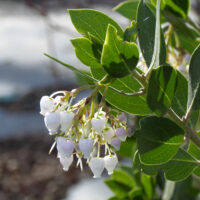
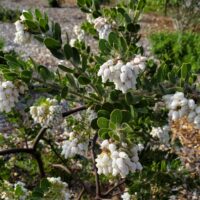
Discovered along Guerneville Road near the Laguna de Santa Rosa, this remarkable manzanita boasts dense clusters of clear white flowers in winter with semi-glossy apple green leaves and burgundy colored bark. Plant in full sun where it will reach a height of about 8 -10 ft. tall by 6 ft. wide or more over time. More garden tolerant than many manzanitas, this selection will accept occasional watering after establishment. Though drought tolerant, 'Laguna White' may benefit from deep monthly waterings in the summer, especially in hot interior sites. An excellent early source of nectar for hummingbirds and native bees.
Arctostaphylos manzanita x ‘Molino Corner’
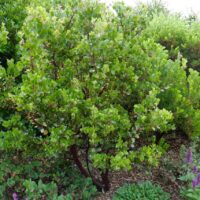
The clear white flowers and attractive, wavy, deep-green leaves make this wild selection from the Sebastopol area a real charmer. Burgundy bark clothes the sinuous trunks on this upright manzanita which reaches 8 ft or more tall and potentially as wide, if left unpruned. The urn-shaped flowers appear in late winter in good-sized clusters, followed by reddish fruits in the summer. This selection is part of a group manzanitas from west Sonoma Co. which naturally share genes with the vine hill manzanita, making them more garden tolerant than most inland forms. Plant in full sun to light shade. Water occasional or let go dry in the summer once established. A great winter food source for hummingbirds and bumblebees.
Arctostaphylos manzanita x ‘Sebastopol White’
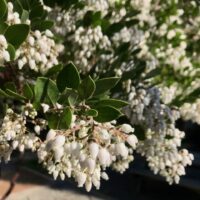
This upright manzanita displays dense growth of soft green, pointed leaves with clusters of white flowers in winter on a burnished mahogany trunk. Reaches a height of 8 ft or more and a width of at least 6 ft. Discovered along Guerneville Rd. in western Sonoma County. Very drought tolerant once established but will tolerate moderate irrigation when young. A disease resistant selection. Heavy soils are not a problem as long as water does not pool at the crown in winter. Enjoys full sun but will tolerate light shade.
Arctostaphylos montana ssp. montana ‘Lagunitas Grey’
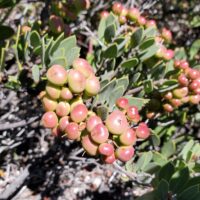
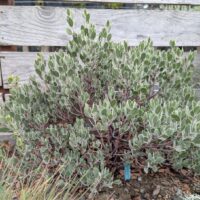
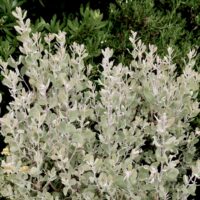
This a strikingly gray and compact form of the rare Mt. Tamalpais manzanita, which is found only in Marin County. Silvery leaves provide all year appeal, set against the smooth, sculptural, burgundy trunks. Winter brings clusters of pink-tinged, white flowers gathered at branch tips, followed by shiny red “little apples” in the summer. Mature plants develop an evenly mounded form, reaching up to about 4’ tall and 5’ wide in about 10 years. They are easily pruned to keep narrower and show of the beautiful bark. While native to serpentine soils, this species does well in most decently draining soil types with full sun and little to no water once established.
Arctostaphylos montana ssp. ravenii
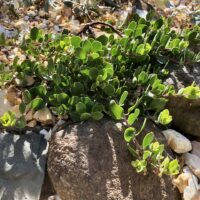
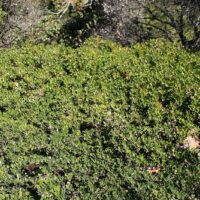
This diminutive, groundcover manzanita once grew on windswept, serpentine outcrops in San Francisco where the Presidio currently exists. Due to rapid development in the late 19th and early 20th centuries, only one clone of this manzanita currently exists in the wild, making it one of the rarest species around. The small, thick, gray-green leaves line creeping stems reaching 6 - 12 inches in height. Forms a large mat over time, crawling around rocks and other obstacles. In late winter/early spring, clusters of little, white, urn-shaped flowers appear at the ends of the stems. Needs full sun to light shade and decent drainage. Drought tolerant once established but will enjoy an occasional deep watering, especially in warmer areas. You don’t have to be a collector to enjoy this appealing little manzanita.
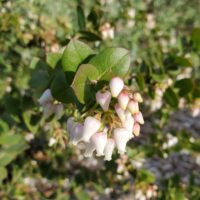
Arctostaphylos osoensis
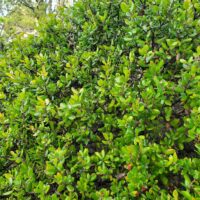
A beautiful and extremely rare manzanita from a small area above Morro Bay. The bright green leaves are auriculate, meaning “ear-shaped”, and have a distinctive matte finish, with new growth emerging in a reddish bronze color. Small clusters of dainty, pinkish-white flowers emerge in late winter/early spring and are adored by hummingbirds. The contorted branches are smooth and colored reddish-brown, aging to gray. Oso manzanita is attractively rounded and dense when young, only reaching to about 5 ft. or so in height with a slightly larger width. With age, it will begin to open, revealing its striking, sculptural trunks. Needs full sun and enjoys occasional irrigation, though it is quite drought tolerant once established.

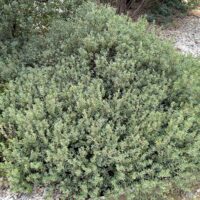
Arctostaphylos pumila ‘Wavelength’
A rare species endemic to areas on and around the Monterey Peninsula. ‘Wavelength’, a Dave Fross selection, is a dense, mounding, low shrub reaching 2 – 3 ft. tall and +10 ft. across. Soft, gray-green foliage and bronzy new growth accentuate its undulating form. White, lantern-shaped flowers appear in spring, enjoyed by hummingbirds. Great for sloped, drainy sites where it can take up a lot of real estate. Can take full sun to light shade. Low irrigation once established.
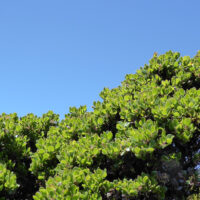
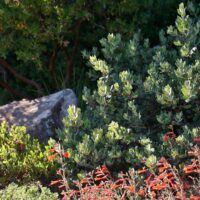
Arctostaphylos uva-ursi ‘Green Supreme’
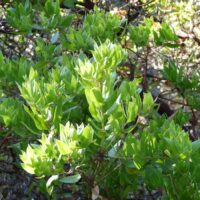
A superior garden hybrid of the trailing bearberry. A volunteer seedling discovered by staff at Tilden Regional Parks Botanic Garden. Ultimately spreads 6 - 12 ft. across and less than a foot tall. Enjoys moderate to occasional irrigation. The glossy bright green leaves create a beautiful groundcover. Tolerates a wide range of soil types with reasonable drainage. Very disease resistant and fast growing. Shy to bloom or set berries. Sun to part-shade.
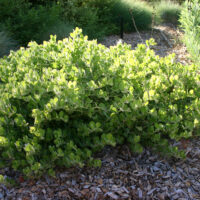
Arctostaphylos x media – Point Arena forms
This special and diverse group of manzanitas come from Point Arena on the southern Mendocino Coast. These naturally occurring hybrids involve at least two species: A. uva-ursi, A. columbiana and sometimes A. nummularia. The resulting offspring have wonderfully varying features. The leaves range from large, light-green, and fuzzy to small, dark-green and glossy. The plants can form a mounding habit reaching up to 4 feet tall or hug the ground to form dense mats. Plant in full sun to light shade and give moderate to infrequent irrigation once established. Plants grown in hot areas will benefit from extra irrigation and some afternoon shade.
Arctostaphylos x media – Tilden form
This big-leaved selection was discovered at Point Arena on the southern Mendocino coast by Steve Edwards of Tilden Botanic Garden. Distinctive for its large, hairy, apple-green leaves and low, dense form only reaching up to about 2 ft in height and at least 6 ft. in width. Clusters of white flowers appear in spring followed by round, bright green fruits. Plant in full sun to light shade and provide moderate to occasional irrigation once established. Should be quite drought tolerant once established.
Arctostaphylos x media ‘Humboldt Mystery’
Arching branches and a mounding habit up to 6 ft. tall and 8 ft. wide distinguish this manzanita from its relatives. In winter, pinkish-white flowers provide nectar for hummingbirds and bees, followed by large, red berries in the autumn. Burnished red trunks display a colorful backdrop to the leathery, large, dark green leaves. Plant in full sun to light shade and provide moderate to infrequent irrigation. James Roof of Tilden Botanic Garden discovered this unusual selection somewhere on the Humboldt Coast, but, true to his enigmatic character, refused to say where he found it. It is believed to be a natural cross between bearberry and the hairy manzanita.
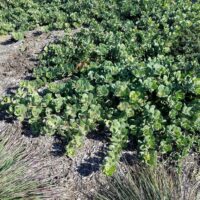
Arctostaphylos x media ‘Peter Ehrlich’
This unusual manzanita from the southern Mendocino coast features what may be the largest leaves of any of the groundcover manzanitas. The round, grey-green foliage mounds densely over time to reach a height of about 3 ft. and a width of up to 8 ft. Clusters of white flowers gather at branch tips in winter, followed by little apple-like fruits in the spring. While fairly adaptable in the garden, decent drainage is best and full sun to light shade. Accepting of moderate irrigation but will become quite drought tolerant once established.
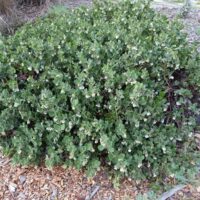
Arctostaphylos x media ‘Reina de Arena’
An outstanding selection from a special population of natural manzanita hybrids, holding court on the rugged, fog shrouded, coastal bluffs of Point Arena in Mendocino County. The "Queen" forms a lovely, compact mound of large, rounded, fuzzy leaves, reaching up to about 2 ft. high and at least 6 ft. wide. Elegant, pure white, urn-shaped flowers decorate the branch tips in winter and are an early nectar source for hummingbirds and bumblebees. Plant in full sun to light shade and give moderate to infrequent summer water once established. Plants grown in hot areas will benefit from some afternoon shade and extra irrigation.
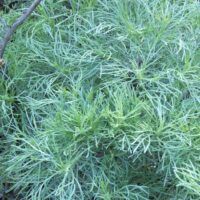
Artemisia californica
Native to coastal regions from Northern California to Baja. Densely branched shrub with finely divided gray-green scented foliage. Grows 2 - 6 ft. tall and wide. Light pruning or pinching help keep it dense. Grown for its wonderful texture and foliage color, flowers are inconspicuous. Requires decent drainage and full sun. Thrives in coastal environments, but has performed well inland, especially on slopes where cold air and winter wet drains away. Drought and deer tolerant.
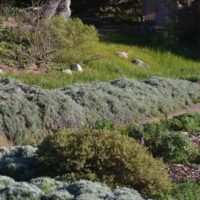
Artemisia californica ‘Canyon Gray’
An unusual prostrate form of our coastal native sagebrush, forming a loose, nearly flat mat of finely cut, silvery, fragrant foliage around 4 ft. wide. Useful as a bank cover or for the top of a retaining wall where it can cascade over the edge. Combines beatifully with ceanothus, buckwheats and iris. Should be cut back from time to time to keep dense. Enjoys full sun to light shade and is very drought tolerant once established. Deer resistant.
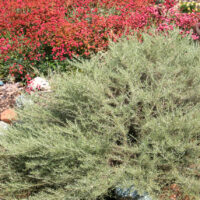
Artemisia californica ‘Montara’
Selected by Roger Raiche at Montara Ridge in San Mateo County. Forms a mound of finely cut fragrant foliage to around 2 ft. tall by 3 ft. (or more) wide. Requires full sun with decent drainage and is drought tolerant once established. Occasional summer water helps retain fresh look. Thrives in coastal environments. Deer resistant.
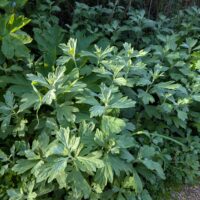
Artemisia douglasiana
Mugwort is native to many plant communities where there is at least some year round moisture: streams and riverbanks, road cuts, ditches, and moist meadows. A stout, rhizomatous perennial with aromatic foliage that is green on top and silvery beneath. The flowers are small and not particularly showy. The foliage is beautiful and fragrant with a long history of medicinal uses. Plant in sun to light shade where it will grow 3 ft. tall and spreading to form a colony. Well watered plants can grow even taller. Provides excellent cover and seeds for birds. Deer resistant.
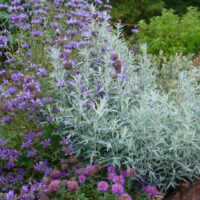
Artemisia suksdorfii
Rhizomatous perennial with sturdy upright stems of whitish-gray felted foliage. Native to coastal California where it grows in seasonal drainages near the ocean. Growing 1 1/2 ft. to 3 ft. tall and spreading to form colonies of beautiful wooly foliage with a pleasant sage scent. The tiny flowers are not particularly showy but are attractive to pollinators. Useful in informal gardens for sunny areas with some summer moisture. Probably best in areas with some coastal influence. Cut to the ground annually to freshen and make room for new spring growth. Deer resistant.
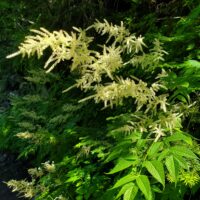
Aruncus dioicus
Native to stream sides and moist woods from Mendocino County, California north to Alaska. A bold and showy perennial looking like a giant astilbe. Forms dense clumps of finely divided foliage with arching, feathery plumes of white flowers 3-5 ft. tall in summer. Requires regular moisture and part shade where it makes a striking specimen or accent plant in the woodland garden. Dies back to its roots in winter. The frothy flower plumes attract an array of tiny little pollinators and the seed heads on female plants are an important food source for birds. Said to be deer resistant.
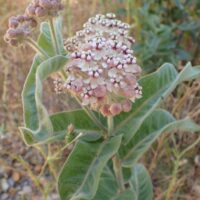
Asclepias eriocarpa
More diminutive than showy milkweed at 1-3 feet, this long-blooming species has similar broad, greyish leaves and creamy, pink-accented flower clusters. Like other milkweeds, it is a larval host for the monarch butterfly. A great choice for habitat gardens in dry, sunny areas, providing nectar for a wide array of pollinators from late spring into fall. Usually found in rocky soils throughout parts of Southern California and in foothill areas north of the San Francisco Bay. Spreads to form colonies with minimal supplemental water. Deer resistant.
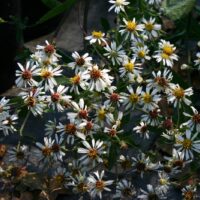
Aster (Eurybia) radulinus ‘Gilliam Creek’
This charming woodland aster makes its home in bright, dryish woods from the Channel Islands all the way up to the Oregon border and into the northern Sierras. Normally a shy, dainty little forest dweller, this selection from Sonoma County is far more robust, featuring large clusters of white-petaled daisies with white centers which turn yellow with age, and finally a deep maroon. Flower stalks reach up to 2 ft. high, much taller than is typical for the species. Serrated, deep green leaves form a high mat on this slowly spreading ground cover. An excellent plant for dry, woodland gardens, but will also tolerate moderate irrigation. One of the few excellent pollinator plants for the lightly shaded garden.