
Eriogonum nudum – robust form
This buckwheat came to us by way of Ginny Hunt and her seed company Seedhunt. Collected from a local race (Santa Cruz area) of naked buckwheat where the flower stems rise to 5 foot or more! Naked buckwheat is the most widely distributed species of buckwheat, growing throughout the state. Forms low mounds of foliage with tall, slender, naked stems, topped with clusters of white to pinkish pom-poms. Plant in full sun to very light shade with good drainage. Drought tolerant once established. Important pollinator plant. Said to be deer resistant.
Eriogonum parvifolium ‘Moss Landing’
Native to coastal bluffs of the central and south coast. Forms a mounding shrub 2 ft. or more tall by 2 – 3 ft. wide with thick, dark green, triangular shaped leaves often with a reddish tinge, and white and woolly beneath. Round pom-poms of white to pink flowers over a long period late spring and summer, fade to an attractive russet brown. A natural for coastal areas where it grows fast in full sun with good drainage and is very drought tolerant once established. Inland, a little afternoon shade is recommended. Looks great on slopes or draping over walls. An important pollinator plant, appealing to a wide array of insects. In its native range, the rare and endangered El Segundo blue butterfly relies exclusively on this species in all stages of its life cycle. Deer tolerant.
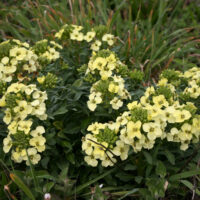
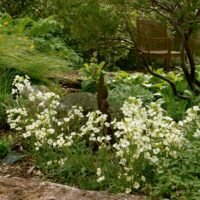
Erysimum franciscanum
This rare and threatened species makes its home in the sand dunes and hills of the San Francisco Bay area. Development has seriously impacted its native habitat. Fragrant, four-petaled flowers ranging in color from creamy white to yellow rise up to 18” above dark green foliage in the spring and early summer. Thrives with good drainage and occasional water once established. Plant this special wallflower in full sun with other small perennials such as buckwheats, checkermallows and coyote mint. Attractive to butterflies.
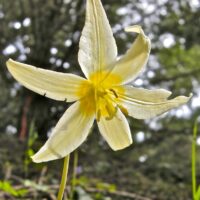
Erythronium oregonum
The giant fawn lily adds a delicate accent in the spring to the bright shade garden featuring starlike flowers of creamy-white with yellow centers. Reaching to a height of about 1 ft when in bloom with low, broad leaves attractively mottled. This bulb will slowly increase to form little clumps, ideal for the forest rock garden. Provide good drainage and water infrequently during its summer dormancy.
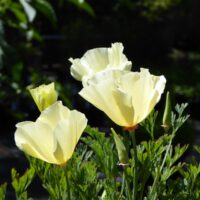
Eschscholzia californica – cream colored flowers
Smaller in stature than the typical robust orange forms of California poppy, this perennial fits into plantings nicely without overwhelming. Low foliage is ferny and finely dissected and topped with cup-shaped blossoms that are a lovely shade of cream to pale yellow. Best in full sun with dryish conditions. Given the opportunity may seed about. Flowers provide pollen that is favored by native bees, bumbles and honey bees.
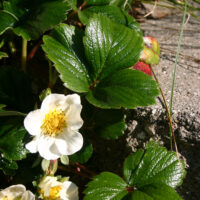
Fragaria chiloensis ‘Green Pastures’
Beach strawberry is native to Pacific coast beaches and bluffs of North and South America. A popular and adaptable groundcover growing well in a wide range of climates and conditions. This selection forms lush carpets of shiny dark green foliage. The five-petaled white flowers are particularly large, showy and profuse in the spring. A great colonizer and stabilizer, this vigorous perennial spreads by runners to form dense carpets. Plant in sun to light shade with moderate to occasional summer water. Drought tolerant along the coast. This ia a male selection and will not fruit. Deer resistant.
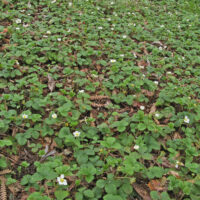
Fragaria vesca
This native woodland strawberry is a great colonizer and can cover a lot of ground in a hurry. Pretty little white flowers are followed by small, tasty, red berries. Tolerates drought but best with a little summer water. Well suited for under oaks and conifers. Said to be deer resistant.
Fragaria vesca ‘Montana de Oro’
A vigorous, heavy blooming selection of woodland strawberry from a coastal canyon at Montana de Oro in San Luis Obisbo County. This easy to grow, carpet forming, ground cover is a great colonizer and stabilizer for lightly shaded areas. Deals well with root competition and thin soils. Pretty little white flowers are followed by small, tasty, red fruits. Often deer resistant.
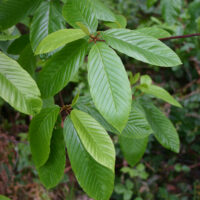
Frangula (Rhamnus) purshiana
Native to moist places from Mendocino County northwards and throughout the Sierra Nevadas, this medium sized deciduous tree is distinctive for its shiny, green leaves with strong venation. Ranges in height from 15 to 30 ft. tall. Bees are attracted to the clusters of small, cream-colored flowers and birds enjoy the dark purple berries which follow. Plant in riparian zones or in areas where it can receive regular moisture. Give full sun to part shade. Requires protection from the afternoon sun in the hottest areas.
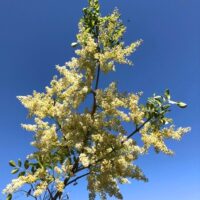
Fraxinus dipetala
This is our only native ash with showy flowers. A large shrub or multi-trunked tree native to slopes, canyons and stream banks in hot interior regions of the state. Grows 7 to 25 ft. tall with pinnately compound leaves. The creamy white flowers are produced on dangling racemes in mid to late spring, followed by pendulous clusters of samara fruits. Like the California buckeye, it loses its leaves early to evade the long dry summer. Grows in sun to partial shade. Drought tolerant once established.
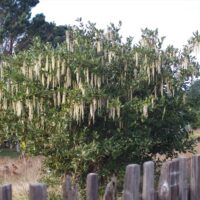
Garrya elliptica
Garryas are grown primarily for their winter flower catkins. The longer, pendulous male catkins have traditionally been the most sought after with selections like 'James Roof' and 'Evie'. Male and female flowers occur on separate plants and both must be present for the female to produce their lovely grapelike clusters of fruit. These plants are seed grown so males and females are of equal probability. All plants feature larger, evergreen leaves on multitrunked shrubs reaching 10 - 15 ft tall and wide. Very amenable to pruning. Plant in full sun or partial shade. Provide moderate irrigation inland, but established plants will be drought tolerant near the coast where they occur naturally. Somewhat deer resistant.
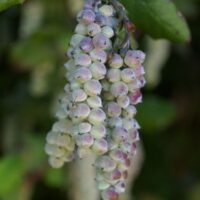
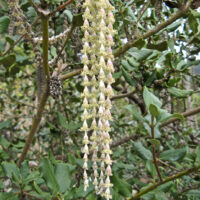
Garrya elliptica ‘Evie’
This cultivar of the native silktassel bush is more compact than the better known ‘James Roof’. The 8 to 10 inch catkins are shorter but more profuse. Evergreen, grows 10 ft. or taller. Sun to part shade, good drainage. Provide moderate to occasional irrigation inland. Winter is its showiest time when it is covered in silvery catkins. Discovered on the northern Sonoma Coast. Somewhat deer resistant.
Garrya elliptica ‘James Roof’
Outstanding cultivar of the native silktassel bush. Evergreen shrub 10 ft. tall or more. Striking 12 inch long silvery catkins in winter. Sun to part shade and drought tolerant. Enjoys moderate summer water inland. Discovered along the coast of Prairie Creek State Park in Humboldt Co.. Somewhat deer resistant.
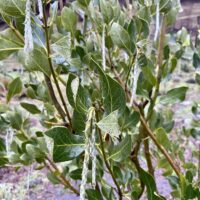
Garrya fremontii
Evergreen shrub with leathery leaves and handsome dangling catkins in late winter and early spring. The male and female flowers occur on separate plants. Native to the west coast where it grows in mixed evergreen forest and chaparral plant communities. This species is a good choice for summer-hot interior sites with well drained soils. Grows 8 - 10 ft. tall and wide in full sun to light shade and is drought tolerant once established. A good specimen shrub or candidate for hedgerow or screen where it provides cover and food for birds and small mammals. Somewhat deer resistant.
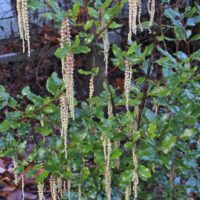
Garrya issaquahensis ‘Pat Ballard’
An elegant winter flowering shrub, uncommon in the trade. A hybrid between Garrya elliptica and Garrya fremontii, 'Pat Ballard' is a tough evergreen growing 6-10 foot tall and wide. Pendulous pinkish gray catkins dangle from the branch tips in winter providing a spectacular display. Plant in full sun to part shade with occasional to infrequent water once established. More cold & drought tolerant than Garrya elliptica. An excellent screen, hedge or foundation shrub, amenable to pruning. Somewhat deer resistant.
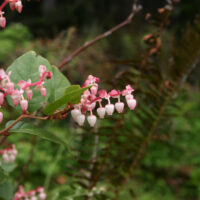
Gaultheria shallon
A handsome evergreen shrub, happiest in fog shrouded coastal zones. Large, leathery, dark green leaves are a gorgeous foil to the loose clusters of white to pinkish urn-shaped flowers. Fat, blue-black berries follow and are relished by wildlife and eaten by people too. Salal can grow tall in moist coastal areas of the Pacific Northwest but usually forms a ground cover 2 - 4 ft. tall and spreading in California. Best with some shade and acidic, humus-rich, moist soils. The foliage is prized for flower arranging. Deer resistant.
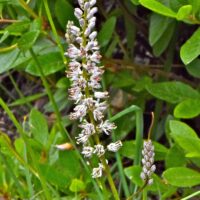
Hastingsia alba
This hard-to-find native bulb features elegant, branched stalks, 3 ft or more high, supporting racemes of sparkling white flowers. The dense blossoms display narrow petals and protruding stamens, giving them a delicate and soft appearance. Grey-green, strap-like leaves grow radially from base of the stalk, creating a tidy rosette 12" - 18" wide. Grows happily in most soils in full sun with regular water, where the bulbs may multiply. In part shade, this lily relative will be a little more drought tolerant. Plants emerge in late winter and go dormant by the end of summer. Hails from the mountains of Northern California, where it makes its home in meadows and open woodlands.
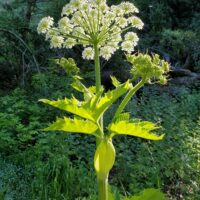
Heracleum maximum
Big, bold, native perennial 3 - 8 ft. tall, is striking in mass or as a specimen. Forms a rosette of large lobed leaves followed by stout flower stems carrying large umbels of white flowers. Thrives in rich soils with some moisture. Full sun along coast, part shade inland. As a member of the carrot family (Apiaceae) the flowers are very effective at attracting beneficial insects. Larval food source for anise swallowtail butterfly. Formerly known as Heracleum lanatum.
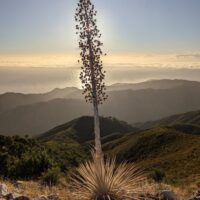
Hesperoyucca whipplei
Bold and dramatic architectural accent plant native to southern California coast and mountains south to Baja. Forms a dense rosette of rigid silver-blue blades, 2 foot tall by 3 - 4 foot wide. Each blade has a VERY SHARP tip and careful thought should be given to its placement to avoid injury. Plants can take 3 to 15 years to bloom with impressive stalks rising 6 foot or more above the rosette with drooping, creamy white, bell shaped, fragrant flowers. The flowering rosette dies after blooming often being replaced by vegetative offsets. Best with good drainage in full sun to light shade. No water once established. Deer resistant
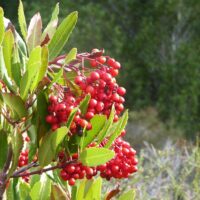
Heteromeles arbutifolia
Toyon is a handsome native evergreen shrub 6 - 10 ft. tall and wide. Sun to part shade, drought tolerant. Clusters of lacy white flowers bloom in summer and areattractive to pollinators. Spectacular bundles of red berries are relished by birds and are a great winter decoration. Valuable as a specimen, screen, hedge or bank plant. Birds attracted to the fruit include the following species: Cedar waxwing, California towhee, spotted towhee, Western bluebird, robins, mockingbirds, bandtailed pigeon, waxwing and quail.
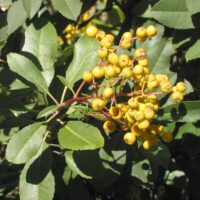
Heteromeles arbutifolia ‘Davis Gold’
An interesting cultivar of the native toyon which bears bright golden yellow berries rather than the more common red-colored fruits. A handsome evergreen shrub 8 - 12 ft. tall and wide (or more). Sun to part shade, drought tolerant. Clusters of lacy white flowers bloom in summer and are attractive to pollinators. The showy clusters of orange-yellow berries are relished by birds and are great winter decoration. Valuable as a specimen, screen, hedge or bank plant. This selection is considered more disease resistant than most toyon.
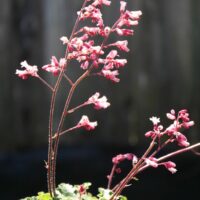
Heuchera ‘Canyon Duet’
A Santa Barbara Botanic Garden selection, part of their Quartet Series of hybrids. This charming, diminutive coral bells forms low, sturdy clumps of small rounded leaves slowly spreading to about 10-12 inches wide. Bi-colored flowers of dark pink and white rise 12 to 18 inches above the dense foliage in spring and early summer. Heuchera's require good light to bloom well but resent full sun, especially inland. Moderate to occasional water. Excellent small scale perennial for mixed border, edging or rock garden. Good container subject too.
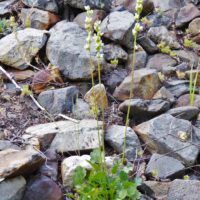
Heuchera cylindrica
Native to the northern mountains of California, the roundleaf alumroot is distinctive for its dense clusters of white to cream-yellow flowers held on vertical stems reaching 1 to 2 ft tall. Round leaves grow in tight mounds up to 8 inches high and 2 ft wide. Combine with pink Heucheras, Iris and small ferns for an attractive woodland display. Needs part shade and decent drainage. Attracts hummingbirds. Drought tolerant.
Heuchera hirsutissima
This miniature alumroot is the perfect addition to the lightly shaded rock garden or along the edge of a path. Pinkish-white, dainty flowers sit atop short stems only about 4 inches tall in spring and summer. The little 2 inch mounds of dark green leaves slowly spread to form tiny drifts. Provide good drainage and moderate irrigation. An excellent plant for a rock crevice or container where it can be combined with Idaho fescue, Erigeron 'Olga' or leather fern. This species comes from the San Jacinto and Santa Rosa mountains of southern California.
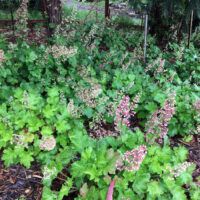
Heuchera maxima
Native to the Channel Islands, this is one of the most adaptable and vigorous of the alum roots, forming broad evergreen mounds of bright green folilage 1 - 1 1/2 ft. high. Maroon flower stems are 3 ft. high topped with pink blushed creamy flowers that have a slight green haze. Best with part shade and a little summer water, but will tolerate full sun close to the coast. Good for use under oaks. This species attracts hummingbirds.
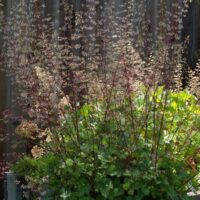
Heuchera micrantha
This is our common alum root which is usually seen on shady cliffs and roadbanks adjacent to forests. Easy to grow in garden situations. Forms low mounds of foliage topped with dainty white flowers on long stems. Likes moisture, but tolerates considerable drought and takes deeper shade than most Heuchera species. This species attracts hummingbirds.
Heuchera pilosissima
Native to the coast from Mendocino to Santa Barbara Counties, this perennial forms compact, evergreen clumps of light-green scalloped leaves. Stocky flower stems 12 – 16 inches long carry small white-pink flowers in early summer. Perfect in coastal areas where it can grow in sun to light shade and will be drought tolerant once established. Must have part shade and some summer water inland. Plant in mass for a nice ground cover in a woodland setting or in mixed plantings with shrubs and ferns. Attracts hummingbirds.
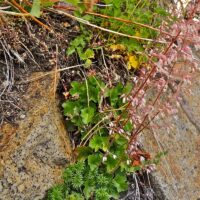
Heuchera rubescens
The pink alumroot stands out with bell-like flowers of pink and white held in clusters on slender stems up to 1 ft tall. The round, scalloped leaves form low, dense mats up to 1 1/2 ft wide and about 6 inches high. This western mountain dweller looks beautiful in a rock garden but will do well in any situation with part shade and good drainage. Needs moderate to occasional irrigation once established. Attracts hummingbirds. Great in a container.