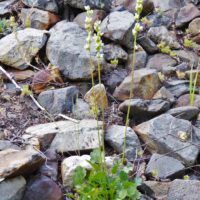
Heuchera cylindrica
Native to the northern mountains of California, the roundleaf alumroot is distinctive for its dense clusters of white to cream-yellow flowers held on vertical stems reaching 1 to 2 ft tall. Round leaves grow in tight mounds up to 8 inches high and 2 ft wide. Combine with pink Heucheras, Iris and small ferns for an attractive woodland display. Needs part shade and decent drainage. Attracts hummingbirds. Drought tolerant.

Heuchera hirsutissima
This miniature alumroot is the perfect addition to the lightly shaded rock garden or along the edge of a path. Pinkish-white, dainty flowers sit atop short stems only about 4 inches tall in spring and summer. The little 2 inch mounds of dark green leaves slowly spread to form tiny drifts. Provide good drainage and moderate irrigation. An excellent plant for a rock crevice or container where it can be combined with Idaho fescue, Erigeron 'Olga' or leather fern. This species comes from the San Jacinto and Santa Rosa mountains of southern California.
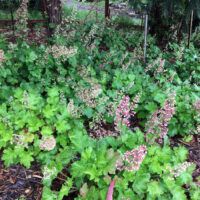
Heuchera maxima
Native to the Channel Islands, this is one of the most adaptable and vigorous of the alum roots, forming broad evergreen mounds of bright green folilage 1 - 1 1/2 ft. high. Maroon flower stems are 3 ft. high topped with pink blushed creamy flowers that have a slight green haze. Best with part shade and a little summer water, but will tolerate full sun close to the coast. Good for use under oaks. This species attracts hummingbirds.
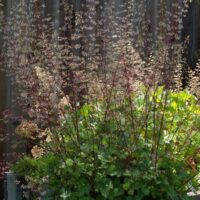
Heuchera micrantha
This is our common alum root which is usually seen on shady cliffs and roadbanks adjacent to forests. Easy to grow in garden situations. Forms low mounds of foliage topped with dainty white flowers on long stems. Likes moisture, but tolerates considerable drought and takes deeper shade than most Heuchera species. This species attracts hummingbirds.
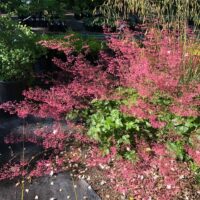
Heuchera micrantha ‘Martha Roderick’
Here’s a pink flowered form of the normally white flowered native alum root. Foliage forms handsome clumps topped with slender stalks 1 - 1 1/2 ft. tall of tiny pink flowers. Excellent in woodland setting for border, slope or rock garden. Drought tolerant but best with a little water. This species attracts hummingbirds.
Heuchera pilosissima
Native to the coast from Mendocino to Santa Barbara Counties, this perennial forms compact, evergreen clumps of light-green scalloped leaves. Stocky flower stems 12 – 16 inches long carry small white-pink flowers in early summer. Perfect in coastal areas where it can grow in sun to light shade and will be drought tolerant once established. Must have part shade and some summer water inland. Plant in mass for a nice ground cover in a woodland setting or in mixed plantings with shrubs and ferns. Attracts hummingbirds.
Heuchera rubescens
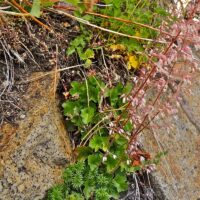
The pink alumroot stands out with bell-like flowers of pink and white held in clusters on slender stems up to 1 ft tall. The round, scalloped leaves form low, dense mats up to 1 1/2 ft wide and about 6 inches high. This western mountain dweller looks beautiful in a rock garden but will do well in any situation with part shade and good drainage. Needs moderate to occasional irrigation once established. Attracts hummingbirds. Great in a container.
Hierochloe (Anthoxanthum) occidentalis
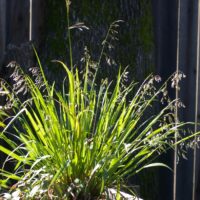
Here is an interesting and elegant grass native to coniferous forests. Broad, bright green, sweetly scented blades grow a foot or more tall. Flowering culms rise another 6 inches or so above the foliage with tight panicles of spikelets. The leaves offer a sweet, vanilla fragrance when dried. Excellent for woodland gardens, compatible with many redwood forest plants. Best with some summer water, but is drought tolerant near the coast. A larval host for the Western branded skipper butterfly. Deer resistant.
Iris douglasiana
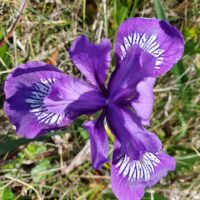
Native to the California coast from Santa Barbara to Oregon. Grows both on the edge of coastal forests and on bluffs and prairies along the ocean. Clumps of evergreen, sword-shaped leaves increase readily and are topped with violet-purple blossoms early to mid spring. Important nectar producer for native bees. An adaptable garden subject for cool full sun to light shade. Drought tolerant once established, but occasional summer water will help keep foliage fresher. Deer resistant.
Iris douglasiana – Robust Form
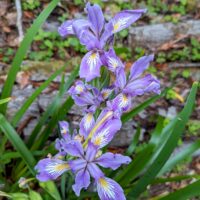
We discovered this incredibly striking form of the popular Douglas iris near Tannery Gulch, outside of Occidental. The dark, evergreen leaves reach up to an astounding three feet in height, and are exceptionally broad. Even though these are grown by seed, the flowers are a dependable lavender-blue, with sprays of white and yellow, held on tall stalks reaching up to a foot above the foliage! Grows well in dappled shade in hotter areas, but can take full sun where there is coastal influence. While drought tolerant, occasional deep soaks keep them looking verdant and vigorous. Deer and gopher resistant.
Iris douglasiana ‘Canyon Snow’
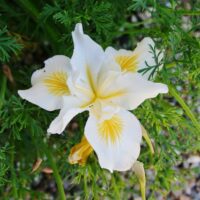
A dependable and floriferous selection of the native Douglas iris, with springtime flowers that are pure white with yellow markings on the falls. Broad shiny blades are mostly evergreen and grow a foot or more tall and form compact clumps. Plant in sun to part shade, particularly in hot inland areas, with moderate to little summer water. Prefers good drainage but will grow well on clay soils provided they are mounded up. Too much summer water on heavy soils will prove fatal. Deer resistant.
Iris douglasiana v. major
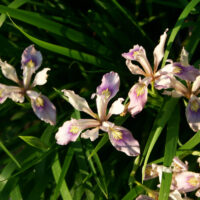
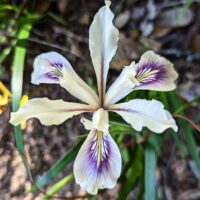
This rare form of the Douglas iris occurs throughout Marin County, offering a rainbow of possible flower colors, including blue-purple, mauve, creamy yellow and white, with all sorts of gradations in between. Since these are seed grown, the color will be a surprise when they bloom. The spring blossoms often have striking venation, and are held on stalks 1’ – 2’ high. Foliage clumps generally reach about a foot tall and spread to form extensive colonies of evergreen, strap like leaves. Plant in full sun in cooler areas, but provide some shade in hotter zones. Plants require little water once established, and are perhaps a little more drought and heat tolerant than the straight species. Deer and gopher resistant.
Iris fernaldii
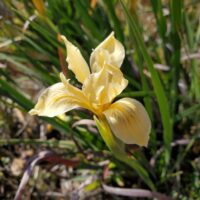
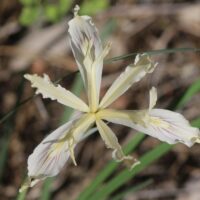
Rarely offered in nurseries, the creamy-white to soft, buttery-yellow flowers of Iris fernaldii brighten up any dry shade to part-sun, inland garden in April. The flowers rise a foot above the evergreen, narrow, strap-like, deep-green foliage. This patch-forming Iris can be found in the more inland canyons of Northwestern California, from the Santa Cruz mountains, throughout inland Sonoma County, to Lake, Colusa, and Glenn counties. Fernald’s iris is well adapted to both extreme heat and cold, but can also perform well in full sun on the coast. Native bees and butterflies are attracted to the cheery flowers of this iris. This species prefers decent drainage and is drought tolerant and deer resistant once established.
Iris innominata
A choice iris with slender, glossy, dark-green leaves and dainty flowers in late spring. Flower color can be from brilliant yellows to shades of purple. Native to the Siskiyou Mountains in Del Norte County, California, into southern Oregon where it forms low, dense, evergreen clumps in openings of woodlands or coniferous forests. This species does better in hot, inland areas than the Douglas iris. Requires good drainage and some summer water. This Del Norte County iris has been used in hybridization programs to produce the popular Pacific Coast Hybrid Iris. Deer resistant.
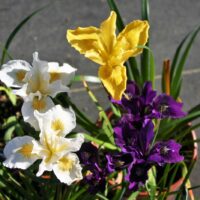
Iris Pacific Coast hybrid
A diverse group bred from the native irises with wonderful coloration, patterning, flower form variation....ranging from soft pastels to mahogany, maroon and midnight purple. Evergreen foliage, about 1 to 2 ft. high. Can eventually form sizable clumps. Full sun to light shade. Often do well as an understory for oaks that needs no summer water. Drought tolerant, moderate to little water when established. Deer don’t seem to eat flowers or foliage.
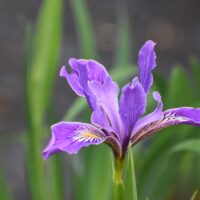
Iris Pacific Coast hybrid – lavender
A native iris hybrid thought to be a cross with Iris douglasiana. Flowers are a deep lavender in color, with purple-veined petals and yellow throats. Evergreen foliage is 12-18 inches tall and spreads to form 2-3 foot-wide clumps. Tolerates full sun on the coast but does best with afternoon shade inland. Occasional water keeps it looking good in summer. Like other Pacific Coast iris hybrids, it can be planted in the understory of oaks, where it will require little irrigation once established. Drought tolerant and deer resistant.
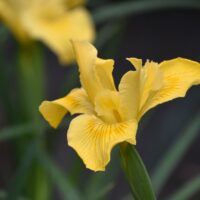
Iris Pacific Coast hybrid ‘Canyon Sunshine’
One of a diverse group of hybrid native irises, this butter-yellow selection with a lemony center is the result of a cross with Iris douglasiana 'Canyon Snow.' The evergreen foliage grows about 1 - 2 feet tall and spreads by rhizomes to form clumps up to 3 feet wide. Tolerates full sun on the coast but does best with afternoon shade inland. Occasional water keeps it looking nice in summer. A good plant for the understory of oaks, where it will require little irrigation once established. Drought tolerant and deer resistant.
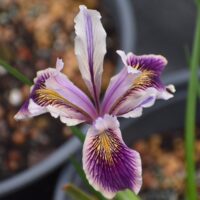
Iris Pacific Coast hybrid ‘Purple & White’
A Pacific Coast hybrid iris with thick purple veins and a splash of yellow at the center of white flowers. The evergreen foliage gets 12-18 inches tall and spreads by rhizomes to form clumps up to 3 feet wide. Does well in full sun in cooler, coastal areas, but needs afternoon shade inland. Occasional water keeps it looking good in summer. A suitable plant for the understory of oaks, where it will require little irrigation once established. Drought tolerant and deer resistant.
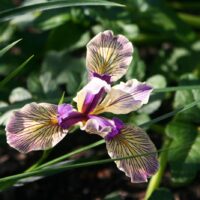
Iris Pacific Coast hybrid ‘Sebastopol’
A diverse group bred from the native irises with wonderful coloration, patterning, flower form variation....ranging from soft pastels to mahogany, maroon and midnight purple. Evergreen foliage, about 1 to 2 ft. high. Can eventually form sizable clumps. Full sun to light shade. Often do well as an understory for oaks that needs no summer water. Drought tolerant, moderate to little water when established. Deer don’t seem to eat flowers or foliage.
Juncus effusus
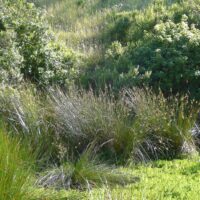
Striking plant with bright green, erect, cylindrical blades that arch somewhat toward the tips. Creamy-gold, tassel-like flowers appear near the tips in spring and early summer. Grows 3 ft. or more tall and wide. Native to moist habitats in temperate regions of the world. Can grow in full sun to light shade with regular to moderate water. A natural for water features, making a great foliage accent for pools, ponds, or streamsides. Can grow in shallow water. Great in containers too. Deer resistant.
Juncus patens
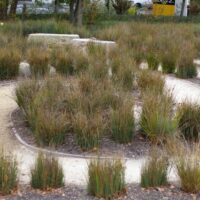
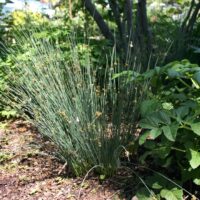
This handsome evergreen rush provides a striking vertical accent 1-1/2 to 2-1/2 ft. tall with grey-green to grey-blue foliage. Brownish-yellow, tassel-like flowers appear in the spring and early summer. Very adaptable, tolerating a wide range of conditions. Enjoys sun with moisture, but will tolerate dry conditions once established. Accepts moderate shade. Robust root systems are excellent for soil stabilization. Deer resistant.
Juncus patens ‘Elk Blue’
Introduced by San Marcos Growers, this form of Juncus patens was selected from the hills southeast of the town of Elk in Mendocino County. Features exceptionally blue foliage and and a vigorous spreading habit. This selection is shorter than the typical grey rush only reaching about 18 inches tall. An adaptable species, will thrive in moist soils, even shallow water but once established tolerates dry conditions too. Grows in sun to moderate shade. An excellent accent plant with its stiff, vertical foliage. Deer resistant.
Juniperus communis ‘Point Saint George’
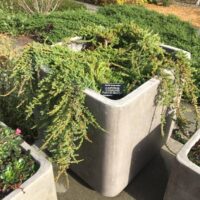
A striking selection from our northern coast of a species that is widespread across the Northern Hemisphere but rare on the coast of California. Sadly, the original population no longer exists due to seaside erosion. Forming dense mats of silver-green foliage under six inches tall, it slowly spreads to several feet wide. A perfect addition to the rock garden, preferring decent drainage and occasional water once established. Also works well as a container plant where the branches can cascade over the sides creating silvery waterfalls. Likes full sun to light shade. Deer resistant.
Koeleria macrantha
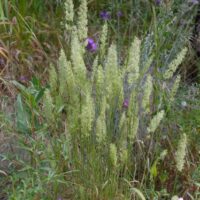
An evergreen perennial bunchgrass forming a rounded tuft of narrow, bluish-green blades 6 - 12 inches long. Spike-like panicles of pale green florets rise another 6 - 12 inches above the blades in summer. This widespread species grows from coastal woodlands and prairies to high mountains. Best in sunny locations with well drained soil and moderate to a little summer water. Tolerates light shade, does NOT like heavy, wet soils or deep shade. Deer resistant.
Lasthenia californica ssp. macrantha
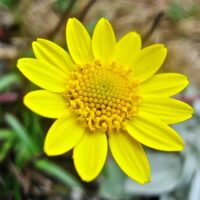
Native along the immediate coast of California and just into Oregon, where it forms low, tight mounds of deep green succulent foliage. Cheerful, bright yellow daisies bloom over a long period. Best in full sun with some summer water and good drainage. Long blooming, open faced flowers are excellent sources of nectar and pollen for butterflies, bees and other pollinators.
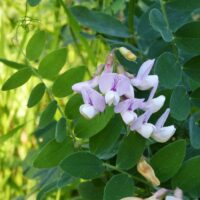
Lathyrus vestitus
From woodland to chaparral throughout much of the California coast ranges comes this charming sweet pea relative. Clusters of dainty flowers ranging in color from white to pink and lavender grace this evergreen vine in the spring, followed by clusters of small peapods. Plant along a fence or amongst shrubs where it will climb up to 8 ft. tall and wide. Provide light shade inland but will tolerate full sun near the coast. Drought tolerant once established but will also accept occasional irrigation. This vine is a host plant to the silvery blue butterfly and the arrowhead blue butterfly.
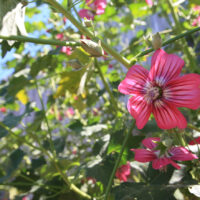
Lavatera (Malva) assurgentiflora
Light green, maple-like leaves with showy, rose-pink flowers with dark veination bloom over a long period from spring to fall. Native to the Channel Islands, this fast growing shrub will grow 10 ft. tall or more. Useful as a drought tolerant, wind resistant, fast growing screen or hedgerow plant, at its best in coastal environments. Inland needs some protection and periodic summer water. Pruning helps maintain a nice habit. Probably best in naturalistic garden designs. A favorite nectar source of orioles.
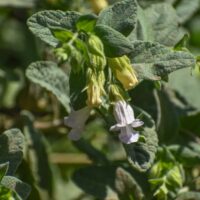
Lepechinia calycina
A super fragrant sage relative with a wide distribution in California’s coastal ranges. White to pale pink or lavender, open-mouthed, tubular flowers appear in late spring and early summer. Fuzzy, grey leaves clothe the plant all year but less densely in the winter. Can grow 2 - 4 ft. tall and wide with a rather lank form which can be improved with regular pinching. A fast growing perennial for sunny to lightly shaded areas with good drainage. Very drought tolerant once established. Attracts hummingbirds. Deer resistant.