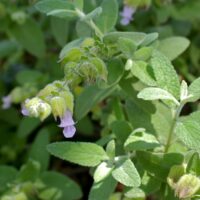
Lepechinia calycina ‘Rocky Point’
An excellent form of a native pitcher sage selected by Tilden Botanic Garden. Features a more compact habit, growing 2 ft. or more tall by 4 ft. or so wide. Pale lavender, tubular flowers appear in spring and summer, drawing hummingbirds into the garden. The fragrant, felted foliage is basically evergreen but is less dense in the winter. Plant in full sun to very light shade and provide good drainage. Very drought tolerant once established and deer resistant.

Lepechinia fragrans
This fragrant sage relative is endemic to Southern California, native to chaparral and woodlands of the Santa Monica and San Gabriel Mountains and the Northern Channel Islands. Softly hairy and strongly fragrant, this woody perennial grows around 4 - 5 feet tall and wide. Showy, lavender-purple, wide-mouthed, tubular flowers bloom in mid to late spring, attracting bumble bees and hummingbirds. Will thrive in full sun to light shade, where it will be drought tolerant once established. Pinching back foliage helps form a dense growth habit. Deer resistant.
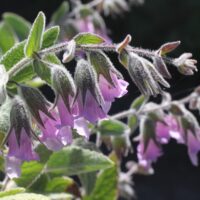
Lepechinia fragrans ‘El Tigre’
A wonderful addition to the dry garden, this rare fragrant pitcher sage is native to the Channel Islands off of California but is quite happy in Sonoma County gardens. Forms a shrub 4 - 5 ft. tall, with soft lavender flowers in the spring hanging gracefully from slender, arching stems. The long, angular leaves are colored soft, gray-green and covered in white hairs. This selection was chosen for its more saturated flowers with darker calyces. Adored by hummingbirds and bees. Plant in full sun on the coast, but provide partial shade inland. Needs good drainage and is drought tolerant once established. Deer resistant.
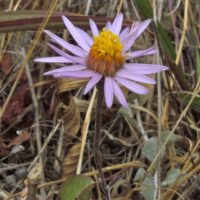
Lessingia (Corethrogyne) filaginifolia
This California native perennial often hugs the ground, spreading widely, it threads its silvery foliage decoratively among other plants. Bright lavender, yellow centered aster-like flowers give a summer long season of bloom. Provide full sun to light shade, some summer water and reasonable drainage. A nectar and larval food source for butterflies. Deer resistant.
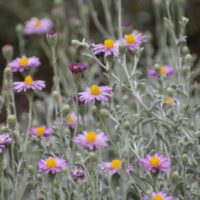
Lessingia (Corethrogyne) filaginifolia ‘Silver Carpet’
A variable species, this selection hails from the Big Sur Coast and was discovered by Carol Bornstein. Forms an attractive ground hugging mat 4 ft. or more wide. The gorgeous silver foliage is the perfect foil for the 1 inch lavender-pink daisies with yellow centers. Tolerates a wide range of conditions including full sun to light shade, drought and wind. Useful groundcover, meadow plant or spiller where its flowers are enjoyed by bees and butterflies. Best with some summer water inland. Deer resistant.
Lewisia cotyledon
Named for Meriwether Lewis, this attractive succulent is native to higher elevations in Northern California and Southern Oregon, typically granite outcrops. The flowers which usually emerge in spring and summer, can range in color from yellow to orange to pink to red. These frost hardy plants form evergreen rosettes, approx. 8 - 10” tall by a foot or so wide. Lewisias need very good, sharp drainage, are heavy feeders, and love a granite rock mulch. They like to be grown sideways, in rock walls, where their crown can drain any moisture away. Plant somewhat high in a fast draining mix and feed every now and then. Morning sun, afternoon shade is best inland. Water as you would any succulent, sparingly, and keep the crown high and dry.
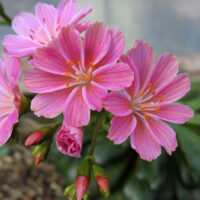
Lewisia cotyledon – Sunset Strain
Named for Meriwether Lewis, this attractive and showy succulent is native to higher elevations in Northern California and Southern Oregon, typically on granite outcrops. Abundant floral sprays arise in spring and summer on stalks reaching 6-10" above evergreen foliage. This seed strain has produced a rainbow of flower colors, including: yellow, white, orange, pink and red. The frost hardy rosettes grow to approx. 8-10” tall by a foot or so wide. Lewisias need very good, sharp drainage, and love a granite rock mulch. They like to be grown sideways, in rock walls, where excess moisture drains away. Plant somewhat high in a fast-draining mix and feed every now and then. Morning sun with afternoon shade is best inland. Water sparingly, as you would any succulent, and keep the crown dry.
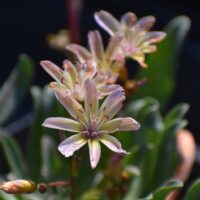
Lewisia longipetala ‘Little Peach’
Large flowers with long petals colored peachy apricot make this selection of our native cliff maids a knockout in the garden. Round clusters of narrow, succulent leaves form patches up to about 8 inches wide. The irresistible flowers emerge en masse from between the leaves on slender stalks up to about 10 inches high. A very long bloomer, beginning in spring and often re-blooming in summer. Works really well in a container with lean, fast draining soil, placed in bright partial shade. Water sparingly. For best results, mulch with granite chips and fertilize occasionally. Lewisias are native to the mountains of California and beyond, where they grow in rock cliffs. An excellent choice for the rock garden.
Lewisia longipetala ‘Little Raspberry’
The parent of this strain of Lewisias is found in rocky outcroppings of the Sierra Nevada Mts. Forms low, fleshy rosettes of tough evergreen leaves. Raspberry-red flowers bloom on short stems above the leathery foliage in the spring into summer and often again in the autumn. Requires good sharp drainage and rock mulch, but appreciates partial shade in hot summer areas. Perfect for rock walls, rock garden, containers and troughs. Water as you would any succulent, sparingly, and keep crown high and dry. This is not the plant for your perennial border, but it is easy to make happy in containers.
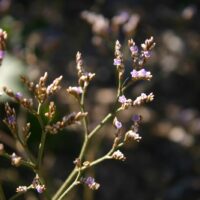
Limonium californicum
Native to coastal areas throughout much of the state, this beautiful statice relative produces clusters of small, lavender-purple flowers on slender stalks up to 18 inches tall. Low rosettes of semi-succulent, dark green leaves provide an excellent contrast to the airy inflorescences. Plant this marsh native in full sun with regular to moderate water. Thrives in wet conditions with poor drainage. Excellent for bees and butterflies. Makes a wonderful dried flower.
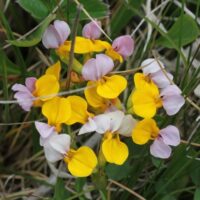
Lotus (Hosackia) formosissimus (gracilis)
A low growing native perennial found in seasonally moist meadows, ditches and seeps along California's coast, north to British Columbia. Small, neat leaves form a pretty, low ground cover spreading up to 2 ft. wide. Pea-like flowers have a bright yellow upper petal and deep pink lower petals which bloom in the spring then sporadically through the summer. Plant in full sun to light shade with regular moisture. Makes a nice container plant, too. Flowers visited by bees and other pollinators. Thought to be the larval food source for the possibly extinct lotus blue butterfly.
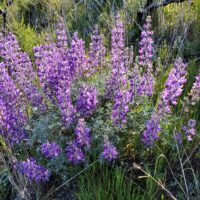
Lupinus albifrons var. albifrons
A popular California native lupine growing to around 3 ft. tall and wide. Beautiful silver foliage with intense blue-purple flower spikes in the spring. To thrive, this lupine needs full sun to very light shade and excellent drainage. Little to no water once established. Vulnerable to snail and slug predation. An excellent species for native pollinators and a larval host for several species of butterflies. Deer resistant.
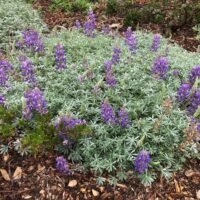
Lupinus albifrons var. collinus
A beautiful low growing form of the silver bush lupine. Forms a mat of gorgeous silvery foliage 12 inches or so wide with spires of rich blue flowers rising 12-18 inches tall in the spring. Plant in full sun to very light shade with well drained soil. Flowers attract a wide array of beneficial insects, especially bees of all types. Drought and deer resistant.
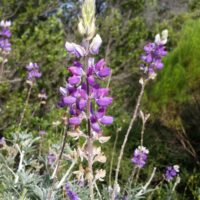
Lupinus albifrons var. douglasii
This variety of the popular silver bush lupine has the same wonderful wands of blue-purple flowers in spring and summer but also features larger, silvery leaves covered with fine hairs. The plant itself is also larger, reaching 3 – 5 feet in height. This variety grows from Marin County down to the Channel Islands. Plant in full sun with excellent drainage and little to no summer water once established. A nectar species for native bumblebees and hummingbirds. This is a butterfly host plant for several blues, hairstreaks and the northern cloudy-wing. Deer resistant.
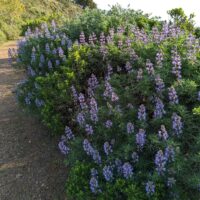
Lupinus arboreus – blue flowered form
Native to coastal areas from Sonoma Co. down to Southern California, the blue bush lupine is distinctive for its grand size (reaching up to 6 ft. tall) and racemes of scented, blue and white flowers. The showy blooms which appear in spring and continue into summer are an excellent nectar source for native bees and hummingbirds. Various butterflies use this species as a larval host plant. The seeds are enjoyed by birds. Grow in full sun with good drainage and occasional to no irrigation once established. Not suitable for areas which get very cold in the winter. Not suitable for Mendocino Co. northwards where it can invade natural areas. Deer resistant.
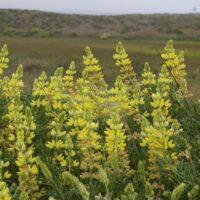
Lupinus arboreus – yellow flowered form
Native to coastal plant communities from Sonoma County south to Ventura County. Showy, fragrant, clear-yellow flowers in long, dense spikes in mid spring and into summer. A fast-growing, floriferous shrub, 3-6 ft. tall and wide. Excellent choice for coastal areas in full sun with good drainage. Not suggested for gardens in coastal Mendocino County due to its ability to quickly naturalize and take over fragile plant communities. Drought and wind tolerant. Lupines have great habitat value, offering nectar for pollinators and nourishing seeds for birds. Great for hummingbirds and a larval food source for various butterflies. Deer resistant.
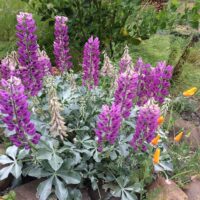
Lupinus sericatus
A rare species from Sonoma, Lake and Napa Counties, this lupine forms a low, wide mound of gorgeous, broad, silver leaves with thick,1 -2 foot spikes of mauve-pink to violet flowers in spring. Requires full sun to very light shade and good drainage. Do not water much once established. Lupine flowers attract a wide array of insects, especially bees. Deer resistant.
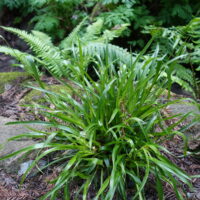
Luzula parviflora
This tidy native woodrush forms grass-like clumps 8 - 10 inches tall and a little wider with broad, bright green leaf blades. The small yellowish flowers occur on the tips of arching flowering stems in late spring. Occurs over a wide range of the Western U.S. and up into Canada, across and down into the northeastern states. Perfect for the woodland garden with moderate moisture. Will seed around if the conditions are right, but we have not found it to be weedy. Deer resistant.
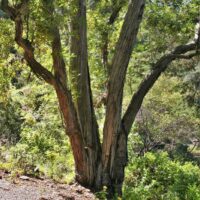
Lyonothamnus floribundus ssp. aspleniifolius
A rare and beautiful evergreen tree from Santa Cruz Island off of the Southern California coast. Fernlike, pinnately divided, shiny, dark-green leaves adorn this fast growing tree which can reach 20 to 50 ft. tall and 15 to 20 ft. wide. Late spring brings large flat-topped clusters of creamy-white flowers on this unusual rose family member. Peeling, reddish-brown bark adds to the interest of this single or multi-trunked tree, which can be used in small groves or as a striking specimen. Plant in full sun to partial shade with moderate to infrequent water. Cold hardy to about 15 degrees. Pollinating insects and birds are attracted to the flowers.
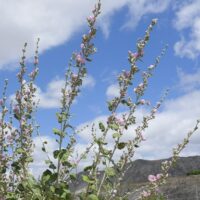
Malacothamnus fasciculatus
Native to western Southern California, this fast growing, evergreen shrub grows to 6 + feet tall and spreads to form colonies. A multi-branched mallow with hairy, gray-green, leaves often shaped like those of maples. The pale pink, cup-shaped flowers held in clusters along the stem, bloom from spring into summer. A native bee magnet. Useful as an evergreen screen for full sun. Occasional irrigation to drought tolerant once established. A larval food source for the west coast lady and the northern white-skipper butterflies. Reported to be deer resistant.
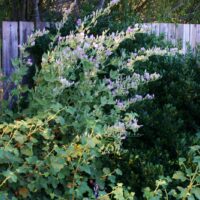
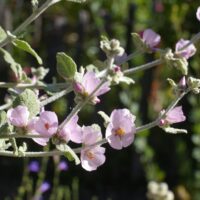
Malacothamnus fremontii
A fast growing, thicket forming, native shrub with silvery white, felted foliage 4 - 6 ft. tall and spreading. A profusion of pale-pink, cup-shaped flowers decorate the branch tips in summer. A tough and adaptable shrub for sunny dry areas, appreciating occasional summer water once established. Useful on banks or other challenging sites. Host plant for the Painted Lady and West Coast Lady butterfly. An excellent nectar source for orioles. Deer often seem to leave it alone.
Malacothamnus jonesii
A rare endemic from southern Monterey and San Luis Obispo counties, growing in foothill woodland and chaparral plant communities. Fast growing shrub, often coming in after fires or disturbance. Growing 4 - 6 ft. tall and wide with beautiful gray foliage, covered in white, velvety hairs. Lovely, soft pink, cup-shaped flowers appear in profusion on the slender branch tips, late spring into summer. Nectar is highly attractive to a myriad of insects, hummingbirds (who seek both nectar and insects), bees and butterflies. Larval food source for the West Coast Lady and Northern White Skipper butterflies. Plant in full sun to ight shade, where it will be drought tolerant once established.
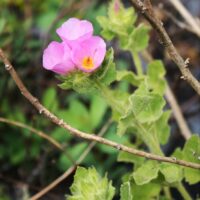
Malacothamnus palmeri var. lucianus
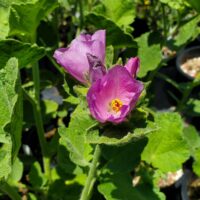
From the hot valleys of the Santa Lucia mountains in central California comes this rare form of the native bush-mallow. Deep pink, cup-shaped flowers appear in late spring and early summer above the fuzzy, light green leaves. Reaches a height of about 6 ft and slowly spreads to form colonies. Give full sun to light shade and provide little to no water once established. A good choice for hot, dry banks with Toyon, Ceanothus and Manzanita. An excellent nectar source for orioles. Deer seem to leave it alone.
Malacothamnus palmeri var. lucianus ‘Hanging Valley’
Description coming soon!
Melica harfordii
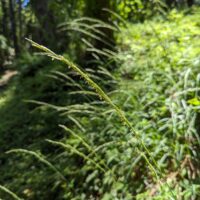
A lovely and useful grass native to dryish slopes and canyons of coniferous forests from central California to British Columbia. Forms a loose vertical clump with slightly arching stems 2 to 4 ft. tall. The delicate, narrow flower spikes add a sparkling effect to the woodland garden. Useful in lightly shaded plantings, where it is drought tolerant especially in cooler areas like western Sonoma County. It would benefit from occasional water during the dry season in warmer regions. Adds a nice vertical touch, as a specimen or in mass. Deer resistant.
Melica torreyana
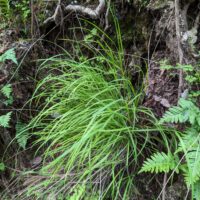
At its best in winter and early spring, this little northern California bunchgrass is a perfect mound of soft green blades. In full bloom it can reach 1 - 3 ft. tall, followed by typical melic fruit resembling small brown rice grains held close to the stem. Grows in sun and shade in nature, but performs best/longest in the garden in part shade. Will go semi-summer dormant with drought, but will be evergreen with some moisture. Deer resistant.
Monardella macrantha ‘Marian Sampson’
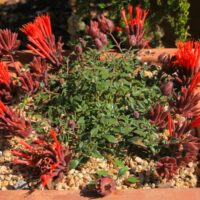
A choice native perennial forming low mats of fragrant dark green shiny leaves. Mid to late spring brings spectacular heads of scarlet tubular flowers which are hummingbird magnets. Well suited for rock garden or container use where good drainage can be provided along with occasional summer water. Appreciates light shade in hot regions. The cultivar ‘Marian Sampson’ is a vigorous and disease resistant selection, but still likely to be short lived, lasting 2 to 4 years. Fantastic accent plant which is deer resistant and attractive to butterflies and hummingbirds.
Monardella purpurea
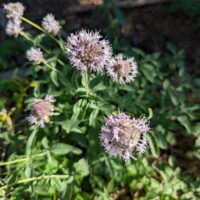
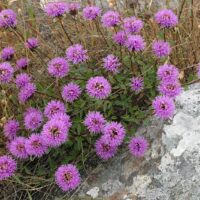
A locally rare and more refined version of our common coyote mint, often with darker flowers, colored purple. Mature plants typically stay under a foot tall, but will get a little wider. Leaves are narrow and dark green, lining burgundy-tinged stems. While native to serpentine soils, it does well in most soils with good drainage. Plant in full sun to part shade and water infrequently. A great, rarely offered native for rock gardens or smaller areas, where butterflies and bees will enjoy the summer blossoms. Deer resistant.