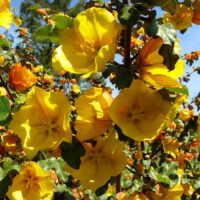
Fremontodendron ‘Pacific Sunset’
This showy hybrid flannel bush grows in a broad “V” shape to 20 ft. tall. Covered with large orange-yellow cup-shaped flowers for a long period in spring. The large flowers attract bees and other pollinators. An excellent nectar plant for orioles. Requires full sun and plenty of room. Best if not watered once established. Needs decent drainage

Fremontodendron ‘San Gabriel’
Large, showy, hybrid flannel bush quickly growing to 20 ft. tall. Covered with buttercup yellow blossoms in the spring. Because of the nature of their branching, ‘San Gabriel’ and ‘Pacific Sunset’ both espalier well. An excellent nectar plant for orioles. Requires full sun. No summer water once established. Needs decent drainage.
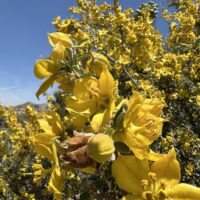
Fremontodendron californicum
In late spring, this evergreen shrub makes for a stunning display along dry foothill slopes. As masses of bright yellow blooms cover its stems, its leathery, fuzzy leaves all but disappear among the showy, cupped flowers. Of the three Fremontodendron species, all native to California, this flannel bush has the widest distribution, mostly in the western Sierra foothills and Southern California. Its range is limited to sites with well-draining, sandy or rocky soil, and it can be sensitive to garden irrigation and heavy soils. Best planted in full sun with similarly low-water species where it receives minimal direct water once established. When happy, it is fast-growing to 15 or more feet, making it a good all-season hedge. Flowers are wildly popular with bees and other pollinators.
Gambelia (Galvezia) speciosa
Evergreen shrub native to the Channel Islands off the So. California coast. Forms an arching mound of medium green foliage 3-4 ft. tall x 5 ft. wide, but can climb or lean on other shrubs to grow even taller. Clusters of scarlet, tubular flowers decorate the branch tips in spring and intermittently throughout the year and are adored by hummingbirds. Full sun along the coast, light shade in hot areas. Drought tolerant and amenable to pruning. Hardy to around 20°F.
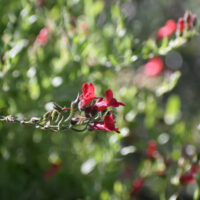
Gambelia (Galvezia) speciosa ‘Firecracker’
An interesting, evergreen subshrub from the California Channel Islands. Showy, deep-red, tubular flowers decorate the branch tips and are highly attractive to hummingbirds. The cultivar ‘Firecracker’ was selected by Tree of Life Nursery for its compact habit, growing 3 foot tall and 5 foot wide, with fuzzy, pale green leaves and larger, red, snapdragon-like flowers. A natural along the coast where it will grow in full sun to light shade, afternoon shade is best in hotter inland sites. Drought tolerant once established, but enjoys occasional summer water, especially away from the coast. Hardy to 15 -20 degrees F.
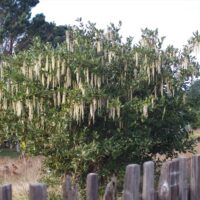
Garrya elliptica
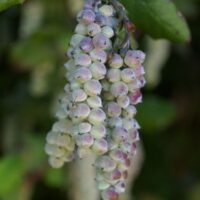
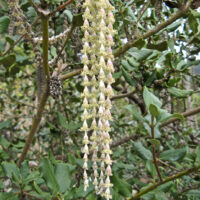
Garryas are grown primarily for their winter flower catkins. The longer, pendulous male catkins have traditionally been the most sought after with selections like 'James Roof' and 'Evie'. Male and female flowers occur on separate plants and both must be present for the female to produce their lovely grapelike clusters of fruit. These plants are seed grown so males and females are of equal probability. All plants feature larger, evergreen leaves on multitrunked shrubs reaching 10 - 15 ft tall and wide. Very amenable to pruning. Plant in full sun or partial shade. Provide moderate irrigation inland, but established plants will be drought tolerant near the coast where they occur naturally. Somewhat deer resistant.
Garrya elliptica ‘Evie’
This cultivar of the native silktassel bush is more compact than the better known ‘James Roof’. The 8 to 10 inch catkins are shorter but more profuse. Evergreen, grows 10 ft. or taller. Sun to part shade, good drainage. Provide moderate to occasional irrigation inland. Winter is its showiest time when it is covered in silvery catkins. Discovered on the northern Sonoma Coast. Somewhat deer resistant.
Garrya elliptica ‘James Roof’
Outstanding cultivar of the native silktassel bush. Evergreen shrub 10 ft. tall or more. Striking 12 inch long silvery catkins in winter. Sun to part shade and drought tolerant. Enjoys moderate summer water inland. Discovered along the coast of Prairie Creek State Park in Humboldt Co.. Somewhat deer resistant.
Garrya fremontii
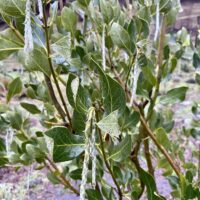
Evergreen shrub with leathery leaves and handsome dangling catkins in late winter and early spring. The male and female flowers occur on separate plants. Native to the west coast where it grows in mixed evergreen forest and chaparral plant communities. This species is a good choice for summer-hot interior sites with well drained soils. Grows 8 - 10 ft. tall and wide in full sun to light shade and is drought tolerant once established. A good specimen shrub or candidate for hedgerow or screen where it provides cover and food for birds and small mammals. Somewhat deer resistant.
Garrya issaquahensis ‘Pat Ballard’
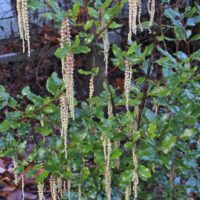
An elegant winter flowering shrub, uncommon in the trade. A hybrid between Garrya elliptica and Garrya fremontii, 'Pat Ballard' is a tough evergreen growing 6-10 foot tall and wide. Pendulous pinkish gray catkins dangle from the branch tips in winter providing a spectacular display. Plant in full sun to part shade with occasional to infrequent water once established. More cold & drought tolerant than Garrya elliptica. An excellent screen, hedge or foundation shrub, amenable to pruning. Somewhat deer resistant.
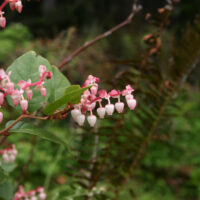
Gaultheria shallon
A handsome evergreen shrub, happiest in fog shrouded coastal zones. Large, leathery, dark green leaves are a gorgeous foil to the loose clusters of white to pinkish urn-shaped flowers. Fat, blue-black berries follow and are relished by wildlife and eaten by people too. Salal can grow tall in moist coastal areas of the Pacific Northwest but usually forms a ground cover 2 - 4 ft. tall and spreading in California. Best with some shade and acidic, humus-rich, moist soils. The foliage is prized for flower arranging. Deer resistant.
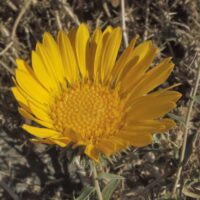
Grindelia camporum
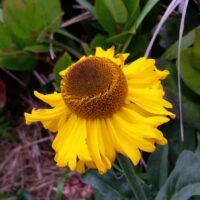
A tough and attractive native perennial found in valleys and lowlands of California. An upright grower, 18-24 inches tall, with resinous foliage and stiff leaves and flower stems. Thick green flower buds hold bright yellow daisies summer through fall which are attractive to bees and butterflies. Best in full sun where it is drought tolerant once established. Tolerates heavy soils and is said to be deer resistant.
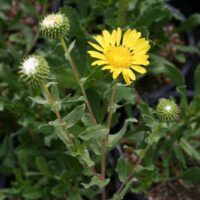
Grindelia hirsutula
Easy to grow, vigorous native perennial that is adaptable to a variety of soils and watering regimes. Grows 1 - 2 ft. tall with good-sized bright yellow daisies over a long period from spring into summer. An excellent nectar plant to add to a habitat garden. With a little grooming and dead heading this sometimes rough looking perennial can look quite handsome in a garden setting. Requires full sun and little to no summer water. Said to be deer resistant.
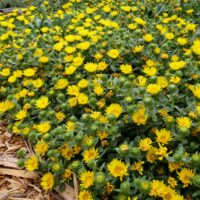
Grindelia stricta var. platyphylla ‘Mendocino’
This selection features particularly large bright yellow 2 1/2 inch daisies over a long period in the summer. Each fat green flower bud holds a dollop of gummy white resin which protects the blooms from predators, hence the name “gum plant”. 'Mendocino' is a particularly prostrate form under 8 inches tall and spreading to at least 6' wide. Native to dunes, marshes and bluffs in coastal scrub throughout coastal California. Excellent pollinator plant. Useful in a meadow planting or with other low groundcovers and shrubs. Looks nice draping over a wall too. An adaptable plant for sun to light shade, moderate to occasional water. A natural along the coast where it tolerates wind and salt spray. Deer resistant.
Hazardia squarrosa v. squarrosa
For a splash of color in late summer and fall, this goldenbush is a great choice, providing clusters of cheery, golden flowers at the height of the dry season, which supply food for butterflies. Birds enjoy the seeds which follow. Rounded leaves with sawtooth margins line the stems and emit a wonderfully sweet scent. This seed strain comes from a hot area in Big Sur and is remarkably compact and rounded, reaching about 3 ft. tall and wide. We’ve found it to be very adaptable, tolerant of clay soils and zero to occasional irrigation. Likes full sun but will accept a little shade. Plant with buckwheats, Salvias, and California fuchsias. Not usually available in Northern California nurseries.
Hesperocyparis macnabiana
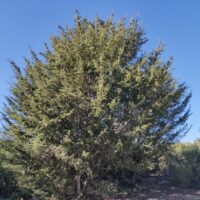
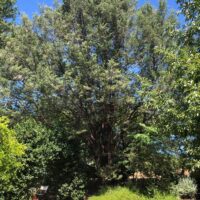
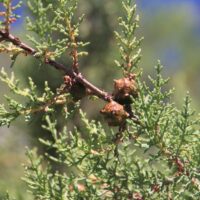
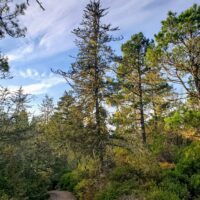
MacNab Cypress is native to dry, open, slopes, usually on serpentine, in chaparral and woodlands of Northern California. Fast growing tree or large shrub, 15 – 40 ft. tall, often with multiple trunks and a spreading crown, growing wider than it is tall. The pleasantly pungent, grey-green, foliage smells like gin and is arranged on flattened branches, giving it a somewhat lacey appearance. The bark is rough and furrowed and the cones are spherical and persistent. Plant in full sun with good drainage and little to no summer water once established. Deer resistant.
Hesperocyparis sargentii
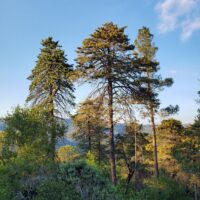
This cypress makes its home in serpentine pygmy forests from Santa Barbara to Mendocino Counties. While often dwarfed in its native terrain, this species can grow quite happily off of serpentine and may reach up to 60 ft. tall. The small, dark-green, scale-like leaves form a bushy canopy against the gray-brown trunk. A good medium-sized tree for hotter inland areas, but will also tolerate coastal conditions. The sargent cypress can grow fairly rapidly, useful as a high privacy screen or wind break. Plant in full sun to light shade and water occasionally. Will be very drought tolerant once established. Needs good drainage. Deer resistant.
Hesperoyucca whipplei
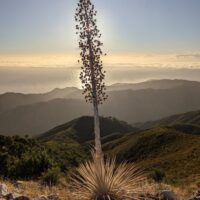
Bold and dramatic architectural accent plant native to southern California coast and mountains south to Baja. Forms a dense rosette of rigid silver-blue blades, 2 foot tall by 3 - 4 foot wide. Each blade has a VERY SHARP tip and careful thought should be given to its placement to avoid injury. Plants can take 3 to 15 years to bloom with impressive stalks rising 6 foot or more above the rosette with drooping, creamy white, bell shaped, fragrant flowers. The flowering rosette dies after blooming often being replaced by vegetative offsets. Best with good drainage in full sun to light shade. No water once established. Deer resistant
Heteromeles arbutifolia
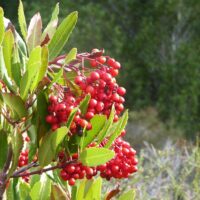
Toyon is a handsome native evergreen shrub 6 - 10 ft. tall and wide. Sun to part shade, drought tolerant. Clusters of lacy white flowers bloom in summer and areattractive to pollinators. Spectacular bundles of red berries are relished by birds and are a great winter decoration. Valuable as a specimen, screen, hedge or bank plant. Birds attracted to the fruit include the following species: Cedar waxwing, California towhee, spotted towhee, Western bluebird, robins, mockingbirds, bandtailed pigeon, waxwing and quail.
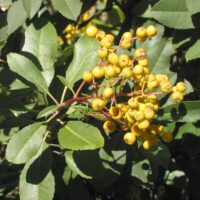
Heteromeles arbutifolia ‘Davis Gold’
An interesting cultivar of the native toyon which bears bright golden yellow berries rather than the more common red-colored fruits. A handsome evergreen shrub 8 - 12 ft. tall and wide (or more). Sun to part shade, drought tolerant. Clusters of lacy white flowers bloom in summer and are attractive to pollinators. The showy clusters of orange-yellow berries are relished by birds and are great winter decoration. Valuable as a specimen, screen, hedge or bank plant. This selection is considered more disease resistant than most toyon.
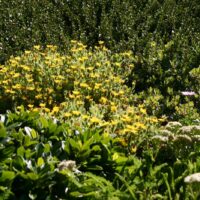
Heterotheca sessiliflora ssp. bolanderi ‘San Bruno Mountain’
Versatile and tough native perennial well suited for the rock garden front of the border or container plantings. Evergreen foliage forms low mats topped with bright yellow daisies in summer - fall. For sunny sites and dryish conditions. Flowers are appealing to bees and butterflies.
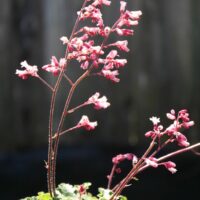
Heuchera ‘Canyon Duet’
A Santa Barbara Botanic Garden selection, part of their Quartet Series of hybrids. This charming, diminutive coral bells forms low, sturdy clumps of small rounded leaves slowly spreading to about 10-12 inches wide. Bi-colored flowers of dark pink and white rise 12 to 18 inches above the dense foliage in spring and early summer. Heuchera's require good light to bloom well but resent full sun, especially inland. Moderate to occasional water. Excellent small scale perennial for mixed border, edging or rock garden. Good container subject too.
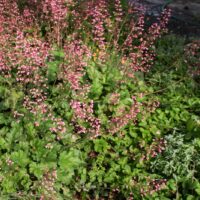
Heuchera ‘Old La Rochette’
Here is a wonderful, often hard to find Heuchera hybrid. Grows into robust clumps of rounded leaves to around 1 ft. tall and 1 - 2 ft. wide. 2 ft. tall flower stalks carry hundreds of soft pink blossoms in the spring, and often intermittently through the summer. Sturdy perennial for part shade and a little summer water. This species attracts hummingbirds.
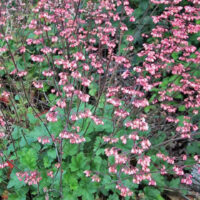
Heuchera ‘Rosada’
Listed as one of U.C. Davis Arboretum’s “All Stars”, this heuchera hybrid is tough and dependable. Forms an attractive mound of evergreen foliage 10 - 12 inches tall. A long display of tall flower stems covered with creamy-pink dainty bells begin in the spring and often continue into the summer. Best with part shade and moderate to occasional summer water. Attracts hummingbirds.
Heuchera ‘Santa Ana Cardinal’
An outstanding hybrid that is vigorous and free flowering. Compact clumps of foliage topped with 2 ft. tall flowering stems with vibrant rose-red blossoms over a long period. Plant in cool full sun to light shade with moderate to occassional summer water once established. This species attracts hummingbirds.