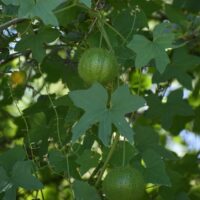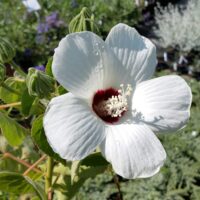
Hibiscus lasiocarpos var. occidentalis (californicus)
A rare species from wetland habitats in the Delta of the Central Valley, which are seriously threatened due to habitat disturbance and development. A large perennial growing 3 - 6 ft. tall with heart-shaped fuzzy leaves on sturdy stems and large showy white flowers with deep pink centers in the summer. Tropical looking and water loving this interesting herbaceous perennial grows best with summer heat. Plant in full sun to light shade with regular water. Tolerates heavy soils and seasonal flooding. Nice container specimen where its needs may be easier to meet.
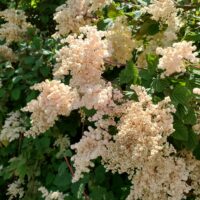
Holodiscus discolor
An elegant, deciduous, native shrub growing 5 - 6 ft. tall or more, depending on the site, and at least as wide. Beautiful, cascading clusters of creamy white flowers hang from branch tips in early summer. The fragrant flowers attract pollinators and a number of butterflies use it as a host plant. Best with light shade. Drought tolerant, but will accept some moisture.
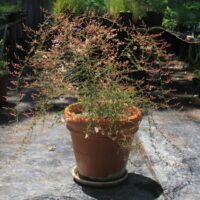
Holodiscus dumosus ‘var. cedrorus’
A recently described endemic shrub discovered by the extraordinary plantsmen Roger Raiche, growing on serpentine soils of the Cedars in northwestern Sonoma County. An open deciduous shrub, approximately 3 ft. x 3 ft. with wiry ruby-red stems and elegant small, shiny, dark green to bronze leaves. Early summer brings erect panicles of cream colored flowers that are suffused in light wine-red or pink coloration. Seems to tolerate a wide range of conditions from full sun to deep shade. Once established has proven durable and drought tolerant. This lovely small creambush is perfect for those who want something completely new and different. It does well in containers and should be interesting to experiment with in different applications and settings.
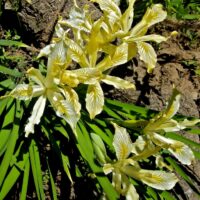
Iris chrysophylla
Native to far northern California and into western Oregon, this uncommon iris grows in fast draining soils in open forests and woodlands. A small scale iris, usually under 12 inches tall in bloom, spreads slowly from slender rhizomes. The delicate blossoms flower in the spring and can vary in color from white to cream to yellow, with a central yellow splash and prominent dark venation. Grow in sun to light shade with occasional to little watering. Visited by bees and hummingbirds. Deer resistant.
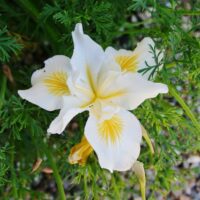
Iris douglasiana ‘Canyon Snow’
A dependable and floriferous selection of the native Douglas iris, with springtime flowers that are pure white with yellow markings on the falls. Broad shiny blades are mostly evergreen and grow a foot or more tall and form compact clumps. Plant in sun to part shade, particularly in hot inland areas, with moderate to little summer water. Prefers good drainage but will grow well on clay soils provided they are mounded up. Too much summer water on heavy soils will prove fatal. Deer resistant.
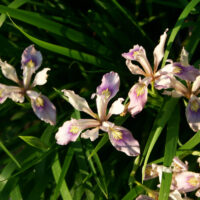
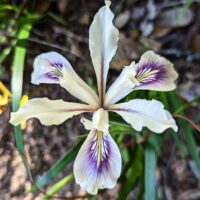
Iris douglasiana v. major
This rare form of the Douglas iris occurs throughout Marin County, offering a rainbow of possible flower colors, including blue-purple, mauve, creamy yellow and white, with all sorts of gradations in between. Since these are seed grown, the color will be a surprise when they bloom. The spring blossoms often have striking venation, and are held on stalks 1’ – 2’ high. Foliage clumps generally reach about a foot tall and spread to form extensive colonies of evergreen, strap like leaves. Plant in full sun in cooler areas, but provide some shade in hotter zones. Plants require little water once established, and are perhaps a little more drought and heat tolerant than the straight species. Deer and gopher resistant.
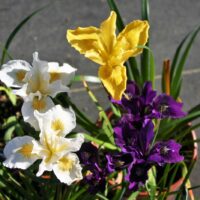
Iris Pacific Coast hybrid
A diverse group bred from the native irises with wonderful coloration, patterning, flower form variation....ranging from soft pastels to mahogany, maroon and midnight purple. Evergreen foliage, about 1 to 2 ft. high. Can eventually form sizable clumps. Full sun to light shade. Often do well as an understory for oaks that needs no summer water. Drought tolerant, moderate to little water when established. Deer don’t seem to eat flowers or foliage.
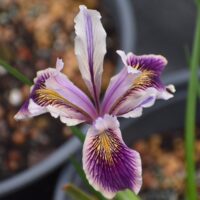
Iris Pacific Coast hybrid ‘Purple & White’
A Pacific Coast hybrid iris with thick purple veins and a splash of yellow at the center of white flowers. The evergreen foliage gets 12-18 inches tall and spreads by rhizomes to form clumps up to 3 feet wide. Does well in full sun in cooler, coastal areas, but needs afternoon shade inland. Occasional water keeps it looking good in summer. A suitable plant for the understory of oaks, where it will require little irrigation once established. Drought tolerant and deer resistant.
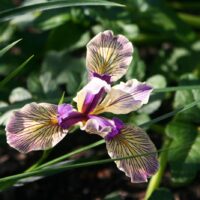
Iris Pacific Coast hybrid ‘Sebastopol’
A diverse group bred from the native irises with wonderful coloration, patterning, flower form variation....ranging from soft pastels to mahogany, maroon and midnight purple. Evergreen foliage, about 1 to 2 ft. high. Can eventually form sizable clumps. Full sun to light shade. Often do well as an understory for oaks that needs no summer water. Drought tolerant, moderate to little water when established. Deer don’t seem to eat flowers or foliage.
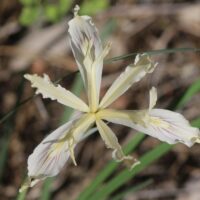
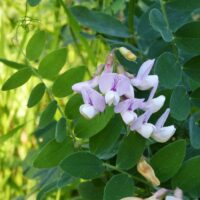
Lathyrus vestitus
From woodland to chaparral throughout much of the California coast ranges comes this charming sweet pea relative. Clusters of dainty flowers ranging in color from white to pink and lavender grace this evergreen vine in the spring, followed by clusters of small peapods. Plant along a fence or amongst shrubs where it will climb up to 8 ft. tall and wide. Provide light shade inland but will tolerate full sun near the coast. Drought tolerant once established but will also accept occasional irrigation. This vine is a host plant to the silvery blue butterfly and the arrowhead blue butterfly.
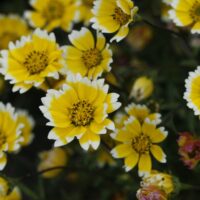
Layia chrysanthemoides
Light up your plantings or containers with this cheerful, ANNUAL wildflower. Boasting clear, bright yellow daisies with pure white-tipped petals, providing a spectacular springtime display. Similar to the common tidy tips, this species is a little smaller, though the flower heads are equally large. Mostly found in the northern part of the state where it is native to vernal pools, grasslands, and valley bottoms, growing in heavy soils and full sun. Attractive to pollinators, especially butterflies. Birds relish the seeds.

Layia platyglossa
Easy to grow native ANNUAL for open sunny areas. Cheerful lemon-yellow daisies with pure white tipped petals entice bees and butterflies. Foliage grows 6-12 inches tall in lean soils and taller with more fertility. Wide distribution, from the coast to inland valleys, Mendocino County to Baja. Birds love the seeds. A knock-out mixed with blues and purples of lupines or baby blue eyes. Does not need water once established.
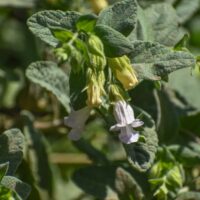
Lepechinia calycina
A super fragrant sage relative with a wide distribution in California’s coastal ranges. White to pale pink or lavender, open-mouthed, tubular flowers appear in late spring and early summer. Fuzzy, grey leaves clothe the plant all year but less densely in the winter. Can grow 2 - 4 ft. tall and wide with a rather lank form which can be improved with regular pinching. A fast growing perennial for sunny to lightly shaded areas with good drainage. Very drought tolerant once established. Attracts hummingbirds. Deer resistant.
Lewisia cotyledon
Named for Meriwether Lewis, this attractive succulent is native to higher elevations in Northern California and Southern Oregon, typically granite outcrops. The flowers which usually emerge in spring and summer, can range in color from yellow to orange to pink to red. These frost hardy plants form evergreen rosettes, approx. 8 - 10” tall by a foot or so wide. Lewisias need very good, sharp drainage, are heavy feeders, and love a granite rock mulch. They like to be grown sideways, in rock walls, where their crown can drain any moisture away. Plant somewhat high in a fast draining mix and feed every now and then. Morning sun, afternoon shade is best inland. Water as you would any succulent, sparingly, and keep the crown high and dry.
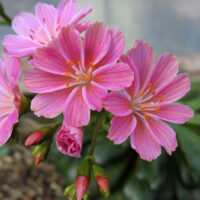
Lewisia cotyledon – Sunset Strain
Named for Meriwether Lewis, this attractive and showy succulent is native to higher elevations in Northern California and Southern Oregon, typically on granite outcrops. Abundant floral sprays arise in spring and summer on stalks reaching 6-10" above evergreen foliage. This seed strain has produced a rainbow of flower colors, including: yellow, white, orange, pink and red. The frost hardy rosettes grow to approx. 8-10” tall by a foot or so wide. Lewisias need very good, sharp drainage, and love a granite rock mulch. They like to be grown sideways, in rock walls, where excess moisture drains away. Plant somewhat high in a fast-draining mix and feed every now and then. Morning sun with afternoon shade is best inland. Water sparingly, as you would any succulent, and keep the crown dry.
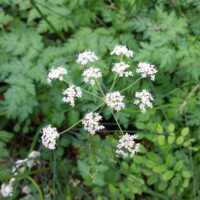
Ligusticum apiifolium
We love members of the carrot family, with their flat-topped clusters of star-like flowers and excellent habitat value. This species is no exception, though it is rarely grown in nurseries. In spring the clear-white flowers appear in delicate umbels on slender stalks 2 - 4 ft. high. The ferny, bright-green foliage stays close to the ground, rarely reaching more than a foot tall. Occurs in the Coast Range from the San Francisco Bay Area northwards. You may find this species in full sun near the coast or in bright woodlands further inland. Needs decent drainage and occasional to infrequent summer water.
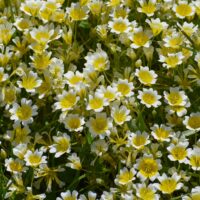
Limnanthes douglasii
California native ANNUAL occurring in grasslands and vernal pools throughout California. Low growing, shiny green foliage is topped with a profusion of sweetly fragrant, cup shaped, bright yellow blossoms with white tips. An excellent choice for low, winter wet areas, drainage swales, retention basins or seasonally dry stream beds. Thrives in heavy soils where it often naturalizes. Plant in full sun to part shade with regular water through the growing season. Fabulous container plant too. Meadowfoam is excellent for encouraging native pollinators, bees and butterflies.
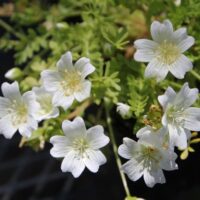
Limnanthes douglasii ssp. nivea
California native ANNUAL occurring in grasslands and vernal pools throughout California. Low growing foliage is topped with a profusion of sweetly fragrant, small white flowers with purple-pink veins on the petals. An excellent choice for low, winter wet areas, drainage swales, retention basins or seasonally dry streambeds. Thrives in heavy soils where it often naturalizes. Plant in full sun to part shade with regular water through the growing season. Good in containers too. Native wildflowers are excellent for encouraging native pollinators.
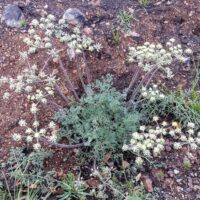
Lomatium dasycarpum
Native to chaparral, grassland and open woodland throughout much of California, this dainty little member of the carrot family produces flat-topped clusters of fuzzy flowers, yellow in bud and creamy-white when open. The fern-like leaves are gray-green and hairy. Blooms in early spring. A larval food source for the Anise Swallowtail butterfly. Needs well-drained soil and full sun to part shade. Do not water once established. Summer dormant.
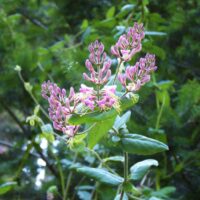
Lonicera hispidula
This native honeysuckle is often seen climbing over shrubs on the edge of woodlands where its roots are shaded and its foliage is sun drenched. The trumpet-shaped flowers range in color from rosy-pink to pink and white and feature prominent yellow stamens emerging from their mouths. They form clusters which decorate the tips of the vining branches and are attractive to bees and hummingbirds. The high point is the drooping clusters of luminous red berries in late summer which are beautiful to behold and provide a feast for birds, especially orioles. A drought tolerant vine but would appreciate occasional deep summer watering. Considered by some to be deer resistant.
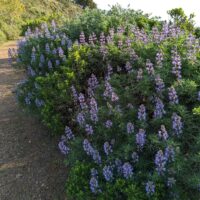
Lupinus arboreus – blue flowered form
Native to coastal areas from Sonoma Co. down to Southern California, the blue bush lupine is distinctive for its grand size (reaching up to 6 ft. tall) and racemes of scented, blue and white flowers. The showy blooms which appear in spring and continue into summer are an excellent nectar source for native bees and hummingbirds. Various butterflies use this species as a larval host plant. The seeds are enjoyed by birds. Grow in full sun with good drainage and occasional to no irrigation once established. Not suitable for areas which get very cold in the winter. Not suitable for Mendocino Co. northwards where it can invade natural areas. Deer resistant.
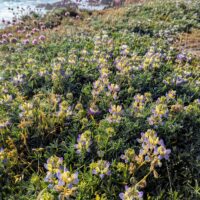
Lupinus littoralis var. variicolor
Often found nestled amid rocks and sand, this low-growing, perennial lupine is native to the beaches and dunes of coastal California. Forms a clump or mat of silver-green foliage under 18 inches tall, with jewel-like flower spikes. Blooms in a subtle range of colors, typically shades of purple-blue with white to pale yellow banners. Makes for an excellent addition to a rock garden. Formerly known as Lupinus variicolor, it is currently considered a variety of bluff lupine that is endemic to the Bay Area from Sonoma County down to the Peninsula. It attracts pollinators, and is one of the few hosts for the rare Mission Blue butterfly. Accepts various watering regimens from regular to occasional so long as it gets excellent drainage. Drought tolerant once established.
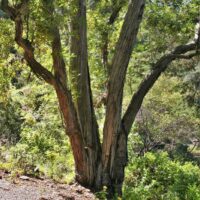
Lyonothamnus floribundus ssp. aspleniifolius
A rare and beautiful evergreen tree from Santa Cruz Island off of the Southern California coast. Fernlike, pinnately divided, shiny, dark-green leaves adorn this fast growing tree which can reach 20 to 50 ft. tall and 15 to 20 ft. wide. Late spring brings large flat-topped clusters of creamy-white flowers on this unusual rose family member. Peeling, reddish-brown bark adds to the interest of this single or multi-trunked tree, which can be used in small groves or as a striking specimen. Plant in full sun to partial shade with moderate to infrequent water. Cold hardy to about 15 degrees. Pollinating insects and birds are attracted to the flowers.
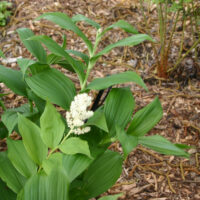
Maianthemum (Smilacina) racemosum
Choice herbaceous perennial native to moist woodlands in California and throughout North America. Forms robust clumps of arching branches 2-3 ft. tall. The branch tips carry dense panicles of sweetly fragrant, white, star-shaped flowers in late spring. Clusters of red berries follow in summer and fall. A lovely addition to the shade garden where it thrives in well drained, woodsy soil with some summer moisture. In cooler coastal environments can go summer dry once established. This lily family member slowly spreads to form striking clumps which die back to the ground in the winter. An elegant and long lived beauty.
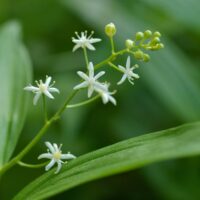
Maianthemum (Smilacina) stellatum
Native to California and much of North America, this woodlander makes a worthy and useful addition to the shade garden. Spreading by stout rhizomes forming colonies of lush, green foliage one foot to 18 inches tall. Small, white, star-shaped flowers top the slender stems in the spring and early summer. Berries follow that are often striped with purple or black, eventually turning red. Thrives in shade with moisture but tolerates dryish conditions once established. Can grow in quite a bit of light as long as there is moisture. A variety of insects seek nectar or pollen from the flowers and woodland song birds love the berries.
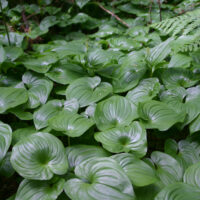
Maianthemum dilatatum
This lush, lily relative is native to coastal forests of Northern California to Alaska. When happy, spreads by underground root stocks to form broad mats of heart-shaped, glossy, green leaves with parallel veins. Bears clusters of tiny white flowers followed by red, translucent berries. Dies back to the ground in winter. Loves shade and moisture. Competes well with tree roots.
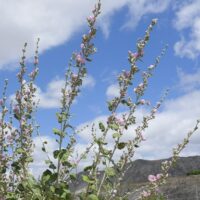
Malacothamnus fasciculatus
Native to western Southern California, this fast growing, evergreen shrub grows to 6 + feet tall and spreads to form colonies. A multi-branched mallow with hairy, gray-green, leaves often shaped like those of maples. The pale pink, cup-shaped flowers held in clusters along the stem, bloom from spring into summer. A native bee magnet. Useful as an evergreen screen for full sun. Occasional irrigation to drought tolerant once established. A larval food source for the west coast lady and the northern white-skipper butterflies. Reported to be deer resistant.