
Monardella villosa ssp. franciscana ‘Pomo Canyon’
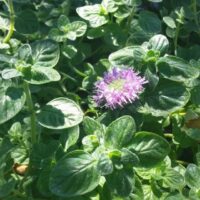
This low growing, dense selection of our native coyote mint was discovered near the mouth of the Russian River. Large, round, deeply veined leaves colored dark blue-green give this groundcover a lush appearance. In summer, soft lavender flowers which look like pincushions cover the plant. Reaches a height of up to 12 inches and spreads fairly quickly to form drifts. Provide full sun to light shade and moderate to infrequent irrigation. A stellar plant for bees, butterflies and hummingbirds. Coyote mint is not a true mint and won’t spread invasively by roots. Deer resistant.
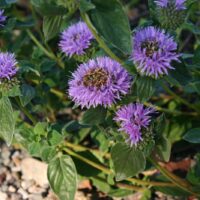
Monardella villosa ssp. franciscana ‘Russian River’
Our own selection of coyote mint from a rocky slope along the lower Russian River. Although Monardella is sometimes difficult in cultivation, this plant has proven to be vigorous. Grows 12 to 18 inches tall with ball-like clusters of pinkish-purple above the fragrant evergreen foliage. Good for a dry sunny site. Attracts bees and butterflies. Deer resistant.
Monardella villosa ssp. villosa – Mark West seed strain
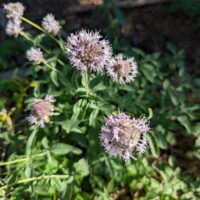
This sweet little coyote mint hails from the dry, inland hills above the Mark West watershed in North East Santa Rosa. It is more compact than the ‘Russian River’ selection, mounding to about 1’ high and spreading to 3’ across. The aromatic foliage is a light minty green, and the round lavender-pink flower heads bloom from late spring through summer. Best with a bit of protection from the hot afternoon sun, this coyote mint is great to tuck under a large, upright, drought tolerant shrub, such as manzanita or Ceanothus. Drought tolerant once established, but blooms best with occasional deep soaks. Needs good drainage. Like other coyote mints, it is a butterfly and native bee magnet. Deer resistant.
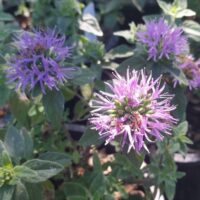
Monardella villosa ssp. villosa – Mark West seed strain ‘Mark West’
This sweet little coyote mint hails from the dry, inland hills above the Mark West watershed in North East Santa Rosa. It is more compact than the ‘Russian River’ selection, mounding to about 1’ high and spreading to 3’ across. The aromatic foliage is a light minty green, and the round lavender-pink flower heads bloom from late spring through summer. Best with a bit of protection from the hot afternoon sun, this coyote mint is great to tuck under a large, upright, drought tolerant shrub, such as manzanita or Ceanothus. Drought tolerant once established, but blooms best with occasional deep soaks. Needs good drainage. Like other coyote mints, it is a butterfly and native bee magnet. Deer resistant.
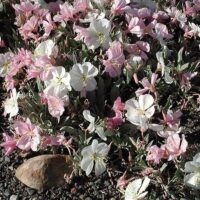
Oenothera californica
California primrose forms low mats of gorgeous, grey foliage, up to 2 to 3 ft. across. The soft leaves, covered with dense hairs, becomes nearly hidden by large, white, sweetly fragrant flowers. The long succession of blooms pop open in early evening from drooping flower buds and last just one night, becoming pink with age. Native to sandy or gravely soils of southern California, southwestern U.S. and Baja, where it can be found in chaparral, high elevation deserts and open woodland habitats. Perfect for the dry garden with well draining soils in full sun to very light shade. The luscious flower display can last from late spring into early summer. Goes completely dormant by mid-summer, returning the next winter. Pollinated by a number of interesting moth species including the Sphinx moth.
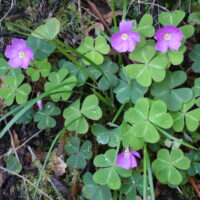
Oxalis oregana
A natural companion of coast redwoods where it forms low carpets of clover-like foliage. Useful ground cover for the woodland garden where it competes well with tree roots and thrives in partial to deep shade. Low and spreading with spring flowers that can range from white through dark pink . Best with humus in the soil and some summer moisture, though it is drought tolerant in coastal zones. Deer resistant.
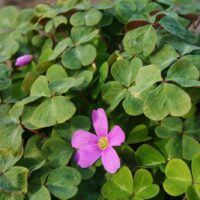
Oxalis oregana ‘American Beauty’
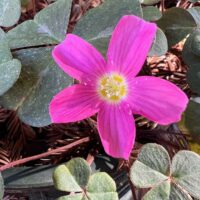
This remarkable selection of our native redwood sorrel has perhaps the largest flowers of any of the forms we've seen. The big pink blooms appear in spring above the lush, green, clover-like foliage. This ground cover competes well with tree roots and thrives in even the shadiest spots. Best with humus in soil and some moisture, though it is drought tolerant in coastal zones. Deer resistant.
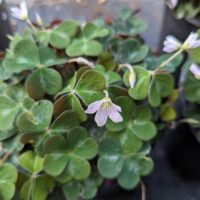
Oxalis oregana ‘Klamath Ruby’
Low spreading groundcover which thrives in the shady conditions of Douglas fir and redwood forests. The cultivar ‘Klamath Ruby’ offers dark green clover-like foliage with beautiful burgundy backed leaves. White flowers with pale pink veining on the petals bloom in the spring. A lovely groundcover for a shady garden with some summer water, though it is drought tolerant in coastal zones, once established. Deer resistant.
Penstemon barbatus ‘Coral Baby’
This dazzling selection of Penstemon is from the Plant Select program of Colorado. Forms a tidy, compact mound of bright green foliage to around 15 inches tall by 12 inches or so wide. Late spring brings upright spikes of eye catching coral-pink tubular flowers which attract bees, butterflies and hummingbirds. Full sun with good drainage and moderate to occasional summer water.
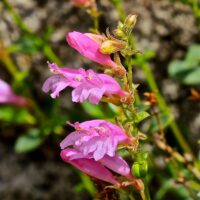
Penstemon newberryi
As the common name implies, this beauty is native to the mountains of California, Oregon and Nevada, where it grows in rocky habitats at high elevations. Forms an evergreen mat, under a foot tall with thick, leathery leaves and gorgeous magenta-pink tubular flowers, in mid to late spring. Good drainage is a must for success and growing in a container is an option for those with heavy soils. Full sun to very light shade with occasional summer waterings. Can be challenging to cultivate, but well worth the extra effort. The showy flowers are highly attractive to hummingbirds and butterflies. Said to be deer resistant.
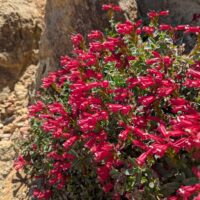
Penstemon newberryi v. sonomensis
This rare, perennial, inland beauty, found only in Sonoma, Napa, and Lake Counties, is a great addition to the dry, inland rock garden. A low mat of small, gray-green, succulent-like leaves gives rise to 5-12” stalks topped with clusters of chunky, tubular, magenta-red flowers with white, fuzzy throats and reproductive structures. Mature plants are no more than 2' wide. A native bee and hummingbird magnet. Plant in full sun with decent soil drainage. Little to no water once established.
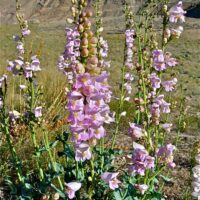
Penstemon palmeri
Showy, grape-scented, pale pink flowers top blue-green, succulent-like foliage on vertical stalks reaching an astonishing 4 to 5 ft. in height. The bulbous flowers have given rise to the common name, ballon flower. Native to desert mountains of southern California and throughout the western United States. This penstemon is attractive to a multitude of pollinators, especially hummingbirds. Plant in full sun to light shade and provide good drainage. Drought tolerant once established. The tall but narrow flower stalks make this penstemon useful in narrow spaces where height is desired.
Penstemon parryi
An adaptable species from the desert southwest of the United States. Thick bluish-green foliage forms a low rosette around 2 feet wide. Bright pink funnel-shaped flowers are produced in profusion on stems 2-3 ft. tall in spring. Good drainage and full sun with moderate to little water once established. Attracts bees, butterflies and hummingbirds.
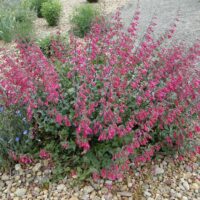
Penstemon pseudospectabilis
From the southeast corner of the state comes this surprisingly adaptable penstemon, with prolific displays of magenta-purple, tubular flowers with flared mouths. Large, serrated, gray-green leaves line stems in attractive pairs. Flower stalks rise 2 – 3 ft. in spring, drawing in hummingbirds and bees. Even though this species is from the desert, it does quite well in local gardens with good drainage, full sun and occasional irrigation once established. Several local butterflies use the desert penstemon as a larval food source, including the common buckeye, variable checkerspot and Edith’s checkerspot.
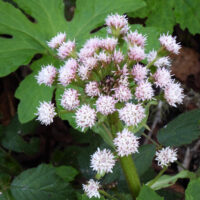
Petasites frigidus var. palmatus
A bold, beautiful and AGGRESSIVE creekside native, found in coastal and montane regions in California, north to Alaska, where it grows along shady creek banks. The large, almost tropical, palmate leaves spread from thick creeping rootstocks to form large colonies. Flowers before the foliage fully emerges in the spring with flat topped clusters of white to pink flowers on 1-2 ft. tall stems. Requires shade and plenty of water and is useful as a soil stabilizer. To control its spreading nature, use in containers or in contained areas. It won't spread into areas which are dry. Dies back to the ground in the winter. Flowers attractive to a wide range of beneficial insects.
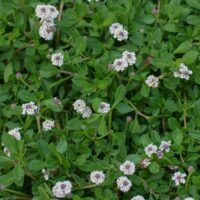
Phyla nodiflora
Vigorous, spreading ground cover native to California, North America and other parts of the world. It's a tough one, able to survive a wide range of conditions and soil types. Tolerates both drought and flooding, but best with occasional deep watering in full sun to very light shade. Flowers heavily over a long period with charming little heads of mauve-pink, lavender and white blossoms, delighting an assortment of bees and butterflies. This dense, carpeting plant makes a serviceable ground cover or lawn-like replacement, tolerating moderate foot traffic and occasional mowing. May look rough in the winter, but quickly recovers in spring. Free flowering and pollinator friendly.
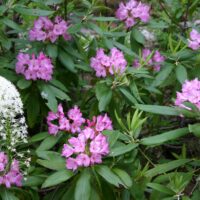
Rhododendron macrophyllum
One of the glories of our coastal redwoods forests, this evergreen rhododendron features clusters of large flowers in the spring which can range in color from deep rose to pale pink. Native from the Big Sur Coast north to Washington. In the wild, this open branched, big leaved shrub can reach a height of 13 feet. Plants in the garden tend to be much smaller, not usually exceeding 8 feet with a slightly narrower width. While somewhat temperamental in cultivation, success can be achieved with dappled shade, well draining soil rich in organic matter and moderate to regular water. Deer resistant.
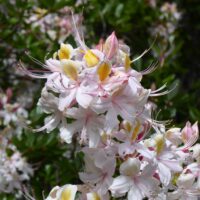
Rhododendron occidentale
A much sought after and admired native deciduous shrub found in moist places and stream banks in many plant communities throughout California. Leafs out in the spring with bright green foliage on a shrubby framework 3-6 ft. or more tall and wide. Glorious displays of fragrant azalea flowers in dense terminal clusters appear in late spring and can be pure white to pale pink often with yellow or orange markings. Needs decent light to bloom well but appreciates light shade, acid soils and regular water. Deer resistant
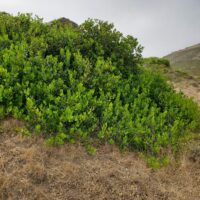
Rhus integrifolia
This sturdy native shrub or small tree is highly valued for its evergreen foliage and as a source of food for birds, bees and butterflies. Round, serrated, leaves, flatter than those of the sugar bush, cover this plant from head to toe. In late winter to early spring, white to pink flower clusters emerge, followed by sticky, reddish fruits. Ranging in height and width from 6 to 20 ft., lemonade berry is very tolerant of pruning, either into a small tree or a low hedge. Cold hardy to about 20 degrees. Plant in full sun to part shade. Will be very drought tolerant once established. Fire resistant. Deer resistant.
Rhus ovata
Handsome evergreen shrub native to dry slopes away from the coast in Southern California, Baja, and Arizona. A durable shrub thriving in hot, rocky conditions in full sun to part shade where it will be completely drought tolerant once established. Grows 6 - 10 ft. tall and wide. A profusion of dense flower clusters are rosy tinted in bud opening to white with a pinkish blush. Small reddish fruits follow that are coated with a sugary secretion that tastes lemony. Excellent subject for hot, dry inland conditions. Good for birds, bees and butterflies. Fire resistant. Deer resistant.
Ribes divaricatum var. pubiflorum
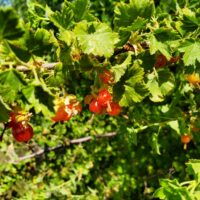
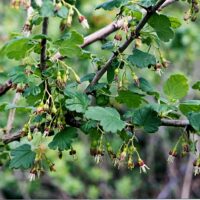
Native to coastal scrub, moist woods and shady canyons of the Pacific coast from British Columbia south through much of coastal California. This gooseberry is perhaps the most tasty of all of our native Ribes. The berries have the added benefit of being free of thorns. Forms an arching shrub 3-6 ft. tall and a bit wider with thorns at the leaf nodes. The tiny flowers are composed of reddish sepals and white petals that dangle beneath the branches and are attractive to hummingbirds. The small, blue-black berries are relished by birds. Plant in light shade with some summer moisture. Will tolerate full sun near the coast. Useful as a barrier, hedgerow or habitat plant where it provides excellent food and thorny cover for birds.
Ribes malvaceum
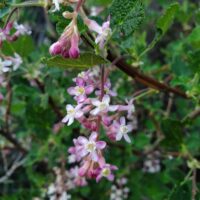
Chaparral currant is a tough and durable native shrub 5 to 8 ft. tall. This deciduous shrub will grow in full sun to light shade and is quite drought tolerant. Flowers early, often midwinter with dangling clusters of pink blossoms. Good early nectar source for hummingbirds. Berries attract many birds including grosbeak and mockingbirds.
Ribes malvaceum ‘Cupertino Rose’
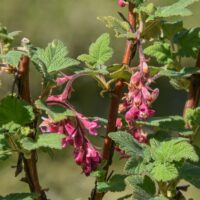
Chaparral currant's flowers can range from white to pink to nearly red in color. This selection carries flower clusters that were the darkest to be found in this population from the foothills of the Santa Cruz Mts. west of Cupertino. The buds are dark pink and the dangling racemes when fully open read medium pink. Deciduous shrub 4-6 ft tall and wide with a very early bloom season often beginning in November, which provides an excellent early source of nectar for hummingbirds. The pendulous clusters of berries that follow are relished by birds. Tolerates full sun along the coast with some shade inland and occasional to little summer water.
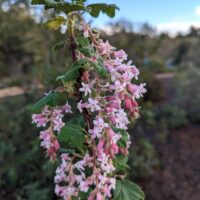
Ribes malvaceum ‘Dancing Tassels’
A dazzling selection by Rancho Santa Ana Botanic Garden from San Clemente Island. Blooming in winter over a long period with the longest dangling flower clusters we’ve seen in the species. Pendulous flower clusters are dusty pink in bud, opening to white and soft pink when fully open. Growing 6 ft. or more tall, this deciduous, vase shaped shrub has gray-green foliage with a pungent resinous fragrance. Peeling red-brown bark and clusters of blue-black berries add to its beauty and appeal. Chaparral currant blooms earlier and is more sun and drought tolerant than the popular pink flowering currant, Ribes sanguineum glutinosum. Plant in full sun to light shade with little to no water once established. An outstanding early nectar source for hummingbirds.