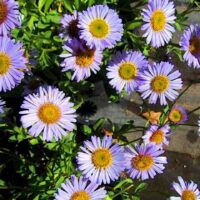
Erigeron ‘W.R.’
The "W. R." stands for the late Wayne Roderick, whom we can thank for many fine plant introductions. This hybrid involves the seaside daisy, Erigeron glaucus and some other native species more tolerant of heat. The lavender daisies sit on slender stalks about 10 inches above low rosettes of narrow leaves. The flowers bloom over a long period in summer and are very attractive to pollinators of all sorts. Provide full sun in cooler areas but will enjoy part shade in hot inland sites. Moderate to occasional irrigation. Their seeds are favored by juncos and finches. Wayne discovered this surpisingly heat tolerant selection on the Del Norte coast. This selection should not be confused with 'Wayne Roderick', which is an entirely diferent selection of Erigeron.
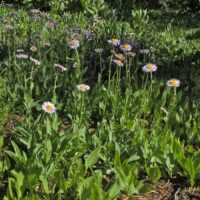
Erigeron glacialis
From mountain meadows throughout much of California and the West comes this endearing little daisy. Features clusters of refined, lavender-pink daisies with yellow centers held on stalks up to 10 inches tall above low, mat-forming leaves. Plant in full sun except in hot, inland areas where some afternoon shade would be appreciated. Needs moderate irrigation. This summer bloomer provides excellent habitat for bees and butterflies. A superlative candidate for a rock garden or narrow planting bed. Works well in containers.
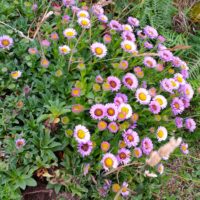
Erigeron glaucus
Low growing native perennial to 1 ft. tall with lovely, lavender, daisy-like flowers blooming over a long part of the year. Native to coastal dunes and bluffs, but does well inland with some afternoon shade and a little extra summer water. A natural along the coast where it thrives with little to no summer water and tolerates wind and salt spray. Good nectar source for butterflies and many different pollinators. Their seeds are favored by juncos and finches.
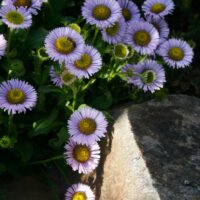
Erigeron glaucus ‘Bountiful’
Forms a lush mound of foliage 10 inches - 1 ft. tall by 2 ft. wide. Exceptionally floriferous and long blooming, 'Bountiful' offers masses of lavender daisies with yellow centers held above loose rosettes of green foliage. It slowly spreads to form drifts which combine wonderfully with Iris and low grasses. A natural along the coast where it grows in full sun and is drought tolerant. Appreciates some afternoon shade and summer water inland. A reliable and easy to grow perennial. Butterfly and bee favorite. Their seeds are favored by juncos and finches.
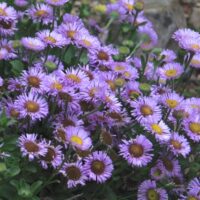
Erigeron glaucus ‘Cal Flora’
This seedling appeared at the base of a decorative pot planted with Erigeron glaucus ‘Cape Sebastian’. The seedling's foliage and form appears to be intermediate between Erigeron glaucus 'Cape Sebastian’ and Erigeron glaucus 'Bountiful'. It has a nice dense habit, though a bit taller than ‘Cape Sebastian', with larger and darker flowers held just above the foliage at about 10 inches in height. A natural along the coast where it thrives with little to no summer water once established and tolerates wind and salt spray. In hotter inland conditions give some afternoon shade and additional summer water. Good pollen and nectar source for bees and butterflies. Their seeds are favored by juncos and finches.
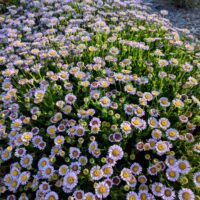
Erigeron glaucus ‘Cape Sebastian’
This selection of the West Coast native seaside daisy is from Oregon, just north of the California border. A compact and dense mound up to 6 inches high, topped with lavender daisies over a long period. Full sun near coast, light shade in hot regions. Best with moderate to occasional summer water in hotter climates. A favorite of pollinators. Their seeds are favored by juncos and finches.
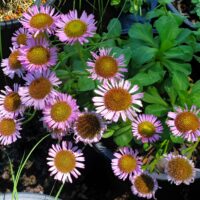
Erigeron glaucus ‘Ron’s Pink’
A delightful pink-flowered version of the useful seaside daisy, an easy to grow perennial native to the coast. Mounds of compact foliage topped with large, pink daisies, spring through autumn. At home on coastal bluffs in full sun with wind and salt spray. Requires afternoon shade and some summer water when grown in hotter interior locations. Looks beautiful when planted with Douglas iris, low fescues and woolly sunflowers. Attractive to a wide array of pollinators, including native bees and butterflies.
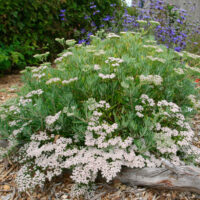
Eriogonum arborescens
A large, shrubby buckwheat with narrow, pale green foliage and sturdy, flat-topped inflorescences of creamy white to pink flowers. The flowers age over time, eventually turning reddish brown, remaining ornamental for a long period. Grows 3 to 4 ft. tall and slightly wider. Normal to very lean well-drained soils. Especially drought tolerant along the coast, may need infrequent summer water inland and possibly a little afternoon shade. Buckwheats are excellent additions to habitat gardens, providing pollen and nectar for bees and butterflies and seeds for many creatures. Deer resistant.

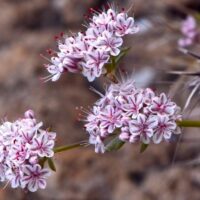
Eriogonum elongatum
This buckwheat is native to dry, rocky places, from Monterey Bay south to Baja, in coastal scrub and chaparral plant communities. Super drought tolerant and late blooming, supporting native bees, parasitic and predatory insects and butterflies. Forms a low mound of gray foliage, topped with long, leafless, flower stems, rising 2 - 3 ft. tall. Flowers late in the summer with ball-like clusters of tiny white and pink flowers spaced along the tall, gray, tomentose stems. Full sun, good drainage. Tolerant of serpentine soils. Deer resistant.
Eriogonum fasciculatum
This adaptable buckwheat is a native of central and southern California. It is a pioneer plant capable of surviving and colonizing some of the hottest driest sites. These attributes are very useful in a garden setting but it should not be planted in or adjacent to wildlands where it may escape and displace local natives. Small native shrub, forming a broad mound 3-4 ft. high and at least 4 ft. wide. Flower clusters are creamy white to pink, turning an attractive rust color with age. Good erosion control plant - best in a well drained, sunny site. Flowers attractive to bees and butterflies. Deer resistant.
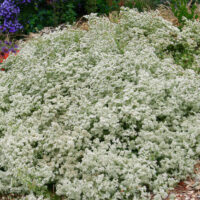
Eriogonum fasciculatum ‘Warriner Lytle’
An interesting form of California buckwheat introduced by the Theodore Payne Foundation. Grows quickly into a low and spreading evergreen groundcover clothed with small, needle-like leaves, 18 inches tall and 6 to 8 feet wide. From late spring to early fall, tight clusters of creamy-whitish pink flowers appear which are very attractive to bees and butterflies. As the flowers go to seed they gradually turn dark russet and are attractive to seed eating birds and mammals. Excellent for dry slopes where it will grow in full sun to light shade with good drainage. Quite drought tolerant once established. Deer resistant.
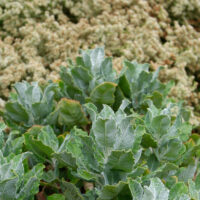
Eriogonum giganteum
Native to the Channel Islands of Southern California, this buckwheat can grow to be a very large mounding shrub with gray felted leaves, 4 - 5 ft. tall and wide. The flower stalks have large, flat sprays of cream-colored to pale pink flowers in summer and are prized by arrangers of dried bouquets. Flowers are attractive to bees and butterflies and birds enjoy the seeds. Best in sunny well-drained sites. Drought tolerant but in hot inland situations they look best with occasional deep waterings in summer.
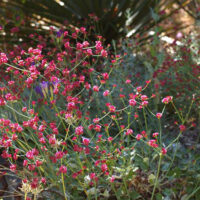
Eriogonum grande var. rubescens
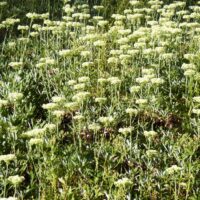
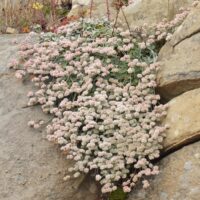
A small, colorful, and highly ornamental native perennial for a sunny spot. Low mounds of grey-green foliage feature flower stems up to a foot tall with rounded heads of intense rosy-pink. Buckwheats have substantial wildlife value, providing pollen and nectar for bees and butterflies, larval food for butterflies, seeds for birds and cover for many creatures. Drought tolerant once established and appreciates decently draining soil. An excellent rock garden plant.
Eriogonum latifolium
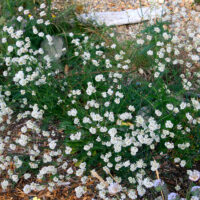
Native to our coastal bluffs, this perennial forms neat mounds of silvery white foliage under 1 ft. tall. Flowers develop in dense pom-poms and are creamy white to pinkish. Tolerates sun, wind and drought once established but needs decent drainage. Provide occasional summer irrigation to keep them looking their best. Buckwheats have substantial wildlife value, providing pollen and nectar for bees and butterflies, larval food for butterflies, seeds for birds and cover for many creatures. Deer resistant.
Eriogonum nudum
Few natives are as excellent a source of nectar for bees and butterflies as the buckwheats. This widely distributed species is known for its elegant flower displays on naked stems rising one to three feet above low mounds of grey-green leaves. Naked buckwheat has flower pom-poms ranging in color from white to pink set on slender stems in open clusters up to twelve inches wide. Blooms from late spring into early autumn. Provide full sun to very light shade in soil with decent drainage. Drought tolerant once established. Generally deer resistant.
Eriogonum nudum – robust form
This buckwheat came to us by way of Ginny Hunt and her seed company Seedhunt. Collected from a local race (Santa Cruz area) of naked buckwheat where the flower stems rise to 5 foot or more! Naked buckwheat is the most widely distributed species of buckwheat, growing throughout the state. Forms low mounds of foliage with tall, slender, naked stems, topped with clusters of white to pinkish pom-poms. Plant in full sun to very light shade with good drainage. Drought tolerant once established. Important pollinator plant. Said to be deer resistant.
Eriogonum parvifolium ‘Moss Landing’
Native to coastal bluffs of the central and south coast. Forms a mounding shrub 2 ft. or more tall by 2 – 3 ft. wide with thick, dark green, triangular shaped leaves often with a reddish tinge, and white and woolly beneath. Round pom-poms of white to pink flowers over a long period late spring and summer, fade to an attractive russet brown. A natural for coastal areas where it grows fast in full sun with good drainage and is very drought tolerant once established. Inland, a little afternoon shade is recommended. Looks great on slopes or draping over walls. An important pollinator plant, appealing to a wide array of insects. In its native range, the rare and endangered El Segundo blue butterfly relies exclusively on this species in all stages of its life cycle. Deer tolerant.
Eriogonum vimineum
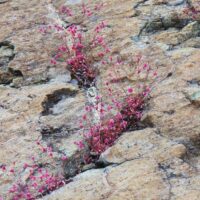
Here is an ANNUAL buckwheat found throughout much of California, growing on gravely and volcanic soils. Summer brings showy domes of rose-pink flowers held on wiry stems 18 inches above small clumps of basal leaves. Buckwheats are excellent for attracting beneficial insects providing pollen and nectar for bees and butterflies and seeds for birds. Plant in full sun with little water once established. Good container plant too.
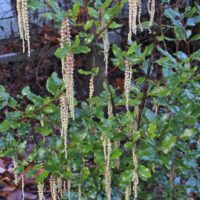
Garrya issaquahensis ‘Pat Ballard’
An elegant winter flowering shrub, uncommon in the trade. A hybrid between Garrya elliptica and Garrya fremontii, 'Pat Ballard' is a tough evergreen growing 6-10 foot tall and wide. Pendulous pinkish gray catkins dangle from the branch tips in winter providing a spectacular display. Plant in full sun to part shade with occasional to infrequent water once established. More cold & drought tolerant than Garrya elliptica. An excellent screen, hedge or foundation shrub, amenable to pruning. Somewhat deer resistant.
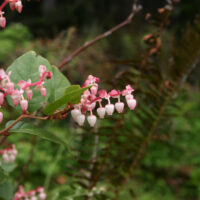
Gaultheria shallon
A handsome evergreen shrub, happiest in fog shrouded coastal zones. Large, leathery, dark green leaves are a gorgeous foil to the loose clusters of white to pinkish urn-shaped flowers. Fat, blue-black berries follow and are relished by wildlife and eaten by people too. Salal can grow tall in moist coastal areas of the Pacific Northwest but usually forms a ground cover 2 - 4 ft. tall and spreading in California. Best with some shade and acidic, humus-rich, moist soils. The foliage is prized for flower arranging. Deer resistant.
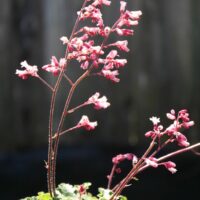
Heuchera ‘Canyon Duet’
A Santa Barbara Botanic Garden selection, part of their Quartet Series of hybrids. This charming, diminutive coral bells forms low, sturdy clumps of small rounded leaves slowly spreading to about 10-12 inches wide. Bi-colored flowers of dark pink and white rise 12 to 18 inches above the dense foliage in spring and early summer. Heuchera's require good light to bloom well but resent full sun, especially inland. Moderate to occasional water. Excellent small scale perennial for mixed border, edging or rock garden. Good container subject too.
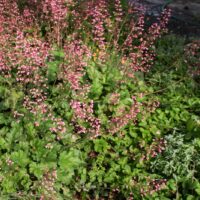
Heuchera ‘Old La Rochette’
Here is a wonderful, often hard to find Heuchera hybrid. Grows into robust clumps of rounded leaves to around 1 ft. tall and 1 - 2 ft. wide. 2 ft. tall flower stalks carry hundreds of soft pink blossoms in the spring, and often intermittently through the summer. Sturdy perennial for part shade and a little summer water. This species attracts hummingbirds.
Heuchera ‘Rosada’
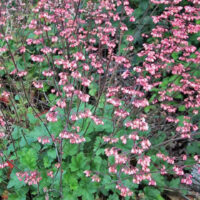
Listed as one of U.C. Davis Arboretum’s “All Stars”, this heuchera hybrid is tough and dependable. Forms an attractive mound of evergreen foliage 10 - 12 inches tall. A long display of tall flower stems covered with creamy-pink dainty bells begin in the spring and often continue into the summer. Best with part shade and moderate to occasional summer water. Attracts hummingbirds.
Heuchera ‘Santa Ana Cardinal’
An outstanding hybrid that is vigorous and free flowering. Compact clumps of foliage topped with 2 ft. tall flowering stems with vibrant rose-red blossoms over a long period. Plant in cool full sun to light shade with moderate to occassional summer water once established. This species attracts hummingbirds.
Heuchera hirsutissima
This miniature alumroot is the perfect addition to the lightly shaded rock garden or along the edge of a path. Pinkish-white, dainty flowers sit atop short stems only about 4 inches tall in spring and summer. The little 2 inch mounds of dark green leaves slowly spread to form tiny drifts. Provide good drainage and moderate irrigation. An excellent plant for a rock crevice or container where it can be combined with Idaho fescue, Erigeron 'Olga' or leather fern. This species comes from the San Jacinto and Santa Rosa mountains of southern California.
Heuchera maxima
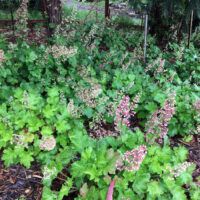
Native to the Channel Islands, this is one of the most adaptable and vigorous of the alum roots, forming broad evergreen mounds of bright green folilage 1 - 1 1/2 ft. high. Maroon flower stems are 3 ft. high topped with pink blushed creamy flowers that have a slight green haze. Best with part shade and a little summer water, but will tolerate full sun close to the coast. Good for use under oaks. This species attracts hummingbirds.
Heuchera micrantha ‘Martha Roderick’
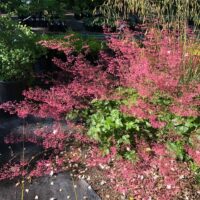
Here’s a pink flowered form of the normally white flowered native alum root. Foliage forms handsome clumps topped with slender stalks 1 - 1 1/2 ft. tall of tiny pink flowers. Excellent in woodland setting for border, slope or rock garden. Drought tolerant but best with a little water. This species attracts hummingbirds.
Heuchera pilosissima
Native to the coast from Mendocino to Santa Barbara Counties, this perennial forms compact, evergreen clumps of light-green scalloped leaves. Stocky flower stems 12 – 16 inches long carry small white-pink flowers in early summer. Perfect in coastal areas where it can grow in sun to light shade and will be drought tolerant once established. Must have part shade and some summer water inland. Plant in mass for a nice ground cover in a woodland setting or in mixed plantings with shrubs and ferns. Attracts hummingbirds.
Heuchera rubescens
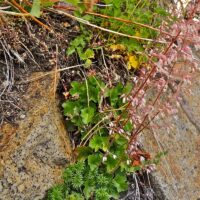
The pink alumroot stands out with bell-like flowers of pink and white held in clusters on slender stems up to 1 ft tall. The round, scalloped leaves form low, dense mats up to 1 1/2 ft wide and about 6 inches high. This western mountain dweller looks beautiful in a rock garden but will do well in any situation with part shade and good drainage. Needs moderate to occasional irrigation once established. Attracts hummingbirds. Great in a container.