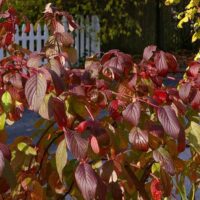
Cornus sericea
Redtwig dogwood is a spreading shrub growing 6 ft. or more tall and at least as wide, forming broad thickets along creeks and rivers. The beautiful red stems stand out in the winter landscape once they loose their leaves in the fall. Flat topped flower clusters are creamy white and are followed by clusters of white fruits. Often takes on nice fall color before loosing its leaves. Plant in full sun to light shade with regular to moderate watering. Does great on heavy clay soils and is a very good soil stabilizer. An excellent habitat plant where it provides food and cover. The fruits are very popular with birds. At the nursery, bluebirds and mockingbirds compete aggressively for the fleshy white fruits.
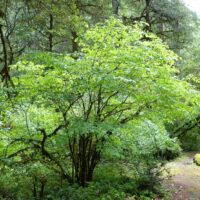
Corylus cornuta ssp. californica
Western hazelnut is a handsome, open, multi-stemmed shrub native to forests from Santa Cruz northwards in the Coast Range, and from Sequoia northwards in the Sierra foothills. Winter deciduous with decorative dangling catkins in winter. The soft, somewhat hairy leaves turn yellow in the fall. Small amounts of tasty nuts are produced in late summer and are relished by wildlife and people. Part shade with some moisture, but will tolerate fairly dry conditions once established. Usually grows 6 - 10 ft. tall. Somewhat deer resistant.
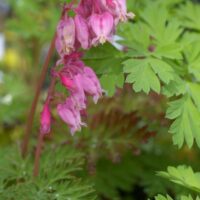
Dicentra formosa
Ferny foliage makes a lacy groundcover in shady areas. Clusters of pendulous, pink, heart-shaped flowers in spring and into summer. Will spread rapidly when happy, enjoying moist but not soggy woodland conditions. Tolerates dry shade where it goes dormant with drought. Early nectar source for hummingbirds and bumble bees. Deer resistant.
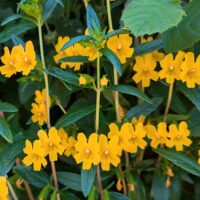
Diplacus (Mimulus) aurantiacus
Sticky monkeyflower is the native monkeyflower species that brightens the hills and coast around Sonoma County. From spring through summer, its profuse yellow-orange tubular flowers decorate evergreen foliage reaching 2-4 feet tall and wide. An unbeatable habitat plant that is highly attractive to hummingbirds. Give it good drainage and keep on the dry side. Thrives in full sun near coast with light shade inland, and benefits from light annual trimming. A larval food source for the common checkerspot and buckeye butterflies. Deer resistant.
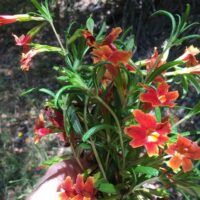
Diplacus (Mimulus) aurantiacus ‘Freezeout Creek’
This stand-out form of our local native monkeyflower was found growing on a slope near a lush redwood forest in western Sonoma County. Instead of the more typical yellow-orange, the trumpet-shaped flowers of 'Freezeout Creek' are larger and boast velvety red petals edged with gold. Monkeyflowers are evergreen sub-shrubs, that grow 2 -4 ft. tall, and bloom profusely in the late spring and into summer. Plant in full sun on the coast to light shade inland and give it decent drainage. Drought tolerant once established but responds to occasional summer water, especially when blooming. Benefits from annual pruning and pinching. The flowers are pollinated by bees and hummingbirds and are a host plant for checkerspot and buckeye butterflies. Deer resistant.
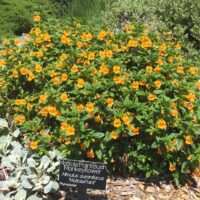
Diplacus (Mimulus) aurantiacus ‘Mattole Point’
Found along the Lost Coast near the mouth of the Mattole River by Mark Moore of the Humboldt Botanic Garden, this fine selection of our native sticky monkeyflower has particularly beautiful evergreen foliage and a compact habit with glossy, dark-green, deeply veined leaves. The abundant orange, tubular flowers are tucked into the dense foliage which grows 2 ft. or so tall and wide. Plant in full sun on the coast to light shade inland and provide good drainage and occasional summer water. Hummingbirds and bees use the flowers and it is a larval food source for checkerspot and buckeye butterflies. Deer resistant.

Diplacus (Mimulus) aurantiacus ‘Rodeo Gold’
This form of sticky monkeyflower offers warm yellow tubular flowers with a golden throat, rather than the more usual orange flowers. This Cal Flora Nursery selection was found in southern coastal Marin County. Evergreen foliage grows roughly 3 ft. tall and wide. Benefits from pinching back of older stems to keep it denser. Plant in full sun on the coast to part shade insland, and provide with occasional summer water. Monkeyflowers are attractive to hummingbirds, butterflies and other pollinators. The checkerspot and buckeye butterflies use it as a larval food source. Deer resistant.
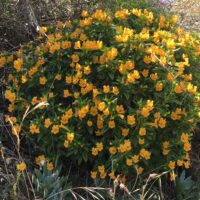
Diplacus (Mimulus) aurantiacus ‘Russian Gulch’
From the bluffs of the Sonoma Coast comes this beautifully compact form of sticky monkeyflower. The shiny, evergreen leaves are spaced to form a tight mound, 2 ft or so tall and wide. From late spring into autumn, cheerful, orange, tubular flowers cover the dense foliage. Makes a colorful, drought-tolerant addition to the garden where it can grow in full sun on the coast to part shade inland. Benefits from pinching to form a strong framework to support the flower display. Requires good drainage and responds to occasional watering, but resents drip irrigation systems that deliver water on a regular basis. Hummingbirds and bees relish the flowers and it is the larval food source for checkerspot and buckeye butterflies. Deer resistant.
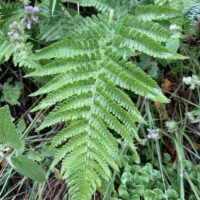
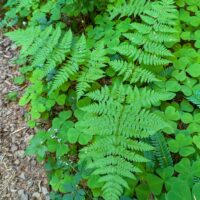
Dryopteris expansa
A very elegant native fern, with soft, bright green, finely divided fronds and a gently arching form. Rarely offered in California nurseries. Mature plants reach up to 3’ tall and wide, make them suitable for most garden spaces. Grows in moist, shady woodlands, mostly along our coast, from the Central Coast north to Alaska. Winter deciduous. Very similar to the lady fern, but with triangular-shaped fronds, not diamond-shaped. Said to be deer resistant.
Dryopteris filix-mas
The male fern is a beautiful, large, deciduous fern, native to much of Europe, Asia as well as North America, where it is uncommon in California. Large and slightly arching, the medium green fronds can reach 3 ft. tall and form a sizable clump. This fern increases slowly from stout rhizomes making it a fine choice for containers. An excellent addition to the woodland garden where it is easy to grow in part to full shade. Prefers humusy soil, rich in organic matter, though it is adaptable and accommodating. Best with regular to moderate watering. Rabbit and deer resistant.

Epipactis gigantea
Here’s a native orchid that’s easy in cultivation. In time it will form a colony producing many flower stems. Each stem holds several interesting orchid blossoms of subtle orange, coral and green tones 12 - 18 inches tall. Dies back to the ground in winter. Best with decent drainage and regular to moderate moisture (NOT soggy soils) and dappled shade part of the day. Wonderful addition to the woodland garden, around pond or near streams. Good in containers too.
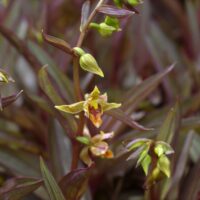
Epipactis gigantea ‘Serpentine Night’
The stream orchid is found in perennial streams, seepages, or other permanently moist places in California. Spreads by runners and will form a colony producing many flower stems. Each stem holds several orchid blosssoms of subtle orange tones 12 - 18 inches tall. The cultivar ‘Serpentine Night’ has wonderful dark purple foliage, emerging in the spring almost black. As the season progresses the color changes to dark bronze then bronzy green. Goes dormant in winter. Best with good light but may need afternoon shade in hot areas. Easy to grow with regular to moderate water. Excellent in containers.
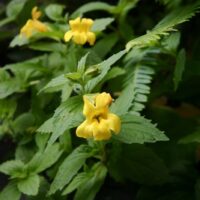
Erythranthe (Mimulus) dentata
Native to coastal streams and wet shady places in Humboldt and Del Norte Counties, north to British Columbia.Handsome bright green leaves with toothed margins,6-15 inches high spreading by slender rhizomes to form perennial patches.Late spring and summer brings funnel shaped bright yellow flowers with tiny red dots in the throat, which bloom over a long period. Excellent for any moist shady spot where the cheerful blossoms brighten. A good container plant too.
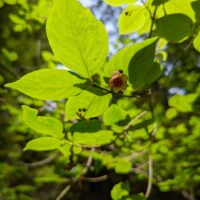
Euonymus occidentalis
Native to moist canyons, the uncommon western burning bush features small, burgundy flowers in the spring followed by dangling orangey-red fruits. The subtle appeal of this medium sized, deciduous shrub will please those native plant enthusiasts looking for a rare find. Reaches a height and width of about 8 ft. in most garden settings and is amenable to pruning. Plant in part shade to full shade. Enjoys moist situations but may become tolerant of drought in shadier locations. Needs good drainage.
Festuca occidentalis
Western fescue has a wide distribution in western north America, largely found in low to mid elevations of Central California north to British Columbia. Native to conifer, oak and mixed evergreen woodlands where it grows in light shade. Forms dense tufts of fine evergreen foliage 6-12 inches tall. Delicate flower panicles on stems rise 2 ft. or so above the blades in early spring or summer. A nice accent in lightly shaded areas with decent drainage and some summer moisture. Deer resistant.
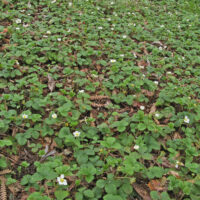
Fragaria vesca
This native woodland strawberry is a great colonizer and can cover a lot of ground in a hurry. Pretty little white flowers are followed by small, tasty, red berries. Tolerates drought but best with a little summer water. Well suited for under oaks and conifers. Said to be deer resistant.
Fragaria vesca ‘Montana de Oro’
A vigorous, heavy blooming selection of woodland strawberry from a coastal canyon at Montana de Oro in San Luis Obisbo County. This easy to grow, carpet forming, ground cover is a great colonizer and stabilizer for lightly shaded areas. Deals well with root competition and thin soils. Pretty little white flowers are followed by small, tasty, red fruits. Often deer resistant.
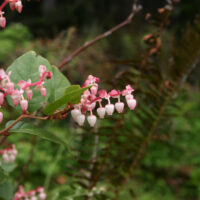
Gaultheria shallon
A handsome evergreen shrub, happiest in fog shrouded coastal zones. Large, leathery, dark green leaves are a gorgeous foil to the loose clusters of white to pinkish urn-shaped flowers. Fat, blue-black berries follow and are relished by wildlife and eaten by people too. Salal can grow tall in moist coastal areas of the Pacific Northwest but usually forms a ground cover 2 - 4 ft. tall and spreading in California. Best with some shade and acidic, humus-rich, moist soils. The foliage is prized for flower arranging. Deer resistant.
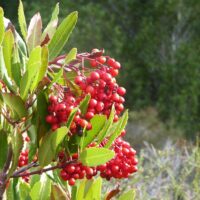
Heteromeles arbutifolia
Toyon is a handsome native evergreen shrub 6 - 10 ft. tall and wide. Sun to part shade, drought tolerant. Clusters of lacy white flowers bloom in summer and areattractive to pollinators. Spectacular bundles of red berries are relished by birds and are a great winter decoration. Valuable as a specimen, screen, hedge or bank plant. Birds attracted to the fruit include the following species: Cedar waxwing, California towhee, spotted towhee, Western bluebird, robins, mockingbirds, bandtailed pigeon, waxwing and quail.
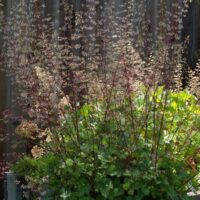
Heuchera micrantha
This is our common alum root which is usually seen on shady cliffs and roadbanks adjacent to forests. Easy to grow in garden situations. Forms low mounds of foliage topped with dainty white flowers on long stems. Likes moisture, but tolerates considerable drought and takes deeper shade than most Heuchera species. This species attracts hummingbirds.
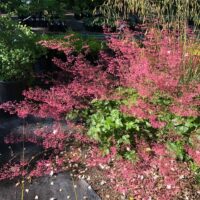
Heuchera micrantha ‘Martha Roderick’
Here’s a pink flowered form of the normally white flowered native alum root. Foliage forms handsome clumps topped with slender stalks 1 - 1 1/2 ft. tall of tiny pink flowers. Excellent in woodland setting for border, slope or rock garden. Drought tolerant but best with a little water. This species attracts hummingbirds.
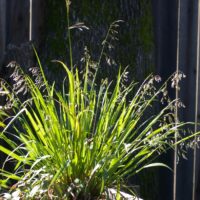
Hierochloe (Anthoxanthum) occidentalis
Here is an interesting and elegant grass native to coniferous forests. Broad, bright green, sweetly scented blades grow a foot or more tall. Flowering culms rise another 6 inches or so above the foliage with tight panicles of spikelets. The leaves offer a sweet, vanilla fragrance when dried. Excellent for woodland gardens, compatible with many redwood forest plants. Best with some summer water, but is drought tolerant near the coast. A larval host for the Western branded skipper butterfly. Deer resistant.
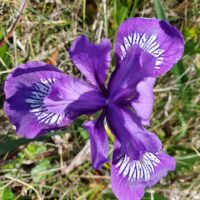
Iris douglasiana
Native to the California coast from Santa Barbara to Oregon. Grows both on the edge of coastal forests and on bluffs and prairies along the ocean. Clumps of evergreen, sword-shaped leaves increase readily and are topped with violet-purple blossoms early to mid spring. Important nectar producer for native bees. An adaptable garden subject for cool full sun to light shade. Drought tolerant once established, but occasional summer water will help keep foliage fresher. Deer resistant.
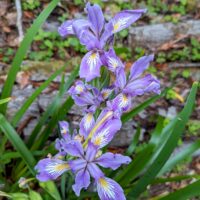
Iris douglasiana – Robust Form
We discovered this incredibly striking form of the popular Douglas iris near Tannery Gulch, outside of Occidental. The dark, evergreen leaves reach up to an astounding three feet in height, and are exceptionally broad. Even though these are grown by seed, the flowers are a dependable lavender-blue, with sprays of white and yellow, held on tall stalks reaching up to a foot above the foliage! Grows well in dappled shade in hotter areas, but can take full sun where there is coastal influence. While drought tolerant, occasional deep soaks keep them looking verdant and vigorous. Deer and gopher resistant.
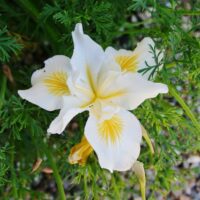
Iris douglasiana ‘Canyon Snow’
A dependable and floriferous selection of the native Douglas iris, with springtime flowers that are pure white with yellow markings on the falls. Broad shiny blades are mostly evergreen and grow a foot or more tall and form compact clumps. Plant in sun to part shade, particularly in hot inland areas, with moderate to little summer water. Prefers good drainage but will grow well on clay soils provided they are mounded up. Too much summer water on heavy soils will prove fatal. Deer resistant.
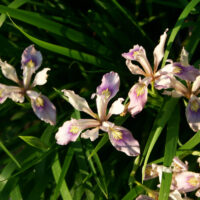
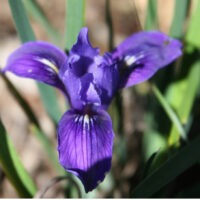
Iris macrosiphon
A widespread and variable species growing throughout Northern California’s coast ranges and Sierra Nevada foothills. Our crop is grown from seed collected in western Sonoma County which has lovely lavender-blue blossoms April through May. Forms small clumps of narrow and slightly arching blades under 18 inches tall. Often found on wooded slopes, in openings or edges of forests where it will form small patches. Prefers good drainage, drought tolerant, or just a little summer moisture. Deer resistant.
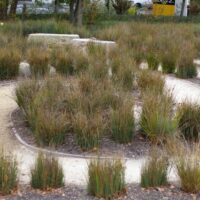
Juncus patens
This handsome evergreen rush provides a striking vertical accent 1-1/2 to 2-1/2 ft. tall with grey-green to grey-blue foliage. Brownish-yellow, tassel-like flowers appear in the spring and early summer. Very adaptable, tolerating a wide range of conditions. Enjoys sun with moisture, but will tolerate dry conditions once established. Accepts moderate shade. Robust root systems are excellent for soil stabilization. Deer resistant.
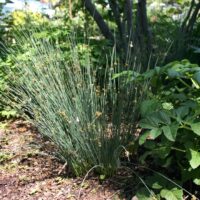
Juncus patens ‘Elk Blue’
Introduced by San Marcos Growers, this form of Juncus patens was selected from the hills southeast of the town of Elk in Mendocino County. Features exceptionally blue foliage and and a vigorous spreading habit. This selection is shorter than the typical grey rush only reaching about 18 inches tall. An adaptable species, will thrive in moist soils, even shallow water but once established tolerates dry conditions too. Grows in sun to moderate shade. An excellent accent plant with its stiff, vertical foliage. Deer resistant.