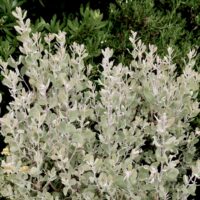
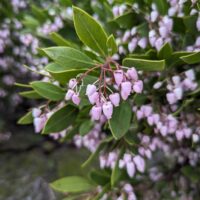
Arctostaphylos stanfordiana
One of the most beautiful of manzanitas with handsome dark mahogany bark, dense shiny green leaves and flowers ranging in color from intense pink to white. Its upright form ranges in height from 4 to 8 ft with a somewhat narrower width. Native to warmer areas of northern California's Coast Range, this species requires excellent drainage, full sun and NO water once established.
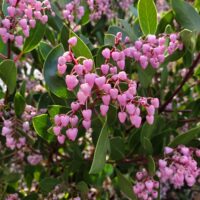
Arctostaphylos stanfordiana ‘Sonoma’
Masses of deep pink flowers and glossy, deep green leaves are an enticing feature of this uncommon selection. But what really distinguishes this cultivar from other Stanford manzanitas is the fact that it actually survives in the garden! Most other selections of this species are notoriously challenging to keep alive in cultivation. While fairly slow growing, the dense foliage mounds up over time to reach a height and width of about 5 ft. The striking burgundy-red trunks contrast nicely with the green leaves. Needs full sun and excellent drainage. No summer water once established.

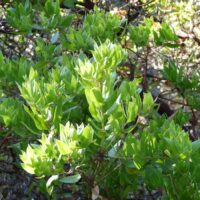
Arctostaphylos x media ‘Humboldt Mystery’
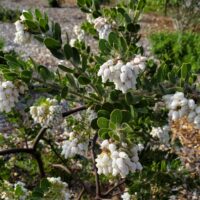
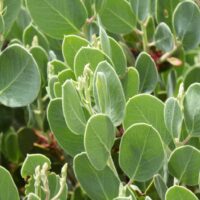
Arching branches and a mounding habit up to 6 ft. tall and 8 ft. wide distinguish this manzanita from its relatives. In winter, pinkish-white flowers provide nectar for hummingbirds and bees, followed by large, red berries in the autumn. Burnished red trunks display a colorful backdrop to the leathery, large, dark green leaves. Plant in full sun to light shade and provide moderate to infrequent irrigation. James Roof of Tilden Botanic Garden discovered this unusual selection somewhere on the Humboldt Coast, but, true to his enigmatic character, refused to say where he found it. It is believed to be a natural cross between bearberry and the hairy manzanita.
Arctostaphylos x media ‘Peter Ehrlich’
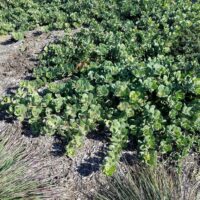
This unusual manzanita from the southern Mendocino coast features what may be the largest leaves of any of the groundcover manzanitas. The round, grey-green foliage mounds densely over time to reach a height of about 3 ft. and a width of up to 8 ft. Clusters of white flowers gather at branch tips in winter, followed by little apple-like fruits in the spring. While fairly adaptable in the garden, decent drainage is best and full sun to light shade. Accepting of moderate irrigation but will become quite drought tolerant once established.
Arctostaphylos x media ‘Reina de Arena’
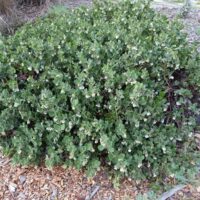
An outstanding selection from a special population of natural manzanita hybrids, holding court on the rugged, fog shrouded, coastal bluffs of Point Arena in Mendocino County. The "Queen" forms a lovely, compact mound of large, rounded, fuzzy leaves, reaching up to about 2 ft. high and at least 6 ft. wide. Elegant, pure white, urn-shaped flowers decorate the branch tips in winter and are an early nectar source for hummingbirds and bumblebees. Plant in full sun to light shade and give moderate to infrequent summer water once established. Plants grown in hot areas will benefit from some afternoon shade and extra irrigation.
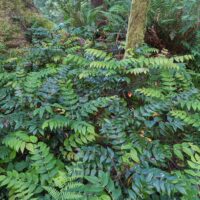
Berberis (Mahonia) nervosa
A handsome species with especially long, leathery, evergreen leaves. Grows to around 2 or more feet tall and spreads by underground stems. Yellow flowers in spring are born in upright clusters, followed by blue berries. Great woodland groundcover for full or partial shade with occasional to regular summer water. Deer resistant. Fruits eaten by robins, finches and towhees. The flowers have nectar for hummingbirds and bees.
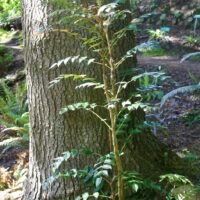
Berberis (Mahonia) nervosa var. mendocinoensis
The rare Mendocino longleaf mahonia comes from moist coniferous forests around Fort Bragg. Differs from the more diminutive longleaf mahonia in its unusual size: growing slowly to 5 ft tall or more and spreading to form narrow colonies. The pointed, leathery, deep green leaves, bronzy orange when young, provide a striking contrast to the bright yellow flower clusters produced in the spring. Attractive deep purple berries are a food source for birds. Needs shade and moderate moisture. Deer resistant.
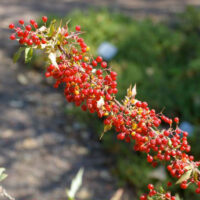
Berberis (Mahonia) nevinii
Nevin's barberry is a very rare southern California shrub with rigidly arching stems densely clothed in pointy silver gray leaflets. Heavy blooming with clear yellow flowers followed by heavy fruiting with bright red translucent fruit. 8 ft. by 8 ft. Does well in sunny well drained locations in the Bay Area. Great companion to matilija poppy and Salvia clevelandii. Very drought tolerant but best with occasional water. Deer resistant.
Brodiaea californica ‘Babylon’
A beautiful selection of a robust species, native to the North Coast Ranges and northern Sierra Nevada. Instead of the more typical lavender-purple colored blossoms, 'Babylon' offers particularly large flowers of pink-lavender. The star shaped flowers are in dense clusters on stout stems up to 24 inches tall. Best in full sun and tolerant of different soil types. Allow to go dry once foliage begins to go dormant. This beauty flowers in late spring/early summer and is favored by butterflies. A good container subject.
Brodiaea elegans
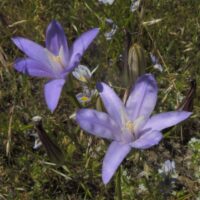
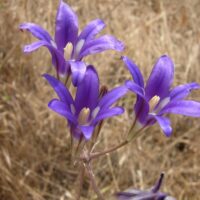
From grassy meadows and open woodlands comes this drought tolerant and colorful wildflower. Open clusters of dainty violet flowers sit atop stems reaching 8 to 20 inches in height. Plant in full sun to bright shade and provide decent drainage. As the name suggests, the harvest Brodiaea is the latest blooming of the Brodiaeas, sometimes not flowering until the end of summer after the grass-like leaves have gone dormant. It spreads rapidly but not invasively to form broad drifts. After blooming, this bulb will sleep until the return of winter rains. Do not irrigate. An excellent candidate for the rock garden where its graceful form will contrast wonderfully with the rigid stone.
Calliandra californica
Clusters of bright red flower filaments, resembling little dusters, adorn this Baja California native for much of the year. The dainty, fern-like leaves are generally evergreen, though they are less ubiquitous in the winter. This mid-sized shrub reaches up to about 5 ft tall over time and spreads to 5 ft wide, forming a loose, rounded mound. Hummingbirds and butterflies favor the flowers on this unusual member of the pea family. Hardy to around 25 degrees. Plant in full sun to light shade and provide occasional to no irrigation once established. Said to be tolerant of clay soils, but will not like flooding.
Calystegia purpurata ssp. purpurata
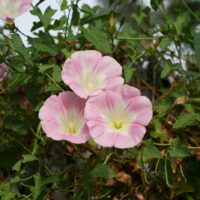
Lush, slender-stemmed vine with gray-green heart-shaped leaves scrambles up, over, or through any support provided. From late spring through early summer the plant is decorated with trumpet-shaped blossoms ranging in color from white to pink to purple. This deciduous vine can grow up to 10 ft. tall and wide. Sun to light shade, most soils, moderate to occasional watering for best appearance. Native throughout the Coast Range of California.
Calystegia purpurata ssp. purpurata ‘Palomarin’
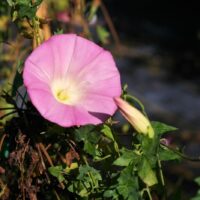
Large flowers which open pinkish-white and darken to a rich lavender distinguish this selection which we discovered near Bolinas in Marin County. This vigorous, deciduous vine spreads quickly to climb over fences and shrubs with clasping stems and grey-green, arrow-shaped leaves. Reaches a height of up to 10 ft. or so and can spread at least as wide. In late spring and early summer, the morning glory flowers put on quite the display, opening at dawn and then closing at dusk. Does great in full sun but also enjoys a little shade, especially in hot, inland areas. Likes moderate irrigation but will become somewhat drought tolerant once established. Hummingbirds and native pollinators are drawn to the flowers.
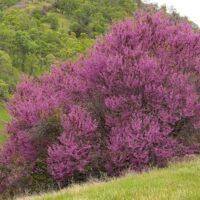
Cercis occidentalis
Beautiful in all its seasons, the native redbud is well worth growing. Highly ornamental multi-trunked shrub or small tree 6 - 20 ft. tall and wide. Masses of brilliant rose-purple blossoms in early spring followed by conspicuous long seed pods that start out lime green and age to purple-brown. The rounded heart-shaped leaves emerge apple green and develop to bluish-green. In colder areas, the leaves take a nice fall color of yellow or red. The smooth silvery-gray branches are picturesque in the winter landscape. Plant in full sun to light shade with good drainage. Drought tolerant. Important nectar and pollen source for bees. Attracts hummingbirds too.
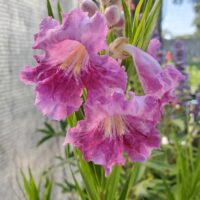
Chilopsis linearis
A graceful, summer-blooming, deciduous shrub, native to desert washes where it grows in gravelly soils and intense heat. Forms a large, multi-branched shrub or small tree reaching up to 15'-20' tall and wide with narrow, willow-like leaves. Terminal clusters of showy, trumpet-shaped flowers in summer come in shades of white, to pink and purple that attract hummingbirds and butterflies. Long, bean-like pods follow and hold on into winter. Enjoys hot climates with plenty of sun, decent drainage and occasional to moderate water. Avoid cool coastal conditions and heavy wet soils. Grows fast when happy with no pest or disease problems, demanding little. A great option for along sidewalks.
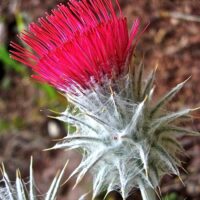
Cirsium occidentale
A beautiful NATIVE and NON-WEEDY thistle. Forms a rosette of gray woolly and spiny leaves the first year. A BIENNIAL, flowering occurs the second year with tall, narrow spikes of showy maroon-red to dark pink flowers with cobweb hairs on the bracts. A striking plant, usually reaching 3 - 6 ft tall when blooming, for sunny areas with good drainage and low to no irrigation. An excellent addition to the habitat garden where it attracts bees, butterflies and hummingbirds. Butterflies such as the painted lady and the mylitta crescent depend on cobweb thistle as a larval food source. Deer resistant.
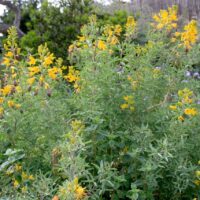
Cleomella (Isomeris) arborea
This distinctive small shrub from Southern California features clusters of golden-yellow flowers with long stamens, giving them a delicate, airy quality. The flowers are followed by papery, lantern-like seed pods which can become almost translucent with age. While this species blooms strongest in the spring, flowers can be seen year-round. Bladderpod has a loose, rounded habit, reaching 4 to 6 ft. tall and wide. If your plant becomes too lanky, simply cut it to the ground to rejuvenate it. Plant in full sun with good drainage and provide infrequent to zero irrigation once established. A great nectar source for hummingbirds, bees and butterflies. Deer resistant.
Previously known as: Peritoma arborea
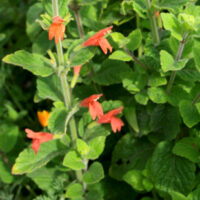
Clinopodium (Satureja) mimuloides
Native to creeksides in the mountains of southern California, this clump forming perennial is rarely seen in cultivation. Growing 2 - 3 ft. tall and wide with soft, fragrant foliage. Orangy-red tubular flowers bloom late spring to early summer and are hummingbird favorites. Plant in sun to light shade with regular moisture.
Comarostaphylis diversifolia
Looking something like a toyon but closely related to manzanita, this handsome evergreen is a useful landscape subject. Native to chaparral communities near the coast in Southern California where it usually grows on north facing slopes. Growing slowly 6-20 ft. tall with shredded red bark and shiny dark green foliage. Creamy-white urn-shaped flowers in racemes bloom March-May are attractive to hummingbirds and pollinators. The dark-red rough textured fruits in summer are enjoyed by many kinds of birds. Grow as an upright shrub or with selective pruning can be trained into a small tree. Useful as a specimen, background screen or informal hedge in full sun to light shade with good drainage. Will except summer water only with good drainage and is drought tolerant once established.
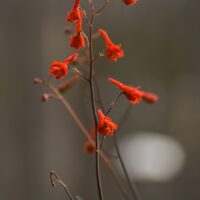
Delphinium nudicaule
In late winter and spring, scarlet flowers with elongated tails perch on upright stalks, usually not more than 3 ft tall. The green, lobed leaves which form a low mound above the ground have a distinctive pale patch in their centers. This native makes its home on summer-dry slopes throughout much of Northern California and parts of Central Ca., inhabiting bright, open woodlands and rocky road cuts. Needs good drainage and little to no irrigation in the summer. While it can grow in a fair amount of shade, it blooms best under a bright, dappled canopy. A favorite of hummingbirds and butterflies. All parts are poisonous if ingested.
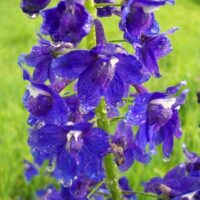
Delphinium trolliifolium
Towers of dense, blue purple flowers reaching up to 4 ft high make this one of our most striking native larkspur. The robust stalks rise above elegantly cut leaves featuring an appealing matte finish. The new leaves emerge in winter after a summer/fall dormancy, followed by the stunning floral display in early spring. Native to the northwest corner of our state, where it grows in oak woodlands, bright, coniferous forests and coast chaparral. Enjoys moisture in the winter and spring, but should be allowed to go somewhat dry in the summer when dormant. Provide light shade away from the coast. Attractive to butterflies and hummingbirds. All parts are poisonous if ingested.
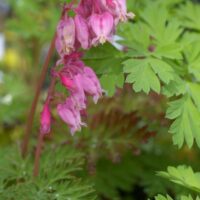
Dicentra formosa
Ferny foliage makes a lacy groundcover in shady areas. Clusters of pendulous, pink, heart-shaped flowers in spring and into summer. Will spread rapidly when happy, enjoying moist but not soggy woodland conditions. Tolerates dry shade where it goes dormant with drought. Early nectar source for hummingbirds and bumble bees. Deer resistant.
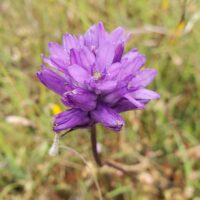
Dichelostemma congestum
A perennial wildflower with rounded, purple flower clusters held atop slender, naked stems. In late spring and early summer, the cheerful floral umbels rise 2 to 3 feet above low, grass-like leaves. Native to hillside grasslands and mountain meadows throughout western North America, this wild hyacinth species is taller than its Brodiaea relatives, with larger inflorescences than the similar blue dick. Usually spreads slowly by corms and seed to form colonies. An excellent nectar plant for the dry borders of pollinator gardens, alongside other native bulbs, and in meadow plantings. Plant in full sun to light shade with decent drainage. Water minimally and leave dry during summer dormancy.