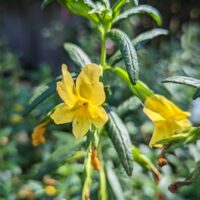
Diplacus (Mimulus) calycinus
From central and southern California, this species is similar to our local sticky monkeyflower but has large, creamy-yellow, trumpet-shaped flowers. Grows 2 - 3 ft tall, and at least as wide, and flowers from late spring through summer. For sun to light shade with good-draining soils and occasional summer water. Flowers attract hummingbirds, bees and butterflies and it is a larval food source for checkerspot and painted lady butterflies. Deer resistant. Previously: Mimulus longiflorus ssp. calycinus.
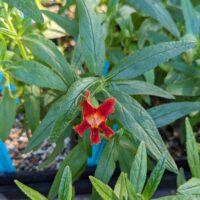
Diplacus (Mimulus) longiflorus
Hummingbirds love the abundant deep red flowers of this stand-out monkeyflower. Hailing from Southern California and growing 2 -3 ft. tall, and at least as wide, this drought-tolerant, floriferous shrublet blooms late spring into fall. Plant in sun to light shade with good drainage and occasional summer water. Besides hummingbirds, other pollinators will be attracted to the flowers, and the foliage is used by checkerspot and painted lady butterfly larvae. Deer resistant.
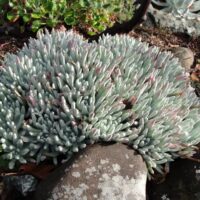
Dudleya ‘Frank Reinelt’
The beautiful and rarely offered Dudleya will form dense mounds 6" - 8" tall with silvery, finger-like leaves, sometimes developing a purple-red blush. Slender stalks appear in late spring and display star-like flowers of soft yellow up to a foot above the foliage. They make handsome specimens in a rock garden or perform as a striking groundcover up to 2' wide mixed with other coastal bluff plants like red buckwheat, seaside daisy, and sea thrift. Great in a container or planted under manzanitas amongst rocks. Needs good drainage and little water once established. Full sun near the coast, but light shade inland.

Dudleya ‘Seedlings from ‘Frank Reinelt’
These seedlings from the beautiful Dudleya ‘Frank Reinelt’ will form dense mounds 6 - 8 inches tall with silvery finger-like leaves. They make handsome specimens in a rock garden or perform as a striking groundcover in mass plantings mixed with other coastal bluff plants like red buckwheat, seaside daisy, and sea thrift. Avoid over-watering and control snails. Full sun to light shade with good drainage.
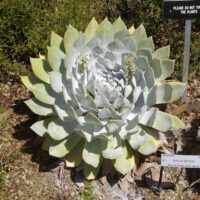
Dudleya brittonii
A Baja California native. Useful and very dramatic in containers or well-drained rock gardens. Likes a protected and sunny microclimate where cold air and winter wet can drain away. Enjoys a little afternoon shade in hotter climates. Develops up to 1 1/2 ft. wide rosettes with fleshy chalk-covered leaves. Yellow flowers sit atop tall stalks in late spring and early summer.
Dudleya cymosa
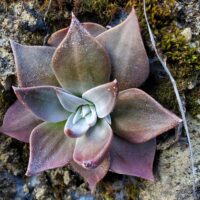
This charming succulent is in native to California where it grows in between rocks on inland cliffs in sun or bright shade. Best in the garden in a rock wall or terra-cotta pot with some afternoon shade. Height in flower is under one foot. The yellow to orange flowers are attractive to hummingbirds. Occasional to infrequent water in the ground. In pots, let dry out between waterings.
Dudleya edulis
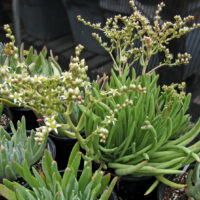
Native to rocky slopes and ledges below 3900’ in Southern Coastal California, the Peninsular Ranges, and Northern Baja California. This Dudleya forms clustering rosettes of dainty, light green, pencil-like leaves. In summer, tall stalks of fragrant, pale yellow flowers rise high above the foliage. Growing about a foot tall (with flowers) by one foot wide. Plant in well drained soil and cool full sun to part shade inland. A delicate accent in a rock garden or amongst coastal plants, also fine in containers. Known as “mission lettuce” for its fleshy raw leaves, once considered a delicacy.
Dudleya farinosa
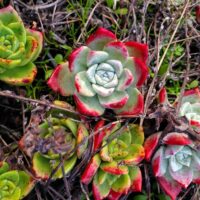
Native to sea bluffs in central and northern California. Rosettes of fleshy leaves are chalky grey or bright green and often red tipped. Candelabra-like clusters of light yellow flowers on thick stalks appear in summer. Provide part shade away from the coast. Excellent for rock garden, walls or containers, where good drainage and a little summer water can be provided.
Dudleya farinosa – Noyo River form
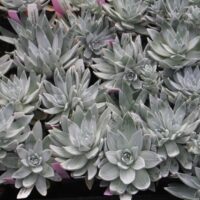
Perched on the cliffs of the Noyo River are beautiful rosettes of bluish-white succulents known as bluff lettuce. This special form from the Mendocino coast was selected by Matt Teel for its small and compact stature, striking color and flat leaves. The foliage reaches a height of about 4 inches and slowly spreads to make small colonies. Yellow flowers sit atop slender pink stalks rising 8 inches off the ground. Provide protection from the afternoon sun in inland sites and plant in well-draining soil. Excellent in containers where it only needs occasional water.
Dudleya pulverulenta
Large, broad, chalky-white leaves forming rosettes up to two ft. wide make this Dudleya one of our most sought-after native succulents. A multitude of tubular red flowers appear in late spring and early summer on stalks reaching from 1.5 to 3 ft. tall. Fleshy, heart-shaped bracts line the stems. Plant in bright shade or provide morning sun and afternoon shade. Needs excellent drainage and infrequent irrigation. Plant at an angle to prevent water from gathering around the base in winter. A gravel mulch around the plant can help stabilize soil temperature and prevent excessive dehydration. Good container plant.
Epilobium ‘Bert’s Bluff’
A Las Pilitas Nursery selection, named for the founder, Bert Wilson. This California fuchsia sports grey foliage, growing 2 -3 foot tall and spreading. Blooming in late summer, the bright orange-red, tubular flowers are beloved by hummingbirds, but visited by bees as well. This cultivar is reputed as being particularly tolerant of a wide range of soil conditions and growing environments. Plant in full sun with occasional deep summer watering.
Epilobium ‘Chaparral Silver’
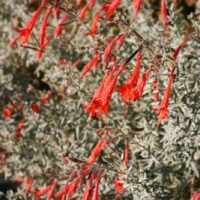
This California fuchsia that we obtained from another grower appears to be identical to our ‘Roger’s U. C. Hybrid’ - same lovely gray foliage 12 -18 inches tall, spreading, with narrow red tubular flowers that the hummingbirds love. Provide full sun to bright shade. Flowers best with occasional deep watering. Pruning plants down to a few inches in late autumn helps to rejuvenate them for the following year.
Epilobium ‘Roger’s U.C. Hybrid’
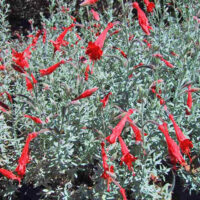
A California fuchsia that is upright in habit with narrow silver-gray foliage and slender trumpet-shaped blossoms of orange-red. Reaches a height of about 1 1/2 ft. and spreads easily. Very similar to the selections ‘Carman’s Gray’ and ‘Chaparral Silver’. Flowers best with occasional deep watering. Hummingbird favorite. Pruning plants down to a few inches in late autumn helps to rejuvenate them for the following year.
Epilobium ‘Schieffelin’s Choice’
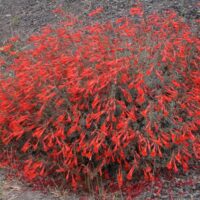
This California fuchsia grows close to the ground - 10 - 12 inches tall with arching flower stalks. Gray foliage makes a wonderful foil for the bright orangey-red tubular flowers which appear summer through fall. Believed to be a cross between E. septentrionale and E. canum. Provide full sun to very light shade. One of the more drought tolerant selections but flowers best with occasional deep watering. Hummingbird favorite. Pruning plants down to a few inches in late autumn helps to rejuvenate them for the following year. Perhaps more deer resistant than other California fuchsias.
Epilobium canum ‘Bowman’s Hybrid’
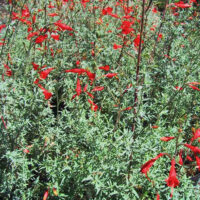
This California fuchsia has distinctive narrow, olive-green foliage and an upright habit about 2-3 ft. tall and spreading widely. The orange-red tubular flowers are petite but profuse. Plant in sunny areas. Flowers best with occasional deep watering. Pruning plants down to a few inches in late autumn helps to rejuvinate them for the following year. Hummingbird favorite.
Epilobium canum ‘Calistoga’
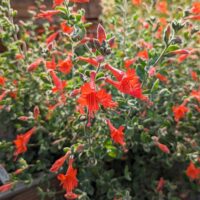
Phil Van Soelen’s selection of California fuchsia from the Palisades east of Calistoga. Forms a spreading mat of unusually wide, fuzzy, gray leaves. The flowers are the typical hummingbird attracting orange-red trumpet shape and appear on stalks reaching up to 18 inches high. For sunny areas. Flowers best with occasional deep watering. Pruning plants down to a few inches in late autumn helps to rejuvenate them for the following year.
Epilobium canum ‘Carman’s Grey’
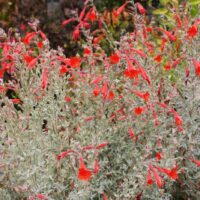
We love California fuchsias and have grown this cultivar for over twenty years. Valued for their beauty and important late season nectar source for hummingbirds, California fuchsias offer many forms and foliage colors. 'Carman's Grey' has gorgeous grey foliage which contrasts beautifully with the masses of orangey-red, tubular flowers, late summer and fall. The grey, narrow leaves form soft mounds 2 foot tall, spreading by underground rhizomes, 4 foot or so wide. Plant in full sun to very light shade where it is tolerant of many soil types, even heavy clay, drought tolerant, but best with occasional summer watering. Hummingbird magnet and bees use it too.
Epilobium canum ‘Catalina’
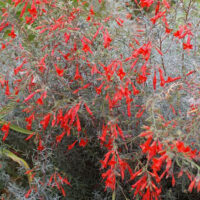
An outstanding selection of California fuchsia growing 3 ft. tall or more. This may be the tallest cultivar available, sometimes reaching as much as 5 ft. tall. The foliage is silvery-gray with an abundance of large, brilliant orangey-red tubular flowers late summer through fall. This species from southern California is particularly drought tolerant. Hummingbird favorite. Flowers best with occasional deep watering. Pruning plants down to a few inches in late autumn helps to rejuvenate them for the following year.
Epilobium canum ‘Cloverdale’
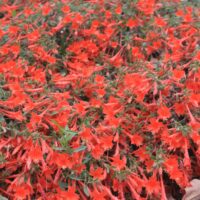
This form of California fuchsia was selected by U.C. Santa Cruz Arboretum from along the Russian River north of Cloverdale. Low, slightly mounding fuzzy olive-green foliage with an abundance of orangey-red tubular flowers the hummingbirds love. Usually stays bellow one ft. in height. 'Cloverdale' is one of the most orange selections of California fuchsia. Plant in full sun. Flowers best with occasional deep watering. Pruning plants down to a few inches in late autumn helps to rejuvenate them for the following year.
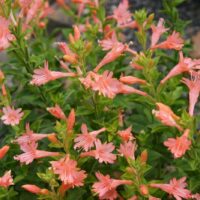
Epilobium canum ‘Coral Canyon’
This elegant and unusual form of the California fuchsia offers a prolific display of peachy-pink flowers, a departure from the more common orangey-red blossoms. The late-summer, autumn blooms are held on distinctly upright stems reaching 1 ½ ft. high above broader, bright green foliage. Unlike most native fuchsias, this selection is somewhat shy to spread, generally forming a rounded mound about 2 ft. wide. Enjoys full sun, but will benefit from a little afternoon shade in hot areas. Likes moderate to occasional irrigation. Hummingbirds and bees partake from the flowers. We must thank Cistus Nursery for discovering the parent plant on a high ridge above the North Fork of the American River.
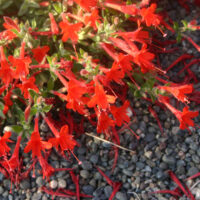
Epilobium canum ‘Everett’s Choice’
A low, spreading form of Californica fuchsia staying below one ft. in height. Distinctive for its fuzzy, gray-green foliage with many scarlet tubular flowers from summer through to fall. Good for sunny areas, though tolerates light shade. Flowers best with occasional deep watering. Attracts hummingbirds. Pruning plants down to a few inches in late autumn helps to rejuvenate them for the following year.
Epilobium canum ‘John Bixby’
A Rancho Santa Ana Botanic Garden introduction, 'John Bixby' is a chance seedling of Epilobium 'Everett's Choice'. Forming a broad patch with a dense rounded form of grey-green foliage 12 -18 inches tall or more. Showy, vivid red-orange tubular flowers put on a spectacular display from summer into fall and are highly attractive to hummingbirds. Vigorous perennial, spreading by underground rhizomes to form large colonies. Plant in full sun to light shade with occasional deep watering for best appearance. Cutting plants down after flowering rejuvinates them for the following year.
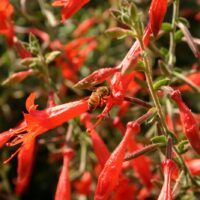
Epilobium canum ‘Liz’s Choice’
This selection of California fuchsia features particularly large, trumpet-shaped, scarlet flowers atop stems reaching 3 ft. tall. The flowers, blooming from summer into fall, are a favorite of hummingbirds and bees. The lance-shaped leaves are a pewter green, providing a striking contrast to the brilliant flowers. It spreads over time to create small colonies. Trim plants down to about 4 inches in winter for vigorous, tidy growth the next year. Provide moderate to infrequent irrigation and full sun. This beautiful cultivar was selected by Milo Baker Chapter CNPS Fellow Liz Parsons.
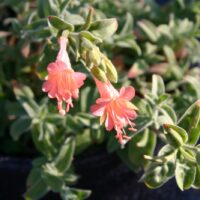
Epilobium canum ‘Marin Pink’
California fuchsias are appreciated for their abundant tubular flowers that bloom in late summer and fall, predominantly in different shades of orange-red. This unusual selection has beautiful PINK tubular flowers produced on sage green mounds of foliage to about 2 ft. tall and spreading by underground rhizomes. Vigorous and easy to grow in full sun to very light shade. Touted as drought tolerant, they will survive dry conditions but will thrive with occasional summer water. Beautiful against a rock wall, in dry stream beds, or naturalistic plantings where they have some room to spread. Hummingbird favorite. Pruning plants down to a few inches in late autumn helps to rejuvenate them for the following year.
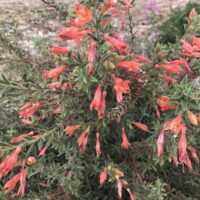
Epilobium canum ‘Sierra Salmon’
California fuchsias have many charms, blooming in late summer into fall with hummingbird attracting, tubular flowers, mostly in shades of red and orange. 'Sierra Salmon' offers unusual salmon-colored blossoms on soft blue-green foliage. This cultivar doesn't tend to wander like some can and forms dense clumps of erect stems 12 - 24 inches tall and wide. Looks wonderful amongst rocks or boulders, in perennial borders or to add pizazz with grass and shrub plantings. Plant in full sun with occasional summer water. Prune down to a few inches after blooms are done.
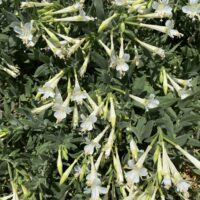
Epilobium canum ‘Summer Snow’
While CA fuchsias are generally known for their abundant showy red flowers, this unusual variety offers surprising clean-white blossoms on low growing green foliage up to 10 inches tall. Spreading by underground rhizomes, this mat forming perennial grows in full sun to light shade with occasional to little summer water once established. Perfect in naturalistic plantings, on slopes amongst boulders, dry creek beds or rock walls. California fuchsias bloom heavily late summer into fall and their tubular flowers are hummingbird favorites. The habit of this plant can be improved with shearing in the winter.
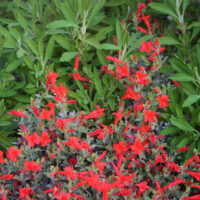
Epilobium septentrionale ‘Select Mattole’
This California fuchsia forms tidy, low, 6 inch high mats of beautiful silver foliage with a matte finish. Late summer through fall brings orangey-red tubular flowers which attract hummingbirds. A somewhat redder flowering selection. Spreading by underground rhizomes, this Epilobium increases a little less vigorously than the others. Full sun to light shade. More shade tolerant than most California fuschias. Needs more water than most Epilobiums. Pruning plants down to a few inches in late autumn helps to rejuvenate them for the following year.
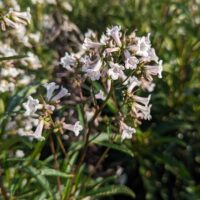
Eriodictyon californicum
Uncommon in the nursery trade, this aromatic, evergreen shrub is native to dry habitats of chaparral and mixed evergreen forest plant communities in North and Central California and into Oregon. An opportunist, this shrub stump sprouts after fires and grows with renewed vigor after any soil disturbance. The dark green, leathery leaves are covered in a shiny, fragrant, resin and are sticky to touch. The common name means, holy herb, and the pungent leaves have a long history of medicinal uses. Grows 3 - 5 ft. tall and spreads by underground roots to form a colony. Late spring brings clusters of small, trumpet-shaped flowers of pale lavender, sometimes white or pale blue, which are highly attractive to butterflies, hummingbirds and bees. Plant in full sun with good drainage and little water once established. Deer resistant.
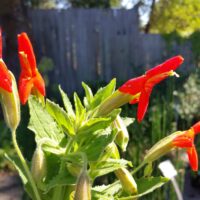
Erythranthe (Mimulus) cardinalis
Native to wet areas throughout the West, this robust perennial can easily grow to more than 2 ft. tall and wide. Tubular scarlet flowers are a hummingbird favorite and are very showy. Plant in sun to part shade with ample water. Perfect beside a pond, stream or water feature. Trim as needed to keep tidy. The flowers provide nectar for hummingbirds.
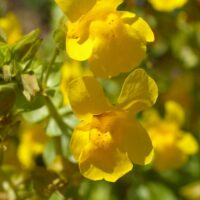
Erythranthe (Mimulus) guttata
This charming monkeyflower is native to wet places throughout the west. Forms mats of bright green foliage topped with flowering stems of cheerful, bright yellow, tubular flower. Needs regular moisture and full sun to light shade. Seeds about when happy. The flowers provide nectar for hummingbirds. Works great in a swale, combined with rushes, Helenium and bee plant.