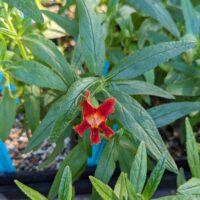
Diplacus (Mimulus) longiflorus
Hummingbirds love the abundant deep red flowers of this stand-out monkeyflower. Hailing from Southern California and growing 2 -3 ft. tall, and at least as wide, this drought-tolerant, floriferous shrublet blooms late spring into fall. Plant in sun to light shade with good drainage and occasional summer water. Besides hummingbirds, other pollinators will be attracted to the flowers, and the foliage is used by checkerspot and painted lady butterfly larvae. Deer resistant.
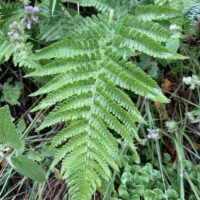
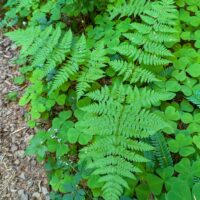
Dryopteris expansa
A very elegant native fern, with soft, bright green, finely divided fronds and a gently arching form. Rarely offered in California nurseries. Mature plants reach up to 3’ tall and wide, make them suitable for most garden spaces. Grows in moist, shady woodlands, mostly along our coast, from the Central Coast north to Alaska. Winter deciduous. Very similar to the lady fern, but with triangular-shaped fronds, not diamond-shaped. Said to be deer resistant.

Dryopteris filix-mas
The male fern is a beautiful, large, deciduous fern, native to much of Europe, Asia as well as North America, where it is uncommon in California. Large and slightly arching, the medium green fronds can reach 3 ft. tall and form a sizable clump. This fern increases slowly from stout rhizomes making it a fine choice for containers. An excellent addition to the woodland garden where it is easy to grow in part to full shade. Prefers humusy soil, rich in organic matter, though it is adaptable and accommodating. Best with regular to moderate watering. Rabbit and deer resistant.
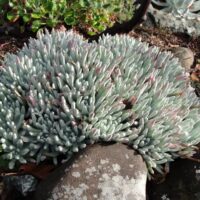
Dudleya ‘Frank Reinelt’
The beautiful and rarely offered Dudleya will form dense mounds 6" - 8" tall with silvery, finger-like leaves, sometimes developing a purple-red blush. Slender stalks appear in late spring and display star-like flowers of soft yellow up to a foot above the foliage. They make handsome specimens in a rock garden or perform as a striking groundcover up to 2' wide mixed with other coastal bluff plants like red buckwheat, seaside daisy, and sea thrift. Great in a container or planted under manzanitas amongst rocks. Needs good drainage and little water once established. Full sun near the coast, but light shade inland.
Dudleya ‘Seedlings from ‘Frank Reinelt’
These seedlings from the beautiful Dudleya ‘Frank Reinelt’ will form dense mounds 6 - 8 inches tall with silvery finger-like leaves. They make handsome specimens in a rock garden or perform as a striking groundcover in mass plantings mixed with other coastal bluff plants like red buckwheat, seaside daisy, and sea thrift. Avoid over-watering and control snails. Full sun to light shade with good drainage.
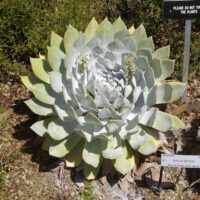
Dudleya brittonii
A Baja California native. Useful and very dramatic in containers or well-drained rock gardens. Likes a protected and sunny microclimate where cold air and winter wet can drain away. Enjoys a little afternoon shade in hotter climates. Develops up to 1 1/2 ft. wide rosettes with fleshy chalk-covered leaves. Yellow flowers sit atop tall stalks in late spring and early summer.
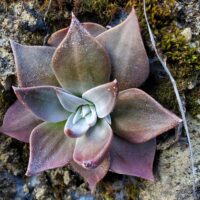
Dudleya cymosa
This charming succulent is in native to California where it grows in between rocks on inland cliffs in sun or bright shade. Best in the garden in a rock wall or terra-cotta pot with some afternoon shade. Height in flower is under one foot. The yellow to orange flowers are attractive to hummingbirds. Occasional to infrequent water in the ground. In pots, let dry out between waterings.
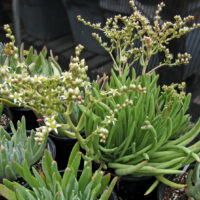
Dudleya edulis
Native to rocky slopes and ledges below 3900’ in Southern Coastal California, the Peninsular Ranges, and Northern Baja California. This Dudleya forms clustering rosettes of dainty, light green, pencil-like leaves. In summer, tall stalks of fragrant, pale yellow flowers rise high above the foliage. Growing about a foot tall (with flowers) by one foot wide. Plant in well drained soil and cool full sun to part shade inland. A delicate accent in a rock garden or amongst coastal plants, also fine in containers. Known as “mission lettuce” for its fleshy raw leaves, once considered a delicacy.
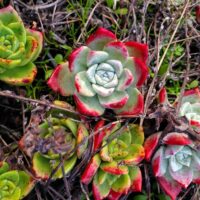
Dudleya farinosa
Native to sea bluffs in central and northern California. Rosettes of fleshy leaves are chalky grey or bright green and often red tipped. Candelabra-like clusters of light yellow flowers on thick stalks appear in summer. Provide part shade away from the coast. Excellent for rock garden, walls or containers, where good drainage and a little summer water can be provided.
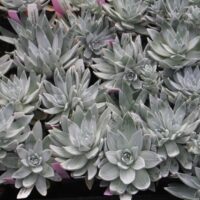
Dudleya farinosa – Noyo River form
Perched on the cliffs of the Noyo River are beautiful rosettes of bluish-white succulents known as bluff lettuce. This special form from the Mendocino coast was selected by Matt Teel for its small and compact stature, striking color and flat leaves. The foliage reaches a height of about 4 inches and slowly spreads to make small colonies. Yellow flowers sit atop slender pink stalks rising 8 inches off the ground. Provide protection from the afternoon sun in inland sites and plant in well-draining soil. Excellent in containers where it only needs occasional water.
Dudleya pulverulenta
Large, broad, chalky-white leaves forming rosettes up to two ft. wide make this Dudleya one of our most sought-after native succulents. A multitude of tubular red flowers appear in late spring and early summer on stalks reaching from 1.5 to 3 ft. tall. Fleshy, heart-shaped bracts line the stems. Plant in bright shade or provide morning sun and afternoon shade. Needs excellent drainage and infrequent irrigation. Plant at an angle to prevent water from gathering around the base in winter. A gravel mulch around the plant can help stabilize soil temperature and prevent excessive dehydration. Good container plant.
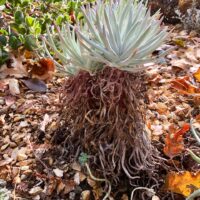
Dudleya virens ssp. hassei
Endemic to Catalina Island, this rare succulent forms chalky-grey rosettes made up of plump fingerlike leaves, 6 inches tall and spreading to form a mat 1 – 2 feet wide. Small white flowers with yellow centers on stems 6 -12 inches tall, bloom in the late spring and are attractive to hummingbirds and other pollinators. Plant in full sun to light shade with occasional deep summer watering. Tolerates heavier soils than most Dudleyas. A dependable small-scale groundcover or container plant.
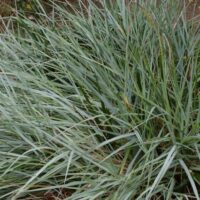
Elymus (Leymus) condensatus ‘Canyon Prince’
A beautiful selection from the Channel Islands off Southern California. Distinctive for the lovely, broad, silver-blue blades 2 1/2 to 3 ft. tall with wand-like grass flowers reaching up to 2 feet above the foliage. Accepts sun to very light shade and moderate to little water. Tolerates heavy soil. Spreads by rhizomes to form striking silver drifts, but is vigorous and aggressive. Best to use where a large patch is desired or where it is contained, such as a parkway strip. Cut back in winter to rejuvenate and remove old leaves. Drought and deer resistant.
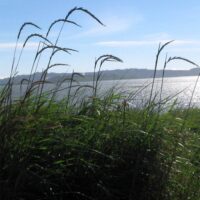
Elymus (Leymus) triticoides
Spreading, turf forming, perennial grass found in somewhat moist areas in many plant communities throughout California. An important restoration species, useful for holding soil and enhancing wildlife habitat value. Growing 2-4 ft. tall and spreading widely with an extensive network of rhizomatous roots which both hold soil and help prevent exotic weed establishment within their dense mats of roots and foliage. Slender blue-green blades are topped with narrow flower spikes 4-6 inches long. Excellent for seasonally moist bottom land and riparian areas where it can grow in full sun to light shade and tolerates many soil types. Will tolerate some drought in heavier soils. May spread too vigorously for small gardens.
Elymus (Leymus) triticoides x ‘Lagunita’
Discovered by grass expert and John Greenlee, who describes it as his personal favorite ground cover grass for meadow installations. Often this species has blue-grey blades and grows tall and floppy, but 'Lagunitas' grows just 10 - 16 inches tall, with rich green blades. This form rarely flowers and is quite adaptable to soil types and watering regimes. The ability to tolerate both wet and dry conditions makes it valuable for areas that seasonally flood like rain gardens. A vigorous spreader, especially when well watered, but is better behaved in dryer sites. Once established, can be maintained with one or two waterings a month, keeping it green and fire safe. Tolerates trimming to about 4 inches, possibly more. Grows in full sun to light shade. Host plant to the Woodland Skipper butterfly.
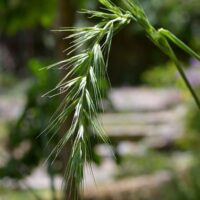
Elymus californicus
California bottlebrush grass is a tall robust grass with broad, bright green blades and nodding brushlike flower spikes. Uncommon in the wild it can be found in coastal counties on shaded banks and wooded areas, including redwood forests. Displays 3 - 6 ft. tall flower stalks with low foliage up to 1 ft. high. Provide moderate to infrequent irrigation. Deer resistant.
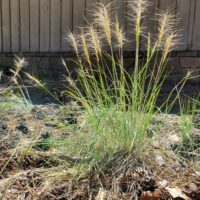
Elymus elymoides
A species of wild rye, this tough, native, widespread, perennial grass, sports distinctive seed heads with a bottlebrush or squirrel tail appearance. Super adaptable and willing to withstand a wide range of soil types and depths. Even tolerates serpentine soils. Able to make a living in full sun where it is extremely drought tolerant. Grows one foot to 18 inches tall with shimmering, purple-toned flower spikes that age to beige, bristly, seed heads. A dependable re-seeder, perfect for sunny, low water using landscapes and erosion control. Host plant for a number of butterfly and moth species including the woodland skipper. Deer resistant.
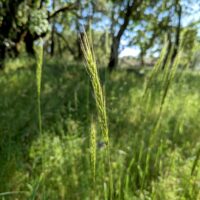
Elymus glaucus
A stiffly upright, clump-forming grass with blue-green blades, native to much of the western U. S.. The flowers form bristle-tipped, narrow, vertical spikes, rising 2-4 feet tall. Easy to grow and a strong reseeder for full sun to light shade. Summer water keeps plants green longer, but will go dormant with drought. This very adaptable grass is excellent for bank stabilization in challenging soils. Deer resistant.
Elymus spicatus
Native to mountainous regions of the western US, where it lives in many plant communities. Grows to around 3 ft. tall with blue-gray blades and blooms in early summer. Narrow flower spikes have long awns that bend at right angles to the stem. Widely used in revegetation for its adaptability where it grows in many soil types, except for high alkalinity or excessive moisture. Plant in full sun to light shade, where it will be drought tolerant once established. Host to a number of butterfly and moth species. Deer resistant.
Epilobium ‘Bert’s Bluff’
A Las Pilitas Nursery selection, named for the founder, Bert Wilson. This California fuchsia sports grey foliage, growing 2 -3 foot tall and spreading. Blooming in late summer, the bright orange-red, tubular flowers are beloved by hummingbirds, but visited by bees as well. This cultivar is reputed as being particularly tolerant of a wide range of soil conditions and growing environments. Plant in full sun with occasional deep summer watering.
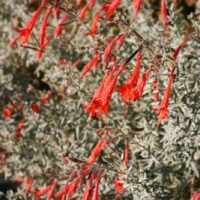
Epilobium ‘Chaparral Silver’
This California fuchsia that we obtained from another grower appears to be identical to our ‘Roger’s U. C. Hybrid’ - same lovely gray foliage 12 -18 inches tall, spreading, with narrow red tubular flowers that the hummingbirds love. Provide full sun to bright shade. Flowers best with occasional deep watering. Pruning plants down to a few inches in late autumn helps to rejuvenate them for the following year.
Epilobium ‘Schieffelin’s Choice’
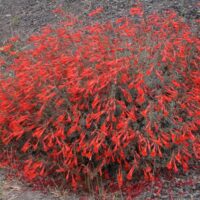
This California fuchsia grows close to the ground - 10 - 12 inches tall with arching flower stalks. Gray foliage makes a wonderful foil for the bright orangey-red tubular flowers which appear summer through fall. Believed to be a cross between E. septentrionale and E. canum. Provide full sun to very light shade. One of the more drought tolerant selections but flowers best with occasional deep watering. Hummingbird favorite. Pruning plants down to a few inches in late autumn helps to rejuvenate them for the following year. Perhaps more deer resistant than other California fuchsias.
Epilobium canum ‘Calistoga’
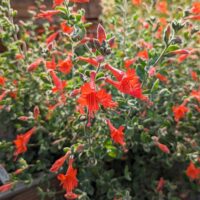
Phil Van Soelen’s selection of California fuchsia from the Palisades east of Calistoga. Forms a spreading mat of unusually wide, fuzzy, gray leaves. The flowers are the typical hummingbird attracting orange-red trumpet shape and appear on stalks reaching up to 18 inches high. For sunny areas. Flowers best with occasional deep watering. Pruning plants down to a few inches in late autumn helps to rejuvenate them for the following year.
Epilobium canum ‘Everett’s Choice’
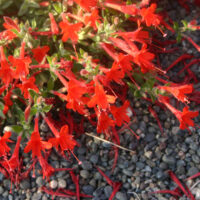
A low, spreading form of Californica fuchsia staying below one ft. in height. Distinctive for its fuzzy, gray-green foliage with many scarlet tubular flowers from summer through to fall. Good for sunny areas, though tolerates light shade. Flowers best with occasional deep watering. Attracts hummingbirds. Pruning plants down to a few inches in late autumn helps to rejuvenate them for the following year.
Epilobium canum ‘John Bixby’
A Rancho Santa Ana Botanic Garden introduction, 'John Bixby' is a chance seedling of Epilobium 'Everett's Choice'. Forming a broad patch with a dense rounded form of grey-green foliage 12 -18 inches tall or more. Showy, vivid red-orange tubular flowers put on a spectacular display from summer into fall and are highly attractive to hummingbirds. Vigorous perennial, spreading by underground rhizomes to form large colonies. Plant in full sun to light shade with occasional deep watering for best appearance. Cutting plants down after flowering rejuvinates them for the following year.
Epilobium canum ‘Marin Pink’
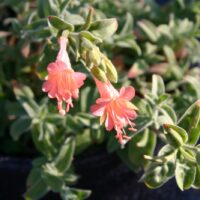
California fuchsias are appreciated for their abundant tubular flowers that bloom in late summer and fall, predominantly in different shades of orange-red. This unusual selection has beautiful PINK tubular flowers produced on sage green mounds of foliage to about 2 ft. tall and spreading by underground rhizomes. Vigorous and easy to grow in full sun to very light shade. Touted as drought tolerant, they will survive dry conditions but will thrive with occasional summer water. Beautiful against a rock wall, in dry stream beds, or naturalistic plantings where they have some room to spread. Hummingbird favorite. Pruning plants down to a few inches in late autumn helps to rejuvenate them for the following year.
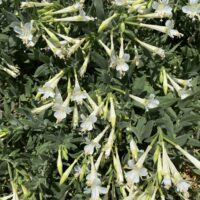
Epilobium canum ‘Summer Snow’
While CA fuchsias are generally known for their abundant showy red flowers, this unusual variety offers surprising clean-white blossoms on low growing green foliage up to 10 inches tall. Spreading by underground rhizomes, this mat forming perennial grows in full sun to light shade with occasional to little summer water once established. Perfect in naturalistic plantings, on slopes amongst boulders, dry creek beds or rock walls. California fuchsias bloom heavily late summer into fall and their tubular flowers are hummingbird favorites. The habit of this plant can be improved with shearing in the winter.
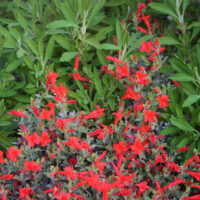
Epilobium septentrionale ‘Select Mattole’
This California fuchsia forms tidy, low, 6 inch high mats of beautiful silver foliage with a matte finish. Late summer through fall brings orangey-red tubular flowers which attract hummingbirds. A somewhat redder flowering selection. Spreading by underground rhizomes, this Epilobium increases a little less vigorously than the others. Full sun to light shade. More shade tolerant than most California fuschias. Needs more water than most Epilobiums. Pruning plants down to a few inches in late autumn helps to rejuvenate them for the following year.

Epipactis gigantea
Here’s a native orchid that’s easy in cultivation. In time it will form a colony producing many flower stems. Each stem holds several interesting orchid blossoms of subtle orange, coral and green tones 12 - 18 inches tall. Dies back to the ground in winter. Best with decent drainage and regular to moderate moisture (NOT soggy soils) and dappled shade part of the day. Wonderful addition to the woodland garden, around pond or near streams. Good in containers too.