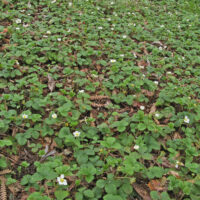
Fragaria vesca
This native woodland strawberry is a great colonizer and can cover a lot of ground in a hurry. Pretty little white flowers are followed by small, tasty, red berries. Tolerates drought but best with a little summer water. Well suited for under oaks and conifers. Said to be deer resistant.

Fragaria vesca ‘Montana de Oro’
A vigorous, heavy blooming selection of woodland strawberry from a coastal canyon at Montana de Oro in San Luis Obisbo County. This easy to grow, carpet forming, ground cover is a great colonizer and stabilizer for lightly shaded areas. Deals well with root competition and thin soils. Pretty little white flowers are followed by small, tasty, red fruits. Often deer resistant.
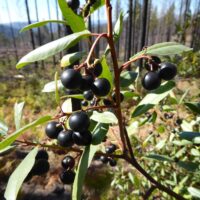
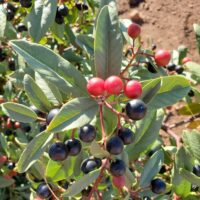
Frangula (Rhamnus) californica – large, inland form
Handsome native evergreen shrub with small greenish-yellow flowers followed by showy dark-colored berries. The propagation material for this this crop was collected from tall, upright shrubs on a hot inland site. Growing 8 ft. or more tall, coffeeberries thrive in full sun to light shade. They are drought tolerant once established, but would appreciate occasional deep summer waterings. A good choice for hedgerows and habitat gardens, coffeeberry provides food and nectar for a wide array of beneficial insects, birds and wildlife.
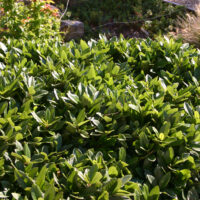
Frangula (Rhamnus) californica ‘Ed Holm’
Prized by gardeners for its low, dense habit and shiny, leathery leaves, this special selection of coffeeberry was discovered along Skyline Dr. in the northern Santa Cruz Mountains. Clusters of small, creamy-yellow flowers are produced from spring through fall and are followed by penny-sized, deep purple fruits. Over time, 'Ed Holm' will reach a height of up to 3 ft. and a width up to 6 ft.. Plant in full sun to light shade. Protect from the hot afternoon sun in hot areas and give moderate to infrequent irrigation. The blossoms are a favorite of bees.
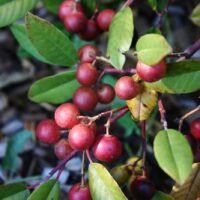
Frangula (Rhamnus) californica ‘Eve Case’
This well-known cultivar of coffeeberry was introduced to the trade in 1975 by the Saratoga Horticultural Foundation. Coffeeberry is a handsome evergreen shrub with broad leathery leaves. This selection grows to 6 ft. tall and wide, though mature specimens can reach 8 ft. or more tall under ideal circumstances. The small yellow-green flowers are not showy but attract an array of pollinators. The berries start out green and age to burgundy-black and are attractive to small mammals and birds. A larval food source for pale swallowtail butterfly. Adaptable, grows in sun to light shade. Drought tolerant but appreciates occasional summer water.
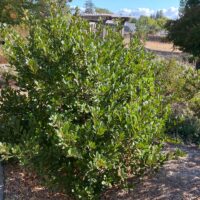
Frangula (Rhamnus) californica ‘Gumdrop’
This somewhat diminutive selection of our native coffeeberry was discovered as a seedling from a plant found on Montara Mountain, south of San Francisco. We thought the dense form and evocative, gumdrop shape was deserving of this sweet moniker. Only reaches to about 5 - 6 ft. tall and wide and offers attractive, slightly-concave, dark green, leathery leaves, not unlike its close relation ‘Leatherleaf’. Will accept full sun in somewhat cooler locations but enjoys a little shade in hotter regions. Occasional to infrequent irrigation once established. The small, yellowish flowers which appear in spring and summer are extremely popular with bees, and the juicy, purple fruits which follow are enjoyed by birds.
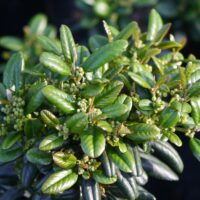
Frangula (Rhamnus) californica ‘Leatherleaf’
Another fine Roger Raiche selection, this coffeeberry cultivar is well worth growing. The evergreen leaves are particularly dark and broad with a mounding habit growing 5 - 6 ft. tall and wide. The tiny flowers attract a wide array of pollinators. Larval food source for pale swallowtail butterfly. The handsome fruits go green to red to black and are enjoyed by small mammals and birds. Plant in sun to light shade. Drought tolerant once established though occasional summer watering is helpful. An adaptable and useful shrub for both formal and naturalistic plantings.
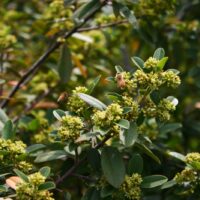
Frangula (Rhamnus) californica ‘Mound San Bruno’
Selected by Roger Raiche on San Bruno Mountain in San Mateo County, this is one of the most reliable coffeeberries. Grows 6 ft tall and wide, with narrow, evergreen leaves and a compact habit. For full sun on the coast to part shade inland. Will tolerate irrigation, but needs only occasional summer water once established. Flowers are loved by pollinators, especially bees. A larval food source for the pale swallowtail butterfly. Provides black juicy fruit in the fall for thrushes, jays, mockingbirds, and robins. May grow to as much as 8 ft. tall with moderate water and good drainage in cooler areas.
Frangula (Rhamnus) californica ‘Olema’
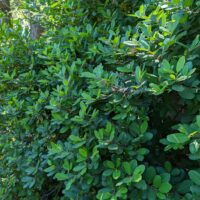
We discovered this large, dense form of our native coffeeberry near the town of Olema in coastal Marin County. While it reached up to around 15 ft. tall and wide in nature, it has been a little slow to do so in the ground here at the nursery. After about 4 years, it’s reached a height of about 9 ft. This selection of coffeeberry is ideal for a tall hedge or screen where an evergreen shrub is needed to create privacy. Grows well in full sun somewhat near the coast but will need a little shade in hot, inland sites. Occasional to infrequent irrigation once established. Coffeeberries are some of the best habitat plants. The small, yellowish flowers are adored by bees in spring and summer, while the plump, purple fruits that follow are relished by birds.
Frangula (Rhamnus) californica ‘Seaview’
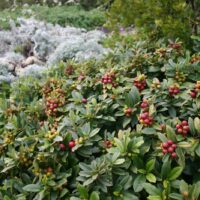
This highly sought after selection of our native coffeeberry stays low and compact only reaching 2 – 3 ft tall and up to 6 ft wide. The tidy, deep green leaves form dense rosettes with small cream-colored flowers appearing from spring through summer. Deep purple “berries” form dense clusters in the summer and fall. Enjoys full sun to moderate shade and moderate to occasional water once established. An excellent habitat plant for bees and birds.
Frangula (Rhamnus) californica ssp. occidentalis
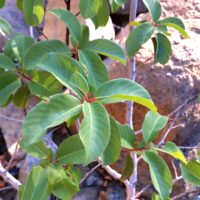
Description coming soon!
Frangula (Rhamnus) californica ssp. tomentella
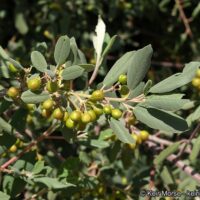
This distinctive species of coffeeberry features blue-grey leaves with velvety, silver undersides and grey, fuzzy stems. The somewhat open form grows 6 to 10 ft tall and wide. Clusters of small cream-colored flowers appear from winter through spring and are a favorite of bees. The deep purple fruits which follow are highly prized by birds. While native to serpentine soils, this coffeeberry should thrive anywhere with decent drainage. Provide full sun to light shade and give occasional irrigation once established. The grey stems contrast beautifully with the shiny, dark green leaves of Ceanothus ‘Yankee Point’.
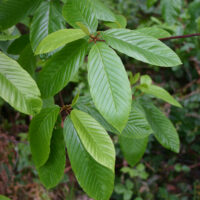
Frangula (Rhamnus) purshiana
Native to moist places from Mendocino County northwards and throughout the Sierra Nevadas, this medium sized deciduous tree is distinctive for its shiny, green leaves with strong venation. Ranges in height from 15 to 30 ft. tall. Bees are attracted to the clusters of small, cream-colored flowers and birds enjoy the dark purple berries which follow. Plant in riparian zones or in areas where it can receive regular moisture. Give full sun to part shade. Requires protection from the afternoon sun in the hottest areas.
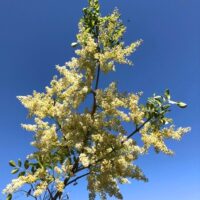
Fraxinus dipetala
This is our only native ash with showy flowers. A large shrub or multi-trunked tree native to slopes, canyons and stream banks in hot interior regions of the state. Grows 7 to 25 ft. tall with pinnately compound leaves. The creamy white flowers are produced on dangling racemes in mid to late spring, followed by pendulous clusters of samara fruits. Like the California buckeye, it loses its leaves early to evade the long dry summer. Grows in sun to partial shade. Drought tolerant once established.
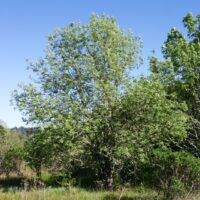
Fraxinus latifolia
Fast growing hardwood tree, native to stream and river banks or other wetland habitats from San Diego to British Columbia. Growing 30 - 70 ft. tall, this deciduous tree has medium green compound leaves. Male and female flowers occur on separate trees and are not particularly showy. They bloom just as the spring foliage is leafing out. Fruits occur on the female trees and are paddle-shaped, single samara-style fruits in drooping clusters. Birds and mammals eat its seed, but probably used more as a nesting site for birds. Plant in sun to light shade with regular to moderate water.
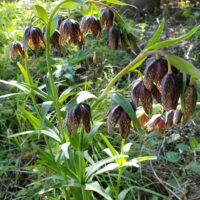
Fritillaria affinis
Charming, spring blooming, bulbous plant in the lily family, with beautiful, pendulous, bell-shaped flowers. This is California's most common fritillary and the most variable, in both size and flower color. Flowers vary greatly and can be yellow-green to purple-brown and may be beautifully checkered with brown and green, sometimes red-purple patterns. Can grow 12 inches - 3 ft tall depending on the habitat and substrate. Native to grasslands, woodlands and chaparral plant communities including serpentine soils. The easiest of the fritillaries to grow, preferring light, well drained soils, sun along the coast to light shade in hotter areas. Plants accept water in their growing season, but should be allowed to go dry once dormant. Protect from gophers, slugs and deer.
Gambelia (Galvezia) speciosa
Evergreen shrub native to the Channel Islands off the So. California coast. Forms an arching mound of medium green foliage 3-4 ft. tall x 5 ft. wide, but can climb or lean on other shrubs to grow even taller. Clusters of scarlet, tubular flowers decorate the branch tips in spring and intermittently throughout the year and are adored by hummingbirds. Full sun along the coast, light shade in hot areas. Drought tolerant and amenable to pruning. Hardy to around 20°F.
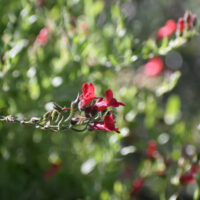
Gambelia (Galvezia) speciosa ‘Firecracker’
An interesting, evergreen subshrub from the California Channel Islands. Showy, deep-red, tubular flowers decorate the branch tips and are highly attractive to hummingbirds. The cultivar ‘Firecracker’ was selected by Tree of Life Nursery for its compact habit, growing 3 foot tall and 5 foot wide, with fuzzy, pale green leaves and larger, red, snapdragon-like flowers. A natural along the coast where it will grow in full sun to light shade, afternoon shade is best in hotter inland sites. Drought tolerant once established, but enjoys occasional summer water, especially away from the coast. Hardy to 15 -20 degrees F.
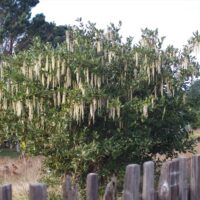
Garrya elliptica
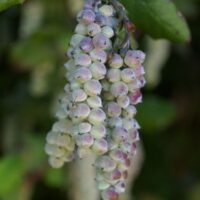
Garryas are grown primarily for their winter flower catkins. The longer, pendulous male catkins have traditionally been the most sought after with selections like 'James Roof' and 'Evie'. Male and female flowers occur on separate plants and both must be present for the female to produce their lovely grapelike clusters of fruit. These plants are seed grown so males and females are of equal probability. All plants feature larger, evergreen leaves on multitrunked shrubs reaching 10 - 15 ft tall and wide. Very amenable to pruning. Plant in full sun or partial shade. Provide moderate irrigation inland, but established plants will be drought tolerant near the coast where they occur naturally. Somewhat deer resistant.
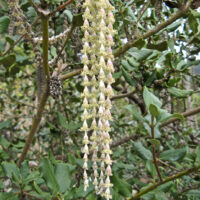
Garrya elliptica ‘Evie’
This cultivar of the native silktassel bush is more compact than the better known ‘James Roof’. The 8 to 10 inch catkins are shorter but more profuse. Evergreen, grows 10 ft. or taller. Sun to part shade, good drainage. Provide moderate to occasional irrigation inland. Winter is its showiest time when it is covered in silvery catkins. Discovered on the northern Sonoma Coast. Somewhat deer resistant.
Garrya elliptica ‘James Roof’
Outstanding cultivar of the native silktassel bush. Evergreen shrub 10 ft. tall or more. Striking 12 inch long silvery catkins in winter. Sun to part shade and drought tolerant. Enjoys moderate summer water inland. Discovered along the coast of Prairie Creek State Park in Humboldt Co.. Somewhat deer resistant.
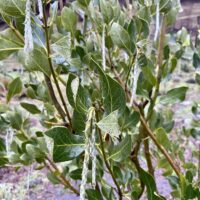
Garrya fremontii
Evergreen shrub with leathery leaves and handsome dangling catkins in late winter and early spring. The male and female flowers occur on separate plants. Native to the west coast where it grows in mixed evergreen forest and chaparral plant communities. This species is a good choice for summer-hot interior sites with well drained soils. Grows 8 - 10 ft. tall and wide in full sun to light shade and is drought tolerant once established. A good specimen shrub or candidate for hedgerow or screen where it provides cover and food for birds and small mammals. Somewhat deer resistant.
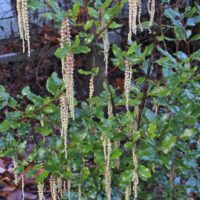
Garrya issaquahensis ‘Pat Ballard’
An elegant winter flowering shrub, uncommon in the trade. A hybrid between Garrya elliptica and Garrya fremontii, 'Pat Ballard' is a tough evergreen growing 6-10 foot tall and wide. Pendulous pinkish gray catkins dangle from the branch tips in winter providing a spectacular display. Plant in full sun to part shade with occasional to infrequent water once established. More cold & drought tolerant than Garrya elliptica. An excellent screen, hedge or foundation shrub, amenable to pruning. Somewhat deer resistant.
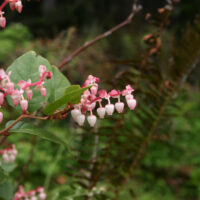
Gaultheria shallon
A handsome evergreen shrub, happiest in fog shrouded coastal zones. Large, leathery, dark green leaves are a gorgeous foil to the loose clusters of white to pinkish urn-shaped flowers. Fat, blue-black berries follow and are relished by wildlife and eaten by people too. Salal can grow tall in moist coastal areas of the Pacific Northwest but usually forms a ground cover 2 - 4 ft. tall and spreading in California. Best with some shade and acidic, humus-rich, moist soils. The foliage is prized for flower arranging. Deer resistant.
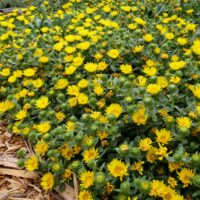
Grindelia stricta var. platyphylla ‘Mendocino’
This selection features particularly large bright yellow 2 1/2 inch daisies over a long period in the summer. Each fat green flower bud holds a dollop of gummy white resin which protects the blooms from predators, hence the name “gum plant”. 'Mendocino' is a particularly prostrate form under 8 inches tall and spreading to at least 6' wide. Native to dunes, marshes and bluffs in coastal scrub throughout coastal California. Excellent pollinator plant. Useful in a meadow planting or with other low groundcovers and shrubs. Looks nice draping over a wall too. An adaptable plant for sun to light shade, moderate to occasional water. A natural along the coast where it tolerates wind and salt spray. Deer resistant.
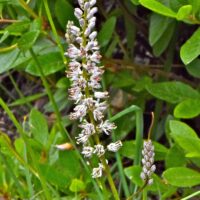
Hastingsia alba
This hard-to-find native bulb features elegant, branched stalks, 3 ft or more high, supporting racemes of sparkling white flowers. The dense blossoms display narrow petals and protruding stamens, giving them a delicate and soft appearance. Grey-green, strap-like leaves grow radially from base of the stalk, creating a tidy rosette 12" - 18" wide. Grows happily in most soils in full sun with regular water, where the bulbs may multiply. In part shade, this lily relative will be a little more drought tolerant. Plants emerge in late winter and go dormant by the end of summer. Hails from the mountains of Northern California, where it makes its home in meadows and open woodlands.
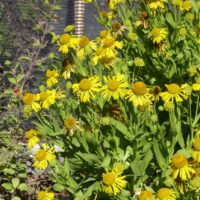
Helenium autumnale
This desirable autumn bloomer is known for its masses of bright yellow daisies up to three inches wide, perched atop stems two to three feet high. Lance-shaped leaves of light green create dense mats six inches high. Native to Northern California and much of North America where it grows in moist meadows. Will slowly increase to form small colonies. Plant in full to part sun and provide regular water. Attracts bees and butterflies. Deer resistant. Despite the common name, this plant is insect pollinated and isn't known to cause hay fever. It was originally used to make snuff, hence the name sneezeweed.
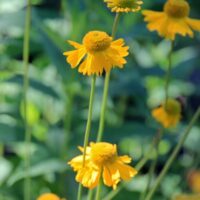
Helenium bigelovii
Native to moist meadows of California and S. Oregon, this summer flowering perennial makes a lovely addition to the garden. The cheerful golden-yellow petals turn down slightly from the rounded dome-like center. The golden daisy-like blossoms are held above the rosette of smooth green leaves on 2 - 3 ft. tall stems and attract a wide variety of insects including bees and butterflies. Despite the common name this plant does not cause allergies. It was originally used for snuff, hence the name sneezeweed. Plant in full sun to light shade with regular water. The seed for this crop is from the Pitkin Marsh in Sonoma County.