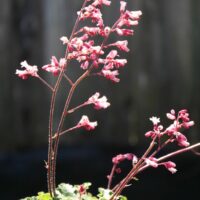
Heuchera ‘Canyon Duet’
A Santa Barbara Botanic Garden selection, part of their Quartet Series of hybrids. This charming, diminutive coral bells forms low, sturdy clumps of small rounded leaves slowly spreading to about 10-12 inches wide. Bi-colored flowers of dark pink and white rise 12 to 18 inches above the dense foliage in spring and early summer. Heuchera's require good light to bloom well but resent full sun, especially inland. Moderate to occasional water. Excellent small scale perennial for mixed border, edging or rock garden. Good container subject too.
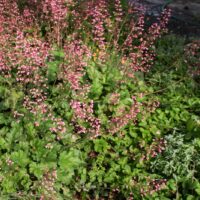
Heuchera ‘Old La Rochette’
Here is a wonderful, often hard to find Heuchera hybrid. Grows into robust clumps of rounded leaves to around 1 ft. tall and 1 - 2 ft. wide. 2 ft. tall flower stalks carry hundreds of soft pink blossoms in the spring, and often intermittently through the summer. Sturdy perennial for part shade and a little summer water. This species attracts hummingbirds.
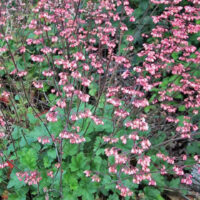
Heuchera ‘Rosada’
Listed as one of U.C. Davis Arboretum’s “All Stars”, this heuchera hybrid is tough and dependable. Forms an attractive mound of evergreen foliage 10 - 12 inches tall. A long display of tall flower stems covered with creamy-pink dainty bells begin in the spring and often continue into the summer. Best with part shade and moderate to occasional summer water. Attracts hummingbirds.

Heuchera ‘Santa Ana Cardinal’
An outstanding hybrid that is vigorous and free flowering. Compact clumps of foliage topped with 2 ft. tall flowering stems with vibrant rose-red blossoms over a long period. Plant in cool full sun to light shade with moderate to occassional summer water once established. This species attracts hummingbirds.
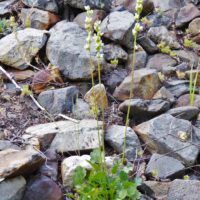
Heuchera cylindrica
Native to the northern mountains of California, the roundleaf alumroot is distinctive for its dense clusters of white to cream-yellow flowers held on vertical stems reaching 1 to 2 ft tall. Round leaves grow in tight mounds up to 8 inches high and 2 ft wide. Combine with pink Heucheras, Iris and small ferns for an attractive woodland display. Needs part shade and decent drainage. Attracts hummingbirds. Drought tolerant.
Heuchera hirsutissima
This miniature alumroot is the perfect addition to the lightly shaded rock garden or along the edge of a path. Pinkish-white, dainty flowers sit atop short stems only about 4 inches tall in spring and summer. The little 2 inch mounds of dark green leaves slowly spread to form tiny drifts. Provide good drainage and moderate irrigation. An excellent plant for a rock crevice or container where it can be combined with Idaho fescue, Erigeron 'Olga' or leather fern. This species comes from the San Jacinto and Santa Rosa mountains of southern California.
Heuchera maxima
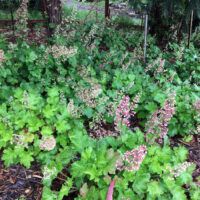
Native to the Channel Islands, this is one of the most adaptable and vigorous of the alum roots, forming broad evergreen mounds of bright green folilage 1 - 1 1/2 ft. high. Maroon flower stems are 3 ft. high topped with pink blushed creamy flowers that have a slight green haze. Best with part shade and a little summer water, but will tolerate full sun close to the coast. Good for use under oaks. This species attracts hummingbirds.
Heuchera micrantha
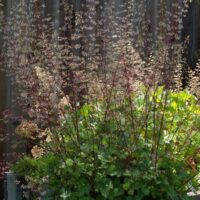
This is our common alum root which is usually seen on shady cliffs and roadbanks adjacent to forests. Easy to grow in garden situations. Forms low mounds of foliage topped with dainty white flowers on long stems. Likes moisture, but tolerates considerable drought and takes deeper shade than most Heuchera species. This species attracts hummingbirds.
Heuchera micrantha ‘Martha Roderick’
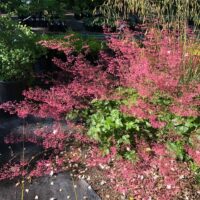
Here’s a pink flowered form of the normally white flowered native alum root. Foliage forms handsome clumps topped with slender stalks 1 - 1 1/2 ft. tall of tiny pink flowers. Excellent in woodland setting for border, slope or rock garden. Drought tolerant but best with a little water. This species attracts hummingbirds.
Heuchera pilosissima
Native to the coast from Mendocino to Santa Barbara Counties, this perennial forms compact, evergreen clumps of light-green scalloped leaves. Stocky flower stems 12 – 16 inches long carry small white-pink flowers in early summer. Perfect in coastal areas where it can grow in sun to light shade and will be drought tolerant once established. Must have part shade and some summer water inland. Plant in mass for a nice ground cover in a woodland setting or in mixed plantings with shrubs and ferns. Attracts hummingbirds.
Heuchera rubescens
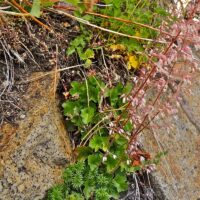
The pink alumroot stands out with bell-like flowers of pink and white held in clusters on slender stems up to 1 ft tall. The round, scalloped leaves form low, dense mats up to 1 1/2 ft wide and about 6 inches high. This western mountain dweller looks beautiful in a rock garden but will do well in any situation with part shade and good drainage. Needs moderate to occasional irrigation once established. Attracts hummingbirds. Great in a container.
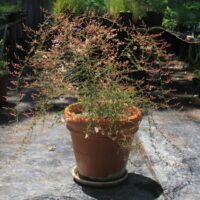
Holodiscus dumosus ‘var. cedrorus’
A recently described endemic shrub discovered by the extraordinary plantsmen Roger Raiche, growing on serpentine soils of the Cedars in northwestern Sonoma County. An open deciduous shrub, approximately 3 ft. x 3 ft. with wiry ruby-red stems and elegant small, shiny, dark green to bronze leaves. Early summer brings erect panicles of cream colored flowers that are suffused in light wine-red or pink coloration. Seems to tolerate a wide range of conditions from full sun to deep shade. Once established has proven durable and drought tolerant. This lovely small creambush is perfect for those who want something completely new and different. It does well in containers and should be interesting to experiment with in different applications and settings.
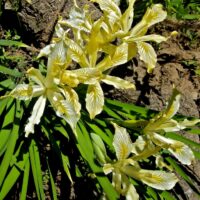
Iris chrysophylla
Native to far northern California and into western Oregon, this uncommon iris grows in fast draining soils in open forests and woodlands. A small scale iris, usually under 12 inches tall in bloom, spreads slowly from slender rhizomes. The delicate blossoms flower in the spring and can vary in color from white to cream to yellow, with a central yellow splash and prominent dark venation. Grow in sun to light shade with occasional to little watering. Visited by bees and hummingbirds. Deer resistant.
Iris innominata
A choice iris with slender, glossy, dark-green leaves and dainty flowers in late spring. Flower color can be from brilliant yellows to shades of purple. Native to the Siskiyou Mountains in Del Norte County, California, into southern Oregon where it forms low, dense, evergreen clumps in openings of woodlands or coniferous forests. This species does better in hot, inland areas than the Douglas iris. Requires good drainage and some summer water. This Del Norte County iris has been used in hybridization programs to produce the popular Pacific Coast Hybrid Iris. Deer resistant.
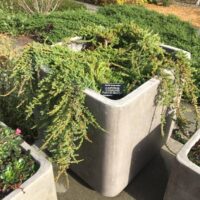
Juniperus communis ‘Point Saint George’
A striking selection from our northern coast of a species that is widespread across the Northern Hemisphere but rare on the coast of California. Sadly, the original population no longer exists due to seaside erosion. Forming dense mats of silver-green foliage under six inches tall, it slowly spreads to several feet wide. A perfect addition to the rock garden, preferring decent drainage and occasional water once established. Also works well as a container plant where the branches can cascade over the sides creating silvery waterfalls. Likes full sun to light shade. Deer resistant.
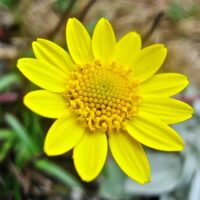
Lasthenia californica ssp. macrantha
Native along the immediate coast of California and just into Oregon, where it forms low, tight mounds of deep green succulent foliage. Cheerful, bright yellow daisies bloom over a long period. Best in full sun with some summer water and good drainage. Long blooming, open faced flowers are excellent sources of nectar and pollen for butterflies, bees and other pollinators.
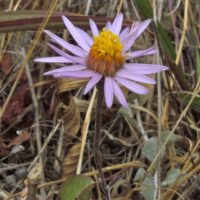
Lessingia (Corethrogyne) filaginifolia
This California native perennial often hugs the ground, spreading widely, it threads its silvery foliage decoratively among other plants. Bright lavender, yellow centered aster-like flowers give a summer long season of bloom. Provide full sun to light shade, some summer water and reasonable drainage. A nectar and larval food source for butterflies. Deer resistant.
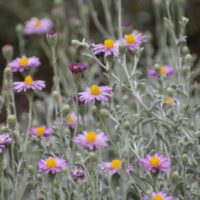
Lessingia (Corethrogyne) filaginifolia ‘Silver Carpet’
A variable species, this selection hails from the Big Sur Coast and was discovered by Carol Bornstein. Forms an attractive ground hugging mat 4 ft. or more wide. The gorgeous silver foliage is the perfect foil for the 1 inch lavender-pink daisies with yellow centers. Tolerates a wide range of conditions including full sun to light shade, drought and wind. Useful groundcover, meadow plant or spiller where its flowers are enjoyed by bees and butterflies. Best with some summer water inland. Deer resistant.
Lewisia cotyledon
Named for Meriwether Lewis, this attractive succulent is native to higher elevations in Northern California and Southern Oregon, typically granite outcrops. The flowers which usually emerge in spring and summer, can range in color from yellow to orange to pink to red. These frost hardy plants form evergreen rosettes, approx. 8 - 10” tall by a foot or so wide. Lewisias need very good, sharp drainage, are heavy feeders, and love a granite rock mulch. They like to be grown sideways, in rock walls, where their crown can drain any moisture away. Plant somewhat high in a fast draining mix and feed every now and then. Morning sun, afternoon shade is best inland. Water as you would any succulent, sparingly, and keep the crown high and dry.
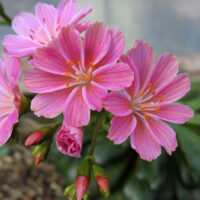
Lewisia cotyledon – Sunset Strain
Named for Meriwether Lewis, this attractive and showy succulent is native to higher elevations in Northern California and Southern Oregon, typically on granite outcrops. Abundant floral sprays arise in spring and summer on stalks reaching 6-10" above evergreen foliage. This seed strain has produced a rainbow of flower colors, including: yellow, white, orange, pink and red. The frost hardy rosettes grow to approx. 8-10” tall by a foot or so wide. Lewisias need very good, sharp drainage, and love a granite rock mulch. They like to be grown sideways, in rock walls, where excess moisture drains away. Plant somewhat high in a fast-draining mix and feed every now and then. Morning sun with afternoon shade is best inland. Water sparingly, as you would any succulent, and keep the crown dry.
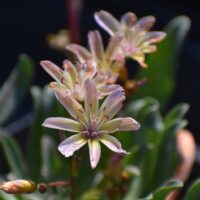
Lewisia longipetala ‘Little Peach’
Large flowers with long petals colored peachy apricot make this selection of our native cliff maids a knockout in the garden. Round clusters of narrow, succulent leaves form patches up to about 8 inches wide. The irresistible flowers emerge en masse from between the leaves on slender stalks up to about 10 inches high. A very long bloomer, beginning in spring and often re-blooming in summer. Works really well in a container with lean, fast draining soil, placed in bright partial shade. Water sparingly. For best results, mulch with granite chips and fertilize occasionally. Lewisias are native to the mountains of California and beyond, where they grow in rock cliffs. An excellent choice for the rock garden.
Lewisia longipetala ‘Little Raspberry’
The parent of this strain of Lewisias is found in rocky outcroppings of the Sierra Nevada Mts. Forms low, fleshy rosettes of tough evergreen leaves. Raspberry-red flowers bloom on short stems above the leathery foliage in the spring into summer and often again in the autumn. Requires good sharp drainage and rock mulch, but appreciates partial shade in hot summer areas. Perfect for rock walls, rock garden, containers and troughs. Water as you would any succulent, sparingly, and keep crown high and dry. This is not the plant for your perennial border, but it is easy to make happy in containers.
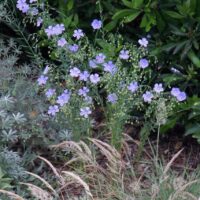
Linum lewisii
A profusion of sky-blue, five petaled, shallowly cupped blossoms flower in late spring and into summer. Growing 12 to 18 inches tall with slender stems and narrow leaves. Can be short lived but often reseeds. A lovely filler, whose true blue flower color seems to go with everything, and the fine foliage contrasts nicely with a variety of leaf colors and shapes. Plant in full sun with moderate to infrequent summer water. Deer resistant.
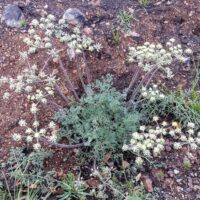
Lomatium dasycarpum
Native to chaparral, grassland and open woodland throughout much of California, this dainty little member of the carrot family produces flat-topped clusters of fuzzy flowers, yellow in bud and creamy-white when open. The fern-like leaves are gray-green and hairy. Blooms in early spring. A larval food source for the Anise Swallowtail butterfly. Needs well-drained soil and full sun to part shade. Do not water once established. Summer dormant.
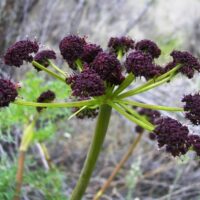
Lomatium dissectum
This carrot relative features clusters of small burgundy or yellow flowers held in round clusters in open umbels. Tall, slender stalks about 3 - 4 ft high support the blossoms above broad, finely dissected leaves. Pollinators love the flowers and the anise and indra swallowtail butterflies depend on the leaves as a food source for the developing caterpillars. Grows throughout much of California in hot, inland areas. Plant in full sun to light shade and provide little to no water once established. Needs excellent drainage. A rarity in nurseries.
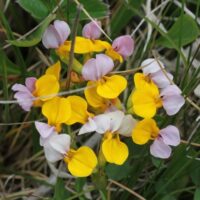
Lotus (Hosackia) formosissimus (gracilis)
A low growing native perennial found in seasonally moist meadows, ditches and seeps along California's coast, north to British Columbia. Small, neat leaves form a pretty, low ground cover spreading up to 2 ft. wide. Pea-like flowers have a bright yellow upper petal and deep pink lower petals which bloom in the spring then sporadically through the summer. Plant in full sun to light shade with regular moisture. Makes a nice container plant, too. Flowers visited by bees and other pollinators. Thought to be the larval food source for the possibly extinct lotus blue butterfly.
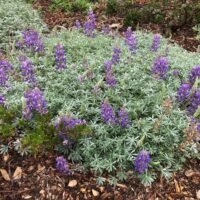
Lupinus albifrons var. collinus
A beautiful low growing form of the silver bush lupine. Forms a mat of gorgeous silvery foliage 12 inches or so wide with spires of rich blue flowers rising 12-18 inches tall in the spring. Plant in full sun to very light shade with well drained soil. Flowers attract a wide array of beneficial insects, especially bees of all types. Drought and deer resistant.
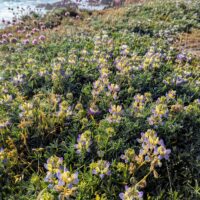
Lupinus littoralis var. variicolor
Often found nestled amid rocks and sand, this low-growing, perennial lupine is native to the beaches and dunes of coastal California. Forms a clump or mat of silver-green foliage under 18 inches tall, with jewel-like flower spikes. Blooms in a subtle range of colors, typically shades of purple-blue with white to pale yellow banners. Makes for an excellent addition to a rock garden. Formerly known as Lupinus variicolor, it is currently considered a variety of bluff lupine that is endemic to the Bay Area from Sonoma County down to the Peninsula. It attracts pollinators, and is one of the few hosts for the rare Mission Blue butterfly. Accepts various watering regimens from regular to occasional so long as it gets excellent drainage. Drought tolerant once established.
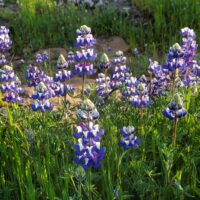
Lupinus nanus
This beautiful ANNUAL lupine can be seen on grassy hills, open slopes and fields, often casting a blue haze of color from a distance in the spring. Low growing, 6 - 20 inches tall and wide, with wonderfully fragrant, rich blue flowers with white markings. Prefers full sun, lean and well drained soils with minimal supplemental watering. Contrasts beautifully with California poppies, providing the classic, blue and gold displays of spring. Attractive to a myriad of pollinators and a larval food source for a number of butterfly and moth species. Deer resistant.
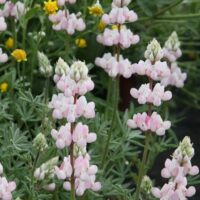
Lupinus nanus – Pacific Pink
Unusual, soft pink flowers distinguish this seed strain of the iconic California sky lupine, the traditionally blue flowered, ANNUAL species which blankets grasslands throughout California in the spring. The blossoms sit in whorls on upright stems above dissected, palmate leaves. This low plant reach 6 – 20 inches tall and wide, combining nicely with low, native perennials and grasses. Enjoys well-draining soil in full sun to light shade. Reseeds fairly readily if exposed soil surrounds the plants. Attractive to a diverse array of pollinators and a larval food source for a number of butterfly and moth species. Deer resistant.