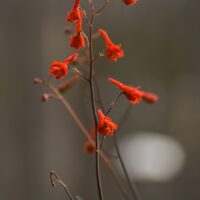
Delphinium nudicaule
In late winter and spring, scarlet flowers with elongated tails perch on upright stalks, usually not more than 3 ft tall. The green, lobed leaves which form a low mound above the ground have a distinctive pale patch in their centers. This native makes its home on summer-dry slopes throughout much of Northern California and parts of Central Ca., inhabiting bright, open woodlands and rocky road cuts. Needs good drainage and little to no irrigation in the summer. While it can grow in a fair amount of shade, it blooms best under a bright, dappled canopy. A favorite of hummingbirds and butterflies. All parts are poisonous if ingested.

Deschampsia cespitosa ssp. holciformis
This native bunchgrass makes its home on windswept coastal bluffs from Central CA north to British Columbia. The tidy, evergreen clumps of foliage reach 6 – 12 inches tall and get at least as wide. Stiff, green leaf blades can give plants a spiky appearance, but also make this variety look more symmetrical than many native grasses. The narrow Inflorescences can reach up to 2 ft tall. Does best with full sun near the coast, but enjoys some afternoon shade in hotter areas, where moderate irrigation is recommended. Grows well with iris, seaside daisies and other coastal species. Deer resistant.

Dichelostemma ida-maia
Blooming firecracker flowers are a sight to behold. Native to grassy slopes and woodland edges from Mendocino County to Southern Oregon, this distinctive native bulb is truly unique. Long, strap-shaped leaves give rise to tall, naked stems, 20 - 25 inches in height. Generous clusters of pendulous, one inch floral tubes of striking crimson with reflexed green tips reveal protruding little fringes of white. Bloom in late spring to early summer. Prefers lightly shaded areas that will go dry in summer after flowering. Does well in containers, as long as it is allowed to go dry once dormant. Flowers are custom built for hummingbirds and butterflies.
Dichelostemma ida-maia x multiflorum ‘Pink Diamond’
A natural occurring hybrid involving the red firecracker flower and a blue flowering species, producing bright, magenta-pink tubular flowers with charming reflexed tips like it's firecracker parent. Strap shaped leaves emerge in the spring with leafless flower stems following, 8-20 inches tall. The umbels of deep pink flowers are favored by hummingbirds and butterflies. Tolerant of different soil types in full sun to light shade. Dry conditions once it goes dormant is a must. Good container plant.
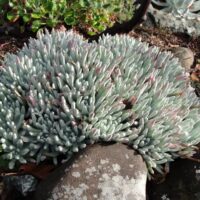
Dudleya ‘Frank Reinelt’
The beautiful and rarely offered Dudleya will form dense mounds 6" - 8" tall with silvery, finger-like leaves, sometimes developing a purple-red blush. Slender stalks appear in late spring and display star-like flowers of soft yellow up to a foot above the foliage. They make handsome specimens in a rock garden or perform as a striking groundcover up to 2' wide mixed with other coastal bluff plants like red buckwheat, seaside daisy, and sea thrift. Great in a container or planted under manzanitas amongst rocks. Needs good drainage and little water once established. Full sun near the coast, but light shade inland.
Dudleya ‘Seedlings from ‘Frank Reinelt’
These seedlings from the beautiful Dudleya ‘Frank Reinelt’ will form dense mounds 6 - 8 inches tall with silvery finger-like leaves. They make handsome specimens in a rock garden or perform as a striking groundcover in mass plantings mixed with other coastal bluff plants like red buckwheat, seaside daisy, and sea thrift. Avoid over-watering and control snails. Full sun to light shade with good drainage.
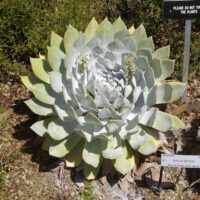
Dudleya brittonii
A Baja California native. Useful and very dramatic in containers or well-drained rock gardens. Likes a protected and sunny microclimate where cold air and winter wet can drain away. Enjoys a little afternoon shade in hotter climates. Develops up to 1 1/2 ft. wide rosettes with fleshy chalk-covered leaves. Yellow flowers sit atop tall stalks in late spring and early summer.
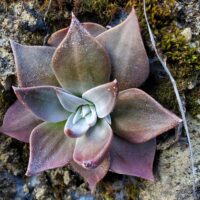
Dudleya cymosa
This charming succulent is in native to California where it grows in between rocks on inland cliffs in sun or bright shade. Best in the garden in a rock wall or terra-cotta pot with some afternoon shade. Height in flower is under one foot. The yellow to orange flowers are attractive to hummingbirds. Occasional to infrequent water in the ground. In pots, let dry out between waterings.
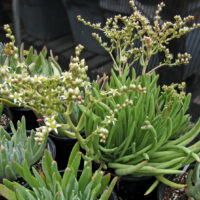
Dudleya edulis
Native to rocky slopes and ledges below 3900’ in Southern Coastal California, the Peninsular Ranges, and Northern Baja California. This Dudleya forms clustering rosettes of dainty, light green, pencil-like leaves. In summer, tall stalks of fragrant, pale yellow flowers rise high above the foliage. Growing about a foot tall (with flowers) by one foot wide. Plant in well drained soil and cool full sun to part shade inland. A delicate accent in a rock garden or amongst coastal plants, also fine in containers. Known as “mission lettuce” for its fleshy raw leaves, once considered a delicacy.
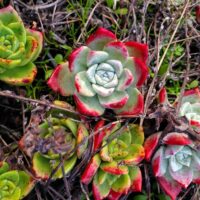
Dudleya farinosa
Native to sea bluffs in central and northern California. Rosettes of fleshy leaves are chalky grey or bright green and often red tipped. Candelabra-like clusters of light yellow flowers on thick stalks appear in summer. Provide part shade away from the coast. Excellent for rock garden, walls or containers, where good drainage and a little summer water can be provided.
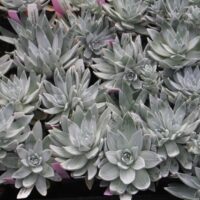
Dudleya farinosa – Noyo River form
Perched on the cliffs of the Noyo River are beautiful rosettes of bluish-white succulents known as bluff lettuce. This special form from the Mendocino coast was selected by Matt Teel for its small and compact stature, striking color and flat leaves. The foliage reaches a height of about 4 inches and slowly spreads to make small colonies. Yellow flowers sit atop slender pink stalks rising 8 inches off the ground. Provide protection from the afternoon sun in inland sites and plant in well-draining soil. Excellent in containers where it only needs occasional water.
Dudleya pulverulenta
Large, broad, chalky-white leaves forming rosettes up to two ft. wide make this Dudleya one of our most sought-after native succulents. A multitude of tubular red flowers appear in late spring and early summer on stalks reaching from 1.5 to 3 ft. tall. Fleshy, heart-shaped bracts line the stems. Plant in bright shade or provide morning sun and afternoon shade. Needs excellent drainage and infrequent irrigation. Plant at an angle to prevent water from gathering around the base in winter. A gravel mulch around the plant can help stabilize soil temperature and prevent excessive dehydration. Good container plant.
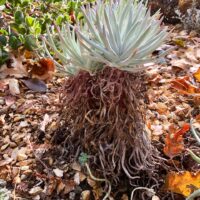
Dudleya virens ssp. hassei
Endemic to Catalina Island, this rare succulent forms chalky-grey rosettes made up of plump fingerlike leaves, 6 inches tall and spreading to form a mat 1 – 2 feet wide. Small white flowers with yellow centers on stems 6 -12 inches tall, bloom in the late spring and are attractive to hummingbirds and other pollinators. Plant in full sun to light shade with occasional deep summer watering. Tolerates heavier soils than most Dudleyas. A dependable small-scale groundcover or container plant.
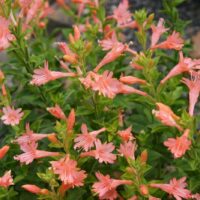
Epilobium canum ‘Coral Canyon’
This elegant and unusual form of the California fuchsia offers a prolific display of peachy-pink flowers, a departure from the more common orangey-red blossoms. The late-summer, autumn blooms are held on distinctly upright stems reaching 1 ½ ft. high above broader, bright green foliage. Unlike most native fuchsias, this selection is somewhat shy to spread, generally forming a rounded mound about 2 ft. wide. Enjoys full sun, but will benefit from a little afternoon shade in hot areas. Likes moderate to occasional irrigation. Hummingbirds and bees partake from the flowers. We must thank Cistus Nursery for discovering the parent plant on a high ridge above the North Fork of the American River.
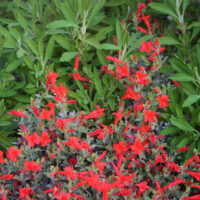
Epilobium septentrionale ‘Select Mattole’
This California fuchsia forms tidy, low, 6 inch high mats of beautiful silver foliage with a matte finish. Late summer through fall brings orangey-red tubular flowers which attract hummingbirds. A somewhat redder flowering selection. Spreading by underground rhizomes, this Epilobium increases a little less vigorously than the others. Full sun to light shade. More shade tolerant than most California fuschias. Needs more water than most Epilobiums. Pruning plants down to a few inches in late autumn helps to rejuvenate them for the following year.
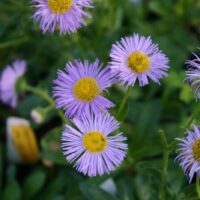
Erigeron ‘Olga’
A fine seaside daisy hybrid introduced by Siskiyou Rare Plant Nursery in Oregon. Forms a tidy, dense mat of dark green foliage. Lavender daisies rise 12 inches above the compact foliage late spring into summer. Plant in full sun along the coast, part shade inland with moderate to occasional summer water. This compact grower is perfect for small spaces, troughs or containers. Bee and butterfly favorite.
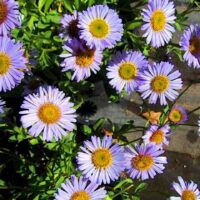
Erigeron ‘W.R.’
The "W. R." stands for the late Wayne Roderick, whom we can thank for many fine plant introductions. This hybrid involves the seaside daisy, Erigeron glaucus and some other native species more tolerant of heat. The lavender daisies sit on slender stalks about 10 inches above low rosettes of narrow leaves. The flowers bloom over a long period in summer and are very attractive to pollinators of all sorts. Provide full sun in cooler areas but will enjoy part shade in hot inland sites. Moderate to occasional irrigation. Their seeds are favored by juncos and finches. Wayne discovered this surpisingly heat tolerant selection on the Del Norte coast. This selection should not be confused with 'Wayne Roderick', which is an entirely diferent selection of Erigeron.
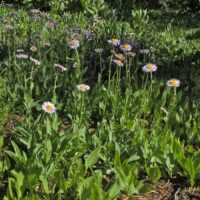
Erigeron glacialis
From mountain meadows throughout much of California and the West comes this endearing little daisy. Features clusters of refined, lavender-pink daisies with yellow centers held on stalks up to 10 inches tall above low, mat-forming leaves. Plant in full sun except in hot, inland areas where some afternoon shade would be appreciated. Needs moderate irrigation. This summer bloomer provides excellent habitat for bees and butterflies. A superlative candidate for a rock garden or narrow planting bed. Works well in containers.
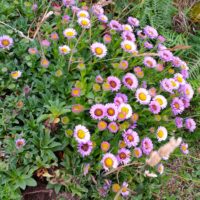
Erigeron glaucus
Low growing native perennial to 1 ft. tall with lovely, lavender, daisy-like flowers blooming over a long part of the year. Native to coastal dunes and bluffs, but does well inland with some afternoon shade and a little extra summer water. A natural along the coast where it thrives with little to no summer water and tolerates wind and salt spray. Good nectar source for butterflies and many different pollinators. Their seeds are favored by juncos and finches.
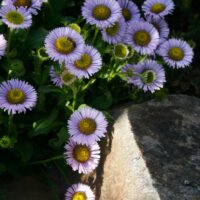
Erigeron glaucus ‘Bountiful’
Forms a lush mound of foliage 10 inches - 1 ft. tall by 2 ft. wide. Exceptionally floriferous and long blooming, 'Bountiful' offers masses of lavender daisies with yellow centers held above loose rosettes of green foliage. It slowly spreads to form drifts which combine wonderfully with Iris and low grasses. A natural along the coast where it grows in full sun and is drought tolerant. Appreciates some afternoon shade and summer water inland. A reliable and easy to grow perennial. Butterfly and bee favorite. Their seeds are favored by juncos and finches.
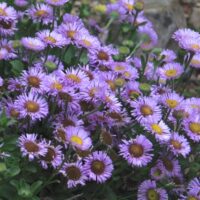
Erigeron glaucus ‘Cal Flora’
This seedling appeared at the base of a decorative pot planted with Erigeron glaucus ‘Cape Sebastian’. The seedling's foliage and form appears to be intermediate between Erigeron glaucus 'Cape Sebastian’ and Erigeron glaucus 'Bountiful'. It has a nice dense habit, though a bit taller than ‘Cape Sebastian', with larger and darker flowers held just above the foliage at about 10 inches in height. A natural along the coast where it thrives with little to no summer water once established and tolerates wind and salt spray. In hotter inland conditions give some afternoon shade and additional summer water. Good pollen and nectar source for bees and butterflies. Their seeds are favored by juncos and finches.
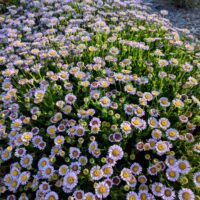
Erigeron glaucus ‘Cape Sebastian’
This selection of the West Coast native seaside daisy is from Oregon, just north of the California border. A compact and dense mound up to 6 inches high, topped with lavender daisies over a long period. Full sun near coast, light shade in hot regions. Best with moderate to occasional summer water in hotter climates. A favorite of pollinators. Their seeds are favored by juncos and finches.
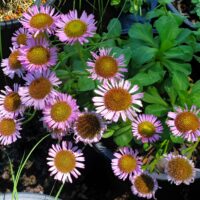
Erigeron glaucus ‘Ron’s Pink’
A delightful pink-flowered version of the useful seaside daisy, an easy to grow perennial native to the coast. Mounds of compact foliage topped with large, pink daisies, spring through autumn. At home on coastal bluffs in full sun with wind and salt spray. Requires afternoon shade and some summer water when grown in hotter interior locations. Looks beautiful when planted with Douglas iris, low fescues and woolly sunflowers. Attractive to a wide array of pollinators, including native bees and butterflies.
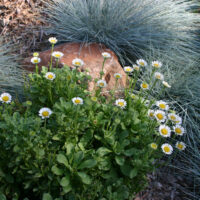
Erigeron glaucus ‘White Lights’
This unusual white flowering form of seaside daisy was discovered along a coastal bluff in Sonoma County by Roger Raiche. It has been a long bloomer, starting in spring and continuing into autumn. Reaches a height of up to 1 ft. and spreads to form a small clump. Prefers sun, decent drainage, and is drought tolerant once established. A little shade and moderate to occasional water is best in hot inland sites. A member of the sunflower family, seaside daisies are excellent sources of both nectar and pollen for butterflies, bees and other pollinators. Their seeds are favored by juncos and finches.
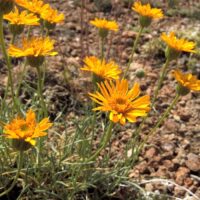
Erigeron linearis
This native Erigeron grows in a number of western states, including California, where it is found in the mountains, on rocky slopes, sagebrush scrub and desert plant communities. Most Erigeron species flowers are white, pink or shades of purple, but this low growing, tufted perennial sports dime-sized, yellow daisies, in the late spring to early summer. The flower buds nod at first, then straighten as they open above the mound of narrow leaves, rising to around 8 inches or so tall and getting about as wide. A natural for the dry garden, rock garden, crevice, wall or container, where it gets full sun and excellent drainage. Bees and butterflies are attracted to the flowers, including several checkerspot butterfly species and the white-lined sphinx moth.
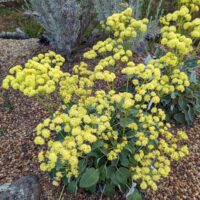
Eriogonum compositum – yellow flowered form
This unusual form of the native arrowleaf buckwheat features soft yellow flowers, as opposed to the more come cream-colored ones. In spring, flattened clusters of blossoms emerge on stout stems held at least a foot above rounded mounds of large, fuzzy, gray-green leaves, reaching up to 2 ft wide. Found in gravelly soils in seasonally dry areas which bake in summer but freeze in the winter. Plant in full sun and water infrequently once plants are established. A surprisingly adaptable species which does well in local gardens. As with other buckwheats, butterflies and bees love the flowers. Numerous butterfly species use this plant as a larval host. Native from Sonoma and Napa Counties north to Washington and east to Idaho.
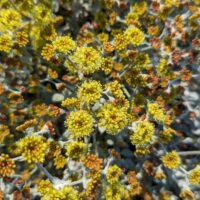
Eriogonum crocatum
A rare buckwheat grown for its beautiful gray, felty foliage and bright, clear yellow flowers. The yellow flowers open from brown buds and then age to a dark rusty brown. Grows 1 - 2 ft. tall and wide, this perennial requires full sun and good drainage. Little to no summer water once established. This Ventura County, California native is hardy to about 15°F. Good nectar source for bees and butterflies. Deer resistant.
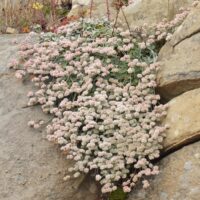
Eriogonum latifolium
Native to our coastal bluffs, this perennial forms neat mounds of silvery white foliage under 1 ft. tall. Flowers develop in dense pom-poms and are creamy white to pinkish. Tolerates sun, wind and drought once established but needs decent drainage. Provide occasional summer irrigation to keep them looking their best. Buckwheats have substantial wildlife value, providing pollen and nectar for bees and butterflies, larval food for butterflies, seeds for birds and cover for many creatures. Deer resistant.
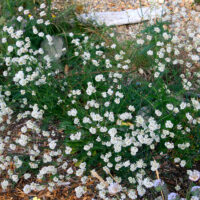
Eriogonum nudum
Few natives are as excellent a source of nectar for bees and butterflies as the buckwheats. This widely distributed species is known for its elegant flower displays on naked stems rising one to three feet above low mounds of grey-green leaves. Naked buckwheat has flower pom-poms ranging in color from white to pink set on slender stems in open clusters up to twelve inches wide. Blooms from late spring into early autumn. Provide full sun to very light shade in soil with decent drainage. Drought tolerant once established. Generally deer resistant.
Eriogonum nudum – robust form
This buckwheat came to us by way of Ginny Hunt and her seed company Seedhunt. Collected from a local race (Santa Cruz area) of naked buckwheat where the flower stems rise to 5 foot or more! Naked buckwheat is the most widely distributed species of buckwheat, growing throughout the state. Forms low mounds of foliage with tall, slender, naked stems, topped with clusters of white to pinkish pom-poms. Plant in full sun to very light shade with good drainage. Drought tolerant once established. Important pollinator plant. Said to be deer resistant.