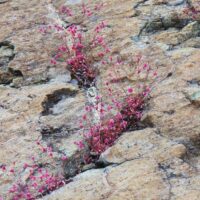
Eriogonum vimineum
Here is an ANNUAL buckwheat found throughout much of California, growing on gravely and volcanic soils. Summer brings showy domes of rose-pink flowers held on wiry stems 18 inches above small clumps of basal leaves. Buckwheats are excellent for attracting beneficial insects providing pollen and nectar for bees and butterflies and seeds for birds. Plant in full sun with little water once established. Good container plant too.
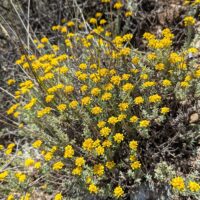
Eriophyllum confertiflorum
Native to dry sites in many plant communities of California. Forms a mound of pale green, finely cut foliage with woolly undersides 12-24 inches tall. Late spring and summer brings domes of bright golden yellow daisies in dense heads. Tough little shrublet for the dry garden in full sun where its interesting fine-textured foliage provides a useful contrast to grasses and bold-leaved shrubs and perennials. The flowers provide nectar to bees and butterflies. Needs good drainage.
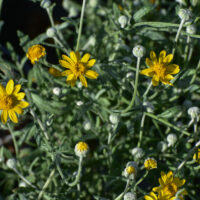
Eriophyllum lanatum – inland form
A cheerful native perennial with yellow, daisy-like flowers from spring to fall. While the species varies in size and habit, our seed-grown strains are upright, reaching around 1.5-3 feet tall and wide when in full bloom. The woolly foliage tends to be silvery, but comes in shades of green, and is most lush and dense around the base. Woolly sunflower is found in a range of plant communities from Central California through the Pacific Northwest, thriving in sun to part-shade. Our seed-grown plants come from hot, inland sites where they grow on dry, rocky slopes and bluffs. Tolerates various soil types with good drainage and minimal irrigation once established. The sunny, 2-in. blossoms are butterfly favorites and attractive to bees and other pollinators. A good choice for rock and habitat gardens. Deer and gopher resistant.
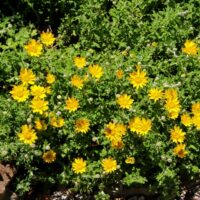
Eriophyllum lanatum ‘Horseshoe Cove’
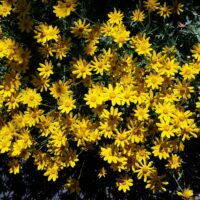
This western native grows on rocky slopes and bluffs over a wide range of plant communities in California, Oregon and Washington. This low dense coastal selection forms a mat of woolly, bright green foliage just a few inches tall and 1-2 ft. across, topped with cheerful golden yellow daisies rising to 6 inches tall, late spring and summer. The flowers are attractive to bees, butterflies and other beneficial insects. Plant in full sun to light shade inland with good drainage and moderate summer water.
Eriophyllum lanatum ‘Siskiyou’
An extremely variable species ranging from the immediate coast to the high mountains of California and into Oregon. The cultivar 'Siskiyou' is a Siskiyou Rare Plant Nursery selection. Lush gray-green woolly foliage forms low mats up to 10 inches and 3-4 feet wide. Blooms over a long period, spring into fall with cheery 2 inch golden-yellow daisies. This tough perennial will thrive in full sun to light shade, decent drainage and moderate to infrequent summer water once established. The open-faced daisies are an excellent sources of pollen and nectar and make good platforms for insects to perch, attracting butterflies, bees and other insects.
Eriophyllum staechadifolium
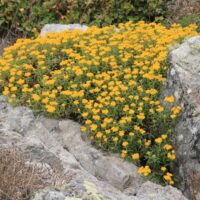
This native perennial is perfect for coastal environments where it tolerates full sun, wind, salt spray and drought. Forms leafy mounds 2 - 3 ft. tall and at least as wide. The foliage is grey-green above and silvery beneath with flower heads densley packed with tiny golden-yellow daisies from May through August. Drought tolerant but appreciates occasional summer waterings, especially when grown away from the coast. Excellent for pollinators. Tip pruning helps keep the mounds tidy. Annual pruning back will refresh.
Euthamia occidentalis
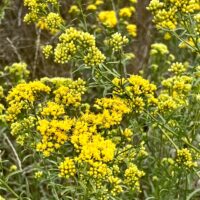
This little known, native goldenrod is a pollinator powerhouse, supporting bees, as well as a wide array of butterflies, including the Monarch, who are drawn to the nectar. In late summer and autumn, small, golden-yellow flowers form rounded clusters at the tops of tall, vertical branches, 4’ to 6’ high, clothed in long, slender, leaves. Grows naturally in sunny, low-lying areas which stay at least somewhat moist into early summer, but may be dry later in the year. Spreads quickly by underground rhizomes, especially in areas with perennial moisture, making it good for erosion control, but not suitable for small gardens. In two years, plants should reach about 4’ wide. Great in containers in smaller spaces.
Fremontodendron ‘California Glory’
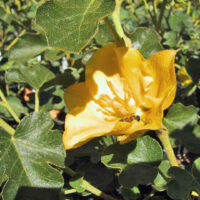
Beautiful, evergreen hybrid flannel bush to 20 ft. tall. Rich yellow, cup-shaped flowers cover the shrub May - June. Plant in full sun with plenty of room and no summer water once established. Fast growing and drought tolerant. The large flowers are attractive to bees and other pollinators. An excellent nectar plant for orioles. Needs decent drainage.
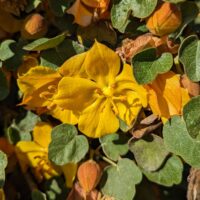
Fremontodendron ‘Ken Taylor’
Showy native shrub for sunny, dry areas. This form of flannel bush only grows 4 - 6 ft. tall and 10 ft. (or more) wide but can be pruned to be kept narrower. Beautiful cup-shaped golden yellow flowers with orange backs bloom in late spring and into summer. Highly attractive to bees and other pollinators. An excellent nectar plant for orioles. Once established, this selection of flannel bush is completely drought tolerant and will accept infrequent summer water only where drainage is excellent.
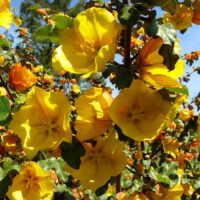
Fremontodendron ‘Pacific Sunset’
This showy hybrid flannel bush grows in a broad “V” shape to 20 ft. tall. Covered with large orange-yellow cup-shaped flowers for a long period in spring. The large flowers attract bees and other pollinators. An excellent nectar plant for orioles. Requires full sun and plenty of room. Best if not watered once established. Needs decent drainage

Fremontodendron ‘San Gabriel’
Large, showy, hybrid flannel bush quickly growing to 20 ft. tall. Covered with buttercup yellow blossoms in the spring. Because of the nature of their branching, ‘San Gabriel’ and ‘Pacific Sunset’ both espalier well. An excellent nectar plant for orioles. Requires full sun. No summer water once established. Needs decent drainage.
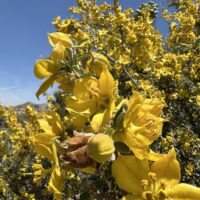
Fremontodendron californicum
In late spring, this evergreen shrub makes for a stunning display along dry foothill slopes as masses of bright yellow blooms cover its stems. Its leathery, fuzzy leaves all but disappear among the showy, cupped flowers. Of the three Fremontodendron species, all native to California, this flannel bush has the widest distribution, mostly in the western Sierra foothills and Southern California. Its range is limited to sites with well-draining, sandy or rocky soil, and it can be sensitive to garden irrigation and heavy soils. Best planted in full sun with similarly low-water species where it receives minimal direct water once established. When happy, it is fast-growing to 15 or more feet, making it a good all-season hedge. Flowers are wildly popular with bees and other pollinators.
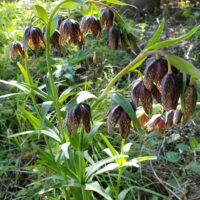
Fritillaria affinis
Charming, spring blooming, bulbous plant in the lily family, with beautiful, pendulous, bell-shaped flowers. This is California's most common fritillary and the most variable, in both size and flower color. Flowers vary greatly and can be yellow-green to purple-brown and may be beautifully checkered with brown and green, sometimes red-purple patterns. Can grow 12 inches - 3 ft tall depending on the habitat and substrate. Native to grasslands, woodlands and chaparral plant communities including serpentine soils. The easiest of the fritillaries to grow, preferring light, well drained soils, sun along the coast to light shade in hotter areas. Plants accept water in their growing season, but should be allowed to go dry once dormant. Protect from gophers, slugs and deer.
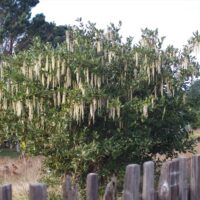
Garrya elliptica
Garryas are grown primarily for their winter flower catkins. The longer, pendulous male catkins have traditionally been the most sought after with selections like 'James Roof' and 'Evie'. Male and female flowers occur on separate plants and both must be present for the female to produce their lovely grapelike clusters of fruit. These plants are seed grown so males and females are of equal probability. All plants feature larger, evergreen leaves on multitrunked shrubs reaching 10 - 15 ft tall and wide. Very amenable to pruning. Plant in full sun or partial shade. Provide moderate irrigation inland, but established plants will be drought tolerant near the coast where they occur naturally. Somewhat deer resistant.
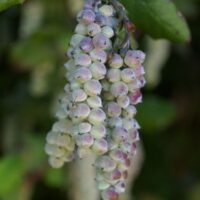
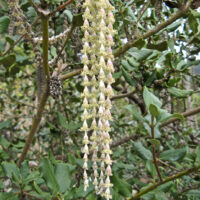
Garrya elliptica ‘Evie’
This cultivar of the native silktassel bush is more compact than the better known ‘James Roof’. The 8 to 10 inch catkins are shorter but more profuse. Evergreen, grows 10 ft. or taller. Sun to part shade, good drainage. Provide moderate to occasional irrigation inland. Winter is its showiest time when it is covered in silvery catkins. Discovered on the northern Sonoma Coast. Somewhat deer resistant.
Garrya elliptica ‘James Roof’
Outstanding cultivar of the native silktassel bush. Evergreen shrub 10 ft. tall or more. Striking 12 inch long silvery catkins in winter. Sun to part shade and drought tolerant. Enjoys moderate summer water inland. Discovered along the coast of Prairie Creek State Park in Humboldt Co.. Somewhat deer resistant.
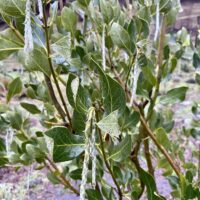
Garrya fremontii
Evergreen shrub with leathery leaves and handsome dangling catkins in late winter and early spring. The male and female flowers occur on separate plants. Native to the west coast where it grows in mixed evergreen forest and chaparral plant communities. This species is a good choice for summer-hot interior sites with well drained soils. Grows 8 - 10 ft. tall and wide in full sun to light shade and is drought tolerant once established. A good specimen shrub or candidate for hedgerow or screen where it provides cover and food for birds and small mammals. Somewhat deer resistant.
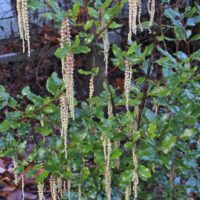
Garrya issaquahensis ‘Pat Ballard’
An elegant winter flowering shrub, uncommon in the trade. A hybrid between Garrya elliptica and Garrya fremontii, 'Pat Ballard' is a tough evergreen growing 6-10 foot tall and wide. Pendulous pinkish gray catkins dangle from the branch tips in winter providing a spectacular display. Plant in full sun to part shade with occasional to infrequent water once established. More cold & drought tolerant than Garrya elliptica. An excellent screen, hedge or foundation shrub, amenable to pruning. Somewhat deer resistant.
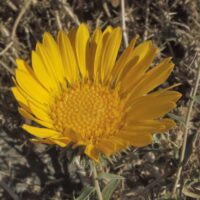
Grindelia camporum
A tough and attractive native perennial found in valleys and lowlands of California. An upright grower, 18-24 inches tall, with resinous foliage and stiff leaves and flower stems. Thick green flower buds hold bright yellow daisies summer through fall which are attractive to bees and butterflies. Best in full sun where it is drought tolerant once established. Tolerates heavy soils and is said to be deer resistant.
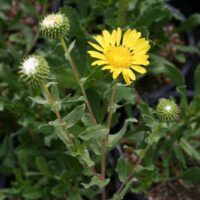
Grindelia hirsutula
Easy to grow, vigorous native perennial that is adaptable to a variety of soils and watering regimes. Grows 1 - 2 ft. tall with good-sized bright yellow daisies over a long period from spring into summer. An excellent nectar plant to add to a habitat garden. With a little grooming and dead heading this sometimes rough looking perennial can look quite handsome in a garden setting. Requires full sun and little to no summer water. Said to be deer resistant.
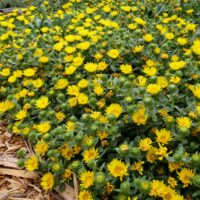
Grindelia stricta var. platyphylla ‘Mendocino’
This selection features particularly large bright yellow 2 1/2 inch daisies over a long period in the summer. Each fat green flower bud holds a dollop of gummy white resin which protects the blooms from predators, hence the name “gum plant”. 'Mendocino' is a particularly prostrate form under 8 inches tall and spreading to at least 6' wide. Native to dunes, marshes and bluffs in coastal scrub throughout coastal California. Excellent pollinator plant. Useful in a meadow planting or with other low groundcovers and shrubs. Looks nice draping over a wall too. An adaptable plant for sun to light shade, moderate to occasional water. A natural along the coast where it tolerates wind and salt spray. Deer resistant.
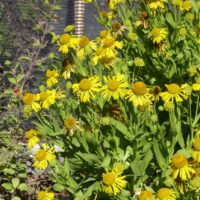
Helenium autumnale
This desirable autumn bloomer is known for its masses of bright yellow daisies up to three inches wide, perched atop stems two to three feet high. Lance-shaped leaves of light green create dense mats six inches high. Native to Northern California and much of North America where it grows in moist meadows. Will slowly increase to form small colonies. Plant in full to part sun and provide regular water. Attracts bees and butterflies. Deer resistant. Despite the common name, this plant is insect pollinated and isn't known to cause hay fever. It was originally used to make snuff, hence the name sneezeweed.
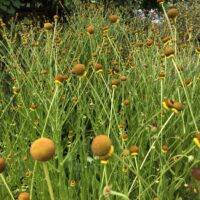
Helenium puberulum
Summer brings clouds of yellow pom-poms which age to brown on this native member of the sunflower family. The round flower clusters sit atop rings of small, down-turned petals, held up on flat stems lined with lanceolate leaves. The flower stalks reach 3 to 5 ft. in height and can be cut down once blooming has finished. Plant in full sun to light shade. Rosilla grows naturally by creeks and seeps and enjoys regular moisture, but will tolerate some drier periods. Attracts a wide variety of insects including bees and butterflies. Goldfinches love the seed. Reseeds readily.
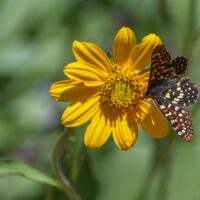
Helianthella californica
Native perennial sunflower growing in chaparral and woodland communities throughout much of California. Forms clumps of dark green, lance shaped leaves under a foot tall. Blooms April through June with small, golden-yellow sunflower heads which rise above foliage 18 inches to 2 ft. tall. Plant in full sun to light shade where it will be quite drought tolerant once established. The flowers attract a wide array of pollinators and beneficial insects.
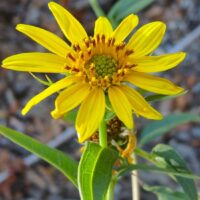
Helianthus californicus
This giant, perennial sunflower is native to riparian habitats in openings with decent light. Dormant in the winter, spring brings rapid growth, with narrow, bright green leaves on tall stalks rising 7 feet or more above a root system which spreads widely. Summer brings many small, golden-yellow sunflowers on the branch tips which are quite dramatic in full bloom. Flowers attract bees and butterflies and the seeds are relished by birds. Perfect for stabilizing soil where there is some summer water and plenty of space. Once established it can take it dryish, but will flower better with water. An excellent cut flower.
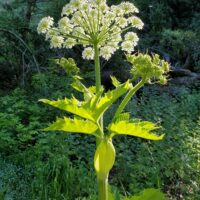
Heracleum maximum
Big, bold, native perennial 3 - 8 ft. tall, is striking in mass or as a specimen. Forms a rosette of large lobed leaves followed by stout flower stems carrying large umbels of white flowers. Thrives in rich soils with some moisture. Full sun along coast, part shade inland. As a member of the carrot family (Apiaceae) the flowers are very effective at attracting beneficial insects. Larval food source for anise swallowtail butterfly. Formerly known as Heracleum lanatum.
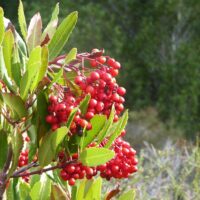
Heteromeles arbutifolia
Toyon is a handsome native evergreen shrub 6 - 10 ft. tall and wide. Sun to part shade, drought tolerant. Clusters of lacy white flowers bloom in summer and areattractive to pollinators. Spectacular bundles of red berries are relished by birds and are a great winter decoration. Valuable as a specimen, screen, hedge or bank plant. Birds attracted to the fruit include the following species: Cedar waxwing, California towhee, spotted towhee, Western bluebird, robins, mockingbirds, bandtailed pigeon, waxwing and quail.
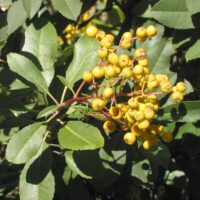
Heteromeles arbutifolia ‘Davis Gold’
An interesting cultivar of the native toyon which bears bright golden yellow berries rather than the more common red-colored fruits. A handsome evergreen shrub 8 - 12 ft. tall and wide (or more). Sun to part shade, drought tolerant. Clusters of lacy white flowers bloom in summer and are attractive to pollinators. The showy clusters of orange-yellow berries are relished by birds and are great winter decoration. Valuable as a specimen, screen, hedge or bank plant. This selection is considered more disease resistant than most toyon.
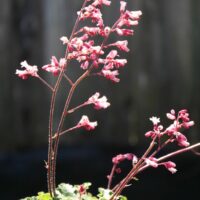
Heuchera ‘Canyon Duet’
A Santa Barbara Botanic Garden selection, part of their Quartet Series of hybrids. This charming, diminutive coral bells forms low, sturdy clumps of small rounded leaves slowly spreading to about 10-12 inches wide. Bi-colored flowers of dark pink and white rise 12 to 18 inches above the dense foliage in spring and early summer. Heuchera's require good light to bloom well but resent full sun, especially inland. Moderate to occasional water. Excellent small scale perennial for mixed border, edging or rock garden. Good container subject too.