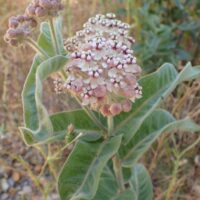
Asclepias eriocarpa
More diminutive than showy milkweed at 1-3 feet, this long-blooming species has similar broad, greyish leaves and creamy, pink-accented flower clusters. Like other milkweeds, it is a larval host for the monarch butterfly. A great choice for habitat gardens in dry, sunny areas, providing nectar for a wide array of pollinators from late spring into fall. Usually found in rocky soils throughout parts of Southern California and in foothill areas north of the San Francisco Bay. Spreads to form colonies with minimal supplemental water. Deer resistant.
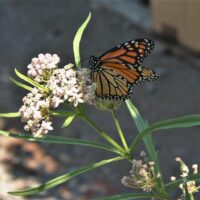
Asclepias fascicularis
Our most common native milkweed is found in meadows and on the banks above ponds. Its flowers are held in umbels of a pale mauve color. They form at the top of 1 - 3 ft. tall slender stems that die back in winter to a perennial rootstock. Its wandering roots form small colonies. Drought tolerant, it prefers seasonally moist soils and likes moderate water in the garden. The narrow leaves are the preferred larval food for the Monarch Butterfly. Full sun to part shade. Unlikely to be bothered by deer.
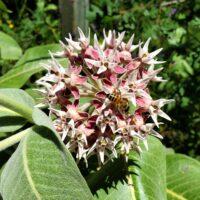
Asclepias speciosa
Bold and beautiful native milkweed that forms a large patch of tall stems with broad pale green leaves. Fragrant clusters of pinkish-purple flowers, followed by interesting seed pods. Spreads by underground shoots. Great in semi-dry naturalistic plantings. Host to Monarch butterflies. Deer resistant.
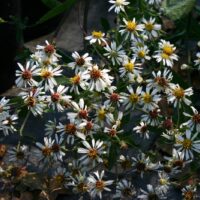
Aster (Eurybia) radulinus ‘Gilliam Creek’
This charming woodland aster makes its home in bright, dryish woods from the Channel Islands all the way up to the Oregon border and into the northern Sierras. Normally a shy, dainty little forest dweller, this selection from Sonoma County is far more robust, featuring large clusters of white-petaled daisies with white centers which turn yellow with age, and finally a deep maroon. Flower stalks reach up to 2 ft. high, much taller than is typical for the species. Serrated, deep green leaves form a high mat on this slowly spreading ground cover. An excellent plant for dry, woodland gardens, but will also tolerate moderate irrigation. One of the few excellent pollinator plants for the lightly shaded garden.

Brodiaea californica ‘Babylon’
A beautiful selection of a robust species, native to the North Coast Ranges and northern Sierra Nevada. Instead of the more typical lavender-purple colored blossoms, 'Babylon' offers particularly large flowers of pink-lavender. The star shaped flowers are in dense clusters on stout stems up to 24 inches tall. Best in full sun and tolerant of different soil types. Allow to go dry once foliage begins to go dormant. This beauty flowers in late spring/early summer and is favored by butterflies. A good container subject.
Brodiaea elegans
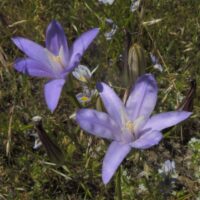
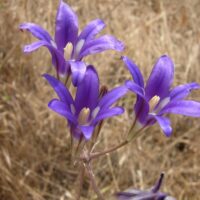
From grassy meadows and open woodlands comes this drought tolerant and colorful wildflower. Open clusters of dainty violet flowers sit atop stems reaching 8 to 20 inches in height. Plant in full sun to bright shade and provide decent drainage. As the name suggests, the harvest Brodiaea is the latest blooming of the Brodiaeas, sometimes not flowering until the end of summer after the grass-like leaves have gone dormant. It spreads rapidly but not invasively to form broad drifts. After blooming, this bulb will sleep until the return of winter rains. Do not irrigate. An excellent candidate for the rock garden where its graceful form will contrast wonderfully with the rigid stone.
Camassia leichtlinii ssp. suksdorfii
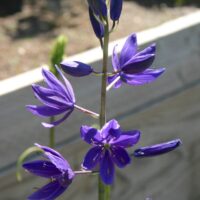
Similar to the common camas, but with larger, star-shaped flowers ranging in color from soft to dark violet-blue on stems up to 3 ft tall. Native to grasslands and moist meadows that dry out in the summer. Also found in open, well lit woodlands. Easy to grow in full sun to light shade in a variety of soil types, including heavy clay. Allow to go dry after seed is set, where it will go completely dormant. This eye catching beauty is appealing to bees, butterflies and hummingbirds. An excellent container plant and cut flower. Deer resistant.
Camassia quamash
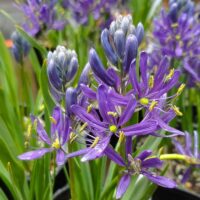
Camas lily is a beautiful native bulb, producing stunning displays of sky blue to violet-purple, star-shaped flowers. Found throughout much of the western United States, growing in moist meadows and grasslands that dry out in the summer. Important species to native peoples, who encouraged the bulb through fire management. Historical accounts describe fields of blue from the massive floral displays. Easy to grow in full sun to very light shade and tolerant of a wide variety of soils, including heavy clay. Long, slender leaves give way to erect racemes of blossoms, to 2 ft. tall in late spring. Allow to go dry once seed set commences. Dormant in the winter. An excellent container plant and cut flower. A favorite of bees, butterflies and hummingbirds. Deer resistant.
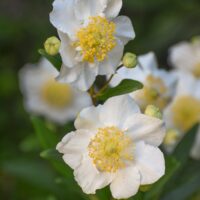
Carpenteria californica
Long in cultivation, this native, evergreen shrub is rare in the wild, with a limited distribution in their native habitat. Forms a multi-branched shrub, 5 - 7 foot tall or more and nearly as wide, with dark green, leathery, lanceolate shaped leaves, which provides a dark foil to the brilliant white flowers. Late spring brings terminal clusters of white, 2 -3 inch, sweetly scented, anemone-like blossoms with yellow centers. An adaptable shrub which makes a striking specimen or foundation plant in a woodland area with morning sun and afternoon shade. Responds well to pruning and can be trained as an espalier. Drought tolerant, but appreciates occasional summer water. Flowers enjoyed by bees and butterflies.
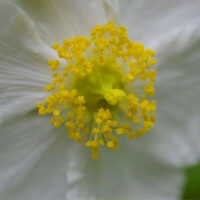
Carpenteria californica ‘Elizabeth’
A beautiful native evergreen shrub 5 - 7 ft. tall and 4 ft. or more wide. Blooms May-July with sweetly scented, pure white, yellow-stamened, camellia-like single flowers. This cultivar is especially free flowering with smaller than usual (2 inch) flowers in masses of up to 20 in each of the terminal clusters. Said to be more disease resistant. Has a narrow upright appearance which is unusual for a native shrub. Best with light shade or morning sun. Drought tolerant, but appearance is improved with some summer water. Does want decent drainage.
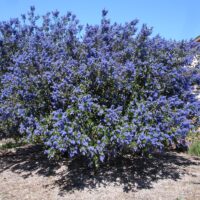
Ceanothus ‘Better Than Ray Hartman’
A friend of ours, Eric Nelson, discovered this spectacular selection growing on a property near where he lived. Masses of rich, blue-purple flowers held in large sprays cover the plant in spring, attracting bees and butterflies. The seeds which follow feed an array of birds. Reaches 10 – 15 ft. tall and wide with larger, deep-green, rounded leaves. We believe this plant is an existing cultivar, but none of the Ceanothus experts have been able to reach a consensus on exactly which one, hence the peculiar name referencing a selection which it resembles. Plant in full sun to light shade and water occasionally or less once established.
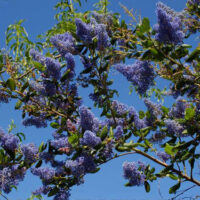
Ceanothus ‘Ray Hartman’
Beautiful large shrub rapidly grows 12 - 20 ft. tall and wide. Dark, shiny green foliage with large, medium blue spike-like flower clusters in the spring. Tolerates pruning and can be trained as a small tree or sheared to create a tall hedge. This selection is especially adaptable, tolerating heat, some summer water and drought. Plant in sun or very light shade. 'Ray Hartman' is a cross between the species C. arboreus and C. thyrsiflorus var. griseus. Ceanothus provide habitat and forage for a wide variety of birds, bees and butterflies.
Ceanothus arboreus ‘Cliff Schmidt’
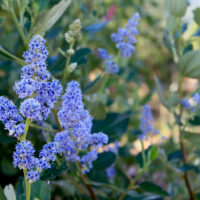
Selected from Santa Cruz Island by Native Son's Nursery, this handsome cultivar has a strong upright habit, growing into a tall and spreading shrub as much as 15-20 ft. tall and wide. Large dark green glossy leaves have white felted undersides. Medium blue flower spikes blossom in late winter to early spring and often again in fall. Excellent for coastal gardens in full sun, give some afternoon shade and a little summer water in warmer inland sites. This large shrub can be pruned into a lovely small tree. Ceanothus are excellent additions to habitat gardens where they provide food, cover and nesting sites for birds and beneficial insects.
Ceanothus integerrimus
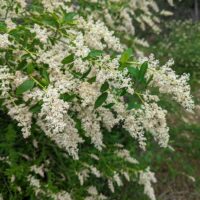
Deer brush is an excellent addition to the dry garden, featuring an abundance of blue, white or even pink flower plumes in late spring. One of the few deciduous species, displaying soft flat leaves which fall in autumn and reemerge in spring. Deer brush is an open upright shrub, growing 5 - 12 feet tall and wide with many different growth habits. A variable species found in a wide range of habitats throughout the state. Often used in restoration for its rugged qualities and ability to deal with summer heat and winter cold. This crop, grown from seed collected near Lake Sonoma has white flowers. Plant in full sun to light shade with good drainage. Little to no summer water once established.
Ceanothus papillosus – upright Baja form
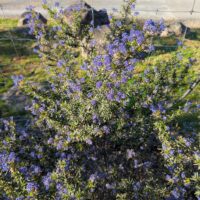
This cold hardy selection from Baja California is highly useful in the garden setting thanks to its tall, upright form and narrow, vaselike shape. Many customers ask us for a big but narrow form of ceanothus. This is one of the few selections that fits the bill. Plants reach 8 – 10 ft tall, but only reach 3 – 4 ft wide, making it ideal for a privacy screen in a small area. Indigo blue flowers cover plants in spring, followed by little seed capsules which are relished by birds. The crinkly, dark-green leaves are elongated and create a nice foil for brighter green plants, such as Salvia and Artemisia. As with all ceanothus, the flowers are loved by a large array of pollinators. Plant in full sun to very light shade and water infrequently once established. Needs decent drainage. This is the variety papillosus.
Cirsium occidentale
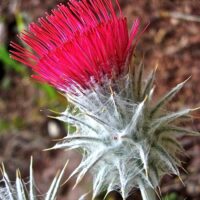
A beautiful NATIVE and NON-WEEDY thistle. Forms a rosette of gray woolly and spiny leaves the first year. A BIENNIAL, flowering occurs the second year with tall, narrow spikes of showy maroon-red to dark pink flowers with cobweb hairs on the bracts. A striking plant, usually reaching 3 - 6 ft tall when blooming, for sunny areas with good drainage and low to no irrigation. An excellent addition to the habitat garden where it attracts bees, butterflies and hummingbirds. Butterflies such as the painted lady and the mylitta crescent depend on cobweb thistle as a larval food source. Deer resistant.
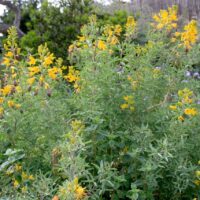
Cleomella (Isomeris) arborea
This distinctive small shrub from Southern California features clusters of golden-yellow flowers with long stamens, giving them a delicate, airy quality. The flowers are followed by papery, lantern-like seed pods which can become almost translucent with age. While this species blooms strongest in the spring, flowers can be seen year-round. Bladderpod has a loose, rounded habit, reaching 4 to 6 ft. tall and wide. If your plant becomes too lanky, simply cut it to the ground to rejuvenate it. Plant in full sun with good drainage and provide infrequent to zero irrigation once established. A great nectar source for hummingbirds, bees and butterflies. Deer resistant.
Previously known as: Peritoma arborea
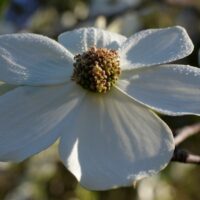
Cornus nuttallii
Spectacular native tree with pleasing horizontal branching, gorgeous white flowers, handsome fruits and good fall color. An elegant specimen tree though notoriously challenging in cultivation. Easiest to grow within its native range. Dislikes poor drainage, fertilizing, pruning, and injury to the tender bark. Drought tolerant in shady, cool situations but enjoys occasional to moderate water in fast draining soils. Once established it can become a show stopping specimen in a wooded garden, under high branching trees, along stream courses and slopes with eastern or northern exposure. Birds relish the red fruits.
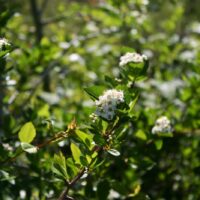
Crataegus gaylussacia
Klamath hawthorn occurs in seasonally wet meadows or borders of forests in northern California. A large deciduous shrub or small tree 6 - 20 ft. tall with reddish-brown bark and formidable thorns. Small, white flowers in flat topped clusters in late spring are followed by red fruits that ripen to black. The fruits are highly attractive to birds. A slight fall/winter chill can turn the leaves a brilliant orangey-red. Plant in full sun to partial shade with regular to moderate water. This shrub tends to sucker and could be encouraged to form a thicket. It is also amenable to pruning, and can be trained into a slender tree. This is our most common, local native hawthorn., and until recently was once thought to be C. douglasii.
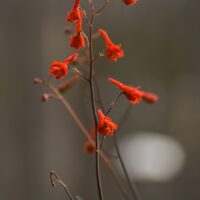
Delphinium nudicaule
In late winter and spring, scarlet flowers with elongated tails perch on upright stalks, usually not more than 3 ft tall. The green, lobed leaves which form a low mound above the ground have a distinctive pale patch in their centers. This native makes its home on summer-dry slopes throughout much of Northern California and parts of Central Ca., inhabiting bright, open woodlands and rocky road cuts. Needs good drainage and little to no irrigation in the summer. While it can grow in a fair amount of shade, it blooms best under a bright, dappled canopy. A favorite of hummingbirds and butterflies. All parts are poisonous if ingested.
Delphinium trolliifolium
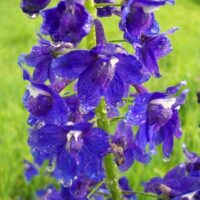
Towers of dense, blue purple flowers reaching up to 4 ft high make this one of our most striking native larkspur. The robust stalks rise above elegantly cut leaves featuring an appealing matte finish. The new leaves emerge in winter after a summer/fall dormancy, followed by the stunning floral display in early spring. Native to the northwest corner of our state, where it grows in oak woodlands, bright, coniferous forests and coast chaparral. Enjoys moisture in the winter and spring, but should be allowed to go somewhat dry in the summer when dormant. Provide light shade away from the coast. Attractive to butterflies and hummingbirds. All parts are poisonous if ingested.
Dendromecon harfordii
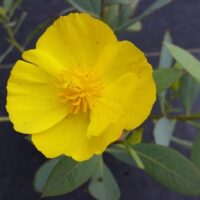
A beautiful and much sought after shrub native to California’s Channel Islands. Growing 6 - 10 ft. tall with bluish-gray foliage and a showy display of brilliant yellow poppy blossoms - spring into early summer, with scattered flowers throughout the year in mild climates. Requires full sun, good drainage, and little to no irrigation once established.
Dendromecon rigida
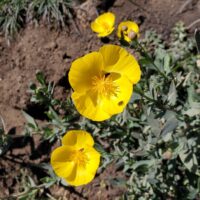
This is our local bush poppy, growing 4 - 8 ft. tall with bluish-gray foliage and a showy display of brilliant yellow poppy blossoms from spring into early summer. Scattered flowers may be seen throughout the year in mild climates. The leaves are narrower than those of the island bush poppy and the plant has a more open form. Requires full sun, good drainage, and little to no irrigation once established.
Dicentra formosa
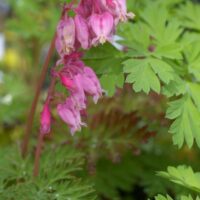
Ferny foliage makes a lacy groundcover in shady areas. Clusters of pendulous, pink, heart-shaped flowers in spring and into summer. Will spread rapidly when happy, enjoying moist but not soggy woodland conditions. Tolerates dry shade where it goes dormant with drought. Early nectar source for hummingbirds and bumble bees. Deer resistant.
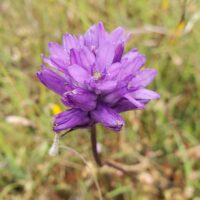
Dichelostemma congestum
A perennial wildflower with rounded, purple flower clusters held atop slender, naked stems. In late spring and early summer, the cheerful floral umbels rise 2 to 3 feet above low, grass-like leaves. Native to hillside grasslands and mountain meadows throughout western North America, this wild hyacinth species is taller than its Brodiaea relatives, with larger inflorescences than the similar blue dick. Usually spreads slowly by corms and seed to form colonies. An excellent nectar plant for the dry borders of pollinator gardens, alongside other native bulbs, and in meadow plantings. Plant in full sun to light shade with decent drainage. Water minimally and leave dry during summer dormancy.

Dichelostemma ida-maia
Blooming firecracker flowers are a sight to behold. Native to grassy slopes and woodland edges from Mendocino County to Southern Oregon, this distinctive native bulb is truly unique. Long, strap-shaped leaves give rise to tall, naked stems, 20 - 25 inches in height. Generous clusters of pendulous, one inch floral tubes of striking crimson with reflexed green tips reveal protruding little fringes of white. Bloom in late spring to early summer. Prefers lightly shaded areas that will go dry in summer after flowering. Does well in containers, as long as it is allowed to go dry once dormant. Flowers are custom built for hummingbirds and butterflies.
Dichelostemma ida-maia x multiflorum ‘Pink Diamond’
A natural occurring hybrid involving the red firecracker flower and a blue flowering species, producing bright, magenta-pink tubular flowers with charming reflexed tips like it's firecracker parent. Strap shaped leaves emerge in the spring with leafless flower stems following, 8-20 inches tall. The umbels of deep pink flowers are favored by hummingbirds and butterflies. Tolerant of different soil types in full sun to light shade. Dry conditions once it goes dormant is a must. Good container plant.
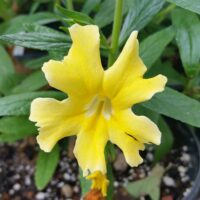
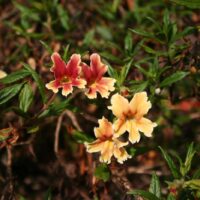
Diplacus (Mimulus) ‘Changeling’
This charming hybrid monkeyflower offers a beautiful blend of soft orange, red, and cream hues on ruffly-edged, trumpet-shaped blossoms. As the mottled colors mellow with age, each bloom looks a little different from the next, adding to the appealing "changeling" effect. Foliage is evergreen and grows to 3 ft. tall and wide. Plant in full sun on the coast to light shade inland and give it well drained soil. Drought tolerant once established, but some occasional summer water is helpful. Bees, butterflies and hummingbirds work the flowers and the painted lady and checkerspot butterflies use it as a larval food source. Deer resistant.