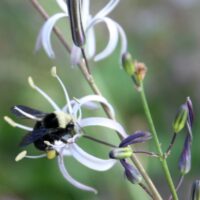
Chlorogalum pomeridianum v. pomeridianum
Known for their large, fibrous bulbs historically used by indigenous peoples and early settlers for soap, food and to stupefy fish. Long, wavy-margined leaves form a rosette in winter followed in late spring by tall, airy flower stems bearing small white flowers that open in the late afternoon and evening. Great in naturalistic settings in full sun to light shade. Needs to go summer dry once established. Larval food source for the Western Brown Elfin butterfly.
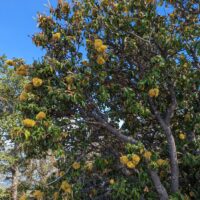
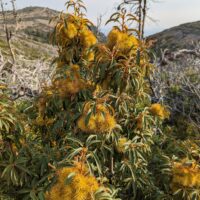
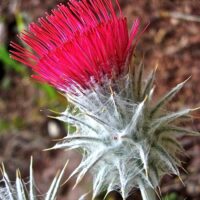
Cirsium occidentale
A beautiful NATIVE and NON-WEEDY thistle. Forms a rosette of gray woolly and spiny leaves the first year. A BIENNIAL, flowering occurs the second year with tall, narrow spikes of showy maroon-red to dark pink flowers with cobweb hairs on the bracts. A striking plant, usually reaching 3 - 6 ft tall when blooming, for sunny areas with good drainage and low to no irrigation. An excellent addition to the habitat garden where it attracts bees, butterflies and hummingbirds. Butterflies such as the painted lady and the mylitta crescent depend on cobweb thistle as a larval food source. Deer resistant.

Clarkia amoena ssp. whitneyi
Nearly extinct in the wild, this beautiful ANNUAL was found in coastal communities in Mendocino and Humboldt Counties. Growing 3 ft. tall and wide, the branched leafy stems are topped with a long succession of 3 inch cup- shaped flowers. The large flowers are light lavender-pink with whitish areas at the base of the petals. Clarkias make excellent garden plants needing very little and giving much in return. Plant in full sun to light shade, as a filler among trees or shrubs, in mixed flower border or meadow planting. A little water while flowering will extend their show. Good container subject too. Excellent cut flowers. Seems to be deer resistant. Attractive to bees and butterflies.
Clarkia rubicunda
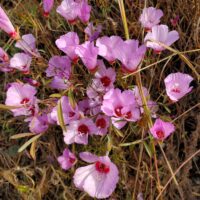
Showy and floriferous, with gorgeous, cup shaped blossoms of silky, pink-purple petals featuring a dark red center with a long bloom from late spring into summer. This endemic, ANNUAL wildflower grows in openings of woodlands and chaparral near the coast, mostly in the central part of state. Grows 2-ft. tall or more in full sun with low water needs. Tolerant of heavy soils, the exuberant blossoms attract bees, butterflies and moths, including Sphinx moth species. Performs well in containers and is an excellent cut flower too. Deer resistant.
Clarkia williamsonii
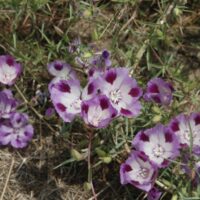
The incredibly showy flowers of this native ANNUAL will take your breath away in late spring and early summer. The large, lavender-pink, papery flowers feature deep, burgundy-red brush strokes and cheery white centers. Plants form a loose mound about 1 ½ ft. around. Butterflies and other pollinators love Clarkias. Native to the Sierra foothills, where it grows in full sun to light shade. Plants enjoy moisture while they are developing in the winter and spring, but are accustom to hot and dry summers. Needs decent drainage. Reseeds readily, as long as there is exposed soil nearby. Deer resistant!
Clematis lasiantha
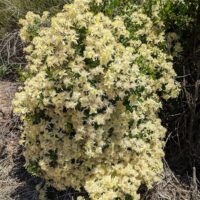
This deciduous native vine climbs over shrubs and trees in full sun to part shade. Produces a wealth of one inch, creamy-white flowers in spring and summer followed by large fluffy attractive seed heads. Use clematis to adorn a pergola or archway, or to train up trees or other structures. Plant in full sun to light shade. Little water once established. Generally deer resistant.
Cleomella (Isomeris) arborea
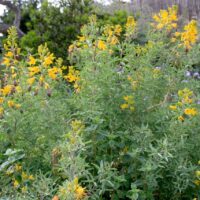
This distinctive small shrub from Southern California features clusters of golden-yellow flowers with long stamens, giving them a delicate, airy quality. The flowers are followed by papery, lantern-like seed pods which can become almost translucent with age. While this species blooms strongest in the spring, flowers can be seen year-round. Bladderpod has a loose, rounded habit, reaching 4 to 6 ft. tall and wide. If your plant becomes too lanky, simply cut it to the ground to rejuvenate it. Plant in full sun with good drainage and provide infrequent to zero irrigation once established. A great nectar source for hummingbirds, bees and butterflies. Deer resistant.
Previously known as: Peritoma arborea
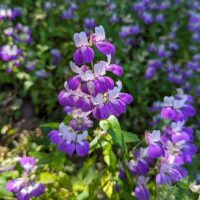
Collinsia heterophylla
A striking form of a native annual wildflower found in open woodlands in much of California. The open lipped flowers are stacked in tiers, and said to look pagoda-like. This charming woodlander is best in bright shade, in edges and openings, or under oaks, where it blooms from mid spring to early summer. Grows around 2 ft. by 2 ft. When happy it will reseed and those seedlings will require no irrigation. A bee and butterfly favorite.
Comarostaphylis diversifolia
Looking something like a toyon but closely related to manzanita, this handsome evergreen is a useful landscape subject. Native to chaparral communities near the coast in Southern California where it usually grows on north facing slopes. Growing slowly 6-20 ft. tall with shredded red bark and shiny dark green foliage. Creamy-white urn-shaped flowers in racemes bloom March-May are attractive to hummingbirds and pollinators. The dark-red rough textured fruits in summer are enjoyed by many kinds of birds. Grow as an upright shrub or with selective pruning can be trained into a small tree. Useful as a specimen, background screen or informal hedge in full sun to light shade with good drainage. Will except summer water only with good drainage and is drought tolerant once established.
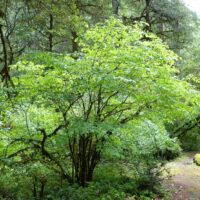
Corylus cornuta ssp. californica
Western hazelnut is a handsome, open, multi-stemmed shrub native to forests from Santa Cruz northwards in the Coast Range, and from Sequoia northwards in the Sierra foothills. Winter deciduous with decorative dangling catkins in winter. The soft, somewhat hairy leaves turn yellow in the fall. Small amounts of tasty nuts are produced in late summer and are relished by wildlife and people. Part shade with some moisture, but will tolerate fairly dry conditions once established. Usually grows 6 - 10 ft. tall. Somewhat deer resistant.
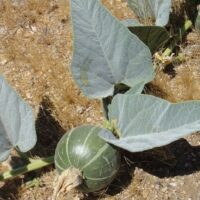
Cucurbita foetidissima
Found in valley grasslands and coastal scrub environments of Central and Southern California, the buffalo gourd is a deciduous perennial ground cover or vine that is sure to grab attention. In late winter and early spring, this vigorously spreading gourd emerges from a tuberous root, potentially spreading to 20’ feet or more, producing big, triangular, gray-green fuzzy leaves, followed by large, showy, orange-yellow, bell-shaped flowers in summer which attract bees. The round fruits, about 4 inches across, are green-striped when young, maturing to yellow. As the fruit matures, it is too bitter for humans to eat. The mature fruit is used by native peoples for decorative purposes or for making musical rattles. Plant in full sun. Drought-tolerant once established.
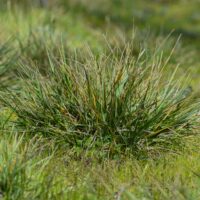
Danthonia californica
California oatgrass is a native bunchgrass found throughout mountains and coast ranges in both open and partly shaded areas. Forms dense leafy tufts with flower stalks of nodding spikelets to 1 1/2 ft. tall. Not to be confused with the invasive alien wild oats, this native makes a good basic grass for a meadow planting. Withstands trampling and traffic. Good for soil stabilization. Sun to very light shade. Little to no summer water once established. Deer resistant.
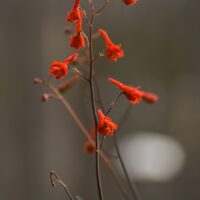
Delphinium nudicaule
In late winter and spring, scarlet flowers with elongated tails perch on upright stalks, usually not more than 3 ft tall. The green, lobed leaves which form a low mound above the ground have a distinctive pale patch in their centers. This native makes its home on summer-dry slopes throughout much of Northern California and parts of Central Ca., inhabiting bright, open woodlands and rocky road cuts. Needs good drainage and little to no irrigation in the summer. While it can grow in a fair amount of shade, it blooms best under a bright, dappled canopy. A favorite of hummingbirds and butterflies. All parts are poisonous if ingested.
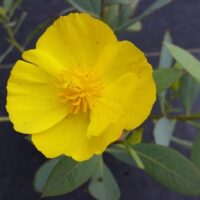
Dendromecon harfordii
A beautiful and much sought after shrub native to California’s Channel Islands. Growing 6 - 10 ft. tall with bluish-gray foliage and a showy display of brilliant yellow poppy blossoms - spring into early summer, with scattered flowers throughout the year in mild climates. Requires full sun, good drainage, and little to no irrigation once established.
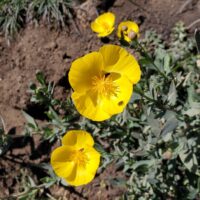
Dendromecon rigida
This is our local bush poppy, growing 4 - 8 ft. tall with bluish-gray foliage and a showy display of brilliant yellow poppy blossoms from spring into early summer. Scattered flowers may be seen throughout the year in mild climates. The leaves are narrower than those of the island bush poppy and the plant has a more open form. Requires full sun, good drainage, and little to no irrigation once established.
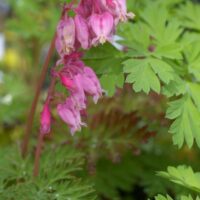
Dicentra formosa
Ferny foliage makes a lacy groundcover in shady areas. Clusters of pendulous, pink, heart-shaped flowers in spring and into summer. Will spread rapidly when happy, enjoying moist but not soggy woodland conditions. Tolerates dry shade where it goes dormant with drought. Early nectar source for hummingbirds and bumble bees. Deer resistant.
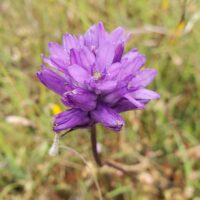
Dichelostemma congestum
A perennial wildflower with rounded, purple flower clusters held atop slender, naked stems. In late spring and early summer, the cheerful floral umbels rise 2 to 3 feet above low, grass-like leaves. Native to hillside grasslands and mountain meadows throughout western North America, this wild hyacinth species is taller than its Brodiaea relatives, with larger inflorescences than the similar blue dick. Usually spreads slowly by corms and seed to form colonies. An excellent nectar plant for the dry borders of pollinator gardens, alongside other native bulbs, and in meadow plantings. Plant in full sun to light shade with decent drainage. Water minimally and leave dry during summer dormancy.

Dichelostemma ida-maia
Blooming firecracker flowers are a sight to behold. Native to grassy slopes and woodland edges from Mendocino County to Southern Oregon, this distinctive native bulb is truly unique. Long, strap-shaped leaves give rise to tall, naked stems, 20 - 25 inches in height. Generous clusters of pendulous, one inch floral tubes of striking crimson with reflexed green tips reveal protruding little fringes of white. Bloom in late spring to early summer. Prefers lightly shaded areas that will go dry in summer after flowering. Does well in containers, as long as it is allowed to go dry once dormant. Flowers are custom built for hummingbirds and butterflies.
Dichelostemma ida-maia x multiflorum ‘Pink Diamond’
A natural occurring hybrid involving the red firecracker flower and a blue flowering species, producing bright, magenta-pink tubular flowers with charming reflexed tips like it's firecracker parent. Strap shaped leaves emerge in the spring with leafless flower stems following, 8-20 inches tall. The umbels of deep pink flowers are favored by hummingbirds and butterflies. Tolerant of different soil types in full sun to light shade. Dry conditions once it goes dormant is a must. Good container plant.
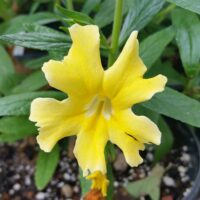
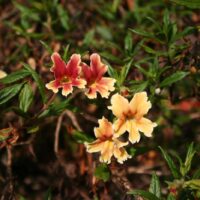
Diplacus (Mimulus) ‘Changeling’
This charming hybrid monkeyflower offers a beautiful blend of soft orange, red, and cream hues on ruffly-edged, trumpet-shaped blossoms. As the mottled colors mellow with age, each bloom looks a little different from the next, adding to the appealing "changeling" effect. Foliage is evergreen and grows to 3 ft. tall and wide. Plant in full sun on the coast to light shade inland and give it well drained soil. Drought tolerant once established, but some occasional summer water is helpful. Bees, butterflies and hummingbirds work the flowers and the painted lady and checkerspot butterflies use it as a larval food source. Deer resistant.
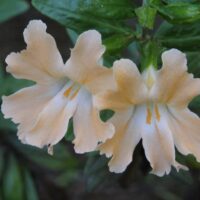
Diplacus (Mimulus) ‘Creamsicle’
The trumpet-shaped blossoms of the 'Creamsicle' monkeyflower are a beautiful, light shade of pastel orange. With their white throats and dark orange nectar guides, the flowers have a two-toned affect. This is one of Phil Van Soelen's first hybrids using Diplacus bifidus from Bowman Lake in the Sierra Nevada (thanks to Ted Kipping). It has proved long lived in both Fulton and Sebastopol and has the useful characteristic of sprouting new growth from the base so that old growth can be pruned away. Evergreen foliage grows 2-3 feet tall and wide. Best with light shade, good drainage, and minimal summer water. Deer resistant.
Diplacus (Mimulus) ‘Eleanor’
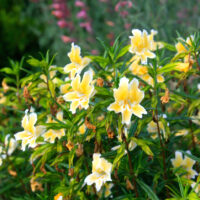
The ‘Eleanor’ monkeyflower selection, introduced by Yerba Buena Nursery, offers an abundance of soft citrusy-yellow blossoms edged in white. Monkeyflowers are evergreen, floriferous subshrubs that bloom spring through the summer. This hybrid form grows to around 3-foot tall and wide. Best with good drainage, light shade, and occasional deep watering once established. Avoid drip irrigation. Pinching older stems helps produce a fresh, dense habit for these profusely blooming plants. Monkeyflowers are deer resistant, and are a larval food source for the painted lady and checkerspot butterflies.
Diplacus (Mimulus) ‘Fiesta Marigold’
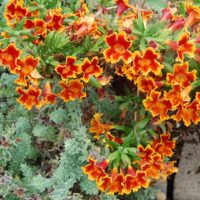
Selected for its large, frilly, brick-red blossoms with orange edging, this striking monkeyflower hybrid comes from horticulturalist Richard Persoff. It is also a relatively compact form at 18 inches to 2 feet tall and wide. Valued for their long bloom season, monkeyflowers perform best with good drainage and sun to light shade. Drought tolerant, but some occasional summer water is helpful. Monkeyflowers benefit from pinching to produce a nice shape and strong structure to hold the abundant blossoms. Highly attractive to bees and hummingbirds. Deer resistant.
Diplacus (Mimulus) ‘Georgie Red’
This hybrid monkey flower has large, brick-red flowers that have an apricot edge to the frilly petals. The result of a breeding program by Ball Horticultural Co. using both wild and commercial material, it has a compact habit, growing 1-2 ft. tall and wide . Monkeyflowers prefer good drainage in sun to light shade with occasional deep watering. Humming bird favorites and deer resistant.
Diplacus (Mimulus) ‘Grape’
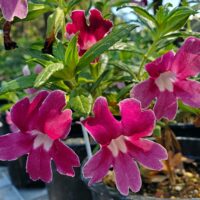
Large, open-mouthed flowers in a fruity purple with white throats and edging make the 'Grape' monkeyflower vibrant and showy. The lush, deep-green foliage stays a compact 2-foot or more tall and wide. This unique selection comes from Bay Area horticulturalist and teacher, Kathy Echols. Plant in full sun on the coast to part shade inland and give it good drainage. Best with occasional summer watering and pinching to keep good form. A favorite of hummingbirds and other pollinators. Checkerspot and buckeye butterfly larval food source. Deer resistant.
Diplacus (Mimulus) ‘Jelly Bean Dark Pink’
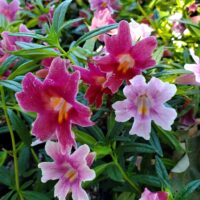
This fine selection by monkeyflower breeder Richard Persoff has large, showy flowers in a dark rosy-pink with orange throats and white edging. As the flowers age, their color becomes paler, creating a dramatic contrast between new and old flowers. Selected for its attractive foliage, floriferousness, and compact habit, it grows to 2 ft. tall and wide. Monkeyflowers are dought tolerant once established, but need good drainage and occasional deep watering to keep the flowers coming. Plant in full sun along the coast and light shade inland. A favorite of hummingbirds and butterflies. Deer resistant.
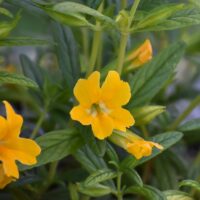
Diplacus (Mimulus) ‘Jelly Bean Gold’
This cheerful monkeyflower boasts impressive displays of sunny yellow flowers throughout most of the year. One of Richard Persoff’s hybrid selections known for their vibrant color and profuse, long-lasting blooms. The lush, evergreen foliage is a compact 2-feet tall and wide, and with periodic pinching back of stems, stays dense and bushy. Monkeyflowers are drought tolerant, but provide them with afternoon shade and occasional summer water to extend the blooming season. Grows even in poor soils so long as it has good drainage. A favorite nectar plant for hummingbirds, bees, and butterflies. The painted lady and checkerspot butterflies use it as a larval food source.