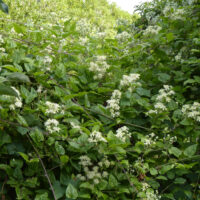
Clematis ligusticifolia
Native to riparian areas where the vining stems will climb and weave their way up and over shrubs and trees. Large masses of fragrant, small creamy-white flowers bloom in summer. Beautiful, silvery, feather-like fruits follow and are as attractive as the blossoms. The intricately divided leaves on long stems can climb 20 - 30 ft. Full sun to light shade with regular to moderate summer water. Deciduous. Generally deer resistant.
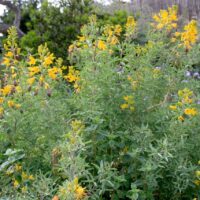
Cleomella (Isomeris) arborea
This distinctive small shrub from Southern California features clusters of golden-yellow flowers with long stamens, giving them a delicate, airy quality. The flowers are followed by papery, lantern-like seed pods which can become almost translucent with age. While this species blooms strongest in the spring, flowers can be seen year-round. Bladderpod has a loose, rounded habit, reaching 4 to 6 ft. tall and wide. If your plant becomes too lanky, simply cut it to the ground to rejuvenate it. Plant in full sun with good drainage and provide infrequent to zero irrigation once established. A great nectar source for hummingbirds, bees and butterflies. Deer resistant.
Previously known as: Peritoma arborea
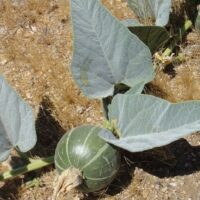
Cucurbita foetidissima
Found in valley grasslands and coastal scrub environments of Central and Southern California, the buffalo gourd is a deciduous perennial ground cover or vine that is sure to grab attention. In late winter and early spring, this vigorously spreading gourd emerges from a tuberous root, potentially spreading to 20’ feet or more, producing big, triangular, gray-green fuzzy leaves, followed by large, showy, orange-yellow, bell-shaped flowers in summer which attract bees. The round fruits, about 4 inches across, are green-striped when young, maturing to yellow. As the fruit matures, it is too bitter for humans to eat. The mature fruit is used by native peoples for decorative purposes or for making musical rattles. Plant in full sun. Drought-tolerant once established.
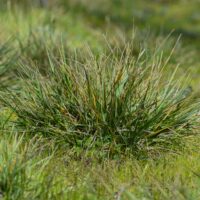
Danthonia californica
California oatgrass is a native bunchgrass found throughout mountains and coast ranges in both open and partly shaded areas. Forms dense leafy tufts with flower stalks of nodding spikelets to 1 1/2 ft. tall. Not to be confused with the invasive alien wild oats, this native makes a good basic grass for a meadow planting. Withstands trampling and traffic. Good for soil stabilization. Sun to very light shade. Little to no summer water once established. Deer resistant.
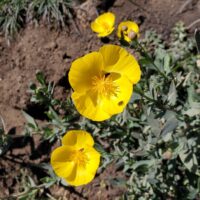
Dendromecon rigida
This is our local bush poppy, growing 4 - 8 ft. tall with bluish-gray foliage and a showy display of brilliant yellow poppy blossoms from spring into early summer. Scattered flowers may be seen throughout the year in mild climates. The leaves are narrower than those of the island bush poppy and the plant has a more open form. Requires full sun, good drainage, and little to no irrigation once established.
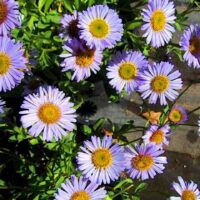
Erigeron ‘W.R.’
The "W. R." stands for the late Wayne Roderick, whom we can thank for many fine plant introductions. This hybrid involves the seaside daisy, Erigeron glaucus and some other native species more tolerant of heat. The lavender daisies sit on slender stalks about 10 inches above low rosettes of narrow leaves. The flowers bloom over a long period in summer and are very attractive to pollinators of all sorts. Provide full sun in cooler areas but will enjoy part shade in hot inland sites. Moderate to occasional irrigation. Their seeds are favored by juncos and finches. Wayne discovered this surpisingly heat tolerant selection on the Del Norte coast. This selection should not be confused with 'Wayne Roderick', which is an entirely diferent selection of Erigeron.
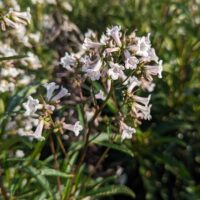
Eriodictyon californicum
Uncommon in the nursery trade, this aromatic, evergreen shrub is native to dry habitats of chaparral and mixed evergreen forest plant communities in North and Central California and into Oregon. An opportunist, this shrub stump sprouts after fires and grows with renewed vigor after any soil disturbance. The dark green, leathery leaves are covered in a shiny, fragrant, resin and are sticky to touch. The common name means, holy herb, and the pungent leaves have a long history of medicinal uses. Grows 3 - 5 ft. tall and spreads by underground roots to form a colony. Late spring brings clusters of small, trumpet-shaped flowers of pale lavender, sometimes white or pale blue, which are highly attractive to butterflies, hummingbirds and bees. Plant in full sun with good drainage and little water once established. Deer resistant.
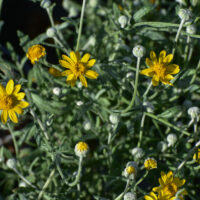
Eriophyllum lanatum – inland form
A cheerful native perennial with yellow, daisy-like flowers from spring to fall. While the species varies in size and habit, our seed-grown strains are upright, reaching around 1.5-3 feet tall and wide when in full bloom. The woolly foliage tends to be silvery, but comes in shades of green, and is most lush and dense around the base. Woolly sunflower is found in a range of plant communities from Central California through the Pacific Northwest, thriving in sun to part-shade. Our seed-grown plants come from hot, inland sites where they grow on dry, rocky slopes and bluffs. Tolerates various soil types with good drainage and minimal irrigation once established. The sunny, 2-in. blossoms are butterfly favorites and attractive to bees and other pollinators. A good choice for rock and habitat gardens. Deer and gopher resistant.

Eschscholzia lobbii – Sundew
This endemic, ANNUAL poppy is more diminutive than the typical big, orange, well known California poppy. Native to inland sites in the Central Valley and Sierra Nevada foothills, where it grows in full sun with good drainage. This floriferous little gem sports smaller, cup-shaped flowers of the most lovely, soft shade of buttery-yellow, atop gray-green, finely cut foliage to about 6 inches tall. Wonderful addition to dry garden plantings, rock gardens, in openings amongst shrubs, perennials or other annuals, or in containers. May reseed if happy. The pollen attracts all sorts of pollinators and is deer and rabbit resistant.
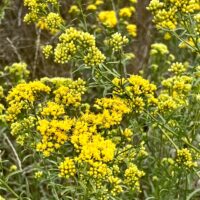
Euthamia occidentalis
This little known, native goldenrod is a pollinator powerhouse, supporting bees, as well as a wide array of butterflies, including the Monarch, who are drawn to the nectar. In late summer and autumn, small, golden-yellow flowers form rounded clusters at the tops of tall, vertical branches, 4’ to 6’ high, clothed in long, slender, leaves. Grows naturally in sunny, low-lying areas which stay at least somewhat moist into early summer, but may be dry later in the year. Spreads quickly by underground rhizomes, especially in areas with perennial moisture, making it good for erosion control, but not suitable for small gardens. In two years, plants should reach about 4’ wide. Great in containers in smaller spaces.
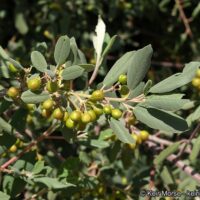
Frangula (Rhamnus) californica ssp. tomentella
This distinctive species of coffeeberry features blue-grey leaves with velvety, silver undersides and grey, fuzzy stems. The somewhat open form grows 6 to 10 ft tall and wide. Clusters of small cream-colored flowers appear from winter through spring and are a favorite of bees. The deep purple fruits which follow are highly prized by birds. While native to serpentine soils, this coffeeberry should thrive anywhere with decent drainage. Provide full sun to light shade and give occasional irrigation once established. The grey stems contrast beautifully with the shiny, dark green leaves of Ceanothus ‘Yankee Point’.
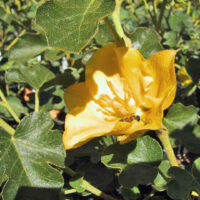
Fremontodendron ‘California Glory’
Beautiful, evergreen hybrid flannel bush to 20 ft. tall. Rich yellow, cup-shaped flowers cover the shrub May - June. Plant in full sun with plenty of room and no summer water once established. Fast growing and drought tolerant. The large flowers are attractive to bees and other pollinators. An excellent nectar plant for orioles. Needs decent drainage.
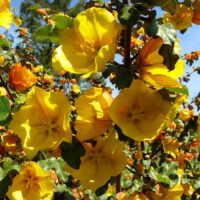
Fremontodendron ‘Pacific Sunset’
This showy hybrid flannel bush grows in a broad “V” shape to 20 ft. tall. Covered with large orange-yellow cup-shaped flowers for a long period in spring. The large flowers attract bees and other pollinators. An excellent nectar plant for orioles. Requires full sun and plenty of room. Best if not watered once established. Needs decent drainage
Fremontodendron ‘San Gabriel’
Large, showy, hybrid flannel bush quickly growing to 20 ft. tall. Covered with buttercup yellow blossoms in the spring. Because of the nature of their branching, ‘San Gabriel’ and ‘Pacific Sunset’ both espalier well. An excellent nectar plant for orioles. Requires full sun. No summer water once established. Needs decent drainage.
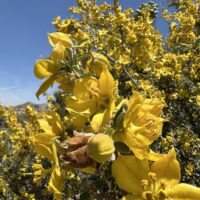
Fremontodendron californicum
In late spring, this evergreen shrub makes for a stunning display along dry foothill slopes. As masses of bright yellow blooms cover its stems, its leathery, fuzzy leaves all but disappear among the showy, cupped flowers. Of the three Fremontodendron species, all native to California, this flannel bush has the widest distribution, mostly in the western Sierra foothills and Southern California. Its range is limited to sites with well-draining, sandy or rocky soil, and it can be sensitive to garden irrigation and heavy soils. Best planted in full sun with similarly low-water species where it receives minimal direct water once established. When happy, it is fast-growing to 15 or more feet, making it a good all-season hedge. Flowers are wildly popular with bees and other pollinators.
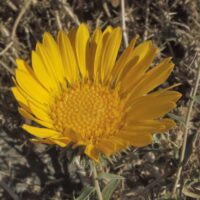
Grindelia camporum
A tough and attractive native perennial found in valleys and lowlands of California. An upright grower, 18-24 inches tall, with resinous foliage and stiff leaves and flower stems. Thick green flower buds hold bright yellow daisies summer through fall which are attractive to bees and butterflies. Best in full sun where it is drought tolerant once established. Tolerates heavy soils and is said to be deer resistant.
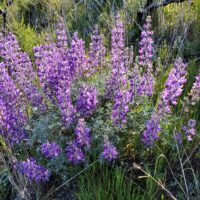
Lupinus albifrons var. albifrons
A popular California native lupine growing to around 3 ft. tall and wide. Beautiful silver foliage with intense blue-purple flower spikes in the spring. To thrive, this lupine needs full sun to very light shade and excellent drainage. Little to no water once established. Vulnerable to snail and slug predation. An excellent species for native pollinators and a larval host for several species of butterflies. Deer resistant.
Penstemon barbatus
Native to sunny, hot, rocky slopes from Utah and Colorado to Texas and Mexico, this striking penstemon is a willing grower. Forms a low mound of lush foliage, topped with 4 ft. tall, erect flower spikes of brilliant, scarlet, tubular blossoms, providing a bold splash of color in beds, borders, rock garden or meadow planting. Plant in full sun with good drainage where it will be drought tolerant once established. Flowers adored by hummingbirds and butterflies. Deer resistant.
Penstemon barbatus ‘Coral Baby’
This dazzling selection of Penstemon is from the Plant Select program of Colorado. Forms a tidy, compact mound of bright green foliage to around 15 inches tall by 12 inches or so wide. Late spring brings upright spikes of eye catching coral-pink tubular flowers which attract bees, butterflies and hummingbirds. Full sun with good drainage and moderate to occasional summer water.
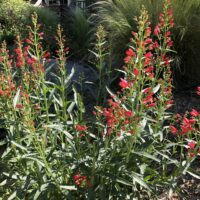
Penstemon barbatus ‘Red Riding Hood’
Trumpet-shaped blossoms of coral-red arise on thick stems up to 2 ft. high on this Dutch selection of the beardlip penstemon. Originating from the American Southwest, this superlative species offers flowers from late spring to the end of summer, enticing hummingbirds, bees and butterflies into the garden. Light green, lanceolate leaves grow densely at the base and climb up the stout stalks. This selection has proven to be very garden tolerant, liking full sun and moderate to infrequent irrigation.
Penstemon barbatus ‘Riding Hood Red’
Trumpet-shaped blossoms of coral-red arise on thick stems up to 2 ft. high on this Dutch selection of the beardlip penstemon. Originating from the American Southwest, this superlative species offers flowers from late spring to the end of summer, enticing hummingbirds, bees and butterflies into the garden. Light green, lanceolate leaves grow densely at the base and climb up the stout stalks. This selection has proven to be very garden tolerant, liking full sun and moderate to infrequent irrigation.
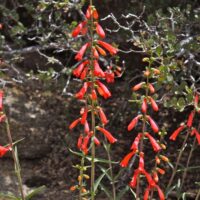
Penstemon centranthifolius
Custom made for hummingbirds, this Penstemon sports an abundance of bright-red to orange-red tubular flowers from late spring into summer. Native to dry habitats in the North Coast Ranges south to Mexico and east to the Southern Sierra, growing in chaparral and openings in woodlands below 6000 ft. Thick, blue-green leaves form a rosette 1 – 2 ft. tall and wide. Long flower spikes rise 2 – 4 ft. above the waxy leaves with many narrow, tubular, scarlet blossoms. Likes full sun, lean soils and good drainage. Drought and cold tolerant. Hummingbird and butterfly favorite.
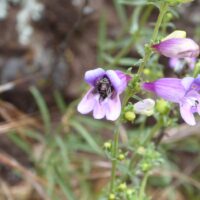
Penstemon heterophyllus
Iridescent blue-purple tubular flowers in short spikes put on a good show over a long period in spring and early summer. The spent flower spikes should be cut off to encourage more blooming, better form, and longer life. Best in full sun with well drained soils and moderate to little water once established. Hummingbird favorite.
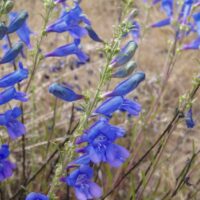
Penstemon heterophyllus – Hood Mt. seed strain
From the rugged Hood Mountain area, southeast of Santa Rosa, comes this local seed strain of foothill penstemon, which is showing promise as a particularly good performer. Proving to be vigorous and disease resistant, blooming freely with particularly large, vivid-blue, open-mouthed, tubular blossoms, spring into summer. An evergreen perennial, growing about 2 ft. tall and at least as wide, for full sun with decent drainage, and little water once established. Bees, butterflies and hummingbirds are all attracted to the showy flowers. A great, local, seed grown alternative to the cutting-grown 'Margarita BOP'.
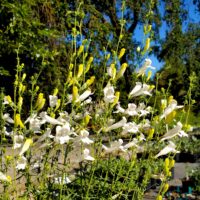
Penstemon heterophyllus ‘GMR White’
An unusual, bright white form of our native foothill penstemon that dazzles with dense blooms from spring to fall. Spring sees the emergence of soft yellow buds on this evergreen perennial, which then open as snowy fresh, tubular flowers. The showy flower stalks reach 18 inches to 2 feet and look spectacular cascading out of a container. A natural selection, its name is an abbreviation of Glendora Mountain Road, the area just north of Los Angeles where it was found. As beloved by hummingbirds and pollinators as the more common blue-violet form of this species and even more shockingly floriferous. Plant in full sun to very light shade where it will have good drainage, and provide occasional to no water. Thrives in large pots. Drought tolerant.
Penstemon heterophyllus ‘Margarita BOP’
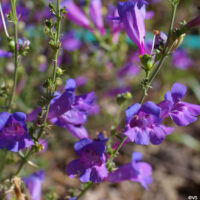
A fine selection of a native penstemon from Las Pilitas Nursery where this chance hybrid seedling was discovered at the “Bottom Of the Porch”. Forms a tidy mound 18 inches tall by 2 ft. or so wide. Iridescent blue-purple tubular flowers in short spikes put on a good show over a long period in spring and early summer. The spent flower spikes should be cut off to encourage more blooming, better form, and longer life. Best in full sun with well drained soils and moderate to little water once established. 'Margarita BOP' has proven particularly adaptable and has survived longer than other cultivars. Hummingbird favorite.
Penstemon newberryi v. sonomensis
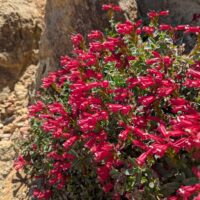
This rare, perennial, inland beauty, found only in Sonoma, Napa, and Lake Counties, is a great addition to the dry, inland rock garden. A low mat of small, gray-green, succulent-like leaves gives rise to 5-12” stalks topped with clusters of chunky, tubular, magenta-red flowers with white, fuzzy throats and reproductive structures. Mature plants are no more than 2' wide. A native bee and hummingbird magnet. Plant in full sun with decent soil drainage. Little to no water once established.
Penstemon palmeri
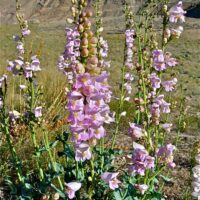
Showy, grape-scented, pale pink flowers top blue-green, succulent-like foliage on vertical stalks reaching an astonishing 4 to 5 ft. in height. The bulbous flowers have given rise to the common name, ballon flower. Native to desert mountains of southern California and throughout the western United States. This penstemon is attractive to a multitude of pollinators, especially hummingbirds. Plant in full sun to light shade and provide good drainage. Drought tolerant once established. The tall but narrow flower stalks make this penstemon useful in narrow spaces where height is desired.
Penstemon parryi
An adaptable species from the desert southwest of the United States. Thick bluish-green foliage forms a low rosette around 2 feet wide. Bright pink funnel-shaped flowers are produced in profusion on stems 2-3 ft. tall in spring. Good drainage and full sun with moderate to little water once established. Attracts bees, butterflies and hummingbirds.
Penstemon pseudospectabilis
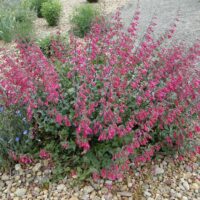
From the southeast corner of the state comes this surprisingly adaptable penstemon, with prolific displays of magenta-purple, tubular flowers with flared mouths. Large, serrated, gray-green leaves line stems in attractive pairs. Flower stalks rise 2 – 3 ft. in spring, drawing in hummingbirds and bees. Even though this species is from the desert, it does quite well in local gardens with good drainage, full sun and occasional irrigation once established. Several local butterflies use the desert penstemon as a larval food source, including the common buckeye, variable checkerspot and Edith’s checkerspot.