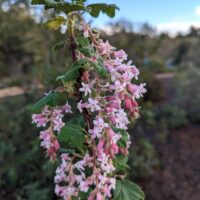
Ribes malvaceum ‘Dancing Tassels’
A dazzling selection by Rancho Santa Ana Botanic Garden from San Clemente Island. Blooming in winter over a long period with the longest dangling flower clusters we’ve seen in the species. Pendulous flower clusters are dusty pink in bud, opening to white and soft pink when fully open. Growing 6 ft. or more tall, this deciduous, vase shaped shrub has gray-green foliage with a pungent resinous fragrance. Peeling red-brown bark and clusters of blue-black berries add to its beauty and appeal. Chaparral currant blooms earlier and is more sun and drought tolerant than the popular pink flowering currant, Ribes sanguineum glutinosum. Plant in full sun to light shade with little to no water once established. An outstanding early nectar source for hummingbirds.
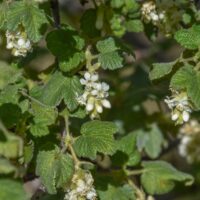
Ribes malvaceum ‘Rana White’
This unusual form of the chaparral currant has pure white flowers, not the typical pink flowers one normally sees. Forming an erect shrub of true green, aromatic foliage 6 ft. or more tall and wider. Winter and early spring bring short pendant racemes of the fragrant white flowers that are highly attractive to hummingbirds and pollinators. Clusters of sticky berries follow and are relished by birds. Though it will tolerate garden conditions, this currant is extremely drought tolerant once established. When allowed to go dry, this well-adapted species drops its leaves in late summer and leafs out again in late autumn. Moderate irrigation can make it almost evergreen. Plant in full sun to light shade. This species can be found throughout much of California in chaparral and on the edges of woodlands. Introduced by Rana Nursery.
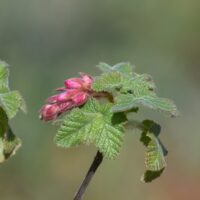
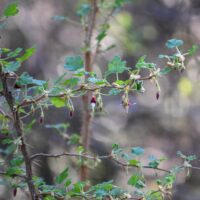
Ribes menziesii
A gooseberry of low elevation forests, growing to around 5-8 ft. tall with an open, arching habit. Bright green scalloped leaves with pale undersides are set on spiny stems. The charming flowers are small but sweet, with maroon sepals and white petals dangling beneath the thorny branches offering nectar to hummingbirds. The spiny red fruits that follow are decorative and attractive to birds. Often found on the edge or in openings of forests, the canyon gooseberry does best with light shade. It is drought tolerant especially near the coast, though it appreciates occasional summer water. An excellent habitat plant that provides shelter and food for a wide variety of birds.
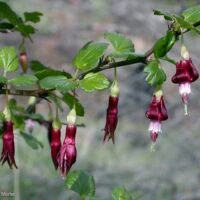
Ribes roezlii
The Sierra gooseberry's natural range is far beyond the Sierras, with varieties growing in the mountains of northern, southern and central California. Forms an arching shrub of thorny branches with pretty, little scalloped leaves, 2 - 4 ft. tall and wide. Pendant flowers are made up of burgundy-red sepals and small white to pink petals with protruding stamens, looking something like miniature fuchsias. Custom built for hummingbirds. In spring, showy, rounded fruits covered with prickles follow the flowers, starting out green and ripening to red, spiny globes which are relished by birds. This charming shrub is a lovely addition to the woodland garden where they receive light to moderate shade and are drought tolerant once established. Needs good drainage.
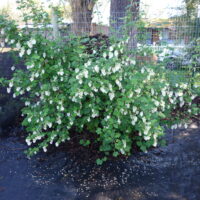
Ribes sanguineum v. glutinosum ‘Cal Flora White’
A Cal Flora Nursery original, a chance seedling in our nursery landscape. We watched this seedling develop into an elegant, eight foot, vase shaped shrub. The five inch pendulous racemes dangle from the branch tips and are pure white. Give flowering currants light or part shade except along the immediate coast where they grow in full sun. Moderate to occasional water once established. Hummingbird and bumblebee favorite. Birds enjoy the fruits.
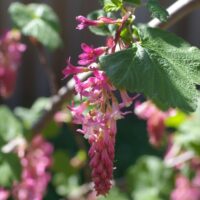
Ribes sanguineum v. glutinosum ‘Claremont’
Distinctive for its extra long, pendulous racemes of pink flowers with white centers. This Rancho Santa Ana Botanic Garden selection of the pink flowering currant is particularly vigorous, featuring abundant floral displays in early spring. Will attain a height and spread of 6 - 8 ft over time. Best with light shade and a little summer water. Important early nectar source for bumblebees and hummingbirds. Berries attract many birds including grosbeak and mockingbirds.
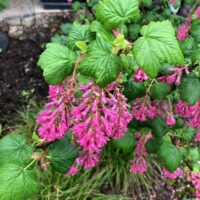
Ribes sanguineum v. glutinosum ‘Heart’s Delight’
A coastal Marin County selection of one of the West's choicest native shrubs. Deciduous, grows 6 ft. tall or more. In early spring it produces long drooping racemes of deep rosy-pink blossoms. Best with light shade inland, humusy soil and some summer water. Hummingbirds love the flowers and the berries attract many birds including robins, grosbeak and mockingbirds.
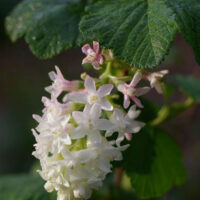
Ribes sanguineum v. glutinosum ‘Inverness White’
Selected by Roger Raiche on Inverness Ridge in Marin County. Distinguished from other white flowering cultivars in that the pure white blossoms develop a rosy cast as they fade. Deciduous shrub about 6 ft. tall by 6 ft. wide. Best with a little shade, woodsy soil and a little summer water. Berries attract many birds including grosbeak and mockingbirds.
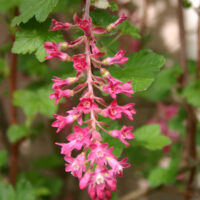
Ribes sanguineum v. glutinosum ‘Monte Bello’
This Cal Flora introduction was discovered in the hills west of Cupertino in the Santa Cruz Mountains. Long clusters of deep pink flowers make this selection of the pink-flowering currant stand out from other forms. In late winter and spring the flowers emerge on bare stems followed by rounded, maple-like leaves. This deciduous shrub has a vase-like shape, reaching a height of up to 10 ft. over time and a width of at least 6 ft. Provide full sun near the coast and light shade inland. Needs moderate to occasional irrigation once established. A great plant for hummingbirds and a wide array of pollinators. Birds enjoy the fruits.
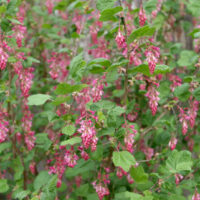
Ribes sanguineum v. glutinosum ‘Tranquillon Ridge’
A Native Sons Nursery selection from Tranquillon Ridge in Santa Barbara County, found growing under a canopy of Bishop pines. Super vigorous and very large, up to 10 ft. tall with extremely long racemes of dark pink flowers in the early spring. The racemes have an appealing shape, tapering to a point at the end of their long pendant flower clusters. Best with some shade even in coastal gardens where it’s drought tolerant. Occasional deep waterings are best in hot inland areas. Berries attract many birds including grosbeak and mockingbirds.
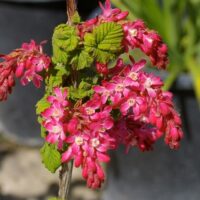
Ribes sanguineum v. sanguineum ‘Barrie Coate’
This selection of red flowering currant is a knock out in bloom. An early bloomer often starting in February with short racemes of nodding clusters of very deep rosy-pink, nearly red blossoms. Clusters of blue-black fruits follow and are enjoyed by birds. This deciduous shrub will grow 6 foot tall by 4 foot wide. Plant in sun to light shade with afternoon shade in hot regions and moderate to occasional summer water. An excellent early source of nectar for hummingbirds.
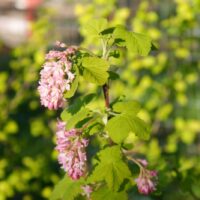
Ribes sanguineum v. sanguineum ‘Brocklebankii’
A distinctive shrub with gorgeous golden foliage on 5 ft. tall stems. Pendulous racemes of pink flowers in early spring just as the leaves are emerging are a favorite of hummingbirds. The leaves will scorch in the hot sun so part shade is best, especially during the hottest time of day. This cultivar prefers even moisture.
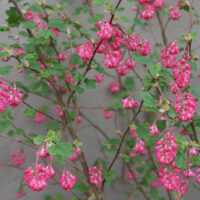
Ribes sanguineum v. sanguineum ‘Elk River Red’
This selection of the red flowering currant is from the Pacific Northwest. A deciduous shrub growing 6 ft. or more tall. Early spring brings eye catching bright rosy-red blossoms in drooping clusters. A wonderful early nectar source for hummingbirds. Plant in cool sun or light shade inland with occasional to moderate summer water. Berries attract many birds including grosbeak and mockingbirds.
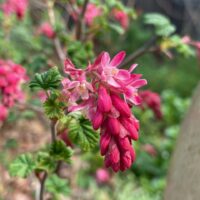
Ribes sanguineum v. sanguineum ‘King Edward VII’
Deep pink flower tassels adorn this native deciduous currant in early spring, providing a vivid splash of color to an awakening landscape. The pendulous flower clusters are followed by scalloped, deep green leaves, creating a useful texture to pair with Iris, Ceanothus and ferns. ‘King Edward VII’ has a very upright vase shape, reaching between 5 to 7 ft. tall and 4 to 5 ft. wide. Provide full sun in coastal climates and bright shade elsewhere, especially in the afternoon. Needs moderate to occasional irrigation. The flowers provide an excellent nectar source for bees, butterflies and hummingbirds while the deep purple fruits are enjoyed by birds. A sturdy selection.
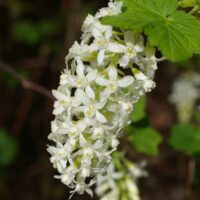
Ribes sanguineum v. sanguineum ‘White Icicle’
This selection of flowering currant is from the University of British Columbia Botanic Garden. Flowers in early spring are pure white on long racemes. Foliage is bright green. Compact habit, 6 - 8 ft. tall. Light shade in hot regions with occasional summer water. Berries attract many birds including grosbeak and mockingbirds.
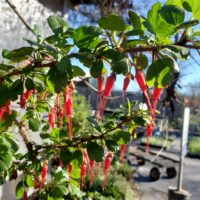
Ribes speciosum
One of California’s showiest gooseberry, blooming in late winter - early spring with charming bright red, pendant, fuchsia-like flowers. The thorny branches are arching and grow 4 - 6 ft. tall and wide. Best with light shade and needs no irrigation once established. Occasional summer water keeps most of the leaves green through the summer, but will go summer dormant with dry conditions. An excellent choice for under native oaks. The flowers attract hummingbirds and the spiny fruits attract many birds including grosbeak and mockingbirds. Deer resistant.
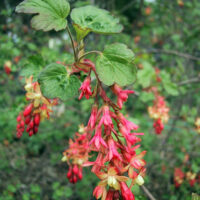
Ribes x gordonianum
A special hybrid flowering currant created in England by Donald Beaton in 1837 between our western U.S. Ribes sanguineum and the central U.S. Ribes odoratum. The fragrant flowers hang in dense dangling clusters in late spring and produce a dazzling color display with warm coppery red on the outside and yellow on the inside. The green maple-like leaves are deciduous. Robust and spreading, this currant grows to about 6 ft. tall and 8 ft. wide. Provide full sun to light shade and give moderate water.
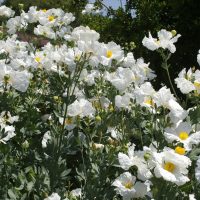
Romneya coulteri
A much admired, spectacular, shrub-like perennial, with a long history in cultivation. Can be both finicky to get going and extremely vigorous once established. The large flowers are made up of crinkly, crape paper-like, white petals with a shaft of yellow stamens in the center, at the top of long, gray-foliaged stems. Plant where its size and spreading won't be a problem and prune severely in winter. Height 4 -8 feet. Full sun. Drought and deer tolerant.
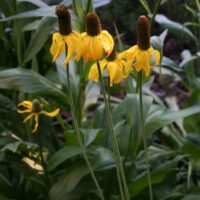
Rudbeckia californica
Large, bold perennial native to montane seeps and meadows where they receive regular moisture. The big leafy clumps can become very large growing 3 foot tall or more. Midsummer brings showy yellow daisies on tall stems with a distinctive long central cone and a skirt of three inch yellow petals. Plant in sun to light shade with regular water. Highly attractive to bees and other pollinators.
Rudbeckia glaucescens
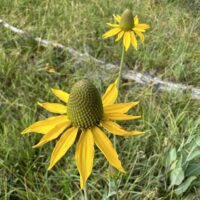
This uncommon coneflower hails from the Klamath Mountains of northern California and southern Oregon. While similar in flower to the California coneflower, featuring yellowish-brown cones encircled with a skirt of long, yellow petals, this species has waxy leaves tinted a striking blue-gray. The flowers perch atop leafless stalks reaching 3 to 4 ft tall, rising above the large, lance-shaped leaves. A favorite of bees and butterflies. Even though this species normally occurs in serpentine soils, it grows easily in almost any soil type, as long as it is kept moist. Enjoys regular to moderate irrigation and full sun to part shade.
Rudbeckia occidentalis
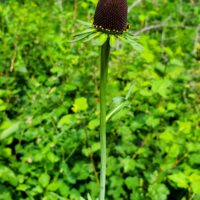
From mountains in Northern California and throughout the West comes this unusual and distinctive coneflower. Deep purple, almost black cones sit atop a star of green sepals without any petals to distract from the striking form. Large, pointed green leaves climb up the flowering stems which can reach 5 or 6 ft. high. Slowly spreads to form a small clump in moist locations with decent drainage. Will tolerate full sun near the coast, but some afternoon shade is needed in hot, inland areas. An excellent pollinator plant from the sunflower family attracting bees and butterflies. Works well in a container. Winter deciduous.

Salvia ‘Aromas’
A hybrid between Salvia clevelandii & Salvia leucophylla, this aromatic shrubby sage grows 4 ft. tall and 4 ft. wide. Early summer brings flower stalks with whorls of lavender-blue blossoms. Good for sunny areas with good drainage. Occasional to little summer water. Flowers are attractive to bees, hummingbirds and butterflies. Deer and drought tolerant.
Salvia ‘Bee’s Bliss’
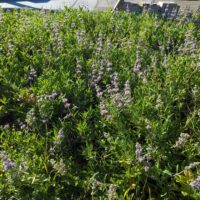
A beautiful native hybrid sage grows around 18 inches tall by 6 ft. wide or more. The handsome gray foliage is topped with a profusion of lavender flowers on long spikes in the spring. Sun, decent drainage, occasional to little water. Deer tolerant. A bee and hummingbird favorite.
Salvia ‘Calamity Jane’
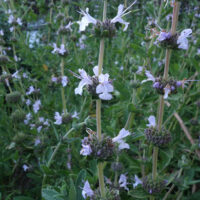
A cross between Salvia leucophylla and a prostrate form of Salvia mellifera. Forms a fragrant mounding shrub up to 4 ft. tall and spreading, with flower spikes of light lavender blossoms. An excellent choice for a dry sunny bank with little to no summer water once established. Flowers are highly attractive to bees and hummingbirds. Deer resistant.
Salvia ‘Celestial Blue’
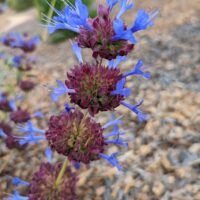
A pollinator powerhouse, this sage attracts hummingbirds, bees and butterflies with its vibrant blossoms. Selected and introduced by Las Pilitas Nursery, thought to be a hybrid between Salvia clevelandii and S. pachyphylla, or perhaps a three way hybrid involving Salvia 'Pozo Blue'. Gray-green, sweetly fragrant foliage, grows 3 to 5 ft. tall and wide. The striking blue flowers are on widely spaced whorls of eye-catching violet-blue. The decorative, architectural seed heads that follow provide food for songbirds. Plant in full sun with good drainage and occasional water. Drought and deer tolerant tolerant.
Salvia ‘Mrs. Beard’
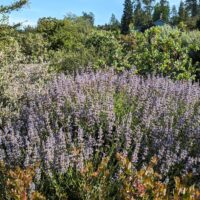
This cultivar has been around since 1965, a chance seedling discovered in a Berkeley garden. A hybrid between Salvia sonomensis and Salvia mellifera, 'Mrs. Beard’ has proven durable and disease resistant. Forms a dense mat of gray fragrant foliage up to 2 ft. tall and 4-6 ft. wide. Spring brings an abundance of tiny pale lavender-blue flowers in ball-like clusters that are highly attractive to bees and hummingbirds. Plant in full sun along coast and light shade in hot inland sites, where it will be quite drought tolerant once established. Deer resistant.
Salvia ‘Shirley’s Creeper’
A vigorous garden hybrid involving the native Salvia mellifera selected by Charlie Christiansen. The cultivar name is misleading. This shrub does not creep exactly but mounds up 4-6 ft. tall and wide. It can be kept lower and more dense by an annual cutting back after flowering. Dark green aromatic foliage is a nice foil for the whorls of white flowers in the spring which are a favorite of bees and hummingbirds. Plant in full sun to light shade. Very drought tolerant once established. Dependably deer resistant.
Salvia apiana
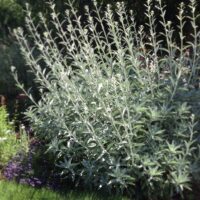
A striking native sage with large, silvery-white, aromatic leaves and tall flower stalks reaching above the foliage displaying lavender tinged white blossoms. The foliage of this shruby sage reaches 3 - 4 ft. tall with flowering stalks adding another 2 ft. or more above that. A useful plant for sunny, dry areas with good drainage. Combine with dark-leaved plants such as ceanothus and manzanitas to create a dramatic display. Used in smudge bundles as a natural incense. A bee and hummingbird favorite. Deer resistant.