
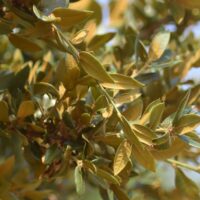
Quercus chrysolepis
A handsome evergreen oak with a rounded, spreading crown, 20 - 60 ft tall and wide. The leaves of its broad, low canopy are dark-green and shiny with fuzzy gold or silver hairs on the underside. Native from Oregon to Baja, it is the most widely distributed oak in California. Often grows near creeks, but requires only occasional water. Plant in full sun to light shade where it will be drought tolerant once established. A good choice for bank stabilization. Like other oaks, it is habitat powerhouse, offering food and cover for a huge variety of wildlife.
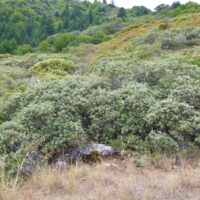
Quercus tomentella
The rarest of all California oaks, an ancient relict of the mainland, now confined to the Channel Islands, off the coast of southern California. Island oak is a small evergreen tree with a rounded canopy, 25 to 40 foot tall. Beautiful dark-green, shiny, leathery leaves with prominent parallel veins are edged with widely spaced teeth. Whitish woolly hairs cover the growing tips, undersides of leaves, and the caps of the 1 inch long acorns. A natural for gardens with coastal influence where it will be drought tolerant once established. Tolerant of many soil conditions, but attains full stature in deeper soils in sheltered locations. Oaks provide beauty, shade and food and cover for a wide array of wildlife.
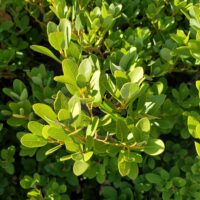
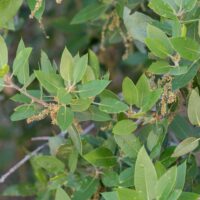
Quercus wislizeni
Typically more compact in stature than the coast live oak, this evergreen oak has similar dark-green, leathery leaves, though often narrower and flatter. A native of dry foothills, the interior live oak has a range that extends throughout much California, and is the dominant live oak in the western Sierra-Nevadas. While it can flourish in the shade, it may remain shrublike. In full sun, its densely-foliated canopy has a pleasingly broad, rounded habit. This adaptable oak takes inland heat, and once established is drought tolerant and generally deer resistant. It tolerates clay, but does best in well-draining soils. Like other oaks, it’s a great habitat plant that supports a wide range of wildlife.
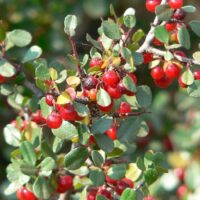
Rhamnus crocea
An under-used evergreen shrub native to chaparral, woodland, and coastal-sage scrub communities in California. Spiny redberry can grow up to 6 feet tall and wider, but is typically in the 2 - 4 ft. height range, spreading to 6 ft. or more across. Small, leathery, dark-green ovate leaves give this tough shrub a delicate look once established. The flowers on both male and female plants are inconspicuous, blooming from late winter into early spring. Female plants produce sporadic, jelly-like red berries. Great for dappled light under oaks, or a dry, shady woodland slope with California fescue. Can tolerate more sun near the coast, but prefers afternoon shade inland. Drought-tolerant once established. Larval host for a multitude of butterflies and moths, including the pale tiger swallowtail butterfly, Ceanothus silk moth, and Hermes copper butterfly. Deer resistant.
Rhamnus ilicifolia
A handsome evergreen shrub with small, dark green, leathery, serrated leaves. Found in the foothills and mountains of southern and central California, the Sierras and west of the Sacramento Valley up to 3,500 feet. Slow-growing, reaching 6-10 feet tall and wide, with a somewhat open, upright habit. Male and female plants are separate, producing inconspicuous yellow-cream flowers from spring into early summer. Female plants produce sporadic, gelatinous red fruits. Hollyleaf redberry can be planted in full sun to shade, but prefers a bit of relief from the afternoon sun in inland sites. It requires decent drainage and is drought-tolerant once established. Larval host for the pale swallowtail butterfly. Reportedly deer resistant.
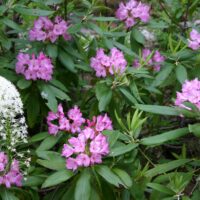
Rhododendron macrophyllum
One of the glories of our coastal redwoods forests, this evergreen rhododendron features clusters of large flowers in the spring which can range in color from deep rose to pale pink. Native from the Big Sur Coast north to Washington. In the wild, this open branched, big leaved shrub can reach a height of 13 feet. Plants in the garden tend to be much smaller, not usually exceeding 8 feet with a slightly narrower width. While somewhat temperamental in cultivation, success can be achieved with dappled shade, well draining soil rich in organic matter and moderate to regular water. Deer resistant.
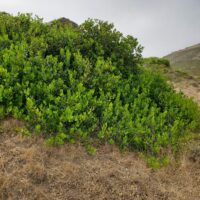
Rhus integrifolia
This sturdy native shrub or small tree is highly valued for its evergreen foliage and as a source of food for birds, bees and butterflies. Round, serrated, leaves, flatter than those of the sugar bush, cover this plant from head to toe. In late winter to early spring, white to pink flower clusters emerge, followed by sticky, reddish fruits. Ranging in height and width from 6 to 20 ft., lemonade berry is very tolerant of pruning, either into a small tree or a low hedge. Cold hardy to about 20 degrees. Plant in full sun to part shade. Will be very drought tolerant once established. Fire resistant. Deer resistant.
Rhus ovata
Handsome evergreen shrub native to dry slopes away from the coast in Southern California, Baja, and Arizona. A durable shrub thriving in hot, rocky conditions in full sun to part shade where it will be completely drought tolerant once established. Grows 6 - 10 ft. tall and wide. A profusion of dense flower clusters are rosy tinted in bud opening to white with a pinkish blush. Small reddish fruits follow that are coated with a sugary secretion that tastes lemony. Excellent subject for hot, dry inland conditions. Good for birds, bees and butterflies. Fire resistant. Deer resistant.
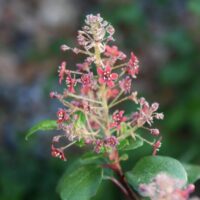
Ribes viburnifolium
Native to Santa Catalina Island, this Ribes is unique for the genus, being evergreen and low growing. Leathery, dark green, glossy leaves with a spicy fragrance on red stems forms a spreading shrubby groundcover to 2- 3 ft. tall. Small clusters of interesting, star-shaped, salmon-pink flowers decorate the arching branches in late winter to early spring, followed by little, red fruits. Requires part shade and is drought tolerant once established. Adaptable to a variety of soil types including heavy clay. Tip pruning is recommended to encourage a dense growth habit. Deer resistant.
Salvia ‘Aromas’
A hybrid between Salvia clevelandii & Salvia leucophylla, this aromatic shrubby sage grows 4 ft. tall and 4 ft. wide. Early summer brings flower stalks with whorls of lavender-blue blossoms. Good for sunny areas with good drainage. Occasional to little summer water. Flowers are attractive to bees, hummingbirds and butterflies. Deer and drought tolerant.
Salvia ‘Bee’s Bliss’
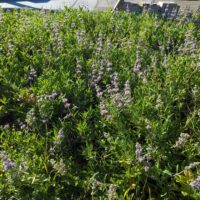
A beautiful native hybrid sage grows around 18 inches tall by 6 ft. wide or more. The handsome gray foliage is topped with a profusion of lavender flowers on long spikes in the spring. Sun, decent drainage, occasional to little water. Deer tolerant. A bee and hummingbird favorite.
Salvia ‘Calamity Jane’
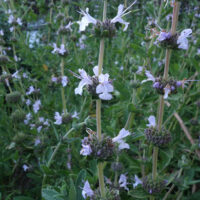
A cross between Salvia leucophylla and a prostrate form of Salvia mellifera. Forms a fragrant mounding shrub up to 4 ft. tall and spreading, with flower spikes of light lavender blossoms. An excellent choice for a dry sunny bank with little to no summer water once established. Flowers are highly attractive to bees and hummingbirds. Deer resistant.
Salvia ‘Celestial Blue’
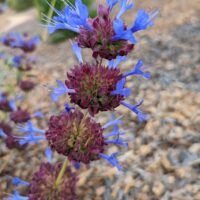
A pollinator powerhouse, this sage attracts hummingbirds, bees and butterflies with its vibrant blossoms. Selected and introduced by Las Pilitas Nursery, thought to be a hybrid between Salvia clevelandii and S. pachyphylla, or perhaps a three way hybrid involving Salvia 'Pozo Blue'. Gray-green, sweetly fragrant foliage, grows 3 to 5 ft. tall and wide. The striking blue flowers are on widely spaced whorls of eye-catching violet-blue. The decorative, architectural seed heads that follow provide food for songbirds. Plant in full sun with good drainage and occasional water. Drought and deer tolerant tolerant.
Salvia ‘Mrs. Beard’
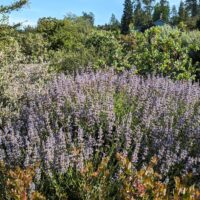
This cultivar has been around since 1965, a chance seedling discovered in a Berkeley garden. A hybrid between Salvia sonomensis and Salvia mellifera, 'Mrs. Beard’ has proven durable and disease resistant. Forms a dense mat of gray fragrant foliage up to 2 ft. tall and 4-6 ft. wide. Spring brings an abundance of tiny pale lavender-blue flowers in ball-like clusters that are highly attractive to bees and hummingbirds. Plant in full sun along coast and light shade in hot inland sites, where it will be quite drought tolerant once established. Deer resistant.
Salvia ‘Shirley’s Creeper’
A vigorous garden hybrid involving the native Salvia mellifera selected by Charlie Christiansen. The cultivar name is misleading. This shrub does not creep exactly but mounds up 4-6 ft. tall and wide. It can be kept lower and more dense by an annual cutting back after flowering. Dark green aromatic foliage is a nice foil for the whorls of white flowers in the spring which are a favorite of bees and hummingbirds. Plant in full sun to light shade. Very drought tolerant once established. Dependably deer resistant.
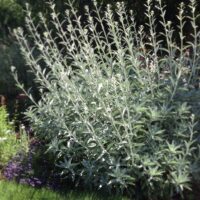
Salvia apiana
A striking native sage with large, silvery-white, aromatic leaves and tall flower stalks reaching above the foliage displaying lavender tinged white blossoms. The foliage of this shruby sage reaches 3 - 4 ft. tall with flowering stalks adding another 2 ft. or more above that. A useful plant for sunny, dry areas with good drainage. Combine with dark-leaved plants such as ceanothus and manzanitas to create a dramatic display. Used in smudge bundles as a natural incense. A bee and hummingbird favorite. Deer resistant.
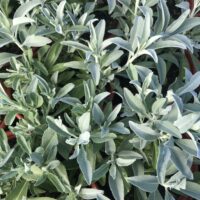
Salvia apiana ‘Compacta’
Having all the attributes of white sage, but growing about half the size, topping out at around 3 ft. tall. Gorgeous silver-gray foliage and stately flower stems of white, pollinator attracting blossoms. Heat and drought tolerant, this striking sage makes a wonderful specimen and contrasts beautifully with greener foliage. Plant in full sun with good drainage where it thrives with summer heat and drought. The powerfully fragrant foliage is dependably deer resistant.
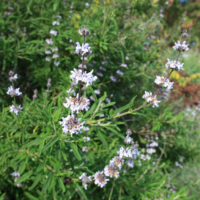
Salvia brandegeei
Native to Southern Spain and North West Africa, this herbaceous perennial spends much of the growing season as a low mound of gray-green wavy leaves. Early summer, tall flower stems rise 3 - 5 feet, with branched spikes of lovely light lavender-blue blossoms, that last about one month. Cut down old spikes or allow to go to seed for future propagation. Plant in sun with good drainage and moderate summer water. Pollinators of all sorts love sages.
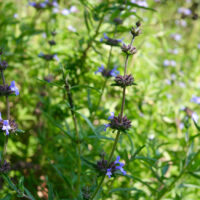
Salvia brandegeei ‘Pacific Blue’
A very nice form of a tough and durable native shrubby sage introduced by Santa Barbara Botanic Garden. Growing 4-6 ft. tall and wide with dark green textured foliage with white hairs on the leaf undersides. Instead of the typical light lavender flowers, this cultivar offers dark lavender-blue blossoms. Plant in full sun with little to no summer water once established. This native sage seems very tolerant of soil types even managing on heavy clay. Sage flowers attract bees, butterflies and hummingbirds, their seeds provide food for birds. Deer resistant.
Salvia clevelandii ‘Winnifred Gilman’
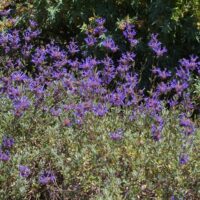
Floriferous native shrubby sage prized for its intense violet-blue flowers and sweetly fragrant foliage. ‘Winnifred Gilman’ has a nice compact habit to around 3 ft. tall. Well suited for sunny areas with good drainage and occasional summer water. Deer and drought tolerant; attracts bees and hummingbirds.
Salvia clevelandii x ‘Allen Chickering’
Delightfully fragrant hybrid sage between S. clevelandii and S. leucophylla. Blue lavender flowers in whorls during summer. Grows 3 - 5 ft. tall and wide. Good for dry sunny areas. Attractive to hummingbirds, bees and butterflies. Deer resistant.
Salvia clevelandii x ‘Kaleidoscope’
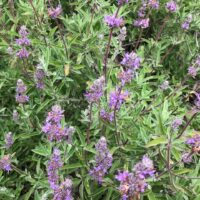
This striking new introduction features rosy-purple flowers in whorls atop dense, grey foliage. ‘Kaleidoscope’ is a nice and compact sage, only reaching to 2 – 3 ft. high and slowly spreading to form a small drift about 4 ft. wide. It is proving to be quite a garden tolerant Salvia and resistant to disease, though we are still evaluating it. Enjoys full sun and occasional to no irrigation once established. Needs decent drainage. An excellent plant for bees and butterflies. This selection was discovered by Terry Loveton in her west Sonoma County garden. Deer resistant.
Salvia clevelandii x ‘Pozo Blue’
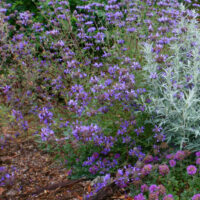
This hybrid of Salvia clevelandii and Salvia leucophylla was selected by Las Pilitas Nursery and is getting very good reviews. It appears to be a good substitute for Cleveland sage tolerating less than perfect soil conditions and colder low temperatures. Growing 3-5 ft tall and wide with gray-green fragrant foliage. Blue-lavender flowers in ball-like clusters top the shrub in late spring through early summer and are highly attractive to bees, butterflies and hummingbirds. Best in full sun with decent drainage. Drought tolerant once established. Deer resistant.
Salvia clevelandii x ‘Whirly Blue’
Large native sage growing 4.5 - 6 ft. tall and wide with aromatic gray-green foliage and rich violet flowers. Very large flower whorls and deeper color distinguish it from Salvia ‘Aromas’ and Salvia ‘Allen Chickering’. Good for dry sunny areas. Deer resistant. Attractive to hummingbirds, bees and butterflies.
Salvia greggii ‘Furman’s Red’
Selected in the 1970’s and a Plant Select winner in 2005, this dependable selection persists in the trade for its profuse displays of dark-red flowers and cold tolerance. Growing 3 to 4 feet tall and 2 to 3 ft. wide with light-green, aromatic foliage. The magenta blossoms can bloom spring through fall and attract hummingbirds, butterflies and other pollinators. Prefers full sun with decent drainage and is drought tolerant once established. Deer resistant.
Salvia greggii ‘Mirage Rose Bicolor’
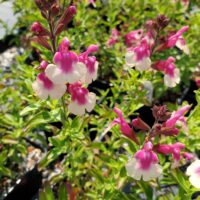
Top winner at the Welby Flower Trials in Colorado, this hybrid sage was bred for long blooming and heat tolerance. Compact and tidy, growing 12 -14 inches tall and a bit wider. The fragrant foliage is topped with a profusion of nectar-rich, two toned flowers of deep rose-pink and creamy-white, summer into fall. The appealing, bold display attracts hummingbirds, butterflies and bees. Plant in full sun to light shade with moderate to occasional water. Makes a good container subject. Deer resistant.