
Ceanothus gloriosus var. gloriosus ‘Heart’s Desire’
One of the lowest growing ceanothus, under one foot tall and spreading three or more feet wide. The small, holly-like leaves line stems which tightly hug the ground. Performs better than most ground cover ceanothus on relatively hot inland sites. Flowers of lavender-blue appear in early spring. Sun, decent drainage, moderate to little summer water once established. Ceanothus are excellent additions to the habitat garden offering flowers for pollinators and seeds for birds. Deer resistant.
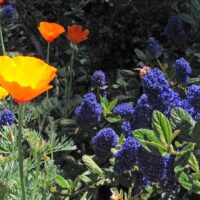
Ceanothus griseus ‘Kurt Zadnik’
Selected by Roger Raiche of the UC Berkeley Botanic Garden from the northern Sonoma Coast. Grows about 3 ft. tall and 10 - 15 ft. wide. The flower buds are very dark with beautiful rich indigo blue flowers, perhaps the darkest of any ceanothus. This fine selection is a prolific bloomer and works well to cover large banks in a hurry. Low to moderate irrigation. Shrubby ceanothus provide seeds eaten by bushtits, mockingbirds, quail and finches, as well as cover for birds.
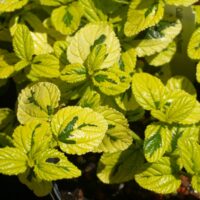
Ceanothus griseus var. horizontalis ‘Diamond Heights’
Grown for its beautiful golden variegated foliage, this low growing shrub spreads 3 - 5 ft. wide and up to 1 ft. high. Scant, light blue flowers in spring contrast nicely with the yellow foliage. Best with light shade in warmer regions. Enjoys some summer water though drought tolerant once established. Discovered from a colony of cultivated Carmel ceanothus in San Francisco in the area known as Diamond Heights.
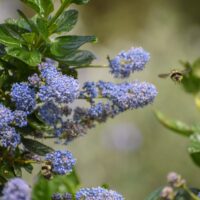
Ceanothus griseus var. horizontalis ‘Yankee Point’
An energetic bright green shrub growing up to 3 ft. tall and spreading rapidly to 10 - 12 ft. wide. Powder blue flowers in the spring. A good evergreen, weed-smothering groundcover for full sun to light shade. Drought tolerant, but appreciates an occasional summer watering and will accept moderate water. Tolerant of hot interior locations as long as some shade and irrigation are provided. Older specimens may reach up to 5 ft. tall, especially when side pruned. Ceanothus are great additions to the habitat garden offering food and cover for birds and nectar for bees and butterflies.
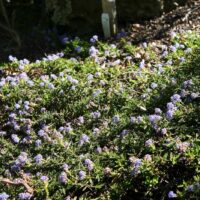
Ceanothus hearstiorum
A rare species with limited distribution in San Luis Obispo County. One of the lowest of the ceanothus, up to 12 inches tall and about 6 ft. wide. Often completely flat with a star-like pattern of growth. Medium-blue flowers sit atop the narrow, wrinkled leaves in spring. Sun to light shade. More shade tolerant than most Ceanothus, making it a suitable option for under the dappled shade of oaks. Drought tolerant but will accept occasional irrigation. Excessive irrigation will shorten the life of this species. Provide good drainage.
Ceanothus integerrimus
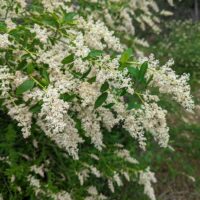
Deer brush is an excellent addition to the dry garden, featuring an abundance of blue, white or even pink flower plumes in late spring. One of the few deciduous species, displaying soft flat leaves which fall in autumn and reemerge in spring. Deer brush is an open upright shrub, growing 5 - 12 feet tall and wide with many different growth habits. A variable species found in a wide range of habitats throughout the state. Often used in restoration for its rugged qualities and ability to deal with summer heat and winter cold. This crop, grown from seed collected near Lake Sonoma has white flowers. Plant in full sun to light shade with good drainage. Little to no summer water once established.
Ceanothus maritimus ‘Point Sierra’
An excellent choice for a small scale ground cover, this rare Ceanothus is found on coastal bluffs and low hills in northern San Luis Obsipo County. Even though it is native to the coast it does surprisingly well inland. Smaller and slower growing than most Ceanothus, it blooms very early often beginning in late January or early February. 'Point Sierra' was selected from Arroyo de la Cruz by Native Son's Nursery. Grows 2-3 ft. tall with small, thick, leathery leaves and a dense mounding habit looking almost like Cotoneaster. Rounded clusters of blue-violet flowers from dusty white buds in late winter provide an early nectar source for pollinators of all sorts. A natural for coastal areas in full sun but has proven durable inland when it is provided a little shade. Tolerates heavy soils. Drought tolerant once established. Somewhat deer resistant.
Ceanothus maritimus ‘Valley Violet’
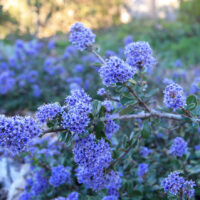
Valley Violet ceanothus is a tough and reliable shrub introduced by the UC Davis Arboretum as an "Arboretum All-Star", one of their 100 top recommended plants. This relatively small Ceanothus grows 2 ft. tall by 4 ft. wide with small leathery leaves and gorgeous dark-violet flowers in early spring. Though native to coastal bluffs of San Luis Obispo County, it performs well in both coastal and inland situations. In hot inland sites it may be best with a little afternoon shade. Drought tolerant once established. For a Ceanothus it is slower growing and has proven to be long lived and tolerant of many soil types. A wide array of pollinators are attracted to its flowers. Deer resistant.
Ceanothus papillosus – upright Baja form
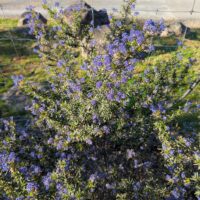
This cold hardy selection from Baja California is highly useful in the garden setting thanks to its tall, upright form and narrow, vaselike shape. Many customers ask us for a big but narrow form of ceanothus. This is one of the few selections that fits the bill. Plants reach 8 – 10 ft tall, but only reach 3 – 4 ft wide, making it ideal for a privacy screen in a small area. Indigo blue flowers cover plants in spring, followed by little seed capsules which are relished by birds. The crinkly, dark-green leaves are elongated and create a nice foil for brighter green plants, such as Salvia and Artemisia. As with all ceanothus, the flowers are loved by a large array of pollinators. Plant in full sun to very light shade and water infrequently once established. Needs decent drainage. This is the variety papillosus.
Ceanothus parryi
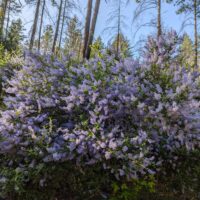
Nicknamed ladybloom, this ceanothus is underused in California gardens. Native to chaparral plant communities in the coast ranges of California and Oregon. Upright habit with arching branches growing 8-12 ft tall and wide with dark green, narrow leaves. Long, narrow flower clusters of medium to deep blue blossoms in the spring. A useful screen, specimen or informal hedge in full sun with little to no water once established. Tolerant of inland heat and conditions. Ceanothus are great additions to the habitat garden offering food and cover for birds and nectar for bees and butterflies.
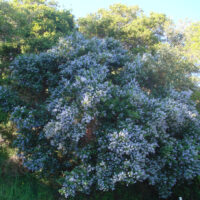
Ceanothus thyrsiflorus
One of the larger ceanothus, forming a good sized shrub or small tree 6-25 ft. tall. Shiny, bright green leaves and good sized clusters of flowers which can range from pure white to pale blue, sky blue through rich darker shades of blue in the spring. Easy, fast growing. Can be trained into a single trunk if desired. Useful as a specimen tree, background shrub or informal hedge. Drought tolerant when established. Ceanothus are fantastic habitat plants providing food and cover for a wide range of creatures. Bees and other pollinators frequent the flowers as do butterflies. Several butterflies and moths use it as a larvel food source. Bushtits, mockingbirds, quail and finches eat the seeds.
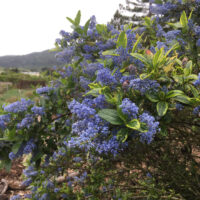
Ceanothus thyrsiflorus ‘El Dorado’
Fast growing upright evergreen shrub 6 - 10 ft. tall and wide. Dark green foliage with golden yellow variegation is a nice foil for the medium blue flowers in spring. Plant in full sun along the coast, some shade for hot interior sites. Drought tolerant once established. Occasional summer irrigation can be helpful, but allow soil to dry between waterings. Good for an informal hedge. An excellent habitat plant.
Ceanothus thyrsiflorus ‘Oregon Mist’
Blue blossom ceanothus grows in chaparral and woodland plant communities of the outer coast ranges, from Santa Barbara, California to southern Oregon. Selected by Xera Plants, 'Oregon Mist' hails from the northern most part of its range, suggesting superior cold hardiness. Growing 8 - 15 ft. tall and wide with deep-green shiny leaves and baby-blue flowers in narrow clusters, blooming in mid to late spring. This fast growing evergreen makes a fine stand alone specimen or as part of a shrubby border or screen, where its particularly dense form can be used to great effect. Plant in sun to light shade where it will be drought tolerant once established. An excellent addition to the habitat garden where it provides food and cover for a wide array of insects and birds.
Ceanothus thyrsiflorus ‘Skylark’
Valued for its compact habit and late flowering, this selection offers clusters of dark blue flowers on short stems appearing just as other ceanothus are finishing their show. 4 - 5 ft. tall and 6 - 7 ft. wide with shiny evergreen foliage. This would be a ceanothus to try in hot areas. 'Skylark' is believed to be a cross between Ceanothus thyrsiflorus and C. velutinus. Shrubby ceanothus provide seeds eaten by bushtits, mockingbirds, quail and finches, as well as cover for birds.
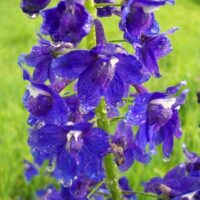
Delphinium trolliifolium
Towers of dense, blue purple flowers reaching up to 4 ft high make this one of our most striking native larkspur. The robust stalks rise above elegantly cut leaves featuring an appealing matte finish. The new leaves emerge in winter after a summer/fall dormancy, followed by the stunning floral display in early spring. Native to the northwest corner of our state, where it grows in oak woodlands, bright, coniferous forests and coast chaparral. Enjoys moisture in the winter and spring, but should be allowed to go somewhat dry in the summer when dormant. Provide light shade away from the coast. Attractive to butterflies and hummingbirds. All parts are poisonous if ingested.
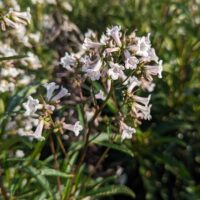
Eriodictyon californicum
Uncommon in the nursery trade, this aromatic, evergreen shrub is native to dry habitats of chaparral and mixed evergreen forest plant communities in North and Central California and into Oregon. An opportunist, this shrub stump sprouts after fires and grows with renewed vigor after any soil disturbance. The dark green, leathery leaves are covered in a shiny, fragrant, resin and are sticky to touch. The common name means, holy herb, and the pungent leaves have a long history of medicinal uses. Grows 3 - 5 ft. tall and spreads by underground roots to form a colony. Late spring brings clusters of small, trumpet-shaped flowers of pale lavender, sometimes white or pale blue, which are highly attractive to butterflies, hummingbirds and bees. Plant in full sun with good drainage and little water once established. Deer resistant.
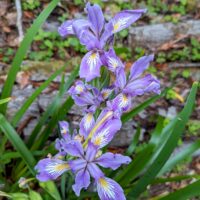
Iris douglasiana – Robust Form
We discovered this incredibly striking form of the popular Douglas iris near Tannery Gulch, outside of Occidental. The dark, evergreen leaves reach up to an astounding three feet in height, and are exceptionally broad. Even though these are grown by seed, the flowers are a dependable lavender-blue, with sprays of white and yellow, held on tall stalks reaching up to a foot above the foliage! Grows well in dappled shade in hotter areas, but can take full sun where there is coastal influence. While drought tolerant, occasional deep soaks keep them looking verdant and vigorous. Deer and gopher resistant.
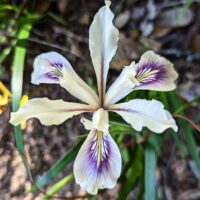
Iris douglasiana v. major
This rare form of the Douglas iris occurs throughout Marin County, offering a rainbow of possible flower colors, including blue-purple, mauve, creamy yellow and white, with all sorts of gradations in between. Since these are seed grown, the color will be a surprise when they bloom. The spring blossoms often have striking venation, and are held on stalks 1’ – 2’ high. Foliage clumps generally reach about a foot tall and spread to form extensive colonies of evergreen, strap like leaves. Plant in full sun in cooler areas, but provide some shade in hotter zones. Plants require little water once established, and are perhaps a little more drought and heat tolerant than the straight species. Deer and gopher resistant.
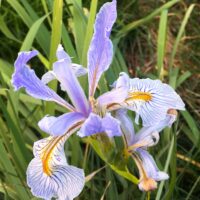
Iris longipetala
Restricted to swales and moist areas in coastal grasslands from San Francisco to Monterey, this uncommon native is well worth growing. Bluish-green evergreen blades form erect clumps one foot to 20 inches tall. Early spring brings beautiful lavender-blue flowers with dark purple venation. Full sun in coastal areas, a little shade inland with regular water through the bloom period. Can go dryer once flowering is finished. Deer resistant.
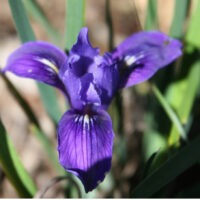
Iris macrosiphon
A widespread and variable species growing throughout Northern California’s coast ranges and Sierra Nevada foothills. Our crop is grown from seed collected in western Sonoma County which has lovely lavender-blue blossoms April through May. Forms small clumps of narrow and slightly arching blades under 18 inches tall. Often found on wooded slopes, in openings or edges of forests where it will form small patches. Prefers good drainage, drought tolerant, or just a little summer moisture. Deer resistant.
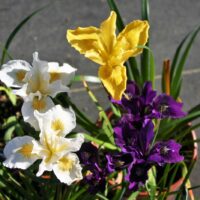
Iris Pacific Coast hybrid
A diverse group bred from the native irises with wonderful coloration, patterning, flower form variation....ranging from soft pastels to mahogany, maroon and midnight purple. Evergreen foliage, about 1 to 2 ft. high. Can eventually form sizable clumps. Full sun to light shade. Often do well as an understory for oaks that needs no summer water. Drought tolerant, moderate to little water when established. Deer don’t seem to eat flowers or foliage.
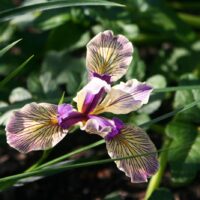
Iris Pacific Coast hybrid ‘Sebastopol’
A diverse group bred from the native irises with wonderful coloration, patterning, flower form variation....ranging from soft pastels to mahogany, maroon and midnight purple. Evergreen foliage, about 1 to 2 ft. high. Can eventually form sizable clumps. Full sun to light shade. Often do well as an understory for oaks that needs no summer water. Drought tolerant, moderate to little water when established. Deer don’t seem to eat flowers or foliage.
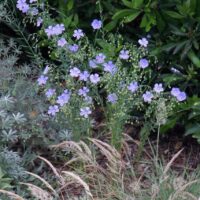
Linum lewisii
A profusion of sky-blue, five petaled, shallowly cupped blossoms flower in late spring and into summer. Growing 12 to 18 inches tall with slender stems and narrow leaves. Can be short lived but often reseeds. A lovely filler, whose true blue flower color seems to go with everything, and the fine foliage contrasts nicely with a variety of leaf colors and shapes. Plant in full sun with moderate to infrequent summer water. Deer resistant.
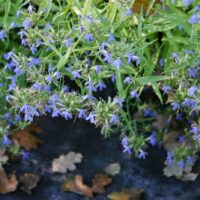
Lobelia dunnii var. serrata
Water loving perennial native to creek sides and other wet places in Southern California. Growing one foot tall and spreading vigorously by rhizomes with clusters of soft blue, one inch flowers in summer. Best with regular water and part shade. A perfect addition for a shady water feature, moist meadow or container planting. The flowers are highly attractive to butterflies of all sorts and are visited by hummingbirds. Winter dormant. Deer resistant.
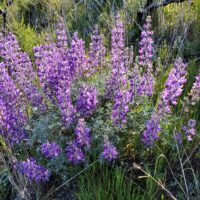
Lupinus albifrons var. albifrons
A popular California native lupine growing to around 3 ft. tall and wide. Beautiful silver foliage with intense blue-purple flower spikes in the spring. To thrive, this lupine needs full sun to very light shade and excellent drainage. Little to no water once established. Vulnerable to snail and slug predation. An excellent species for native pollinators and a larval host for several species of butterflies. Deer resistant.
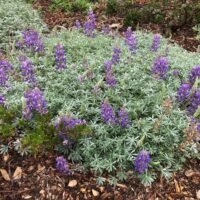
Lupinus albifrons var. collinus
A beautiful low growing form of the silver bush lupine. Forms a mat of gorgeous silvery foliage 12 inches or so wide with spires of rich blue flowers rising 12-18 inches tall in the spring. Plant in full sun to very light shade with well drained soil. Flowers attract a wide array of beneficial insects, especially bees of all types. Drought and deer resistant.
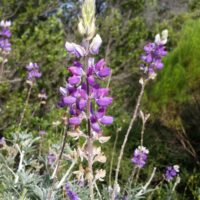
Lupinus albifrons var. douglasii
This variety of the popular silver bush lupine has the same wonderful wands of blue-purple flowers in spring and summer but also features larger, silvery leaves covered with fine hairs. The plant itself is also larger, reaching 3 – 5 feet in height. This variety grows from Marin County down to the Channel Islands. Plant in full sun with excellent drainage and little to no summer water once established. A nectar species for native bumblebees and hummingbirds. This is a butterfly host plant for several blues, hairstreaks and the northern cloudy-wing. Deer resistant.
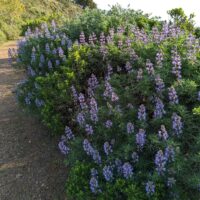
Lupinus arboreus – blue flowered form
Native to coastal areas from Sonoma Co. down to Southern California, the blue bush lupine is distinctive for its grand size (reaching up to 6 ft. tall) and racemes of scented, blue and white flowers. The showy blooms which appear in spring and continue into summer are an excellent nectar source for native bees and hummingbirds. Various butterflies use this species as a larval host plant. The seeds are enjoyed by birds. Grow in full sun with good drainage and occasional to no irrigation once established. Not suitable for areas which get very cold in the winter. Not suitable for Mendocino Co. northwards where it can invade natural areas. Deer resistant.
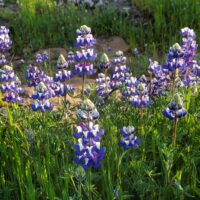
Lupinus nanus
This beautiful ANNUAL lupine can be seen on grassy hills, open slopes and fields, often casting a blue haze of color from a distance in the spring. Low growing, 6 - 20 inches tall and wide, with wonderfully fragrant, rich blue flowers with white markings. Prefers full sun, lean and well drained soils with minimal supplemental watering. Contrasts beautifully with California poppies, providing the classic, blue and gold displays of spring. Attractive to a myriad of pollinators and a larval food source for a number of butterfly and moth species. Deer resistant.
Lupinus polyphyllus
The bog lupine is known for its tall flower spikes of blue to purple or sometimes pink, reaching up to almost 5' tall from a bed of large, dark green leaves about 18" in height. Clumps can grow about 3' wide. This species is the dominant parent used in many popular hybrid lupines. Native to moist places from the San Francisco Bay area northward along the coast and in mountainous places in the interior. Prefers full sun along the coast and dappled shade inland. This lupine tends to go winter dormant. Snails and slugs find lupines especially tasty when young. Needs regular water. One can create a wonderful meadow by planting the bog lupine with other moisture loving species such as lady ferns, umbrella plant and seep monkeyflower. Deer resistant.