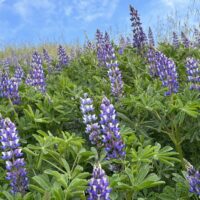
Lupinus succulentus
One of the easier-to-grow lupines, this long-blooming ANNUAL is low maintenance and thrives in heavier soils. Bright-green, palmate leaves topped by purple-blue spires quickly reach 2-3 feet tall and wide—or more, if happy. Reseeds easily and returns with winter rains, or whenever conditions are moist and fertile. Although it enjoys moderate to occasional water, it will tolerate both wet and dry areas. Arroyo lupine is found in diverse habitats with a broad native range in California, but prefers full sun and clay-rich soil. Looks splendid planted en masse and can serve as a nitrogen-fixing, seasonal groundcover. All parts of the plant are toxic if eaten, but it's an important butterfly larval host and a food source for native bees. Deer resistant.
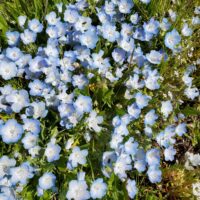
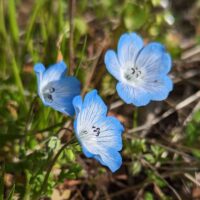
Nemophila menziesii – Frosty Blue
An interesting seed strain of the charming, ANNUAL baby blue eyes. Found in many habitat types throughout California, this beauty has long been in cultivation. The slender, succulent, lobed leaves grow 4 - 6 inches tall, spreading and spilling about 1 ft wide. The "Frosty" in the name refers to the silvery color to the foliage, which contrast nicely with the profusion of gorgeous, bright, baby-blue blossoms. Spectacular in drifts, where it can spill and cascade, at the front of a garden bed, in meadow plantings, rock gardens or in containers. Plant in full sun to light shade where it is early to bloom during the cool of spring. Hot weather triggers seed production. The large black seeds are relished by birds. Reseeds readily.
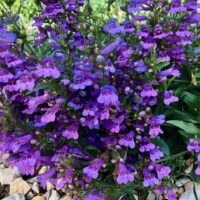
Penstemon ‘Catherine de la Mare’
Beautiful electric blue tubular flowers blush purple as they age. Low (12 -18 inches tall) plant with a loose, open habit. Blooming begins in May and continues for a month or two. An easy and hardy penstemon requiring moderate water and sun to light shade. Wonderful for the front of borders. Adored by hummingbirds and bees.
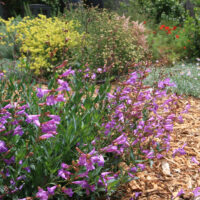
Penstemon azureus
Native to the mountains of California and Oregon where it grows in woodland and chaparral plant communities. Forms a tidy mound of bluish-green leaves 1-2 ft. tall and wide with bright blue tubular flowers late spring into summer. Requires good drainage and sun to light shade. This species is drought tolerant but prefers occasional summer water and is more garden tolerant than most native Penstemons. Attractive to bees and hummingbirds.
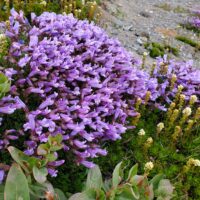
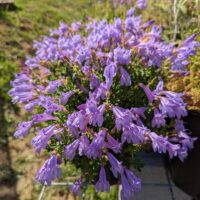
Penstemon fruticosus
Blue-purple, trumpet-shaped flowers with curvy, flared lips cover this diminutive mountain species with a showy display in spring or early summer. Truly a delightful and easy to grow mountain penstemon, only reaching about 12 inches high and spreading to about 1.5 ft, covered in dense, narrow leaves. Perfect for a container or in a rock garden with good drainage. Enjoys full sun to light shade and occasional to infrequent irrigation. Native to the Pacific Northwest and the Northern Rockies, almost making it into California. A favorite of hummingbirds and enjoyed by bees.
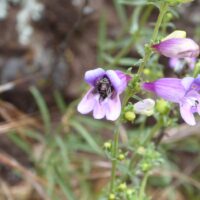
Penstemon heterophyllus
Iridescent blue-purple tubular flowers in short spikes put on a good show over a long period in spring and early summer. The spent flower spikes should be cut off to encourage more blooming, better form, and longer life. Best in full sun with well drained soils and moderate to little water once established. Hummingbird favorite.
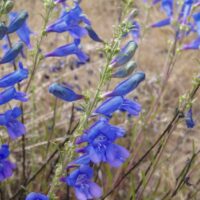
Penstemon heterophyllus – Hood Mt. seed strain
From the rugged Hood Mountain area, southeast of Santa Rosa, comes this local seed strain of foothill penstemon, which is showing promise as a particularly good performer. Proving to be vigorous and disease resistant, blooming freely with particularly large, vivid-blue, open-mouthed, tubular blossoms, spring into summer. An evergreen perennial, growing about 2 ft. tall and at least as wide, for full sun with decent drainage, and little water once established. Bees, butterflies and hummingbirds are all attracted to the showy flowers. A great, local, seed grown alternative to the cutting-grown 'Margarita BOP'.
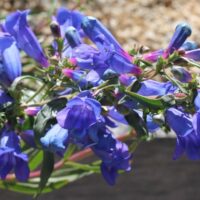
Penstemon heterophyllus ‘Blue Springs’
A seed strain of a highly variable native penstemon. Attractive narrow, shiny, bluish-green leaves topped with dense spikes of narrow bell-shaped blossoms of bright blue. Flowers late spring to early summer, growing to around 1 to 1 1/2 ft. tall and wide. The spent flower spikes should be cut off to encourage more blooming, better form, and longer life. Best in full sun with good drainage and moderate to little summer water.
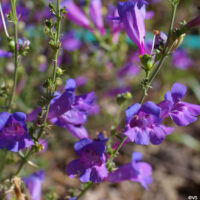
Penstemon heterophyllus ‘Margarita BOP’
A fine selection of a native penstemon from Las Pilitas Nursery where this chance hybrid seedling was discovered at the “Bottom Of the Porch”. Forms a tidy mound 18 inches tall by 2 ft. or so wide. Iridescent blue-purple tubular flowers in short spikes put on a good show over a long period in spring and early summer. The spent flower spikes should be cut off to encourage more blooming, better form, and longer life. Best in full sun with well drained soils and moderate to little water once established. 'Margarita BOP' has proven particularly adaptable and has survived longer than other cultivars. Hummingbird favorite.
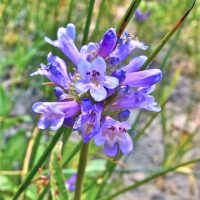
Penstemon rydbergii
A widespread species native to much of the western United States, including California, growing in mountainous regions in moist meadows and along streams. Forms a low rosette of bright green leaves topped with flower stems 1 -2 foot tall. The small, lavender-purple, tubular flowers are clustered in whorls on dense spikes. The blossoms offer an excellent source of nectar and pollen to hummingbirds, bees and butterflies, as well as a larval food source for a number of butterfly species. Considered easy to grow and long lived. Plant in full sun to light shade with regular moisture. Somewhat winter deciduous. Deer resistant.
Penstemon speciosus
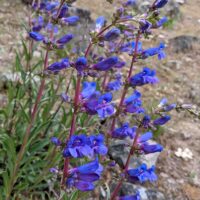
Found in higher elevation localities of inland Northern California, royal penstemon is a vibrantly colorful addition to the dry, full sun garden. In summer, the large, saturated blue-purple florets are held in clusters on stems rising almost 2’ tall above a low, evergreen rosette of glossy, strap-like foliage, reaching 1' - 2' wide. Attracts a multitude of pollinators. Does best with decent soil drainage, and inland sites that provide seasonality—colder winters, and hotter summers. Drought-tolerant once established.

Penstemon strictus
Showy perennial, native to a number of states in the Rocky Mountains, where it grows in sage brush and coniferous forest communities. Forming clumps of neat evergreen foliage 8 - 10 inches tall by 36 inches wide. Mid to late spring brings flowering stems 2 foot or so above the foliage with deep blue-purple tubular flowers. Considered one of the easier to grow, tolerating heavier soil and moisture better than many Penstemon species. Still, good drainage is best with little summer water once established. Plant in full sun to light shade in hot regions. Very cold tolerant. Penstemons are attractive to hummingbirds, bees and butterflies.
Penstemon venustus
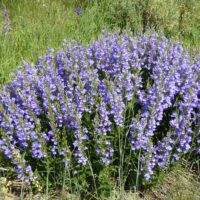
This jewel of the mountains displays richly toned, trumpet-shaped flowers of blue to lavender held on stalks reaching 1 – 3 ft. tall. Dark green, serrated leaves form a low mound up to 2ft. wide over time. Hummingbirds love the tubular flowers as do bees. Plant in full sun with excellent drainage and water infrequently. While native to much of the West, this penstemon doesn’t quite make it into California.
Phacelia bolanderi
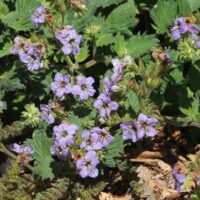
Easy to grow perennial for part shade and a little summer water. Native to slopes and canyons of coastal forests in northern California. Forms low mounds of soft foliage 6 - 8 inches tall by 2 ft. or so wide. Pretty powder blue-purple one inch flowers late spring into summer offer nectar to hummingbirds, bees, and butterflies. The seeds are enjoyed by songbirds. Though somewhat short-lived, it often reseeds. Appears to be deer resistant.
Phacelia campanularia
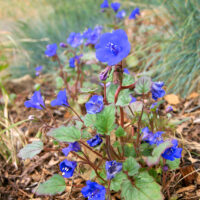
This ANNUAL is endemic to washes in Southern California deserts. Amazing, royal blue flowers make a show stopping display atop foliage 6-10 inches tall. Surprisingly adaptable, requiring well drained soils, full sun and dryish conditions. Excellent in containers too. Bee favorite.
Salvia ‘Aromas’
A hybrid between Salvia clevelandii & Salvia leucophylla, this aromatic shrubby sage grows 4 ft. tall and 4 ft. wide. Early summer brings flower stalks with whorls of lavender-blue blossoms. Good for sunny areas with good drainage. Occasional to little summer water. Flowers are attractive to bees, hummingbirds and butterflies. Deer and drought tolerant.
Salvia ‘Celestial Blue’
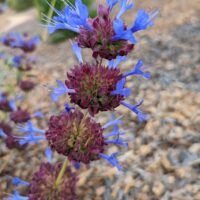
A pollinator powerhouse, this sage attracts hummingbirds, bees and butterflies with its vibrant blossoms. Selected and introduced by Las Pilitas Nursery, thought to be a hybrid between Salvia clevelandii and S. pachyphylla, or perhaps a three way hybrid involving Salvia 'Pozo Blue'. Gray-green, sweetly fragrant foliage, grows 3 to 5 ft. tall and wide. The striking blue flowers are on widely spaced whorls of eye-catching violet-blue. The decorative, architectural seed heads that follow provide food for songbirds. Plant in full sun with good drainage and occasional water. Drought and deer tolerant tolerant.
Salvia ‘Mrs. Beard’
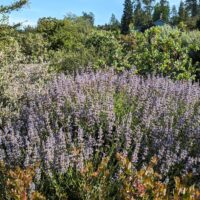
This cultivar has been around since 1965, a chance seedling discovered in a Berkeley garden. A hybrid between Salvia sonomensis and Salvia mellifera, 'Mrs. Beard’ has proven durable and disease resistant. Forms a dense mat of gray fragrant foliage up to 2 ft. tall and 4-6 ft. wide. Spring brings an abundance of tiny pale lavender-blue flowers in ball-like clusters that are highly attractive to bees and hummingbirds. Plant in full sun along coast and light shade in hot inland sites, where it will be quite drought tolerant once established. Deer resistant.
Salvia brandegeei
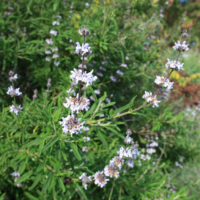
Native to Southern Spain and North West Africa, this herbaceous perennial spends much of the growing season as a low mound of gray-green wavy leaves. Early summer, tall flower stems rise 3 - 5 feet, with branched spikes of lovely light lavender-blue blossoms, that last about one month. Cut down old spikes or allow to go to seed for future propagation. Plant in sun with good drainage and moderate summer water. Pollinators of all sorts love sages.
Salvia brandegeei ‘Pacific Blue’
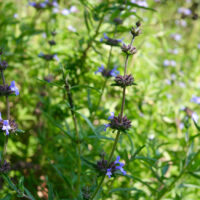
A very nice form of a tough and durable native shrubby sage introduced by Santa Barbara Botanic Garden. Growing 4-6 ft. tall and wide with dark green textured foliage with white hairs on the leaf undersides. Instead of the typical light lavender flowers, this cultivar offers dark lavender-blue blossoms. Plant in full sun with little to no summer water once established. This native sage seems very tolerant of soil types even managing on heavy clay. Sage flowers attract bees, butterflies and hummingbirds, their seeds provide food for birds. Deer resistant.
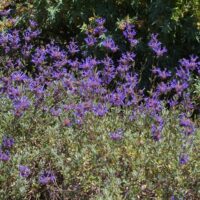
Salvia clevelandii ‘Winnifred Gilman’
Floriferous native shrubby sage prized for its intense violet-blue flowers and sweetly fragrant foliage. ‘Winnifred Gilman’ has a nice compact habit to around 3 ft. tall. Well suited for sunny areas with good drainage and occasional summer water. Deer and drought tolerant; attracts bees and hummingbirds.
Salvia clevelandii x ‘Allen Chickering’
Delightfully fragrant hybrid sage between S. clevelandii and S. leucophylla. Blue lavender flowers in whorls during summer. Grows 3 - 5 ft. tall and wide. Good for dry sunny areas. Attractive to hummingbirds, bees and butterflies. Deer resistant.
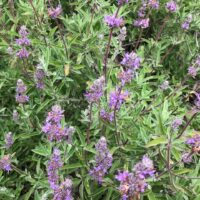
Salvia clevelandii x ‘Kaleidoscope’
This striking new introduction features rosy-purple flowers in whorls atop dense, grey foliage. ‘Kaleidoscope’ is a nice and compact sage, only reaching to 2 – 3 ft. high and slowly spreading to form a small drift about 4 ft. wide. It is proving to be quite a garden tolerant Salvia and resistant to disease, though we are still evaluating it. Enjoys full sun and occasional to no irrigation once established. Needs decent drainage. An excellent plant for bees and butterflies. This selection was discovered by Terry Loveton in her west Sonoma County garden. Deer resistant.
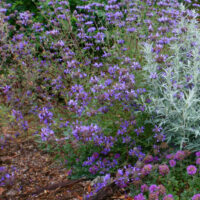
Salvia clevelandii x ‘Pozo Blue’
This hybrid of Salvia clevelandii and Salvia leucophylla was selected by Las Pilitas Nursery and is getting very good reviews. It appears to be a good substitute for Cleveland sage tolerating less than perfect soil conditions and colder low temperatures. Growing 3-5 ft tall and wide with gray-green fragrant foliage. Blue-lavender flowers in ball-like clusters top the shrub in late spring through early summer and are highly attractive to bees, butterflies and hummingbirds. Best in full sun with decent drainage. Drought tolerant once established. Deer resistant.
Salvia clevelandii x ‘Whirly Blue’
Large native sage growing 4.5 - 6 ft. tall and wide with aromatic gray-green foliage and rich violet flowers. Very large flower whorls and deeper color distinguish it from Salvia ‘Aromas’ and Salvia ‘Allen Chickering’. Good for dry sunny areas. Deer resistant. Attractive to hummingbirds, bees and butterflies.
Salvia pachyphylla
Native to southern California deserts, this beautiful silvery shrub of intensely aromatic foliage grows 18 - 30 inches tall and wide. Spikes of densely packed violet whorls support elongated blue flowers, blooming over a long period in summer. This striking sage requires full sun with excellent drainage, where it will be extremely drought tolerant once established. A magnet for pollinators including butterflies and hummingbirds. Deer resistant.
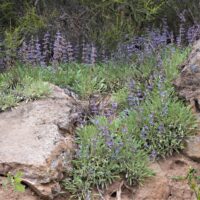
Salvia sonomensis
Sonoma sage is a wonderful native perennial and can be a serviceable groundcover if its needs are met. Good drainage is a must and it performs best with light shade. Water plants to get established-very drought tolerant, will NOT tolerate regular summer water. Mat forming, flowers rise to about 6 inches above the foliage and are lavender-blue. This species attracts bees and hummingbirds. Deer resistant.
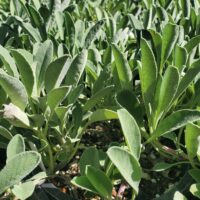
Salvia sonomensis ‘Greenberg Gray’
We named this wonderful gray-leaved form of the Sonoma sage for Katherine Greenberg who had it growing in her beautiful Lafayette garden. This striking species forms a ground hugging carpet of leaves with charming, blue-purple flowers in late spring on stems up to 6 inches tall. Bees, butterflies and hummingbirds love the blossoms. Needs lightly dappled shade and excellent drainage with little to no water once established. Great under manzanitas. Deer resistant.