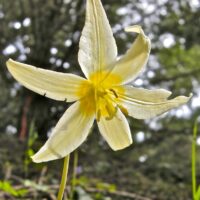
Erythronium oregonum
The giant fawn lily adds a delicate accent in the spring to the bright shade garden featuring starlike flowers of creamy-white with yellow centers. Reaching to a height of about 1 ft when in bloom with low, broad leaves attractively mottled. This bulb will slowly increase to form little clumps, ideal for the forest rock garden. Provide good drainage and water infrequently during its summer dormancy.
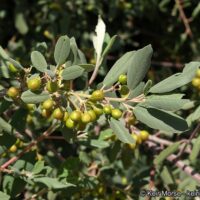
Frangula (Rhamnus) californica ssp. tomentella
This distinctive species of coffeeberry features blue-grey leaves with velvety, silver undersides and grey, fuzzy stems. The somewhat open form grows 6 to 10 ft tall and wide. Clusters of small cream-colored flowers appear from winter through spring and are a favorite of bees. The deep purple fruits which follow are highly prized by birds. While native to serpentine soils, this coffeeberry should thrive anywhere with decent drainage. Provide full sun to light shade and give occasional irrigation once established. The grey stems contrast beautifully with the shiny, dark green leaves of Ceanothus ‘Yankee Point’.

Gambelia (Galvezia) speciosa
Evergreen shrub native to the Channel Islands off the So. California coast. Forms an arching mound of medium green foliage 3-4 ft. tall x 5 ft. wide, but can climb or lean on other shrubs to grow even taller. Clusters of scarlet, tubular flowers decorate the branch tips in spring and intermittently throughout the year and are adored by hummingbirds. Full sun along the coast, light shade in hot areas. Drought tolerant and amenable to pruning. Hardy to around 20°F.
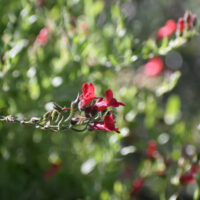
Gambelia (Galvezia) speciosa ‘Firecracker’
An interesting, evergreen subshrub from the California Channel Islands. Showy, deep-red, tubular flowers decorate the branch tips and are highly attractive to hummingbirds. The cultivar ‘Firecracker’ was selected by Tree of Life Nursery for its compact habit, growing 3 foot tall and 5 foot wide, with fuzzy, pale green leaves and larger, red, snapdragon-like flowers. A natural along the coast where it will grow in full sun to light shade, afternoon shade is best in hotter inland sites. Drought tolerant once established, but enjoys occasional summer water, especially away from the coast. Hardy to 15 -20 degrees F.
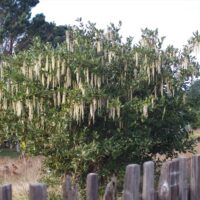
Garrya elliptica
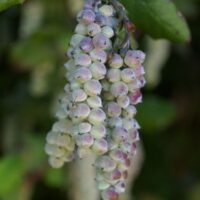
Garryas are grown primarily for their winter flower catkins. The longer, pendulous male catkins have traditionally been the most sought after with selections like 'James Roof' and 'Evie'. Male and female flowers occur on separate plants and both must be present for the female to produce their lovely grapelike clusters of fruit. These plants are seed grown so males and females are of equal probability. All plants feature larger, evergreen leaves on multitrunked shrubs reaching 10 - 15 ft tall and wide. Very amenable to pruning. Plant in full sun or partial shade. Provide moderate irrigation inland, but established plants will be drought tolerant near the coast where they occur naturally. Somewhat deer resistant.
Garrya elliptica ‘Evie’
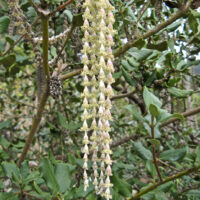
This cultivar of the native silktassel bush is more compact than the better known ‘James Roof’. The 8 to 10 inch catkins are shorter but more profuse. Evergreen, grows 10 ft. or taller. Sun to part shade, good drainage. Provide moderate to occasional irrigation inland. Winter is its showiest time when it is covered in silvery catkins. Discovered on the northern Sonoma Coast. Somewhat deer resistant.
Garrya elliptica ‘James Roof’
Outstanding cultivar of the native silktassel bush. Evergreen shrub 10 ft. tall or more. Striking 12 inch long silvery catkins in winter. Sun to part shade and drought tolerant. Enjoys moderate summer water inland. Discovered along the coast of Prairie Creek State Park in Humboldt Co.. Somewhat deer resistant.
Garrya fremontii
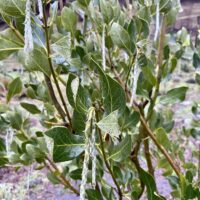
Evergreen shrub with leathery leaves and handsome dangling catkins in late winter and early spring. The male and female flowers occur on separate plants. Native to the west coast where it grows in mixed evergreen forest and chaparral plant communities. This species is a good choice for summer-hot interior sites with well drained soils. Grows 8 - 10 ft. tall and wide in full sun to light shade and is drought tolerant once established. A good specimen shrub or candidate for hedgerow or screen where it provides cover and food for birds and small mammals. Somewhat deer resistant.
Garrya issaquahensis ‘Pat Ballard’
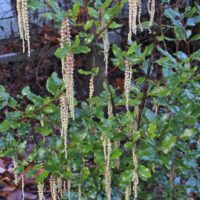
An elegant winter flowering shrub, uncommon in the trade. A hybrid between Garrya elliptica and Garrya fremontii, 'Pat Ballard' is a tough evergreen growing 6-10 foot tall and wide. Pendulous pinkish gray catkins dangle from the branch tips in winter providing a spectacular display. Plant in full sun to part shade with occasional to infrequent water once established. More cold & drought tolerant than Garrya elliptica. An excellent screen, hedge or foundation shrub, amenable to pruning. Somewhat deer resistant.
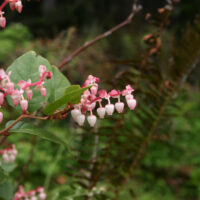
Gaultheria shallon
A handsome evergreen shrub, happiest in fog shrouded coastal zones. Large, leathery, dark green leaves are a gorgeous foil to the loose clusters of white to pinkish urn-shaped flowers. Fat, blue-black berries follow and are relished by wildlife and eaten by people too. Salal can grow tall in moist coastal areas of the Pacific Northwest but usually forms a ground cover 2 - 4 ft. tall and spreading in California. Best with some shade and acidic, humus-rich, moist soils. The foliage is prized for flower arranging. Deer resistant.
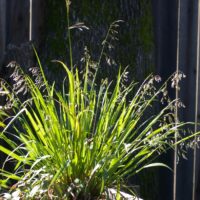
Hierochloe (Anthoxanthum) occidentalis
Here is an interesting and elegant grass native to coniferous forests. Broad, bright green, sweetly scented blades grow a foot or more tall. Flowering culms rise another 6 inches or so above the foliage with tight panicles of spikelets. The leaves offer a sweet, vanilla fragrance when dried. Excellent for woodland gardens, compatible with many redwood forest plants. Best with some summer water, but is drought tolerant near the coast. A larval host for the Western branded skipper butterfly. Deer resistant.
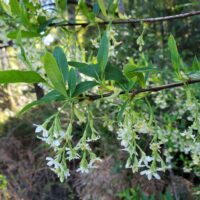
Oemleria cerasiformis
A charming native shrub which grows in moist areas along the coast or when inland on forest edges. Blooms in early spring just as the new leaves are beginning to expand with drooping clusters of fragrant white flowers. Male and female plants are separate and you'll need both to get the small blue-black fruits that birds enjoy. A suckering shrub growing 5 - 6 ft. tall or more. Plant in part shade with regular to occasional water. Can grow in cool full sun such as you find along the coast.
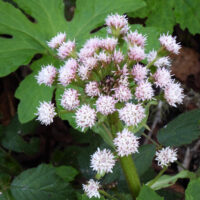
Petasites frigidus var. palmatus
A bold, beautiful and AGGRESSIVE creekside native, found in coastal and montane regions in California, north to Alaska, where it grows along shady creek banks. The large, almost tropical, palmate leaves spread from thick creeping rootstocks to form large colonies. Flowers before the foliage fully emerges in the spring with flat topped clusters of white to pink flowers on 1-2 ft. tall stems. Requires shade and plenty of water and is useful as a soil stabilizer. To control its spreading nature, use in containers or in contained areas. It won't spread into areas which are dry. Dies back to the ground in the winter. Flowers attractive to a wide range of beneficial insects.
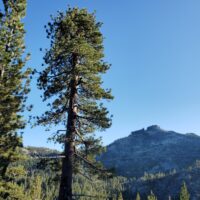
Pinus jeffreyi
This stately pine hales from many of California’s mountain regions and is the dominant pine of the Tahoe basin. Features long needles and a broad trunk with deeply furrowed bark of orangy-red. Similar to the ponderosa pine but occurs at higher elevations and the bark has a distinctive vanilla scent. The cones are also larger than those of the ponderosa and don’t have sharp, outwardly protruding scales, hence the affectionate name “gentle Jeffrey.” Often reaches heights of over 100 feet with an open canopy. Provide good drainage and full sun to light shade. Drought tolerant and deer resistant.
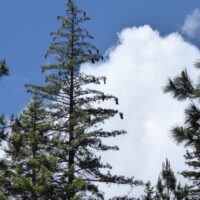
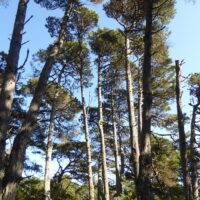
Pinus muricata
The Bishop pine is native to the northern California coast from Marin to Mendocino. A medium to large sized tree with a beautifully rounded crown and long, gray-green needles. Distinguished from the more southerly Monterey pine by its smaller cones which prick the hand when held. The Bishop pine often cohabitates with redwoods and other coastal conifers. Drought tolerant once established except in interior locations where an occasional deep watering may be required. Generally reaches 40 to 70 feet in height. Deer resistant.
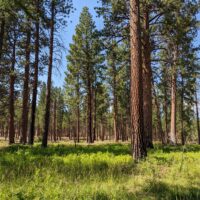
Pinus ponderosa
Often associated with the Sierra Nevada mountains, this majestic pine can be found in Sonoma County as well. Long, gray-green needles form bushy clusters at the ends of branches with cantaloupe-sized cones that emerge at the very tips. The bark at maturity is a colorful patchwork of orange-tan plates separated by deep grooves of dark brown. It can grow a couple of feet a year, and averages from 60 to more than 100 feet in height in a garden setting. Provide full sun to light shade with occasional deep waterings when young. Needs decent drainage. Deer resistant.
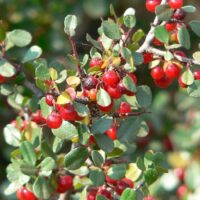
Rhamnus crocea
An under-used evergreen shrub native to chaparral, woodland, and coastal-sage scrub communities in California. Spiny redberry can grow up to 6 feet tall and wider, but is typically in the 2 - 4 ft. height range, spreading to 6 ft. or more across. Small, leathery, dark-green ovate leaves give this tough shrub a delicate look once established. The flowers on both male and female plants are inconspicuous, blooming from late winter into early spring. Female plants produce sporadic, jelly-like red berries. Great for dappled light under oaks, or a dry, shady woodland slope with California fescue. Can tolerate more sun near the coast, but prefers afternoon shade inland. Drought-tolerant once established. Larval host for a multitude of butterflies and moths, including the pale tiger swallowtail butterfly, Ceanothus silk moth, and Hermes copper butterfly. Deer resistant.
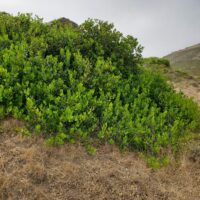
Rhus integrifolia
This sturdy native shrub or small tree is highly valued for its evergreen foliage and as a source of food for birds, bees and butterflies. Round, serrated, leaves, flatter than those of the sugar bush, cover this plant from head to toe. In late winter to early spring, white to pink flower clusters emerge, followed by sticky, reddish fruits. Ranging in height and width from 6 to 20 ft., lemonade berry is very tolerant of pruning, either into a small tree or a low hedge. Cold hardy to about 20 degrees. Plant in full sun to part shade. Will be very drought tolerant once established. Fire resistant. Deer resistant.
Rhus ovata
Handsome evergreen shrub native to dry slopes away from the coast in Southern California, Baja, and Arizona. A durable shrub thriving in hot, rocky conditions in full sun to part shade where it will be completely drought tolerant once established. Grows 6 - 10 ft. tall and wide. A profusion of dense flower clusters are rosy tinted in bud opening to white with a pinkish blush. Small reddish fruits follow that are coated with a sugary secretion that tastes lemony. Excellent subject for hot, dry inland conditions. Good for birds, bees and butterflies. Fire resistant. Deer resistant.
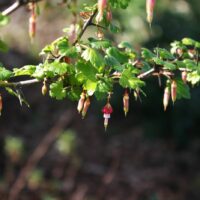
Ribes californicum
Undemanding, winter blooming, deciduous shrub, native to Coast Range mountains of California, from Mendocino County south to Orange County. Excellent choice for habitat gardens, where it provides abundant flowers and fruits plus thorny, protective cover. Variable in size, this spiny shrub can grow 4 - 6 ft. tall and wide. The pendant flowers are tiny but numerous and charming on close inspection. The tubular flower parts are white and extend beyond the reflexed red sepals, and are highly attractive to hummingbirds and other pollinators. Red, bristly, globular fruits follow and are adored by birds. The bright green leaves often take on striking crimson colors in the late summer before going dormant with drought. Host plant to several butterfly species as well as the white-lined sphinx moth. Best with light shade and a little irrigation, though once established it is completely drought tolerant.
Ribes indecorum
Native to Southern California chaparral and coastal scrub plant communities from Santa Barbara County to Northern Baja. This vase shaped deciduous shrub features thick, aromatic, scalloped leaves and grows 6 feet or so tall and wide. Small clusters of white flowers cover the stems in November and attract hummingbirds, bees and butterflies. The fruits that follow are very appealing to birds. Plant in sun to light shade. Little to no summer water is required once established. While this currant is often summer deciduous, a little extra water will help it to retain most of its leaves all year long.
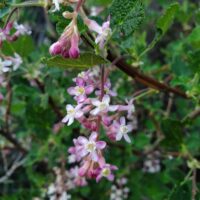
Ribes malvaceum
Chaparral currant is a tough and durable native shrub 5 to 8 ft. tall. This deciduous shrub will grow in full sun to light shade and is quite drought tolerant. Flowers early, often midwinter with dangling clusters of pink blossoms. Good early nectar source for hummingbirds. Berries attract many birds including grosbeak and mockingbirds.
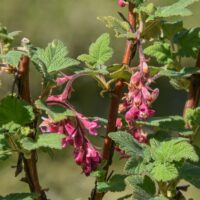
Ribes malvaceum ‘Cupertino Rose’
Chaparral currant's flowers can range from white to pink to nearly red in color. This selection carries flower clusters that were the darkest to be found in this population from the foothills of the Santa Cruz Mts. west of Cupertino. The buds are dark pink and the dangling racemes when fully open read medium pink. Deciduous shrub 4-6 ft tall and wide with a very early bloom season often beginning in November, which provides an excellent early source of nectar for hummingbirds. The pendulous clusters of berries that follow are relished by birds. Tolerates full sun along the coast with some shade inland and occasional to little summer water.
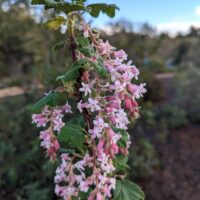
Ribes malvaceum ‘Dancing Tassels’
A dazzling selection by Rancho Santa Ana Botanic Garden from San Clemente Island. Blooming in winter over a long period with the longest dangling flower clusters we’ve seen in the species. Pendulous flower clusters are dusty pink in bud, opening to white and soft pink when fully open. Growing 6 ft. or more tall, this deciduous, vase shaped shrub has gray-green foliage with a pungent resinous fragrance. Peeling red-brown bark and clusters of blue-black berries add to its beauty and appeal. Chaparral currant blooms earlier and is more sun and drought tolerant than the popular pink flowering currant, Ribes sanguineum glutinosum. Plant in full sun to light shade with little to no water once established. An outstanding early nectar source for hummingbirds.
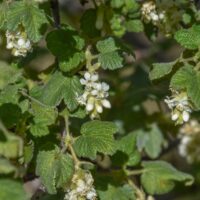
Ribes malvaceum ‘Rana White’
This unusual form of the chaparral currant has pure white flowers, not the typical pink flowers one normally sees. Forming an erect shrub of true green, aromatic foliage 6 ft. or more tall and wider. Winter and early spring bring short pendant racemes of the fragrant white flowers that are highly attractive to hummingbirds and pollinators. Clusters of sticky berries follow and are relished by birds. Though it will tolerate garden conditions, this currant is extremely drought tolerant once established. When allowed to go dry, this well-adapted species drops its leaves in late summer and leafs out again in late autumn. Moderate irrigation can make it almost evergreen. Plant in full sun to light shade. This species can be found throughout much of California in chaparral and on the edges of woodlands. Introduced by Rana Nursery.
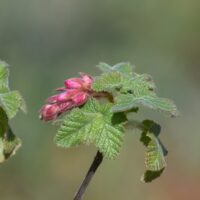
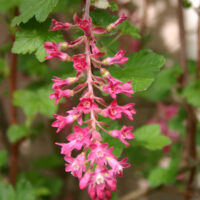
Ribes sanguineum v. glutinosum ‘Monte Bello’
This Cal Flora introduction was discovered in the hills west of Cupertino in the Santa Cruz Mountains. Long clusters of deep pink flowers make this selection of the pink-flowering currant stand out from other forms. In late winter and spring the flowers emerge on bare stems followed by rounded, maple-like leaves. This deciduous shrub has a vase-like shape, reaching a height of up to 10 ft. over time and a width of at least 6 ft. Provide full sun near the coast and light shade inland. Needs moderate to occasional irrigation once established. A great plant for hummingbirds and a wide array of pollinators. Birds enjoy the fruits.
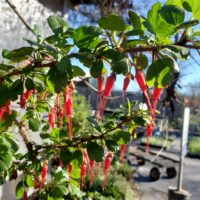
Ribes speciosum
One of California’s showiest gooseberry, blooming in late winter - early spring with charming bright red, pendant, fuchsia-like flowers. The thorny branches are arching and grow 4 - 6 ft. tall and wide. Best with light shade and needs no irrigation once established. Occasional summer water keeps most of the leaves green through the summer, but will go summer dormant with dry conditions. An excellent choice for under native oaks. The flowers attract hummingbirds and the spiny fruits attract many birds including grosbeak and mockingbirds. Deer resistant.