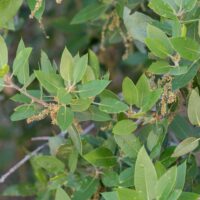
Quercus wislizeni
Typically more compact in stature than the coast live oak, this evergreen oak has similar dark-green, leathery leaves, though often narrower and flatter. A native of dry foothills, the interior live oak has a range that extends throughout much California, and is the dominant live oak in the western Sierra-Nevadas. While it can flourish in the shade, it may remain shrublike. In full sun, its densely-foliated canopy has a pleasingly broad, rounded habit. This adaptable oak takes inland heat, and once established is drought tolerant and generally deer resistant. It tolerates clay, but does best in well-draining soils. Like other oaks, it’s a great habitat plant that supports a wide range of wildlife.
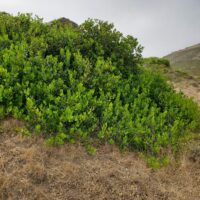
Rhus integrifolia
This sturdy native shrub or small tree is highly valued for its evergreen foliage and as a source of food for birds, bees and butterflies. Round, serrated, leaves, flatter than those of the sugar bush, cover this plant from head to toe. In late winter to early spring, white to pink flower clusters emerge, followed by sticky, reddish fruits. Ranging in height and width from 6 to 20 ft., lemonade berry is very tolerant of pruning, either into a small tree or a low hedge. Cold hardy to about 20 degrees. Plant in full sun to part shade. Will be very drought tolerant once established. Fire resistant. Deer resistant.

Rhus ovata
Handsome evergreen shrub native to dry slopes away from the coast in Southern California, Baja, and Arizona. A durable shrub thriving in hot, rocky conditions in full sun to part shade where it will be completely drought tolerant once established. Grows 6 - 10 ft. tall and wide. A profusion of dense flower clusters are rosy tinted in bud opening to white with a pinkish blush. Small reddish fruits follow that are coated with a sugary secretion that tastes lemony. Excellent subject for hot, dry inland conditions. Good for birds, bees and butterflies. Fire resistant. Deer resistant.
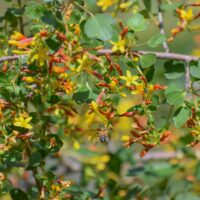
Ribes aureum
A vigorous deciduous shrub with masses of cheerful yellow blooms that appear in early spring. The light green foliage returns in late winter followed by delicate clusters of bright yellow tubular flowers that mature to a reddish-orange. Makes a wonderful addition to any habitat garden. Hummingbirds and bees adore the flowers, and the golden berries attract birds. Tolerates a variety of conditions from creeksides to dry woodland foothills to higher elevations - and even snow. Grows 6 to 8 ft. tall and wide. Where it finds water, it can spread by suckers, but is highly amenable to pruning. Adaptable to sun or shade, but does best with afternoon shade and moderate to occasional summer water.
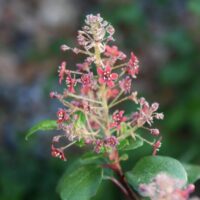
Ribes viburnifolium
Native to Santa Catalina Island, this Ribes is unique for the genus, being evergreen and low growing. Leathery, dark green, glossy leaves with a spicy fragrance on red stems forms a spreading shrubby groundcover to 2- 3 ft. tall. Small clusters of interesting, star-shaped, salmon-pink flowers decorate the arching branches in late winter to early spring, followed by little, red fruits. Requires part shade and is drought tolerant once established. Adaptable to a variety of soil types including heavy clay. Tip pruning is recommended to encourage a dense growth habit. Deer resistant.
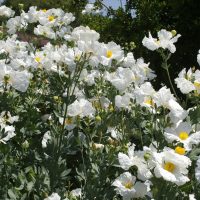
Romneya coulteri
A much admired, spectacular, shrub-like perennial, with a long history in cultivation. Can be both finicky to get going and extremely vigorous once established. The large flowers are made up of crinkly, crape paper-like, white petals with a shaft of yellow stamens in the center, at the top of long, gray-foliaged stems. Plant where its size and spreading won't be a problem and prune severely in winter. Height 4 -8 feet. Full sun. Drought and deer tolerant.
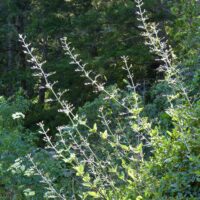
Scrophularia californica
Native to open places of the coastal scrub and woodlands where it can form large colonies in moist areas. Grows 3 to 6 ft. tall and wide in cool full sun to light shade. Pretty purplish-red new growth matures to deep green. The flower spikes carry many small open-mouthed maroon-red flowers followed by attractive seed stalks which are nice in dried flower arrangements. This prolific nectar producer attracts all sorts of pollinators including bees and hummingbirds. Larval food source for the Chalcedon Checkerspot and Common Buckeye butterfly.
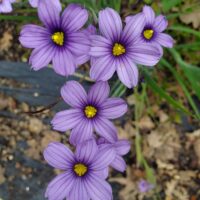
Sisyrinchium bellum
A beloved native perennial wildflower with grass-like foliage and six-petaled spring blossoms that range from blue to purple with occasional pure white forms. Grows 6 - 12 inches tall in small clumps where it is useful in meadow or grassland plantings as well as mixed borders. Sun to partial shade, with moderate to infrequent summer water. Goes summer dormant in dry gardens. Does well in heavy soils and often seeds about when happy.
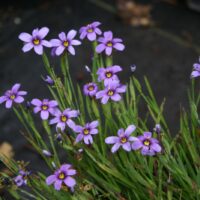
Sisyrinchium bellum ‘Dwarf’
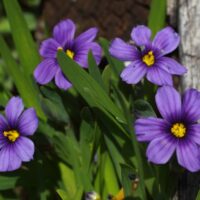
While we’re a little unsure about this selection’s origins, we do know it’s an AMAZING bloomer and an easy garden plant! In spring and into summer, deep blue-purple flowers with yellow centers cover this very dwarf blue-eyed grass which stays under 6 inches tall. Very narrow, iris-like leaves slowly increase to form a small clump. Plant in full sun to light shade and provide moderate to infrequent irrigation. If allowed to go dry in summer, it will go dormant, only to re-emerge with the winter rains. Deer resistant.
Sisyrinchium bellum ‘Rocky Point’
A vigorous selection of dwarf blue-eyed grass discovered on Rocky Point south of Carmel in Monterey County and introduced by Native Sons Nursery. Robust, rich green clumps of wide, iris-like leaf blades 4 - 6 inches tall feature vibrant blue-purple flowers with yellow centers. A great rock garden item. Plant in full sun to part shade. This spring bloomer will go semi-dormant in summer if allowed to go somewhat dry. With moderate irrigation it will be evergreen and have an extended bloom preiod. Deer resistant.
Symphoricarpos albus var. laevigatus
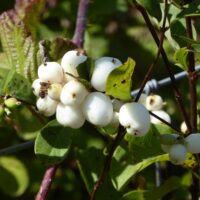
Snowberry is a deciduous, native shrub for dry or moist shade. Reaches about 4 - 6 ft. tall and spreading. Clusters of tiny, pinkish, urn-shaped flowers are followed by showy white berries on arching branches. Responds well to shearing. A good choice for under native oaks. Fruit may be toxic to humans. Hummingbirds like the flowers. Berries are palatable to hermit thrush, Swainson’s thrush, robins and other birds. Also creates good cover for birds.
Symphoricarpos albus var. laevigatus ‘Bartlett Springs’
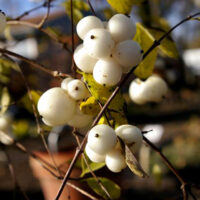
Snowberry is a deciduous, native shrub for dry or moist shade. Our own selection from Lake County, has particularly large oval leaves on graceful arching branches with exceptionally big fruits. Reaches about 4 ft. tall and spreading. Clusters of tiny, pinkish, urn-shaped flowers are followed by showy white berries on the branch tips. Responds well to shearing. A good choice for under native oaks. Fruit may be toxic to humans. Hummingbirds and bees like the flowers. Berries are palatable to hermit thrush, Swainson’s thrush, robins and other birds. Also creates good cover for birds.
Symphoricarpos albus var. laevigatus ‘San Bruno Mountain’
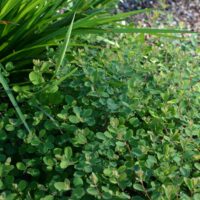
This attractive low-growing form of our native snowberry is a Cal Flora Nursery selection from San Bruno Mountain. Its dimensions are about 8 inches tall and spreading. Indeed the spreading nature of this plant is robust and it should be included in areas where that is an asset rather than a liability. The wiry arching branches hold light green rounded leaves and the effect of the new growth is delicate and appealing. Tiny pink urn-shaped flowers decorate the branch tips, followed by small white fruits. Perfect for a lightly shaded bank or the light shade of a tree where it will be very drought tolerant. With total drought it may go summer deciduous but occasional summer water will keep it looking fresh. The flowers attract bees and hummingbirds.
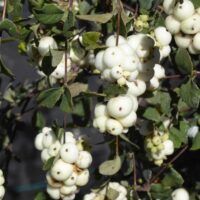
Symphoricarpos albus var. laevigatus ‘Tilden Park’
Here is a particularly fine selection of the native snowberry, notable for its dependable crop of showy white berries on arching branches. A deciduous shrub, snowberry grows to about 4 ft. tall and spreads to form drifts. A good choice for a shady bank, woodland edge, or under oaks. Appreciates and responds to moisture, but once established will tolerate dry conditions. Fruit may be toxic to humans. Hummingbirds like the flowers. Berries are palatable to hermit thrush, Swainson’s thrush, robins and other birds. Also creates good cover for birds.
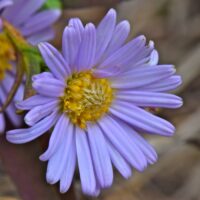
Symphyotrichum (Aster) chilense
This native aster is found throughout much of Sonoma County, usually in moist soils. More slender in form than the burly Point St. George selection. Spreads vigorously but with a lighter touch, integrating itself well with native grasses and bulbs. Its summer-to-fall blossoms are white to lavender blue and provide excellent nectar for butterflies and beneficial insects. 1-3 ft. tall and spreading. Thrives in sun to light shade with moderate to little summer irrigation.
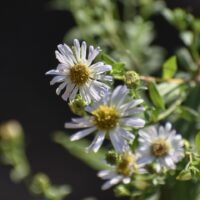
Symphyotrichum (Aster) chilense ‘Olema White’
Clear white flowers replace the class purple ones in this unusual selection of California aster that we found near the town of Olema in Marin County. In summer and into fall, a profusion of flowers bursts forth on this VIGOROUSLY spreading native perennial. An extremely adaptable groundcover reaching up to 3 ft. tall. Accepts regular to very little irrigation and full sun to light shade. This prolific bloomer is a bee magnet and also enjoyed by butterflies. Tolerant of clay and periodic flooding. Looks best when sheared to the ground after blooming.
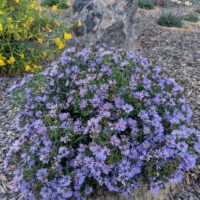
Symphyotrichum (Aster) chilense ‘Plumas Purple’
This form of the California aster is remarkably compact and refined, featuring blue-purple daisies which are darker than any other selection we have seen. Grows to a height of under a foot and so far has been much less likely to spread aggressively, though it should get to at least 3’ wide. In late summer and early autumn, the dense blooms turn plants into bonbons of flowers. Grow in full sun, where they will be drought tolerant once established, but will enjoy an occasional soak. California asters provide an important late nectar and pollen source for bees, while butterflies enjoy the nectar and are reported to utilize them as a larval hosts. Thank you to Pete Veilleux for giving us this stellar selection! It’s thought to have been found in Plumas County, so should be quite heat and cold tolerant.
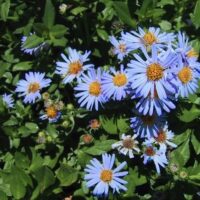
Symphyotrichum (Aster) chilense ‘Point Saint George’
A low-growing native perennial, reaching up to 1.5 feet in height and spreading widely and vigorously. Covered with soft lavender daisies over a long period, summer through fall and often into winter. Careful thought should be given to its placement as this plant really spreads. Far too vigorous for many settings, perhaps best used in planters, garden boxes or other contained areas or in large, naturalistic plantings. For sunny areas with at least a little summer water. Will tolerate flooding and periodic inundation. An excellent nectar source for bees and butterflies and seeds for birds.
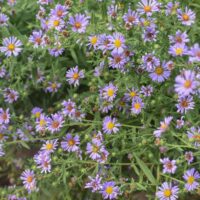
Symphyotrichum (Aster) chilense ‘Purple Haze’
A wonderful selection of our native Pacific aster, chosen by the Santa Barbara Botanical Garden for its deep lavender blossoms. Blooms late summer through fall and often into winter with one-inch daisies opening from dark purple buds. This plant SPREADS VIGOROUSLY by underground rhizomes, so works best when constrained by a planter or garden box or in a meadow planting. Excellent for areas needing soil stablization. The dense foliage grows quickly to 2-3 feet tall each spring, and can be annually pruned to the ground in winter. Tolerates many soil types and full sun to part shade. Requires minimal water, but occasional deep soaks keep it blooming longer. This easy to grow habitat plant will delight bees and butterflies.

Tellima grandiflora
Fringe cups is a sweet native perennial for the shade garden. Slender flower stalks rise above the soft mounds of foliage 18 inches to 2 ft. The small, urn-shaped flowers have tiny fringed petals which open green and then age to pink. Seeds about in a nice way. Tolerates dry shade. Deer resistant.
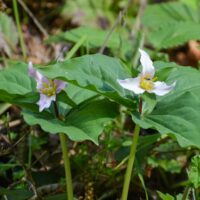
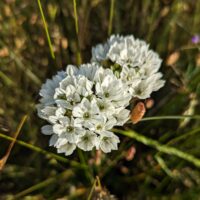
Triteleia hyacinthina
One of the easier to grow native bulbs that adapts well to garden conditions. Native to vernally moist areas that become summer dry in the Coast Ranges, Central Valley and Sierra Nevada into southwestern Oregon. Slender flowering stems rise one to two feet above the narrow leaves, with umbels of white, star-shaped flowers with green centers. If happy, the corms will multiply, forming drifts among grasses and shrubs and in open woodland settings. Easy to grow in containers, where they can be stashed in the shade once they go dormant. Bee and butterfly favorite.
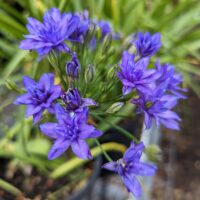
Triteleia laxa ‘Corrina’
A beautifully dark flowered form of our Ithuriel’s spear, with flowers a darker blue-purple than the more common ‘Queen Fabiola’. The trumpet-shaped flowers form circular clusters at the top of slender stalks 12 to 18 inches high. This easy to grow bulb sends up slender, grass-like leaves in late winter followed by the striking flowers in late spring. Multiplies readily forming colorful drifts which mix well with grasses and smaller perennials. Tolerant of pretty much all soil types and can be allowed to dry out completely in summer when it goes dormant. Unlike most grassland bulbs, this species will also tolerate moderate irrigation. Plant in full sun to light shade. Attracts bees, butterflies and hummingbirds.
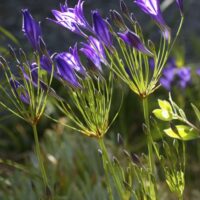
Triteleia laxa ‘Queen Fabiola’
Trumpets of bluish-purple blossoms make a dazzling display at the height of spring on this easily grown lily relative. The showy flowers rise up to 18 inches tall in dense whorls on slender stalks above grasslike leaves. The small bulbs increase rapidly to form small, colorful drifts. Give full sun to light shade. Tolerant of dry conditions but accepts occasional irrigation. Will go dormant by mid-summer but reemerges in early winter. Attracts bees, butterflies and hummingbirds. Plant in openings between low, evergreen plants or in meadows with yarrow, California fuchsia and grasses.
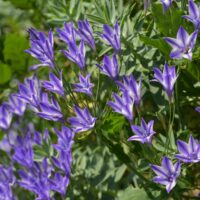
Triteleia laxa ‘Rudy’
An interesting flower color variation of this easy to grow native bulb. Grasslike blades 12 - 18 inches tall produce flower stems with large clusters of showy, funnel-shaped, pale blue-lavender blossoms with a vivid violet stripe down the center of each petal. An eye catching addition to a naturalistic planting, in sun to light shade. A willing grower which will multiply if happy. Enjoys dry conditions once done flowering, but will accept some moisture. Good container subject. Attracts bees, hummingbirds and butterflies.
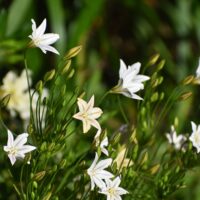
Triteleia laxa ‘Silver Queen’
A white form of Ithuriel’s spear! We kid you not. You may be familiar with this species and its traditionally blue-purple, trumpet-shaped flowers perched in whorls atop stalks a foot or more tall. We now have a selection featuring soft white flowers. This native bulb sends up grass-like foliage in the winter followed by the charming flowers in spring and early summer. The bulbs multiply readily, forming small colonies over time. While it tolerates dry conditions in summer, it will also accept occasional irrigation, making it very useful in the garden. Enjoys full sun to light shade and will tolerate clay soil.
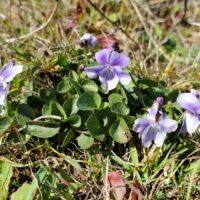
Viola adunca
Native to both coastal and mountain plant communities, this violet can be seen locally blooming in coastal meadows and bluffs. Forms low-growing, slowly creeping, neat clumps of heart-shaped leaves. Sweetly fragrant, nodding, blue to purple flowers with white interiors and purple nectar guides bloom in the spring. This pretty little wildflower is visited by bees and other pollinators and is a host plant for a number of butterflies, some of which are rare and endangered. Grows in sun along the coast and light shade inland with moderate summer water. Can reseed if happy.
Viola palustris
Native to moist environments in both coast and mountain plant communities of N. America and Eurasia. Rare in California, where it is found in the northern counties of Mendocino, Humboldt and Del Norte. Rounded to heart shaped leaves with shallow scalloped edges grow from basal rosettes and spread by slender rhizomes. The charming flowers bloom April through July and range from white through lavender in color with dark-purple nectar guides. Used by Fritillary butterflies as a larval food source. Easy to grow, this is not a violet for heavy shade, but prefers brighter locations with light shade and moist, but well drained soils.