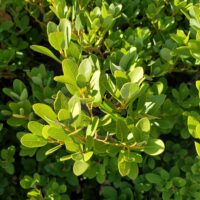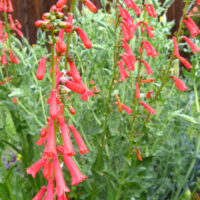
Penstemon eatonii
Adaptable and beautiful perennial native to the western United States including southeastern California. Narrow, leathery leaves form an evergreen rosette of foliage. Flower stalks rise 2-3 ft above the foliage. This form has brilliant red tubular flowers lining the erect stems in early summer. Requires good drainage, full sun to light shade and occasional to little summer water. Tolerates winter cold to 18 degrees and drought once established. Hummingbird favorite.
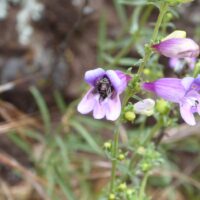
Penstemon heterophyllus
Iridescent blue-purple tubular flowers in short spikes put on a good show over a long period in spring and early summer. The spent flower spikes should be cut off to encourage more blooming, better form, and longer life. Best in full sun with well drained soils and moderate to little water once established. Hummingbird favorite.
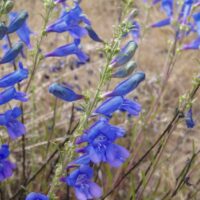
Penstemon heterophyllus – Hood Mt. seed strain
From the rugged Hood Mountain area, southeast of Santa Rosa, comes this local seed strain of foothill penstemon, which is showing promise as a particularly good performer. Proving to be vigorous and disease resistant, blooming freely with particularly large, vivid-blue, open-mouthed, tubular blossoms, spring into summer. An evergreen perennial, growing about 2 ft. tall and at least as wide, for full sun with decent drainage, and little water once established. Bees, butterflies and hummingbirds are all attracted to the showy flowers. A great, local, seed grown alternative to the cutting-grown 'Margarita BOP'.
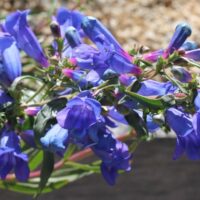
Penstemon heterophyllus ‘Blue Springs’
A seed strain of a highly variable native penstemon. Attractive narrow, shiny, bluish-green leaves topped with dense spikes of narrow bell-shaped blossoms of bright blue. Flowers late spring to early summer, growing to around 1 to 1 1/2 ft. tall and wide. The spent flower spikes should be cut off to encourage more blooming, better form, and longer life. Best in full sun with good drainage and moderate to little summer water.
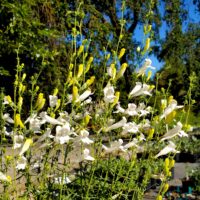
Penstemon heterophyllus ‘GMR White’
An unusual, bright white form of our native foothill penstemon that dazzles with dense blooms from spring to fall. Spring sees the emergence of soft yellow buds on this evergreen perennial, which then open as snowy fresh, tubular flowers. The showy flower stalks reach 18 inches to 2 feet and look spectacular cascading out of a container. A natural selection, its name is an abbreviation of Glendora Mountain Road, the area just north of Los Angeles where it was found. As beloved by hummingbirds and pollinators as the more common blue-violet form of this species and even more shockingly floriferous. Plant in full sun to very light shade where it will have good drainage, and provide occasional to no water. Thrives in large pots. Drought tolerant.
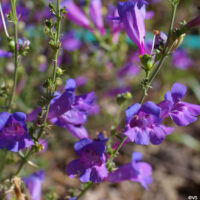
Penstemon heterophyllus ‘Margarita BOP’
A fine selection of a native penstemon from Las Pilitas Nursery where this chance hybrid seedling was discovered at the “Bottom Of the Porch”. Forms a tidy mound 18 inches tall by 2 ft. or so wide. Iridescent blue-purple tubular flowers in short spikes put on a good show over a long period in spring and early summer. The spent flower spikes should be cut off to encourage more blooming, better form, and longer life. Best in full sun with well drained soils and moderate to little water once established. 'Margarita BOP' has proven particularly adaptable and has survived longer than other cultivars. Hummingbird favorite.
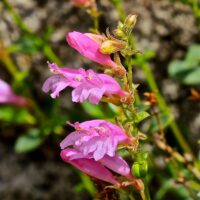
Penstemon newberryi
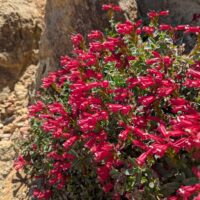
As the common name implies, this beauty is native to the mountains of California, Oregon and Nevada, where it grows in rocky habitats at high elevations. Forms an evergreen mat, under a foot tall with thick, leathery leaves and gorgeous magenta-pink tubular flowers, in mid to late spring. Good drainage is a must for success and growing in a container is an option for those with heavy soils. Full sun to very light shade with occasional summer waterings. Can be challenging to cultivate, but well worth the extra effort. The showy flowers are highly attractive to hummingbirds and butterflies. Said to be deer resistant.
Penstemon newberryi v. sonomensis
This rare, perennial, inland beauty, found only in Sonoma, Napa, and Lake Counties, is a great addition to the dry, inland rock garden. A low mat of small, gray-green, succulent-like leaves gives rise to 5-12” stalks topped with clusters of chunky, tubular, magenta-red flowers with white, fuzzy throats and reproductive structures. Mature plants are no more than 2' wide. A native bee and hummingbird magnet. Plant in full sun with decent soil drainage. Little to no water once established.
Penstemon palmeri
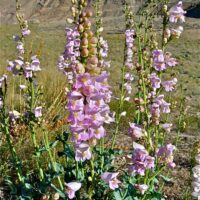
Showy, grape-scented, pale pink flowers top blue-green, succulent-like foliage on vertical stalks reaching an astonishing 4 to 5 ft. in height. The bulbous flowers have given rise to the common name, ballon flower. Native to desert mountains of southern California and throughout the western United States. This penstemon is attractive to a multitude of pollinators, especially hummingbirds. Plant in full sun to light shade and provide good drainage. Drought tolerant once established. The tall but narrow flower stalks make this penstemon useful in narrow spaces where height is desired.
Penstemon pseudospectabilis
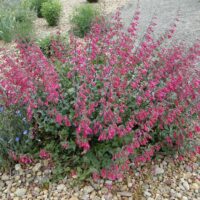
From the southeast corner of the state comes this surprisingly adaptable penstemon, with prolific displays of magenta-purple, tubular flowers with flared mouths. Large, serrated, gray-green leaves line stems in attractive pairs. Flower stalks rise 2 – 3 ft. in spring, drawing in hummingbirds and bees. Even though this species is from the desert, it does quite well in local gardens with good drainage, full sun and occasional irrigation once established. Several local butterflies use the desert penstemon as a larval food source, including the common buckeye, variable checkerspot and Edith’s checkerspot.
Penstemon rostriflorus
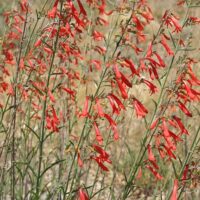
A wonderful addition to the dry garden, bringing late summer color through abundant, bright red, tubular flowers. Growing 2 - 4 feet tall and wide, with attractive, glossy foliage, that takes on red and bronze tones in winter. A late blooming Penstemon, beginning in July, provides copious nectar for hummingbirds as well as bees, butterflies, and moths. Tolerant of wide range of soils and conditions, plant in full sun to light shade with occasional water. Drought tolerant once established.
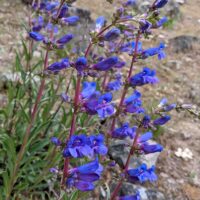
Penstemon speciosus
Found in higher elevation localities of inland Northern California, royal penstemon is a vibrantly colorful addition to the dry, full sun garden. In summer, the large, saturated blue-purple florets are held in clusters on stems rising almost 2’ tall above a low, evergreen rosette of glossy, strap-like foliage, reaching 1' - 2' wide. Attracts a multitude of pollinators. Does best with decent soil drainage, and inland sites that provide seasonality—colder winters, and hotter summers. Drought-tolerant once established.
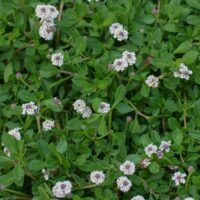
Phyla nodiflora
Vigorous, spreading ground cover native to California, North America and other parts of the world. It's a tough one, able to survive a wide range of conditions and soil types. Tolerates both drought and flooding, but best with occasional deep watering in full sun to very light shade. Flowers heavily over a long period with charming little heads of mauve-pink, lavender and white blossoms, delighting an assortment of bees and butterflies. This dense, carpeting plant makes a serviceable ground cover or lawn-like replacement, tolerating moderate foot traffic and occasional mowing. May look rough in the winter, but quickly recovers in spring. Free flowering and pollinator friendly.
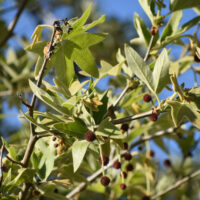
Platanus racemosa
This most Californian of trees from the southern and central parts of our state features stunning bark mottled white and grey on a large, sculptured trunk. The maple-like leaves create an open canopy on this stately tree which can reach up to around 80 ft. tall at maturity. Seeds are produced in fuzzy pom-poms dangling on short stems and are a great food source for birds. In autumn, the leaves can turn orangey-yellow before they drop, adding rare fall color to the California landscape. Makes its home in sunny, low-lying areas and canyons with moderate to occasional irrigation. A great shade tree for the large garden and a larval host for the Western tiger swallowtail butterfly. Deer resistant.
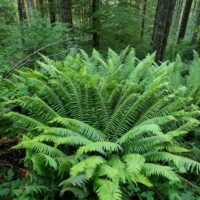
Polystichum munitum
The versatile western sword fern is an evergreen native fern from California to Alaska. In most gardens it will reach about three feet tall and wide. In prime areas near the coast where moisture is readily available and cool temperatures prevail, this fern can get up to 5 feet tall and wide. Excellent for shady beds, along walls, as a large scale groundcover and mixed woodland planting. Best with humusy soil and regular to moderate water, but drought tolerant once established and tolerant of most soil types. Actually quite adaptable and deer resistant.
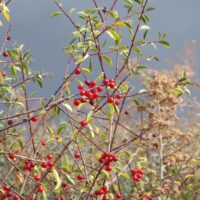
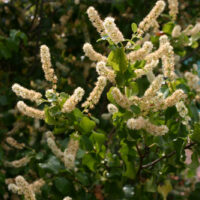
Prunus ilicifolia ssp. ilicifolia
Hollyleaf cherry is a large, evergreen shrub that can grow more than 15 feet tall and wide, but is easily pruned to be more compact. This adaptable foothill native can be clipped into a formal hedge, pruned to be treelike, or left to its own natural gumdrop-shaped habit. Often it is used for background or screen plantings. Glossy, holly-like leaves are accompanied by showy displays of creamy-white flowers in narrow spikes from late spring to early summer. Plant in full sun to very light shade. Looks best with occasional deep waterings, but can tolerate very dry conditions once established. Although it requires good drainage, it is tolerant of heat, drought, wind and oak root fungus. An excellent habitat plant, offering food and cover for wildlife. Birds enjoy the small reddish-purple cherries. Generally deer resistant.
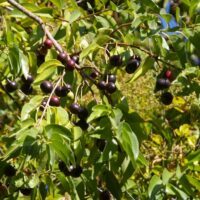
Prunus ilicifolia ssp. lyonii
This subspecies of our native cherry comes from Southern California and can be grown as a large shrub or trained into a small tree. The Catalina cherry is evergreen, with soft, glossy leaves and without the toothed leaf margin of our more local hollyleaf cherry. Gorgeous, creamy-white flower clusters make a showy display in spring. The purple-red fruits are edible, but are mostly preferred by wildlife. At 20-40 feet in height and slightly narrower in width, it is also larger than the hollyleaf cherry, but can be pruned to 8-10 feet. Its dense foliage makes an excellent hedge. Does best in well-drained soil with occasional deep watering once established. The flowers are adored by pollinators. Black-headed Grosbeaks, Cedar Waxings, Western Tanagers, and many other bird species love the cherries, which offer an excellent fall-migration food source.
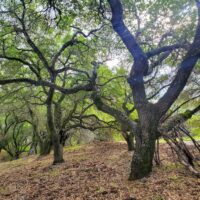
Quercus agrifolia
A beautiful and stately evergreen oak, native to many plant communities from Mendocino County south to Baja. One of the fastest growing California oaks and a versatile landscape subject as long as space allows. Young trees have a dense rounded canopy covered with thick, dark green, oval and convex leaves with spiny margins. Smooth gray bark becomes furrowed with age. Flowers are produced on short yellow hanging catkins followed by long tapered acorns. In time, develops a magnificent architecture with broad spreading branches. Planting native oaks provides beauty, shade, food and cover to a dazzling array of wildlife. Plant in sun to light shade. No additional summer water required once established.

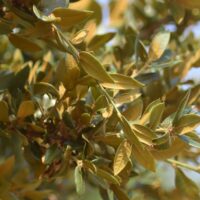
Quercus chrysolepis
A handsome evergreen oak with a rounded, spreading crown, 20 - 60 ft tall and wide. The leaves of its broad, low canopy are dark-green and shiny with fuzzy gold or silver hairs on the underside. Native from Oregon to Baja, it is the most widely distributed oak in California. Often grows near creeks, but requires only occasional water. Plant in full sun to light shade where it will be drought tolerant once established. A good choice for bank stabilization. Like other oaks, it is habitat powerhouse, offering food and cover for a huge variety of wildlife.
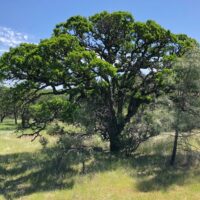
Quercus douglasii
This is the oak of California’s interior, where hot and dry summer conditions prevail. A medium-sized oak, growing 20 to 50 feet tall, The canopy is compact and round with bluish-green lobed leaves. The acorns are oval shaped with shallow caps. Grows slowly but is long lived. A well sited oak is a gift to future generations of humans as well as a myriad of wildlife. Plant in full sun where it will be extremely drought tolerant once established.
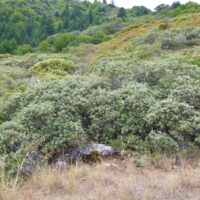
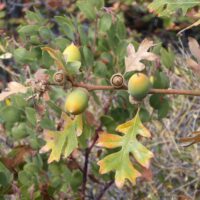
Quercus kelloggii
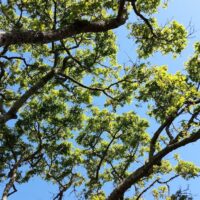
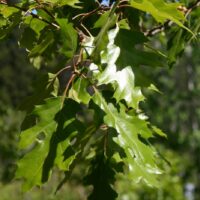
Beautiful in all seasons, the native black oak makes a fine specimen. Found mostly in foothills and low mountains away from the immediate coast, often in association with conifers, from California to Oregon. Growing 35 - 80 ft tall, this graceful, deciduous tree starts the spring with gorgeous, rosy-pink new growth. The soft pink leaves soon mature to a lustrous, shiny, dark green and are deeply lobed with pointed tips. Gold-green catkins dangle from the branch tips in the spring, leading to plump acorns, set deep in their scaly cups. In the autumn, the bold, leathery leaves take on golden hues before they fall. Oak trees are the ultimate habitat plant, offering food and cover for a myriad of species, including invertebrates, mammals and birds. Plant in full sun to light shade where it will be drought tolerant once established.
Quercus lobata
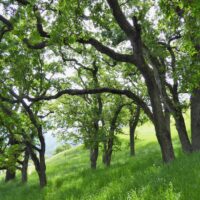
This majestic oak once covered the Santa Rosa Valley and many other fertile valleys throughout the state. Becomes large and picturesque with long drooping branches and beautiful thick, checked bark. Best in deep soils with room to develop. Wonderful planted for wildlife. Deciduous, long lived. Oaks are some of the greatest trees for birds. Oak titmice, acorn woodpeckers, and many other species utilize them for nest sites, cover, insects and acorns.
Quercus tomentella
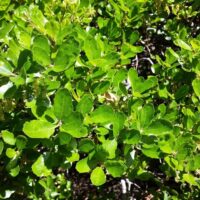
The rarest of all California oaks, an ancient relict of the mainland, now confined to the Channel Islands, off the coast of southern California. Island oak is a small evergreen tree with a rounded canopy, 25 to 40 foot tall. Beautiful dark-green, shiny, leathery leaves with prominent parallel veins are edged with widely spaced teeth. Whitish woolly hairs cover the growing tips, undersides of leaves, and the caps of the 1 inch long acorns. A natural for gardens with coastal influence where it will be drought tolerant once established. Tolerant of many soil conditions, but attains full stature in deeper soils in sheltered locations. Oaks provide beauty, shade and food and cover for a wide array of wildlife.