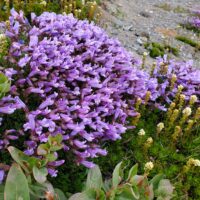
Heuchera ‘Santa Ana Cardinal’
An outstanding hybrid that is vigorous and free flowering. Compact clumps of foliage topped with 2 ft. tall flowering stems with vibrant rose-red blossoms over a long period. Plant in cool full sun to light shade with moderate to occassional summer water once established. This species attracts hummingbirds.
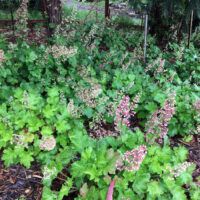
Heuchera maxima
Native to the Channel Islands, this is one of the most adaptable and vigorous of the alum roots, forming broad evergreen mounds of bright green folilage 1 - 1 1/2 ft. high. Maroon flower stems are 3 ft. high topped with pink blushed creamy flowers that have a slight green haze. Best with part shade and a little summer water, but will tolerate full sun close to the coast. Good for use under oaks. This species attracts hummingbirds.
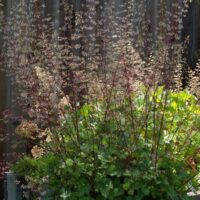
Heuchera micrantha
This is our common alum root which is usually seen on shady cliffs and roadbanks adjacent to forests. Easy to grow in garden situations. Forms low mounds of foliage topped with dainty white flowers on long stems. Likes moisture, but tolerates considerable drought and takes deeper shade than most Heuchera species. This species attracts hummingbirds.
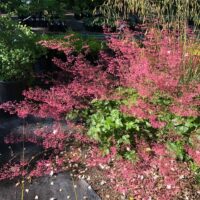
Heuchera micrantha ‘Martha Roderick’
Here’s a pink flowered form of the normally white flowered native alum root. Foliage forms handsome clumps topped with slender stalks 1 - 1 1/2 ft. tall of tiny pink flowers. Excellent in woodland setting for border, slope or rock garden. Drought tolerant but best with a little water. This species attracts hummingbirds.
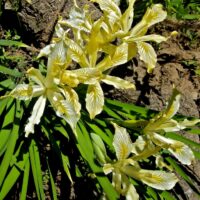
Iris chrysophylla
Native to far northern California and into western Oregon, this uncommon iris grows in fast draining soils in open forests and woodlands. A small scale iris, usually under 12 inches tall in bloom, spreads slowly from slender rhizomes. The delicate blossoms flower in the spring and can vary in color from white to cream to yellow, with a central yellow splash and prominent dark venation. Grow in sun to light shade with occasional to little watering. Visited by bees and hummingbirds. Deer resistant.
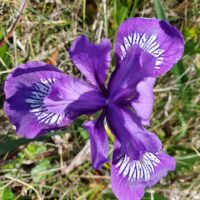
Iris douglasiana
Native to the California coast from Santa Barbara to Oregon. Grows both on the edge of coastal forests and on bluffs and prairies along the ocean. Clumps of evergreen, sword-shaped leaves increase readily and are topped with violet-purple blossoms early to mid spring. Important nectar producer for native bees. An adaptable garden subject for cool full sun to light shade. Drought tolerant once established, but occasional summer water will help keep foliage fresher. Deer resistant.
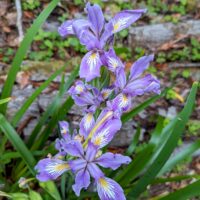
Iris douglasiana – Robust Form
We discovered this incredibly striking form of the popular Douglas iris near Tannery Gulch, outside of Occidental. The dark, evergreen leaves reach up to an astounding three feet in height, and are exceptionally broad. Even though these are grown by seed, the flowers are a dependable lavender-blue, with sprays of white and yellow, held on tall stalks reaching up to a foot above the foliage! Grows well in dappled shade in hotter areas, but can take full sun where there is coastal influence. While drought tolerant, occasional deep soaks keep them looking verdant and vigorous. Deer and gopher resistant.
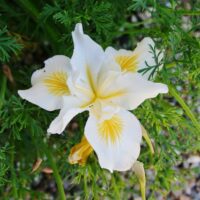
Iris douglasiana ‘Canyon Snow’
A dependable and floriferous selection of the native Douglas iris, with springtime flowers that are pure white with yellow markings on the falls. Broad shiny blades are mostly evergreen and grow a foot or more tall and form compact clumps. Plant in sun to part shade, particularly in hot inland areas, with moderate to little summer water. Prefers good drainage but will grow well on clay soils provided they are mounded up. Too much summer water on heavy soils will prove fatal. Deer resistant.
Iris douglasiana v. major
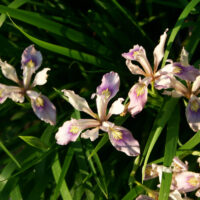
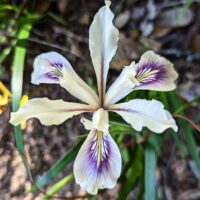
This rare form of the Douglas iris occurs throughout Marin County, offering a rainbow of possible flower colors, including blue-purple, mauve, creamy yellow and white, with all sorts of gradations in between. Since these are seed grown, the color will be a surprise when they bloom. The spring blossoms often have striking venation, and are held on stalks 1’ – 2’ high. Foliage clumps generally reach about a foot tall and spread to form extensive colonies of evergreen, strap like leaves. Plant in full sun in cooler areas, but provide some shade in hotter zones. Plants require little water once established, and are perhaps a little more drought and heat tolerant than the straight species. Deer and gopher resistant.
Iris fernaldii
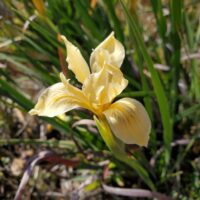
Rarely offered in nurseries, the creamy-white to soft, buttery-yellow flowers of Iris fernaldii brighten up any dry shade to part-sun, inland garden in April. The flowers rise a foot above the evergreen, narrow, strap-like, deep-green foliage. This patch-forming Iris can be found in the more inland canyons of Northwestern California, from the Santa Cruz mountains, throughout inland Sonoma County, to Lake, Colusa, and Glenn counties. Fernald’s iris is well adapted to both extreme heat and cold, but can also perform well in full sun on the coast. Native bees and butterflies are attracted to the cheery flowers of this iris. This species prefers decent drainage and is drought tolerant and deer resistant once established.
Iris innominata
A choice iris with slender, glossy, dark-green leaves and dainty flowers in late spring. Flower color can be from brilliant yellows to shades of purple. Native to the Siskiyou Mountains in Del Norte County, California, into southern Oregon where it forms low, dense, evergreen clumps in openings of woodlands or coniferous forests. This species does better in hot, inland areas than the Douglas iris. Requires good drainage and some summer water. This Del Norte County iris has been used in hybridization programs to produce the popular Pacific Coast Hybrid Iris. Deer resistant.
Iris longipetala
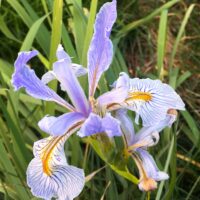
Restricted to swales and moist areas in coastal grasslands from San Francisco to Monterey, this uncommon native is well worth growing. Bluish-green evergreen blades form erect clumps one foot to 20 inches tall. Early spring brings beautiful lavender-blue flowers with dark purple venation. Full sun in coastal areas, a little shade inland with regular water through the bloom period. Can go dryer once flowering is finished. Deer resistant.
Iris macrosiphon
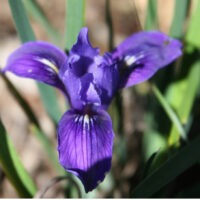
A widespread and variable species growing throughout Northern California’s coast ranges and Sierra Nevada foothills. Our crop is grown from seed collected in western Sonoma County which has lovely lavender-blue blossoms April through May. Forms small clumps of narrow and slightly arching blades under 18 inches tall. Often found on wooded slopes, in openings or edges of forests where it will form small patches. Prefers good drainage, drought tolerant, or just a little summer moisture. Deer resistant.
Iris Pacific Coast hybrid
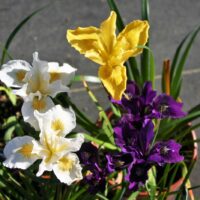
A diverse group bred from the native irises with wonderful coloration, patterning, flower form variation....ranging from soft pastels to mahogany, maroon and midnight purple. Evergreen foliage, about 1 to 2 ft. high. Can eventually form sizable clumps. Full sun to light shade. Often do well as an understory for oaks that needs no summer water. Drought tolerant, moderate to little water when established. Deer don’t seem to eat flowers or foliage.
Iris Pacific Coast hybrid – lavender
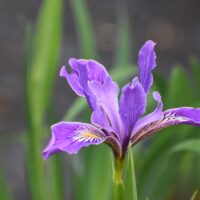
A native iris hybrid thought to be a cross with Iris douglasiana. Flowers are a deep lavender in color, with purple-veined petals and yellow throats. Evergreen foliage is 12-18 inches tall and spreads to form 2-3 foot-wide clumps. Tolerates full sun on the coast but does best with afternoon shade inland. Occasional water keeps it looking good in summer. Like other Pacific Coast iris hybrids, it can be planted in the understory of oaks, where it will require little irrigation once established. Drought tolerant and deer resistant.
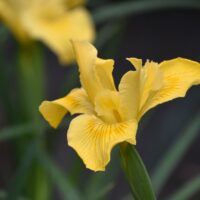
Iris Pacific Coast hybrid ‘Canyon Sunshine’
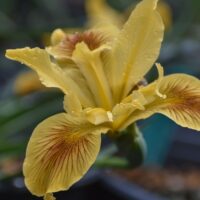
One of a diverse group of hybrid native irises, this butter-yellow selection with a lemony center is the result of a cross with Iris douglasiana 'Canyon Snow.' The evergreen foliage grows about 1 - 2 feet tall and spreads by rhizomes to form clumps up to 3 feet wide. Tolerates full sun on the coast but does best with afternoon shade inland. Occasional water keeps it looking nice in summer. A good plant for the understory of oaks, where it will require little irrigation once established. Drought tolerant and deer resistant.
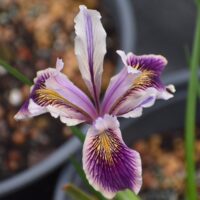
Iris Pacific Coast hybrid ‘Purple & White’
A Pacific Coast hybrid iris with thick purple veins and a splash of yellow at the center of white flowers. The evergreen foliage gets 12-18 inches tall and spreads by rhizomes to form clumps up to 3 feet wide. Does well in full sun in cooler, coastal areas, but needs afternoon shade inland. Occasional water keeps it looking good in summer. A suitable plant for the understory of oaks, where it will require little irrigation once established. Drought tolerant and deer resistant.
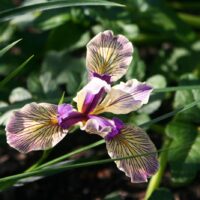
Iris Pacific Coast hybrid ‘Sebastopol’
A diverse group bred from the native irises with wonderful coloration, patterning, flower form variation....ranging from soft pastels to mahogany, maroon and midnight purple. Evergreen foliage, about 1 to 2 ft. high. Can eventually form sizable clumps. Full sun to light shade. Often do well as an understory for oaks that needs no summer water. Drought tolerant, moderate to little water when established. Deer don’t seem to eat flowers or foliage.
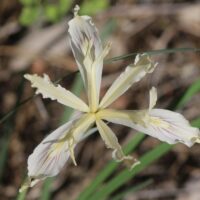
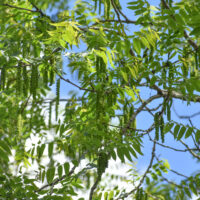
Juglans hindsii
Beautiful, deciduous tree native to riparian areas in Northern California. Canopies of pinnately compound leaves form a round-topped tree 20 - 60 ft. tall. Flowers in early spring are dangling catkins, followed by round nuts in a fleshy husk. The delicious nuts are small and held in thick, hard to crack shells. An important food source for wildlife. Prefers deep soils and is drought tolerant once established. A natural for along the upper slopes of creeks and rivers.
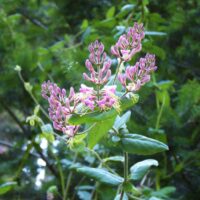
Lonicera hispidula
This native honeysuckle is often seen climbing over shrubs on the edge of woodlands where its roots are shaded and its foliage is sun drenched. The trumpet-shaped flowers range in color from rosy-pink to pink and white and feature prominent yellow stamens emerging from their mouths. They form clusters which decorate the tips of the vining branches and are attractive to bees and hummingbirds. The high point is the drooping clusters of luminous red berries in late summer which are beautiful to behold and provide a feast for birds, especially orioles. A drought tolerant vine but would appreciate occasional deep summer watering. Considered by some to be deer resistant.
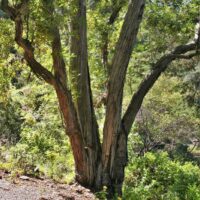
Lyonothamnus floribundus ssp. aspleniifolius
A rare and beautiful evergreen tree from Santa Cruz Island off of the Southern California coast. Fernlike, pinnately divided, shiny, dark-green leaves adorn this fast growing tree which can reach 20 to 50 ft. tall and 15 to 20 ft. wide. Late spring brings large flat-topped clusters of creamy-white flowers on this unusual rose family member. Peeling, reddish-brown bark adds to the interest of this single or multi-trunked tree, which can be used in small groves or as a striking specimen. Plant in full sun to partial shade with moderate to infrequent water. Cold hardy to about 15 degrees. Pollinating insects and birds are attracted to the flowers.
Penstemon barbatus
Native to sunny, hot, rocky slopes from Utah and Colorado to Texas and Mexico, this striking penstemon is a willing grower. Forms a low mound of lush foliage, topped with 4 ft. tall, erect flower spikes of brilliant, scarlet, tubular blossoms, providing a bold splash of color in beds, borders, rock garden or meadow planting. Plant in full sun with good drainage where it will be drought tolerant once established. Flowers adored by hummingbirds and butterflies. Deer resistant.
Penstemon barbatus ‘Coral Baby’
This dazzling selection of Penstemon is from the Plant Select program of Colorado. Forms a tidy, compact mound of bright green foliage to around 15 inches tall by 12 inches or so wide. Late spring brings upright spikes of eye catching coral-pink tubular flowers which attract bees, butterflies and hummingbirds. Full sun with good drainage and moderate to occasional summer water.
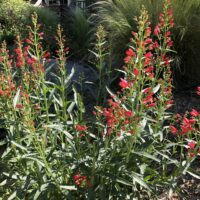
Penstemon barbatus ‘Red Riding Hood’
Trumpet-shaped blossoms of coral-red arise on thick stems up to 2 ft. high on this Dutch selection of the beardlip penstemon. Originating from the American Southwest, this superlative species offers flowers from late spring to the end of summer, enticing hummingbirds, bees and butterflies into the garden. Light green, lanceolate leaves grow densely at the base and climb up the stout stalks. This selection has proven to be very garden tolerant, liking full sun and moderate to infrequent irrigation.
Penstemon barbatus ‘Riding Hood Red’
Trumpet-shaped blossoms of coral-red arise on thick stems up to 2 ft. high on this Dutch selection of the beardlip penstemon. Originating from the American Southwest, this superlative species offers flowers from late spring to the end of summer, enticing hummingbirds, bees and butterflies into the garden. Light green, lanceolate leaves grow densely at the base and climb up the stout stalks. This selection has proven to be very garden tolerant, liking full sun and moderate to infrequent irrigation.
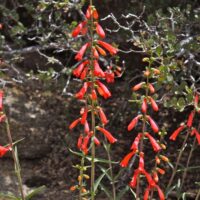
Penstemon centranthifolius
Custom made for hummingbirds, this Penstemon sports an abundance of bright-red to orange-red tubular flowers from late spring into summer. Native to dry habitats in the North Coast Ranges south to Mexico and east to the Southern Sierra, growing in chaparral and openings in woodlands below 6000 ft. Thick, blue-green leaves form a rosette 1 – 2 ft. tall and wide. Long flower spikes rise 2 – 4 ft. above the waxy leaves with many narrow, tubular, scarlet blossoms. Likes full sun, lean soils and good drainage. Drought and cold tolerant. Hummingbird and butterfly favorite.