
Bouteloua gracilis ‘Pestanas de Angeles’
Long lived, warm season, perennial grass, native to North America. The selection ‘Pestanas de Angeles’ is from San Bernardino County in Southern California. Fine textured, grey-green blades about 6 inches tall. Intriguing flower heads look like little flags or eye lashes on wiry stems under a foot tall. Tolerant of heat, drought and poor soils, this grass is at home in the arid west. Plant in full sun where it will be drought tolerant once established. Blades go dormant in the winter. Excellent in rock gardens, with succulents or as a meadow subject. Good cut flower. Deer resistant.
Brodiaea californica ‘Babylon’
A beautiful selection of a robust species, native to the North Coast Ranges and northern Sierra Nevada. Instead of the more typical lavender-purple colored blossoms, 'Babylon' offers particularly large flowers of pink-lavender. The star shaped flowers are in dense clusters on stout stems up to 24 inches tall. Best in full sun and tolerant of different soil types. Allow to go dry once foliage begins to go dormant. This beauty flowers in late spring/early summer and is favored by butterflies. A good container subject.
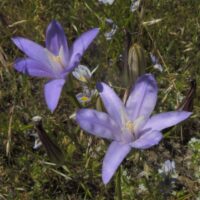
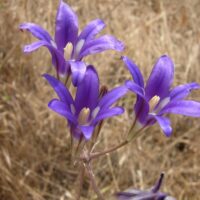
Brodiaea elegans
From grassy meadows and open woodlands comes this drought tolerant and colorful wildflower. Open clusters of dainty violet flowers sit atop stems reaching 8 to 20 inches in height. Plant in full sun to bright shade and provide decent drainage. As the name suggests, the harvest Brodiaea is the latest blooming of the Brodiaeas, sometimes not flowering until the end of summer after the grass-like leaves have gone dormant. It spreads rapidly but not invasively to form broad drifts. After blooming, this bulb will sleep until the return of winter rains. Do not irrigate. An excellent candidate for the rock garden where its graceful form will contrast wonderfully with the rigid stone.
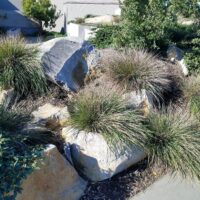
Calamagrostis foliosa
A beautiful native grass offering a very useful size and form for the landscape. Growing one foot tall by two feet wide with beautiful arching mounds of blue-grey blades often highlighted with purple tones. Spring brings flower spikes on arching stems with tight silvery- purple heads that turn tawny with age. A natural for coastal climates with good drainage and moderate to occasional watering, where it will tolerate wind and salt spray. In warmer interior sites it requires some shade and additional water. Excellent as a specimen or in mass, in a rock garden, perennial border, meadow, woodland margin or slope. Deer resistant.
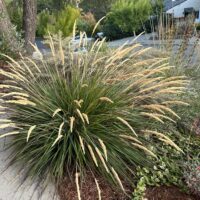
Calamagrostis foliosa x nutkaensis ‘Little Nootka’
This robust, but elegant bunchgrass was discovered by Cal Flora as a chance cross between the Pacific and Mendocino reed grasses. A beautiful garden plant which inherited useful traits from both parents. It’s shorter and denser than the Pacific reed grass, with foliage reaching up to about 1 ½ ft. high, but still retaining its lush, broad, green leaves. One can see the influence of the Mendocino reed grass in the broader form, spreading up to 3 ft. wide. The tight grass flowers are generally held upright on prolific stalks which rise to about a foot above the foliage. Plant in full sun near the coast, but with some afternoon shade in hotter areas. Somewhat drought tolerant once established. Accepts moderate to occasional irrigation. Deer resistant.
Calamagrostis koelerioides
An uncommon but widely distributed mid-sized native grass appearing in meadows and on rocky ridges throughout California. The soft green leaves reach a height of up to 2 ft. tall and will slowly spread to create a small clump. Narrow, feathery grass flowers reach 2 - 3 ft. high in summer and age to a pale tan color. Since this grass is new to us and we don't know of any other nurseries who have grown it, we are uncertain of its requirements. Based on this species' habitat in nature, we would recommend providing it full sun to light shade and moderate to infrequent irrigation with excellent drainage. Deer resistant.
Calamagrostis nutkaensis
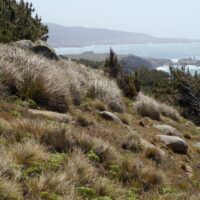
A large handsome bunch grass from the coastal regions of Monterey County to Alaska that forms huge tussocks in open moist meadows and on coastal bluffs. It can also be found as an understory at the edges of coniferous forests. Wide green blades grow 2 - 3 ft. tall with flowering culms to 4 ft. Good background or accent plant for the woodland or meadow. Will take full sun in somewhat cooler areas. Best with some summer water and partial shade inland. Deer resistant.
Calamagrostis nutkaensis ‘The King’
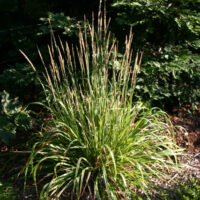
Large, handsome, evergreen native bunch grass selected by Roger Raiche in the King Range on the North Coast. Big bold deep green foliage and robust form 3 - 4 ft. tall and wide. Flower stalks rise a foot or two above the foliage. Good background or accent for woodland or partly shaded meadow. Will take full sun in somewhat cooler areas. Best with some summer water. Deer resistant.
Calamagrostis ophitidis
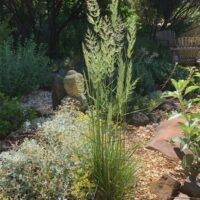
This handsome native bunchgrass deserves special attention for its tidy, upright form and sturdy character. A rare and threatened species from serpentine areas along our central coast, serpentine reed grass performs well in full sun but may need afternoon shade in hot, inland locations. The leaves reach a height of between one and two feet with flower spikes rising up to three feet tall. Does best with decent drainage and moderate summer water. Deer resistant.
Calamagrostis rubescens
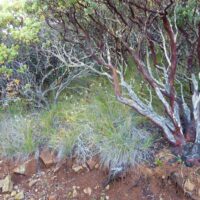
Native to wooded areas throughout the West, this slowly spreading grass forms dense drifts excellent for naturalizing in bright shade. The foliage reaches a height of about 12 inches with narrow inflorescences rising another 12 inches or so. While drought tolerant, it enjoys an occasional watering. Works well under oaks. Deer resistant.
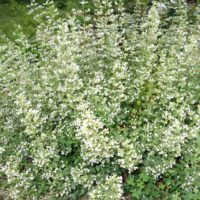
Calamintha nepetoides
A pretty, little, non-spreading mint relative, forming a rounded shrublet of shiny, bright green foliage to around 1’ tall and about 2 ft wide. Covered with hundreds of tiny, pale blue, nearly white blossoms over a long period in summer. Good for full sun to light shade with moderate watering. Tolerant of clay soil. One of our bee magnets. Deer resistant.
Calliandra californica
Clusters of bright red flower filaments, resembling little dusters, adorn this Baja California native for much of the year. The dainty, fern-like leaves are generally evergreen, though they are less ubiquitous in the winter. This mid-sized shrub reaches up to about 5 ft tall over time and spreads to 5 ft wide, forming a loose, rounded mound. Hummingbirds and butterflies favor the flowers on this unusual member of the pea family. Hardy to around 25 degrees. Plant in full sun to light shade and provide occasional to no irrigation once established. Said to be tolerant of clay soils, but will not like flooding.
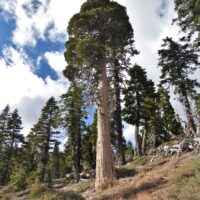
Calocedrus decurrens
Cinnamon colored bark and a distinctly conical form distinguish this lovely conifer known for its appealing woodsy scent. Bright green, scale-like leaves drape from the ends of branches in dense clusters with small, flattened cones.Native to rocky areas throughout California. Slowly grows to become a large tree not suitable for a small garden. Requires decent drainage and occasional deep waterings when young. Enjoys full to part sun.Striking when planted as a single specimen or when combined with broadleaved trees such as maples and oaks. Deer resistant.
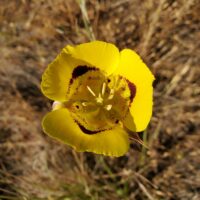
Calochortus luteus
This showy mariposa lily offers vibrant, golden-yellow flowers, often with reddish brown markings at the base of each of the three petals. The upward facing, bowl-shaped flowers seem to hover over grasslands on stems reaching one to two feet tall. In early winter, grass like leaves emerge from the soil, followed by the butterfly-favored blossoms in late spring and early summer. Once the flowers are done, this native bulb will go dormant. Plant in full sun to light shade with well-draining soil. Allow to go completely dry in the summer. Said to be one of the easiest of the mariposa lilies to grow in gardens.
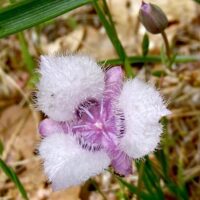
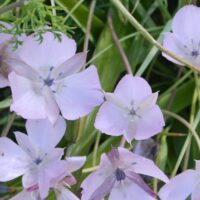
Calochortus uniflorus ‘Cupido’
While many Calochortus are known to be challenging in the garden, this selection is quite easy and blooms in abundance! Blue-grey, iris-like leaves emerge in the winter, followed by soft lavender-pink, tulip-like flowers in late spring. After flowering they will go dormant. Plant in full sun to light shade. Very drought tolerant but will tolerate occasional irrigation. This rare species has a surprisingly wide-ranging distribution, from the coast to the mountains of Northern California. Attracts native pollinators.
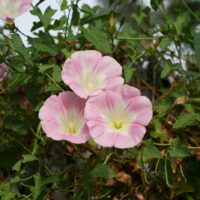
Calystegia purpurata ssp. purpurata
Lush, slender-stemmed vine with gray-green heart-shaped leaves scrambles up, over, or through any support provided. From late spring through early summer the plant is decorated with trumpet-shaped blossoms ranging in color from white to pink to purple. This deciduous vine can grow up to 10 ft. tall and wide. Sun to light shade, most soils, moderate to occasional watering for best appearance. Native throughout the Coast Range of California.
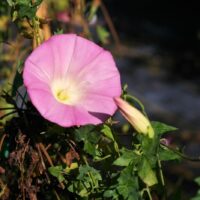
Calystegia purpurata ssp. purpurata ‘Palomarin’
Large flowers which open pinkish-white and darken to a rich lavender distinguish this selection which we discovered near Bolinas in Marin County. This vigorous, deciduous vine spreads quickly to climb over fences and shrubs with clasping stems and grey-green, arrow-shaped leaves. Reaches a height of up to 10 ft. or so and can spread at least as wide. In late spring and early summer, the morning glory flowers put on quite the display, opening at dawn and then closing at dusk. Does great in full sun but also enjoys a little shade, especially in hot, inland areas. Likes moderate irrigation but will become somewhat drought tolerant once established. Hummingbirds and native pollinators are drawn to the flowers.
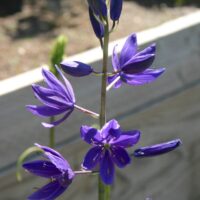
Camassia leichtlinii ssp. suksdorfii
Similar to the common camas, but with larger, star-shaped flowers ranging in color from soft to dark violet-blue on stems up to 3 ft tall. Native to grasslands and moist meadows that dry out in the summer. Also found in open, well lit woodlands. Easy to grow in full sun to light shade in a variety of soil types, including heavy clay. Allow to go dry after seed is set, where it will go completely dormant. This eye catching beauty is appealing to bees, butterflies and hummingbirds. An excellent container plant and cut flower. Deer resistant.
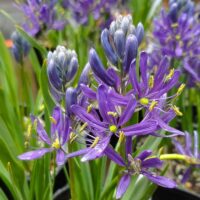
Camassia quamash
Camas lily is a beautiful native bulb, producing stunning displays of sky blue to violet-purple, star-shaped flowers. Found throughout much of the western United States, growing in moist meadows and grasslands that dry out in the summer. Important species to native peoples, who encouraged the bulb through fire management. Historical accounts describe fields of blue from the massive floral displays. Easy to grow in full sun to very light shade and tolerant of a wide variety of soils, including heavy clay. Long, slender leaves give way to erect racemes of blossoms, to 2 ft. tall in late spring. Allow to go dry once seed set commences. Dormant in the winter. An excellent container plant and cut flower. A favorite of bees, butterflies and hummingbirds. Deer resistant.
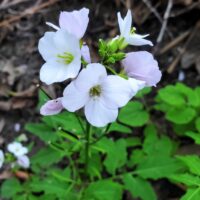
Cardamine californica
One of California's most widespread and earliest spring wildflowers, often beginning to bloom in the winter. Found in somewhat shady locations in a number of plant communities, this slender perennial has rounded basal leaves. Flower stems 10 inches to 20 inches tall are topped with four petaled flowers of pure white to soft pink. This sweet harbinger of spring is easy to grow given a little shade and winter rain. After flowering and setting seed it dies back to its roots where it goes dormant until next year's rains awaken it. Good under oaks.
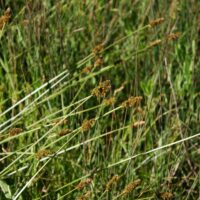
Carex densa
While uncommon in nurseries, this semi-evergreen sedge forms green tussocks which are very useful in seasonally moist meadows and open woodlands. Elongated, chunky seed heads rise above the dense leaf blades on slender stalks up to 2 ½ ft. tall. The foliage reaches 1 to 2 ft. high and slowly spreads to form small clumps. Useful for smaller gardens where you want a sedge that doesn’t spread super vigorously. Tolerates summer drought in somewhat heavier soils. A little extra irrigation will keep this sedge more evergreen. Native to much of California and north to Washington. Deer resistant.
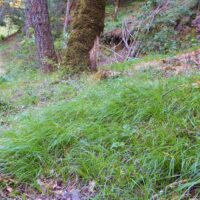
Carex globosa
Here is a sturdy and useful woodland sedge native to well-drained soils in wooded areas. Grows 6 - 12 inches tall and spreads slowly to form bright green tussocks. Useful as a filler among shrubs or trees in filtered shade where it tolerates drought; but some summer water will keep it looking fresh for longer. Great under oaks. Deer resistant.
Carex pansa
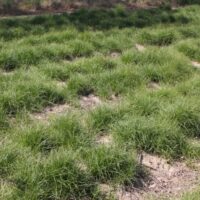
A durable spreading sedge which can be used as a lawn substitute or unmowed meadow. Growing 8 -12 inches tall and spreading by rhizomes to form dense colonies of curling dark green foliage. The foliage is evergreen in mild climates and grows well in full sun to partial shade with regular to occasional water. Too much drought causes summer dormancy. Flowers appear in early spring but are not real showy. Deer resistant.
Carex praegracilis
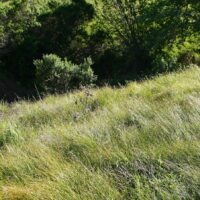
Similar to Carex pansa but growing taller. The fine textured grass-like blades can reach a foot or more tall and spreads freely by rhizomes to form a thick weed smothering groundcover. Useful for meadows, green roofs, bio-swales, erosion control and as a lawn substitute. Can be left natural where it has a lush tousled appearance or trimmed occasionally for a low turf-like appearance. Tolerates drought, inundation, poor soils, salt spray, heat, cold, shade and foot traffic. Plant in sun to light shade where it requires some summer moisture but far less than a conventional lawn. Will go summer dormant if allowed to get too dry. Deer resistant.
Carex praegracilis ‘Chisai’
An excellent cultivar of the native field sedge, selected for it's compact form and slower spreading habit. Increases by short rhizomes to form a sturdy, dark-green carpet, 6 -8 inches tall and 1 - 2 ft wide. Grows more clumping and significantly tighter than the rapidly spreading forms more typical of the species. Still, it will form a solid, small scale ground cover or turf substitute, between stepping stones or mixed with bulbs and perennials for a meadow affect. Plant in full sun to light shade with occasional to moderate water. Tolerates light foot traffic. Deer resistant.
Carex tumulicola
This is the TRUE Carex tumulicola, the foothill sedge, not to be confused with the so called Berkeley sedge which is correctly identified as Carex divulsa and is non-native AND invasive. Foothill sedge has a wide distribution in California and north to Washington. A tough and adaptable tufted evergreen growing 12 inches (or more) tall and spreading slowly by underground rootstocks. Useful as an informal groundcover under shrubs or trees, for a meadow planting or for soil stabilization where the spreading roots help control erosion. Best with some shade unless right along the coast. Responds to water but is able to tolerate periods of dryness.
Carpenteria californica
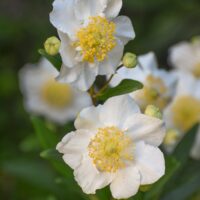
Long in cultivation, this native, evergreen shrub is rare in the wild, with a limited distribution in their native habitat. Forms a multi-branched shrub, 5 - 7 foot tall or more and nearly as wide, with dark green, leathery, lanceolate shaped leaves, which provides a dark foil to the brilliant white flowers. Late spring brings terminal clusters of white, 2 -3 inch, sweetly scented, anemone-like blossoms with yellow centers. An adaptable shrub which makes a striking specimen or foundation plant in a woodland area with morning sun and afternoon shade. Responds well to pruning and can be trained as an espalier. Drought tolerant, but appreciates occasional summer water. Flowers enjoyed by bees and butterflies.
Carpenteria californica ‘Elizabeth’
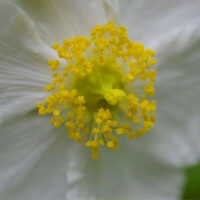
A beautiful native evergreen shrub 5 - 7 ft. tall and 4 ft. or more wide. Blooms May-July with sweetly scented, pure white, yellow-stamened, camellia-like single flowers. This cultivar is especially free flowering with smaller than usual (2 inch) flowers in masses of up to 20 in each of the terminal clusters. Said to be more disease resistant. Has a narrow upright appearance which is unusual for a native shrub. Best with light shade or morning sun. Drought tolerant, but appearance is improved with some summer water. Does want decent drainage.