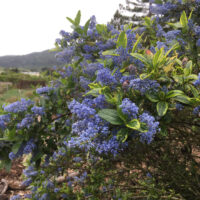
Ceanothus thyrsiflorus ‘El Dorado’
Fast growing upright evergreen shrub 6 - 10 ft. tall and wide. Dark green foliage with golden yellow variegation is a nice foil for the medium blue flowers in spring. Plant in full sun along the coast, some shade for hot interior sites. Drought tolerant once established. Occasional summer irrigation can be helpful, but allow soil to dry between waterings. Good for an informal hedge. An excellent habitat plant.

Ceanothus thyrsiflorus ‘Snow Flurry’
A beautiful large shrub or small tree 12 ft. (or more) tall and wide. Rich deep green foliage and profuse clusters of radiant pure white flowers in the spring. Adaptable, dependable and garden tolerant. Does well in coastal and inland situations. Best in full sun. 'Snow Flurry' is drought tolerant, but would appreciate a little summer water in hot regions. Not tolerant of very cold winter conditions. Selected from the Big Sur coast. Shrubby ceanothus provide seeds eaten by bushtits, mockingbirds, quail and finches, as well as cover for birds.
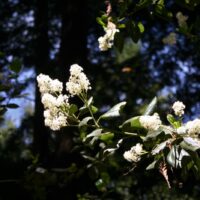
Ceanothus velutinus
Found primarily in the northern half of the state in the Coast Ranges, Sierras, Klamath and Modoc regions, in coniferous forests, chaparral, and various woodland environments up to 11,000 ft in elevation, the resinous floral scent and plumes of soft white flowers from spring to early summer make tobacco brush a choice evergreen shrub for dry, sunny to part-shade garden sites that drain well. Grows to 6-10 ft tall, and has large, sticky dark-green, aromatic, leathery foliage. A larval host for many native butterfly species such as the ceanothus silk moth, California tortoiseshell butterfly, and the hedgerow hairstreak butterfly. The flowers are also attractive to native bee and butterfly pollinators. Drought-tolerant once established.
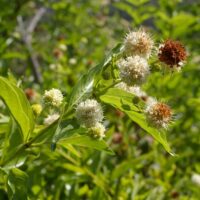
Cephalanthus occidentalis
Button willow is a large deciduous shrub, at times becoming treelike, growing 6-12 ft. (infrequently as much as 20 ft.) tall and wide. It lines waterways in foothills and warm interior valleys. Smooth, glossy bright- green leaves clothe this shrub during the growing season, turning yellow in the autumn. Creamy white flowers are arranged in spherical heads with protruding styles which give the flowers a pincushion-like appearance. The summer blooming, fragrant flowers are extremely rich in nectar and attract bees, butterflies and other pollinators. The globe-like fruits persists into winter and attract birds. Plant in sun to light shade with regular summer water or continuously moist or wet soils. An excellent habitat plant offering food and cover for a wide array of insects and birds.
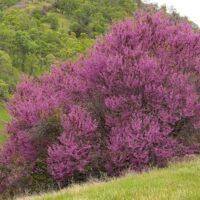
Cercis occidentalis
Beautiful in all its seasons, the native redbud is well worth growing. Highly ornamental multi-trunked shrub or small tree 6 - 20 ft. tall and wide. Masses of brilliant rose-purple blossoms in early spring followed by conspicuous long seed pods that start out lime green and age to purple-brown. The rounded heart-shaped leaves emerge apple green and develop to bluish-green. In colder areas, the leaves take a nice fall color of yellow or red. The smooth silvery-gray branches are picturesque in the winter landscape. Plant in full sun to light shade with good drainage. Drought tolerant. Important nectar and pollen source for bees. Attracts hummingbirds too.
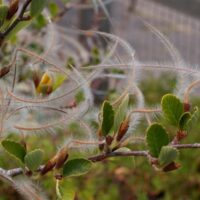
Cercocarpus betuloides
Mountain mahogany is an adaptable, semi-evergreen native shrub (8 to 12 ft. high and wide) or small tree with charming birch-like leaves set against silver-grey bark. Small, honey-scented flowers appear in spring followed by seeds with intriguing silky, curled, feather-like tails. The open habit contrasts nicely with evergreen shrubs or rock walls where its pleasing silhouette can be seen. Flowers are attractive to bees. Mountain mahogany is one of those rare native shrubs which can easily be pruned for narrow garden beds. Grows on dry slopes in chaparral or at the edges of woodlands. Provide full sun to light shade. It is surprisingly adaptable to diferent water regimes, from moderate irrigation to no water once established. Somewhat deer resistant.
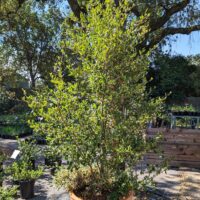
Cercocarpus betuloides var. blancheae
This rare and beautiful variety of our native mountain mahogany offers larger, birch-like leaves with fuzzy and whitish undersides. The highly useful from generally reaches 8 – 15 ft. tall, but only spreads to about 6 ft. wide, making it ideal for narrow locations where a screening, evergreen, fast-growing bush is needed. Small, disk-like, creamy flowers appear in the spring, followed in summer by seed pods with hairy, grey tails which curl upwards, giving the plant a silver halo. Over time, the trunks are covered in a smooth, grey bark. The Island mountain mahogany typically grows much more rapidly than our local variety and is tolerant of moist or dry soils once established and part shade to full sun. Heat isn’t an issue. A great candidate for a container, where it is very amenable to pruning.
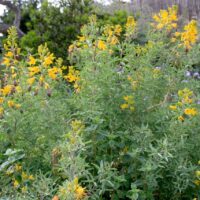
Cleomella (Isomeris) arborea
This distinctive small shrub from Southern California features clusters of golden-yellow flowers with long stamens, giving them a delicate, airy quality. The flowers are followed by papery, lantern-like seed pods which can become almost translucent with age. While this species blooms strongest in the spring, flowers can be seen year-round. Bladderpod has a loose, rounded habit, reaching 4 to 6 ft. tall and wide. If your plant becomes too lanky, simply cut it to the ground to rejuvenate it. Plant in full sun with good drainage and provide infrequent to zero irrigation once established. A great nectar source for hummingbirds, bees and butterflies. Deer resistant.
Previously known as: Peritoma arborea
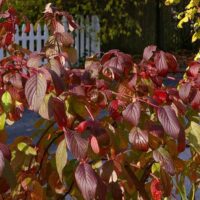
Cornus sericea
Redtwig dogwood is a spreading shrub growing 6 ft. or more tall and at least as wide, forming broad thickets along creeks and rivers. The beautiful red stems stand out in the winter landscape once they loose their leaves in the fall. Flat topped flower clusters are creamy white and are followed by clusters of white fruits. Often takes on nice fall color before loosing its leaves. Plant in full sun to light shade with regular to moderate watering. Does great on heavy clay soils and is a very good soil stabilizer. An excellent habitat plant where it provides food and cover. The fruits are very popular with birds. At the nursery, bluebirds and mockingbirds compete aggressively for the fleshy white fruits.
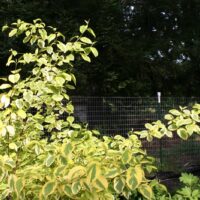
Cornus sericea ‘Hedgerow’s Gold’
A striking selection of redtwig dogwood, discovered near the Deschutes River in Eastern Oregon and introduced by Hedgerows Nursery. The large leaves of soft green have a broad, irregular, bright golden edge. In autumn the leaves turn an attractive ruby color. Forms a thicket that easily reaches 6 ft. tall by 6 ft. wide. The red stems stand out in the winter landscape after the leaves have fallen. Flat topped cluster of white flowers appear in spring and are followed by small white fruits enjoyed by birds. Best with regular water, good light and protection from the hot afternoon sun.
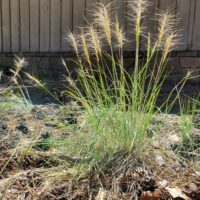
Elymus elymoides
A species of wild rye, this tough, native, widespread, perennial grass, sports distinctive seed heads with a bottlebrush or squirrel tail appearance. Super adaptable and willing to withstand a wide range of soil types and depths. Even tolerates serpentine soils. Able to make a living in full sun where it is extremely drought tolerant. Grows one foot to 18 inches tall with shimmering, purple-toned flower spikes that age to beige, bristly, seed heads. A dependable re-seeder, perfect for sunny, low water using landscapes and erosion control. Host plant for a number of butterfly and moth species including the woodland skipper. Deer resistant.
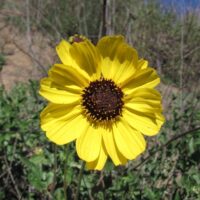
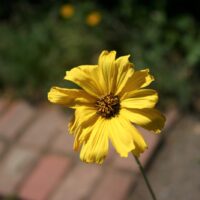
Encelia californica
Cheery yellow daisies with purplish-brown centers cover this sunflower from late winter all the way into summer, making it one of our longest blooming natives. The 2-inch-wide blossoms make for stupendous cut flowers and are loved by bees and butterflies. Goldfinches enjoy the seeds which follow. This somewhat short-lived subshrub features dark green, diamond-shaped leaves and reaches about 3 – 4 ft. tall, spreading a little wider. Should reseed if the spent flowers aren’t removed. Enjoys full sun to light shade and occasional to infrequent irrigation with decent drainage to look its best. Native to generally coastal areas in southern California. While not especially cold sensitive, it will freeze if the temperature gets down to the mid 20s.
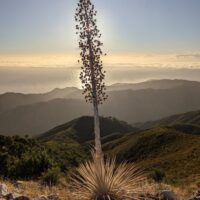
Hesperoyucca whipplei
Bold and dramatic architectural accent plant native to southern California coast and mountains south to Baja. Forms a dense rosette of rigid silver-blue blades, 2 foot tall by 3 - 4 foot wide. Each blade has a VERY SHARP tip and careful thought should be given to its placement to avoid injury. Plants can take 3 to 15 years to bloom with impressive stalks rising 6 foot or more above the rosette with drooping, creamy white, bell shaped, fragrant flowers. The flowering rosette dies after blooming often being replaced by vegetative offsets. Best with good drainage in full sun to light shade. No water once established. Deer resistant
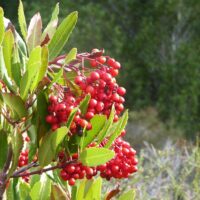
Heteromeles arbutifolia
Toyon is a handsome native evergreen shrub 6 - 10 ft. tall and wide. Sun to part shade, drought tolerant. Clusters of lacy white flowers bloom in summer and areattractive to pollinators. Spectacular bundles of red berries are relished by birds and are a great winter decoration. Valuable as a specimen, screen, hedge or bank plant. Birds attracted to the fruit include the following species: Cedar waxwing, California towhee, spotted towhee, Western bluebird, robins, mockingbirds, bandtailed pigeon, waxwing and quail.
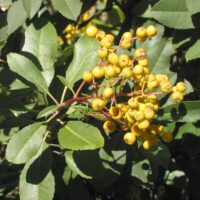
Heteromeles arbutifolia ‘Davis Gold’
An interesting cultivar of the native toyon which bears bright golden yellow berries rather than the more common red-colored fruits. A handsome evergreen shrub 8 - 12 ft. tall and wide (or more). Sun to part shade, drought tolerant. Clusters of lacy white flowers bloom in summer and are attractive to pollinators. The showy clusters of orange-yellow berries are relished by birds and are great winter decoration. Valuable as a specimen, screen, hedge or bank plant. This selection is considered more disease resistant than most toyon.
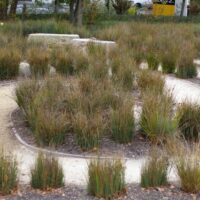
Juncus patens
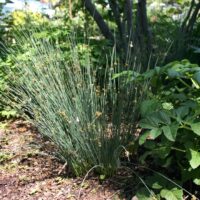
This handsome evergreen rush provides a striking vertical accent 1-1/2 to 2-1/2 ft. tall with grey-green to grey-blue foliage. Brownish-yellow, tassel-like flowers appear in the spring and early summer. Very adaptable, tolerating a wide range of conditions. Enjoys sun with moisture, but will tolerate dry conditions once established. Accepts moderate shade. Robust root systems are excellent for soil stabilization. Deer resistant.
Juncus patens ‘Elk Blue’
Introduced by San Marcos Growers, this form of Juncus patens was selected from the hills southeast of the town of Elk in Mendocino County. Features exceptionally blue foliage and and a vigorous spreading habit. This selection is shorter than the typical grey rush only reaching about 18 inches tall. An adaptable species, will thrive in moist soils, even shallow water but once established tolerates dry conditions too. Grows in sun to moderate shade. An excellent accent plant with its stiff, vertical foliage. Deer resistant.
Quercus agrifolia
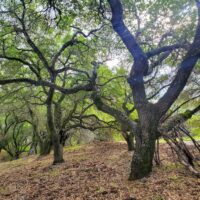
A beautiful and stately evergreen oak, native to many plant communities from Mendocino County south to Baja. One of the fastest growing California oaks and a versatile landscape subject as long as space allows. Young trees have a dense rounded canopy covered with thick, dark green, oval and convex leaves with spiny margins. Smooth gray bark becomes furrowed with age. Flowers are produced on short yellow hanging catkins followed by long tapered acorns. In time, develops a magnificent architecture with broad spreading branches. Planting native oaks provides beauty, shade, food and cover to a dazzling array of wildlife. Plant in sun to light shade. No additional summer water required once established.
Quercus chrysolepis
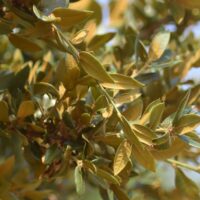
A handsome evergreen oak with a rounded, spreading crown, 20 - 60 ft tall and wide. The leaves of its broad, low canopy are dark-green and shiny with fuzzy gold or silver hairs on the underside. Native from Oregon to Baja, it is the most widely distributed oak in California. Often grows near creeks, but requires only occasional water. Plant in full sun to light shade where it will be drought tolerant once established. A good choice for bank stabilization. Like other oaks, it is habitat powerhouse, offering food and cover for a huge variety of wildlife.
Quercus wislizeni
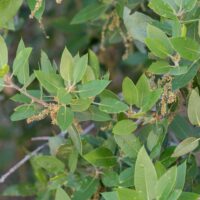
Typically more compact in stature than the coast live oak, this evergreen oak has similar dark-green, leathery leaves, though often narrower and flatter. A native of dry foothills, the interior live oak has a range that extends throughout much California, and is the dominant live oak in the western Sierra-Nevadas. While it can flourish in the shade, it may remain shrublike. In full sun, its densely-foliated canopy has a pleasingly broad, rounded habit. This adaptable oak takes inland heat, and once established is drought tolerant and generally deer resistant. It tolerates clay, but does best in well-draining soils. Like other oaks, it’s a great habitat plant that supports a wide range of wildlife.
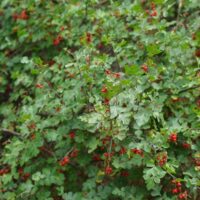
Rhus aromatica
An arching, mounding native shrub related to sugar bush and lemonade berry. Early spring brings a profusion of soft yellow flowers followed by orange-red fruits relished by wildlife. The leaves turn shades of yellow, orange and red in the fall. Plant in sun to light shade where it is drought, cold and heat tolerant. Useful addition to the naturalistic garden, as a shrubby groundcover, along seasonally moist streams, and for erosion control. Used by the native people for basketry.
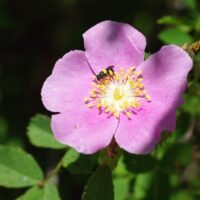
Rosa californica
A thicket forming, deciduous shrub native to riparian zones throughout the state. Fragrant, pink blossoms with yellow centers are followed by attractive red fruits or rosehips. The stems are lined with little thorns and gray-green, pinnately divided leaves. A good screen or living fence, where it will grows at least 5 ft. tall and usually spread wider. Very important for erosion control along streams. This is one of our most popular hedgerow plants due to the cover it provides for foraging wildlife and the value it offers to pollinators and birds. Prefers full sun to light shade and seasonally moist soils, but can go a little drier in the summer. A larval host to several butterflies.
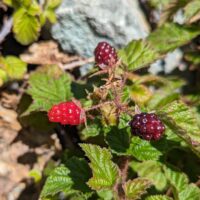
Rubus ursinus
Not to be confused with the weedy non-native Himalaya berry that has taken over acres in northern California. The native blackberry when happy can form a good sized patch, growing to about 3 ft. tall and spreading more than 6 ft. wide depending on available moisture. This thorny, spreading evergreen has excellent habitat value. The berries are widely used as a food source for wildlife. Offers excellent escape and nesting cover and is good for erosion control. People relish the berries and its fruits are highly prized for pies and jam. Best with some shade and moisture, but is drought tolerant once established.
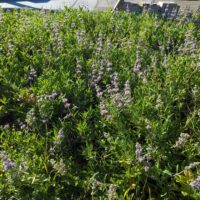
Salvia ‘Bee’s Bliss’
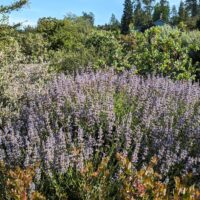
A beautiful native hybrid sage grows around 18 inches tall by 6 ft. wide or more. The handsome gray foliage is topped with a profusion of lavender flowers on long spikes in the spring. Sun, decent drainage, occasional to little water. Deer tolerant. A bee and hummingbird favorite.
Salvia ‘Mrs. Beard’
This cultivar has been around since 1965, a chance seedling discovered in a Berkeley garden. A hybrid between Salvia sonomensis and Salvia mellifera, 'Mrs. Beard’ has proven durable and disease resistant. Forms a dense mat of gray fragrant foliage up to 2 ft. tall and 4-6 ft. wide. Spring brings an abundance of tiny pale lavender-blue flowers in ball-like clusters that are highly attractive to bees and hummingbirds. Plant in full sun along coast and light shade in hot inland sites, where it will be quite drought tolerant once established. Deer resistant.
Salvia leucophylla
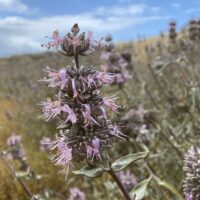
Purple sage is a highly-aromatic shrub, native to coastal scrub and chaparral from the Big Sur to San Diego. This delightful and dependable salvia boasts lavender-pink floral whorls arranged along spike-like stems. In summer, the spent flower stalks retain attractive showy bracts, good for seasonal interest and seeds for birds. The foliage has a mounding habit with soft-green-to-silvery leaves. This species generally reaches 3-5 ft tall and considerably wide, but some popular cultivars range from more upright to a 2-foot spreading groundcover. Easy to grow in full sun with occasional-to-infrequent water. A great choice for a sunny bank. Deer resistant.
Salvia leucophylla ‘Amethyst Bluff’
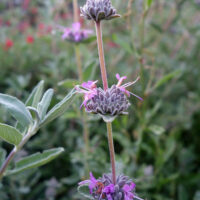
Selected by Carol Bornstein for its vivid rosy-pink flowers, this willing grower starts out as a low mounding shrub, eventually getting very large, reaching 5 ft. or more tall by 8 ft. wide. The fragrant silvery foliage is a lovely foil for the large flower heads on 12 inch stalks. Perfect choice for sunny banks where it can sprawl freely and is excellent for erosion control. Drought tolerant, particularly along the coast, but appreciates an occasional summer watering. A bee and hummingbird favorite. Deer and drought resistant.
Salvia leucophylla ‘Point Sal’
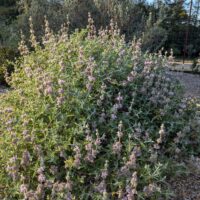
A compact, low form of the native purple sage reaching 2 ft. or so tall by more than 6 ft. wide. An evergreen shrub with beautiful, silvery, aromatic foliage and pale lavender-pink flowers in whorls on wand-like stems. Useful in dry sunny areas but will also accept moderate moisture, unlike most native sages. An excellent garden subject which is more sturdy and disease resistant than the popular 'Bee's Bliss'. Great for covering hot banks and retaining walls. Discovered on Point Sal in southern California. Attracts bees and hummingbirds. Deer resistant.
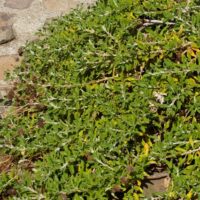
Salvia mellifera ‘Terra Seca’
Here is an interesting form of the normally upright, native black sage. 'Terra Seca' grows to about 2 1/2 ft. tall and 5 ft. wide. Perfect for a dry sunny bank where it will cover the ground densely and thickly. It will spill over a wall beautifully. The flowers are pale lavender. Deer and drought resistant. This species attracts bees and hummingbirds.