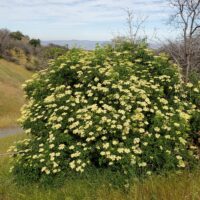
Sambucus mexicana (nigra ssp. caerulea)
Our native blue elderberry, often seen on banks above rivers and streams, or even on somewhat drier slopes. A fast growing deciduous shrub or small tree 8 to 30 ft. tall with pinnately divided leaves. Creamy yellow flowers appear in late spring in flat-topped clusters, followed by blue berries. High on the birds’ favorite list! Ripe berries feed many species of birds. Moderate to infrequent summer water.
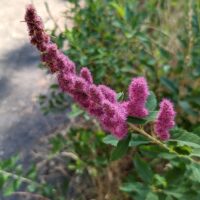
Spiraea douglasii
In summer, wands of violet-pink flower clusters decorate the branch tips of this deciduous shrub. Forms broad thickets 3 - 6 ft. tall with bluish-green leaves. Enjoys regular moisture and full sun to light shade. Great for a naturalistic planting in a woodland garden or along streams. Attracts bees and butterflies and is a larval host for various butterflies and moths in its native range. Native to the coast and into the mountains from northern California to Alaska.

Stachys bullata
A native perennial from the mint family, found primarily near the coast from San Francisco southward, where it inhabits oak, pine and fir woodlands. Medium-green leaves are softly fuzzy with scalloped edges, growing around 2 ft. or more tall and spreading by underground rhizomes to form a colony. Blooming spring through summer, with lavender-pink tubular flowers in whorls, which attract bees, butterflies and hummingbirds. Tends to grow in somewhat drier areas, but responds well to moisture and also tolerates inundation. A natural with rushes, ferns and snowberries. Useful for partly shaded bioswales and oak/mixed conifer woodlands. The underground rhizomes make it a good choice for erosion control. Deer resistant.
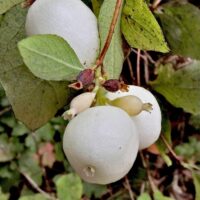
Symphoricarpos mollis
Low growing, spreading groundcover, usually staying around a foot tall by 3-6 feet wide. Rounded blue-green leaves on arching stems makes an excellent low growing thicket which competes well with tree roots. An amenable plant, able to grow in full sun in coastal areas and different depths of shade elsewhere, even fairly deep shade. The tiny, pink, bell shaped flowers are attractive to bees and hummingbirds and the white fruits that follow are eaten by birds. Good for erosion control and does well under oaks. Offers excellent habitat value with its flowers and fruits and provides cover for ground nesting birds. Drought tolerant once established. Deer often leave it alone.
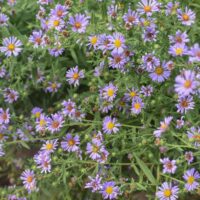
Symphyotrichum (Aster) chilense ‘Purple Haze’
A wonderful selection of our native Pacific aster, chosen by the Santa Barbara Botanical Garden for its deep lavender blossoms. Blooms late summer through fall and often into winter with one-inch daisies opening from dark purple buds. This plant SPREADS VIGOROUSLY by underground rhizomes, so works best when constrained by a planter or garden box or in a meadow planting. Excellent for areas needing soil stablization. The dense foliage grows quickly to 2-3 feet tall each spring, and can be annually pruned to the ground in winter. Tolerates many soil types and full sun to part shade. Requires minimal water, but occasional deep soaks keep it blooming longer. This easy to grow habitat plant will delight bees and butterflies.
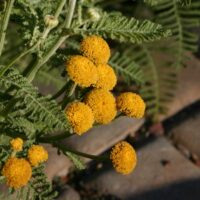
Tanacetum bipinnatum (camphoratum)
Native to sand dunes from the Bay Area north, this shrubby evergreen groundcover spreads quickly to create drifts of soft fern-like foliage. Yellow, button-shaped flowers form small clusters atop stalks up to 2 ft. tall. Enjoys full sun to light shade. Tolerant of clay soils and excessive moisture but will thrive with only occasional water once established. Reducing irrigation can temper this tansy's somewhat aggressive nature. Dune tansy has a strong scent of camphor and is valued for its medicinal uses. Beautiful when combined with ceanothus, Douglas iris and other plants from our coastal areas. Good for erosion control.