
Achillea millefolium – Bodega Bay form
Larger leaves up to 10 inches long distinguish this form from most other local yarrow selections. While most yarrow from our coastline have very green leaves, this strain is on the grey side. From spring through autumn, large white flower clusters sit upon stalks about to at least 2 feet in height. Water occasionally in areas away from the coast and provide full sun. The foliage is deer resistant.

Achillea millefolium – inland form – Lake County seed source
A vigorous and easy to grow perennial, yarrow grows native throughout California in many plant communities. This crop is grown from seed collected from a hot inland site in Lake County. In this form, flower stems rise 18 inches above the gray ferny foliage bearing white flowers in flat topped clusters. Plant in a sunny location with moderate to a little water. Spreads by rhizomes and can form sizable clumps if happy. A good addition to the habitat garden where the flowers provide nectar for bees and butterflies and the foliage provides winter forage for birds. The foliage is deer resistant.

Achillea millefolium – inland form – Napa County seed source
A vigorous and easy to grow perennial, yarrow grows native throughout California in many plant communities. This crop is grown from seed collected from a hot inland site in Napa County. In this form, flower stems rise 18 inches above the gray ferny foliage bearing white flowers in flat topped clusters. Plant in a sunny location with moderate to a little water. Spreads by rhizomes and can form sizable clumps if happy. A good addition to the habitat garden where the flowers provide nectar for bees and butterflies and the foliage provides winter forage for birds. The foliage is deer resistant.

Achillea millefolium – inland form – Sonoma County seed source
A vigorous and easy to grow perennial, yarrow grows native throughout California in many plant communities. This crop is grown from seed collected from a hot inland site in Sonoma County. In this form, flower stems rise 18 inches above the gray ferny foliage bearing white flowers in flat topped clusters. Plant in a sunny location with moderate to a little water. Spreads by rhizomes and can form sizable clumps if happy. A good addition to the habitat garden where the flowers provide nectar for bees and butterflies and the foliage provides winter forage for birds. The foliage is deer resistant.
Achillea millefolium – Montara Mountain form
We discovered the parent of this giant seed strain on the lower slopes of Montara Mountain in San Mateo Co.. With broad, white flower clusters reaching up to 4 ft. high, this is the largest yarrow we've encountered. While seedlings can vary, we have high hopes for this new introduction. Give full sun and moderate to infrequent irrigation. Potentially an excellent spreading perennial for a tall meadow. Attracts all sorts of pollinators. The green, fuzzy leaves are usually considered to be deer resistant.

Achillea millefolium ‘Island Pink’
A color variant of the normally white California native yarrow from Santa Cruz Island. Dark green ferny foliage topped with clusters of bright pink flowers on 18 inch stems over a long period. Sun to partial shade, occasional to moderate water. Good habitat value, providing nectar for bees and butterflies. The foliage is deer resistant.

Achillea millefolium ‘Sonoma Coast’
This is a local selection from the Sonoma County coast near Salmon Creek. Bright green foliage is topped with white flowers in dense heads on compact stems to around 1 ft. tall. Can bloom over a long period, spring through fall, depending on conditions. Best in sunny areas with some summer water, though it is drought tolerant. Flowers attract butterflies and other insects. The foliage is deer resistant.

Actaea rubra
Native to moist wooded plant communities throughout the Coast Ranges and the Sierra Nevada. The attractive astilbe-like foliage emerges in the early spring. The tiny white flowers have no petals and are made up of clusters of creamy white stamens. The spikes of vivid, shiny red berries are very showy though poisonous - hence the common name baneberry. A wonderful addition to shady situations with some summer water. Goes dormant in the winter. Deer resistant.
Actaea rubra – white fruited form
This is the special white fruited form of the more commonly seen red fruited baneberry. We are not sure how true these will come from seed and suspect there will be some red berries showing up in this crop. So far we have had only white fruits coming from this seed source, but we will have to see how the entire crop develops. Baneberry is a wonderful woodland plant and easy to grow in shady locales with some summer moisture. The foliage is astilbe-like and late spring brings tall flower stems topped with white flowers that have no real petals and are made up of clusters of creamy white stamens. The showy and VERY POISONOUS fruits follow, hopefully in this case white, but may be shiny red. Dies back to the ground in the winter. Deer resistant.

Adenostoma fasciculatum
Chamise is found on the poorest soils in hot, dry, exposed areas of chaparral plant communities. Bright green needle-like leaves cover this evergreen shrub. Late spring brings showy plumes of creamy white flowers in small dense sprays, persisting as they age to reddish brown. This tough shrub can grow 4-10 ft tall and wide depending on conditions. An excellent erosion control plant for tough sites where it holds soil, provides cover for wildlife and acts as a nurse plant, paving the way for the other species to get started. Plant in full sun with no water required once established.
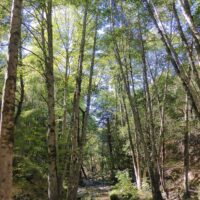
Alnus rhombifolia
From creeks and rivers throughout California, the white alder rapidly grows to become a large tree, reaching to 50 ft. or more at maturity. Serrated green leaves produce an excellent canopy above the straight, silvery-gray trunk. In winter, when the leaves have fallen, the ghostly branches make a striking silhouette with dangling catkins from the branch tips. An excellent plant for creek restoration where its aggressive roots help to stabilize banks. Keep away from irrigation pipes and foundations. Needs regular moisture and sun to light shade.
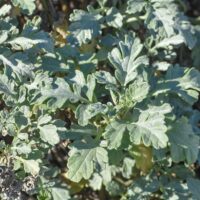
Ambrosia chamissonis
The silvery mats of this sand-dwelling species are important for soil stabilization along our coastline, but can also be used as an attractive, evergreen groundcover in the garden setting. Dissected leaves line crawling branches, forming a dense carpet up to about 10” high and spreading wherever they have room to grow. While vigorous, it can be pruned back easily. In summer, short stalks of inconspicuous, cream colored flowers raise, followed by bur-like seed capsules. Plant in sunny locations with moderate to occasional irrigation. Tolerant of different soil types.
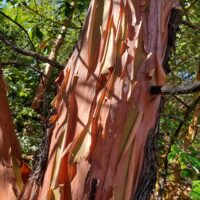
Arbutus menziesii
A beautiful native evergreen tree which features handsome, smooth, reddish bark that peels in thin flakes. Leaves are leathery and shiny dark green. Large clusters of white flowers give way to red-orange berries that can remain into winter if the birds don't get them. It can be tricky to establish, necessitating planting in the fall. MUST have good drainage and just enough water to establish. Once established give only infrequent deep waterings or no water at all. Bees and hummingbirds love the flowers.
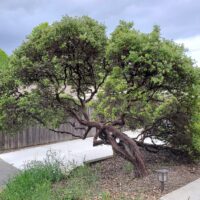
Arctostaphylos ‘Sunset’
A handsome manzanita growing 6 ft. tall and wide with especially attractive coppery-red new growth. Flowers are urn-shaped pinkish-white. Exfoliating shaggy bark reveals smooth red toned trunks. Can be pruned to expose the beautiful sinuous branching structure. A naturally occuring hybrid discovered near Prunedale in Monterey Co. involving A. pajaroensis and A. hookeri. Tolerant of heavy soils and heat as well as occasional irrigation.
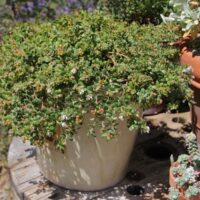
Arctostaphylos edmundsii ‘Bert Johnson’
Choice, low growing manzanita introduced by the Tilden Botanic Garden. Dense, mounding or cascading habit growing to around a foot tall by 6 ft. wide with small dark green leaves and bronzy new growth. Not as fast growing as 'Carmel Sur'. Clusters of tiny pink to white urn-shaped flowers in winter attract hummingbirds and are followed by handsome cinnamon colored little apple-shaped fruits. Excellent cascading over walls, rocks, or containers in sun to light shade. This manzanita has proven adaptable and fairly garden tolerant putting up with heavy soils and more summer water than many. Full sun along the coast with light shade in hot inland sites. Drought tolerant once established but appreciates occasional summer water.
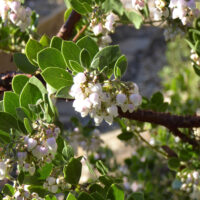
Arctostaphylos edmundsii ‘Big Sur’
Prized for its compact size and clean, rich green foliage, this selection from the Central Coast is a great addition to smaller gardens, where a rounded, upright manzanita is called for, that doesn’t get too big. Reaches 3’ – 5’ tall and 4- 6’ wide, with a somewhat open habit that shows off its beautifully sculpted, burnished red trunk. The winter blossoms are larger than those on many manzanitas, and are a soft, pinkish-white. ‘Big Sur’ enjoys average soil and is tolerant of garden conditions, being quite disease resistant. Plant in full sun or very light shade with little to no water once established. We’ve found it to be very amenable to pruning for small spaces. Gopher resistant.
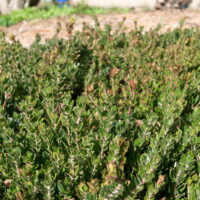
Arctostaphylos edmundsii ‘Carmel Sur’
Perhaps the fastest growing variety of this species. Attractive gray-green foliage with a dense, spreading habit under 1 ft. tall and 6 ft. across. Light pink flowers appear in winter but are few and infrequent. A handsome alternative to other groundcover manzanitas. More drought and heat tolerant than the bearberries and 'Emerald Carpet'. Likes full sun but may enjoy a little afternoon shade in especially hot inland sites.
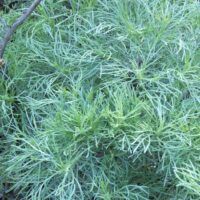
Artemisia californica
Native to coastal regions from Northern California to Baja. Densely branched shrub with finely divided gray-green scented foliage. Grows 2 - 6 ft. tall and wide. Light pruning or pinching help keep it dense. Grown for its wonderful texture and foliage color, flowers are inconspicuous. Requires decent drainage and full sun. Thrives in coastal environments, but has performed well inland, especially on slopes where cold air and winter wet drains away. Drought and deer tolerant.
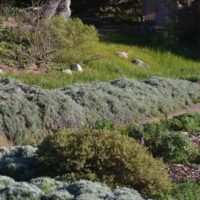
Artemisia californica ‘Canyon Gray’
An unusual prostrate form of our coastal native sagebrush, forming a loose, nearly flat mat of finely cut, silvery, fragrant foliage around 4 ft. wide. Useful as a bank cover or for the top of a retaining wall where it can cascade over the edge. Combines beatifully with ceanothus, buckwheats and iris. Should be cut back from time to time to keep dense. Enjoys full sun to light shade and is very drought tolerant once established. Deer resistant.
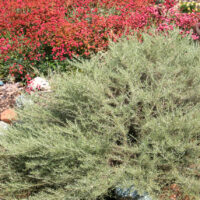
Artemisia californica ‘Montara’
Selected by Roger Raiche at Montara Ridge in San Mateo County. Forms a mound of finely cut fragrant foliage to around 2 ft. tall by 3 ft. (or more) wide. Requires full sun with decent drainage and is drought tolerant once established. Occasional summer water helps retain fresh look. Thrives in coastal environments. Deer resistant.
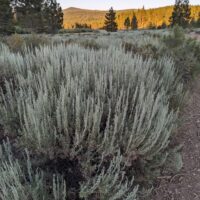
Artemisia tridentata
This long-lived, highly-aromatic shrub is emblematic of the American West, dominating high-desert landscapes east of the Sierras and along the Southern California and Baja coast. Its evergreen foliage is dense, silvery and held on tall stems that are woodier and more upright than the more coastal California sagebrush. In late summer, long flower stalks bear clusters of inconspicuous yellow blooms. Essential to wildlife in sagebrush ecosystems of the eastern Sierras and Great Basin, it also supports birds and bees in the garden setting. Although it can get quite statuesque, it averages 4-6 feet, with a rounded habit and architecturally twisty trunk. It thrives in well-draining soils with minimal water once established. This drought-tolerant species is excellent for erosion control and is nitrogen-fixing. Its fragrant leaves are deer resistant.
Atriplex lentiformis
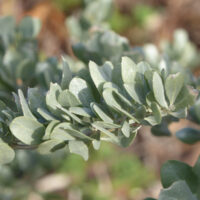
This native bird favorite is a tough and useful shrub with beautiful silvery gray foliage. Growing 5 ft. or more tall and spreading widely, quail bush is valued for its ability to deal with difficult sites where it tolerates wind, salt spray, saline and alkaline soils. A terrific habitat plant, providing food and cover for a wide array of birds and mammals. Native from the coast to the desert. Excellent for erosion control and is fire resistant. Benefits from annual shearing and occasional aggressive pruning to rejuvenate. Plant in full sun with occasional to little summer water.
Baccharis pilularis
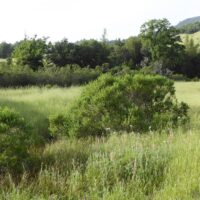
This is the upright form of coyote bush, growing 4 - 8 ft. tall and wide. Valued for its ability to flourish in a wide range of conditions. Also valued as an excellent habitat plant offering food and cover to a wide variety of wildlife. Flowers are not showy and the male and female flowers are borne on separate shrubs. This crop of plants are a mix of males and females and one can’t tell until they bloom. Plant in sunn or light shade. Not fussy about soils. Quite drought tolerant once established. Responds well to pruning or shearing, working well as a screen. Deer resistant.
Baccharis pilularis – Bodega Dunes form
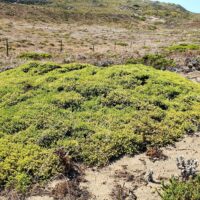
Coyote bush is a tough, native, evergreen shrub, forming mounds of dense foliage that hold soil and provide food and cover for birds and mammals. Flowers are small and cream-colored and appear in the autumn. This crop is grown from seed collected in the Bodega Bay Dunes from parents that were under two feet tall and around 6 ft or so wide. Time will reveal the exact form and sex of each plant in this crop. Both male and female plants have significant habitat value, with their combined contributions of abundant pollen, nectar and copious seed late in the season. It will be a surprise as well as a useful addition to the habitat garden. Plant in full sun, though a little shade is helpful in hotter sites. Shear occasionally to renovate and keep dense. Drought tolerant on the coast, but best with occasional water inland. Deer resistant.
Baccharis pilularis – female
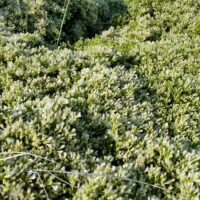
Upright form of coyote brush, growing 4 - 8 ft. tall and wide. Valued for its ability to flourish in a wide range of conditions. Also valued as an excellent habitat plant offering food and cover to a wide variety of wildlife. Flowers are not showy and the male and female flowers are borne on separate shrubs. Theses plants are FEMALE and will produce seed (when male plants are present). An abundance of pollinators and beneficial insects use Baccharis flowers and birds love their seeds. Plant in sun to light shade. Not fussy about soils. Quite drought tolerant once established. Responds well to pruning or shearing and is useful as a screen. Deer resistant.
Baccharis pilularis – male
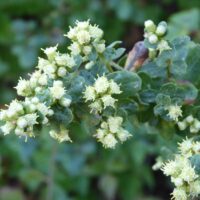
Upright form of coyote brush, growing 4 - 8 ft. tall and wide. Valued for its ability to flourish in a wide range of conditions. Also valued as an excellent habitat plant offering food and cover to a wide variety of wildlife. Flowers are not showy and the male and female flowers are borne on separate shrubs. These plants are MALE and produce ivory colored flowers with pollen and nectar. An abundance of pollinators and beneficial insects use Baccharis flowers. Plant in sun to light shade. Not fussy about soils. Quite drought tolerant once established. Responds well to pruning or shearing and is useful as a screen. Deer resistant.
Baccharis pilularis ‘Mayacama Mound’
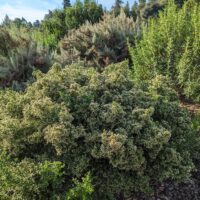
This dense, bright green, gumdrop-shaped coyote bush only reaches about 3 ft tall and spreads a wider. We discovered this heat and drought tolerant selection in a batch of seedlings from inland Sonoma Co.. A great alternative for the ubiquitous ‘Twin Peaks’, which is a coastal selection and less suitable for hot, dry sites. Plant in full sun to light shade where mature plants won’t need supplemental water, but an infrequent deep soak will keep them looking fresh. The small, whitish flowers are relished by pollinators in the early autumn. This selection is female, so the late autumn seeds provide an important food source for birds. A sturdy, low, evergreen shrub for tough situations.
Baccharis pilularis ‘Pigeon Point’
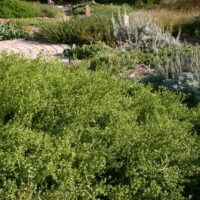
Adaptable and dependable low growing form of the native coyote bush. Forms a mound of bright green leaves with an undulating habit 2 - 3 ft. tall and 6-8 ft. wide. Able to tolerate many soil types and watering regimes this shrub is best in full sun to light shade. Extremely drought tolerant along the coast but best with moderate to occasional summer water inland. When watered and annually trimmed to keep low and free of debris it is recommended for fire resistance landscapes. A good addition to the habitat garden, coyote bush offers excellent cover to a wide variety of wildlife. ‘Pigeon Point’ is a male selection and does not make seed. Deer resistant.
Baccharis pilularis ‘Twin Peaks’
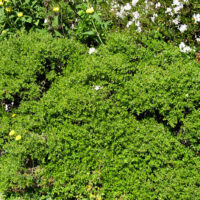
One of the fastest, toughest, densest evergreen native large scale groundcovers. Discovered on Twin Peaks in San Francisco. Grows at least to 6 ft. wide and 2 - 3 ft. tall. Extremely drought tolerant along the coast but best with moderate to occasional summer water inland. Shear hard annually in spring to keep rejuvenated. Sun on coast, afternoon shade inland. This is a male selection so it won't produce seeds. Deer don’t seem to eat it.
Berberis (Mahonia) aquifolium
This attractive, western native evergreen has a long history in cultivation for good reason. Erect stems rise 4 to 7 feet or more tall and wide, spreading slowly by underground rhizomes to form dense clumps. Bronzy-red new growth gives way to dark-green, glossy leaves with spiny margins that are prickly to the touch. Cold winters can darken the foliage with purple-red tones. Late spring brings clusters of bright yellow, sweetly scented flowers. Edible blue-black fruits follow and are pretty and tasty. A useful and adaptable shrub in a hedge or a shrubby border. Takes full sun to part shade. Performs best with some afternoon shade in hot areas and moderate to infrequent water. A great habitat plant which provides cover, nectar rich flowers and fruits relished by all. Deer resistant.