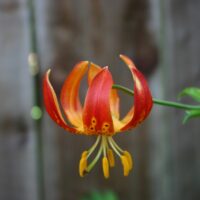
Lilium pardalinum ‘Giganteum’
A towering lily reaching up to 7 feet tall with orange and crimson flowers 3 to 4 inches wide. Who can resist that! Believed to have been discovered along the Van Duzen River in Northern California and thought to be a natural cross between L. humboldtii and L. pardalinum. The large stalks are crowned in summer by layers of flowers up to 30 in number with whorls of large leaves ascending up the base. Forms colonies over time to dramatic effect. Plant in full sun near the coast but protect from the hot afternoon sun, inland. Needs moderate water but is intolerant of soggy soils. Tolerates drier soil than the typical leopard lily.
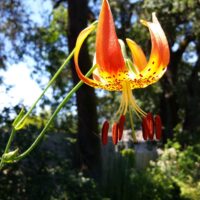
Lilium pardalinum (Gualala River)
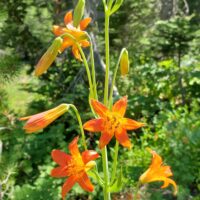
An elegant and beautiful native from moist places and along stream banks in many plant communities from southern Oregon to southern California. A reliable species easily growing 4 ft. tall or more, slowly increasing its width over time. The Turk’s cap style flowers bloom in summer and are orange with red tips and maroon spots. Dies back to the ground in winter. Prefers fertile, well drained soils. Where summers are cool you can plant in full sun. Elsewhere plant in filtered sun, light shade or afternoon shade. Requires moderate summer water.
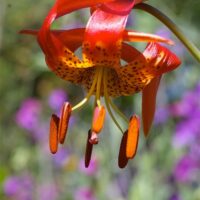
Lilium pardalinum ssp. pitkinense
This is the local rare subspecies of the leopard lily, threatened by habitat loss, grazing, competition with Himalayan blackberries, and collecting. Ours are responsibly grown by scale division from seed grown parent plants. A beautiful turks cap lily with intense orange-red reflexed petals revealing maroon spots. Needs moisture until it's through flowering and protection from gophers. Bright shade or morning sun with afternoon shade is best. This species attracts hummingbirds and butterflies.
Limonium californicum
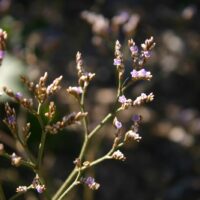
Native to coastal areas throughout much of the state, this beautiful statice relative produces clusters of small, lavender-purple flowers on slender stalks up to 18 inches tall. Low rosettes of semi-succulent, dark green leaves provide an excellent contrast to the airy inflorescences. Plant this marsh native in full sun with regular to moderate water. Thrives in wet conditions with poor drainage. Excellent for bees and butterflies. Makes a wonderful dried flower.
Linum lewisii
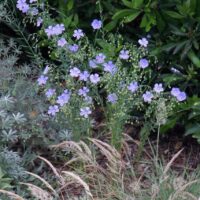
A profusion of sky-blue, five petaled, shallowly cupped blossoms flower in late spring and into summer. Growing 12 to 18 inches tall with slender stems and narrow leaves. Can be short lived but often reseeds. A lovely filler, whose true blue flower color seems to go with everything, and the fine foliage contrasts nicely with a variety of leaf colors and shapes. Plant in full sun with moderate to infrequent summer water. Deer resistant.
Lobelia cardinalis
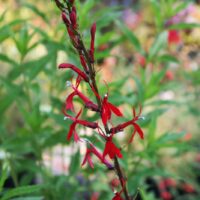
Cardinal flower is native to wet places throughout much of North America. A hummingbird favorite with show stopping, intense scarlet-red tubular flowers on erect terminal spikes in late summer. Growing 2 - 3 ft. tall by 2 ft. wide, this clump-forming perennial has dark green, serrated leaves. Tends to be rather short lived, but is a strong re-seeder. Prefers areas with constant moisture and cool sun to part shade, affective in moist areas of woodland gardens, meadows, pond edges, and rain gardens. Attracts hummingbirds and butterflies, but is resistant to deer browse.
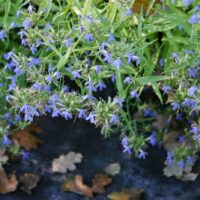
Lobelia dunnii var. serrata
Water loving perennial native to creek sides and other wet places in Southern California. Growing one foot tall and spreading vigorously by rhizomes with clusters of soft blue, one inch flowers in summer. Best with regular water and part shade. A perfect addition for a shady water feature, moist meadow or container planting. The flowers are highly attractive to butterflies of all sorts and are visited by hummingbirds. Winter dormant. Deer resistant.
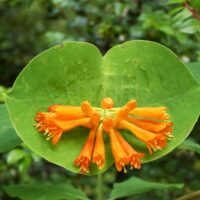
Lonicera ciliosa
Native to north slopes, creeks and river banks from very northern California to British Columbia and Montana. Lovely blue-green, oval-shaped leaves on rapidly growing woody stems will clamber up any support it can find. Terminal flower clusters with narrow, trumpet-shaped, orange flowers are adored by hummingbirds. Red translucent fruits follow that are relished by birds. Plant in cool sun to moderate shade with regular water. Possibly deer resistant.
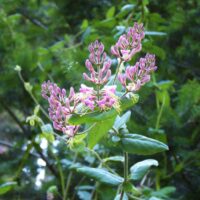
Lonicera hispidula
This native honeysuckle is often seen climbing over shrubs on the edge of woodlands where its roots are shaded and its foliage is sun drenched. The trumpet-shaped flowers range in color from rosy-pink to pink and white and feature prominent yellow stamens emerging from their mouths. They form clusters which decorate the tips of the vining branches and are attractive to bees and hummingbirds. The high point is the drooping clusters of luminous red berries in late summer which are beautiful to behold and provide a feast for birds, especially orioles. A drought tolerant vine but would appreciate occasional deep summer watering. Considered by some to be deer resistant.
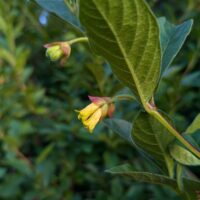
Lonicera involucrata
An interesting native shrub that grows along streams and other moist places. The tubular, red and yellow flowers are borne in pairs on bright red bracts and are hummingbird favorites. Two black shiny fruits follow the flower and are very showy set against the red bracts, making them attractive to birds. Reaches 6 - 10 ft. tall and wide, this neatly branched shrub loses its leaves in the winter. A great addition to the habitat garden in full sun to light shade with regular to occasional deep summer water. Orioles love the fruits. Needs afternoon shade in hot, inland areas. Deer resistant.
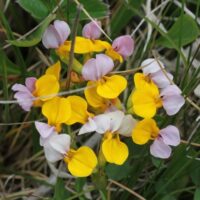
Lotus (Hosackia) formosissimus (gracilis)
A low growing native perennial found in seasonally moist meadows, ditches and seeps along California's coast, north to British Columbia. Small, neat leaves form a pretty, low ground cover spreading up to 2 ft. wide. Pea-like flowers have a bright yellow upper petal and deep pink lower petals which bloom in the spring then sporadically through the summer. Plant in full sun to light shade with regular moisture. Makes a nice container plant, too. Flowers visited by bees and other pollinators. Thought to be the larval food source for the possibly extinct lotus blue butterfly.
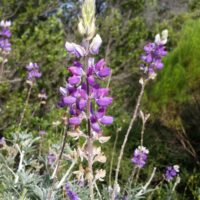
Lupinus albifrons var. douglasii
This variety of the popular silver bush lupine has the same wonderful wands of blue-purple flowers in spring and summer but also features larger, silvery leaves covered with fine hairs. The plant itself is also larger, reaching 3 – 5 feet in height. This variety grows from Marin County down to the Channel Islands. Plant in full sun with excellent drainage and little to no summer water once established. A nectar species for native bumblebees and hummingbirds. This is a butterfly host plant for several blues, hairstreaks and the northern cloudy-wing. Deer resistant.
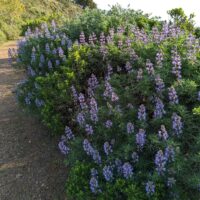
Lupinus arboreus – blue flowered form
Native to coastal areas from Sonoma Co. down to Southern California, the blue bush lupine is distinctive for its grand size (reaching up to 6 ft. tall) and racemes of scented, blue and white flowers. The showy blooms which appear in spring and continue into summer are an excellent nectar source for native bees and hummingbirds. Various butterflies use this species as a larval host plant. The seeds are enjoyed by birds. Grow in full sun with good drainage and occasional to no irrigation once established. Not suitable for areas which get very cold in the winter. Not suitable for Mendocino Co. northwards where it can invade natural areas. Deer resistant.
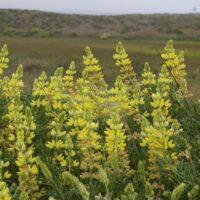
Lupinus arboreus – yellow flowered form
Native to coastal plant communities from Sonoma County south to Ventura County. Showy, fragrant, clear-yellow flowers in long, dense spikes in mid spring and into summer. A fast-growing, floriferous shrub, 3-6 ft. tall and wide. Excellent choice for coastal areas in full sun with good drainage. Not suggested for gardens in coastal Mendocino County due to its ability to quickly naturalize and take over fragile plant communities. Drought and wind tolerant. Lupines have great habitat value, offering nectar for pollinators and nourishing seeds for birds. Great for hummingbirds and a larval food source for various butterflies. Deer resistant.
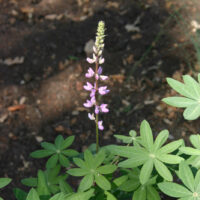
Lupinus latifolius var. parishii
A moisture loving lupine that grows along streambanks and throughout woodlands in central and southern California. A lush perennial, growing 3-4 feet tall and wide, with foot long flower spikes of scented, pink to lavender flowers in late spring-early summer. The large, dark green leaves create a bold texture beneath the slender flower stalks. Plant in lightly shaded conditions with some summer water. Dies back to the ground in winter. Attractive to bees and hummingbirds. Deer resistant.

Lupinus polyphyllus
The bog lupine is known for its tall flower spikes of blue to purple or sometimes pink, reaching up to almost 5' tall from a bed of large, dark green leaves about 18" in height. Clumps can grow about 3' wide. This species is the dominant parent used in many popular hybrid lupines. Native to moist places from the San Francisco Bay area northward along the coast and in mountainous places in the interior. Prefers full sun along the coast and dappled shade inland. This lupine tends to go winter dormant. Snails and slugs find lupines especially tasty when young. Needs regular water. One can create a wonderful meadow by planting the bog lupine with other moisture loving species such as lady ferns, umbrella plant and seep monkeyflower. Deer resistant.
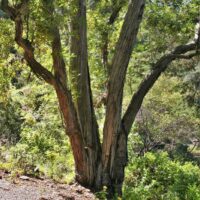
Lyonothamnus floribundus ssp. aspleniifolius
A rare and beautiful evergreen tree from Santa Cruz Island off of the Southern California coast. Fernlike, pinnately divided, shiny, dark-green leaves adorn this fast growing tree which can reach 20 to 50 ft. tall and 15 to 20 ft. wide. Late spring brings large flat-topped clusters of creamy-white flowers on this unusual rose family member. Peeling, reddish-brown bark adds to the interest of this single or multi-trunked tree, which can be used in small groves or as a striking specimen. Plant in full sun to partial shade with moderate to infrequent water. Cold hardy to about 15 degrees. Pollinating insects and birds are attracted to the flowers.
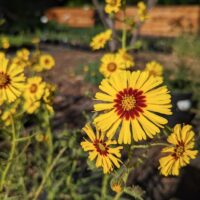
Madia elegans
Native ANNUAL growing 3-4 ft. tall with multi branching aromatic stems. Cheerful bright yellow daisies top the stems in the summer and can be solid yellow or may have a maroon spot at the base of each petal. Tarweeds are an important late nectar source for butterflies, bees and other beneficial insects. The seeds are relished by small mammals and birds, especially finches. Native to grasslands and open forests, well adapted to clay soils and full sun, perfectly adapted to our long, dry summers.
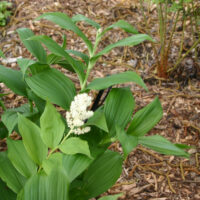
Maianthemum (Smilacina) racemosum
Choice herbaceous perennial native to moist woodlands in California and throughout North America. Forms robust clumps of arching branches 2-3 ft. tall. The branch tips carry dense panicles of sweetly fragrant, white, star-shaped flowers in late spring. Clusters of red berries follow in summer and fall. A lovely addition to the shade garden where it thrives in well drained, woodsy soil with some summer moisture. In cooler coastal environments can go summer dry once established. This lily family member slowly spreads to form striking clumps which die back to the ground in the winter. An elegant and long lived beauty.
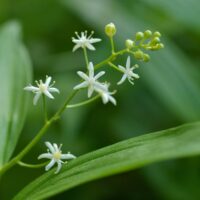
Maianthemum (Smilacina) stellatum
Native to California and much of North America, this woodlander makes a worthy and useful addition to the shade garden. Spreading by stout rhizomes forming colonies of lush, green foliage one foot to 18 inches tall. Small, white, star-shaped flowers top the slender stems in the spring and early summer. Berries follow that are often striped with purple or black, eventually turning red. Thrives in shade with moisture but tolerates dryish conditions once established. Can grow in quite a bit of light as long as there is moisture. A variety of insects seek nectar or pollen from the flowers and woodland song birds love the berries.
Maianthemum dilatatum
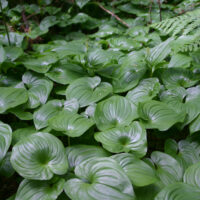
This lush, lily relative is native to coastal forests of Northern California to Alaska. When happy, spreads by underground root stocks to form broad mats of heart-shaped, glossy, green leaves with parallel veins. Bears clusters of tiny white flowers followed by red, translucent berries. Dies back to the ground in winter. Loves shade and moisture. Competes well with tree roots.
Malacothamnus fasciculatus
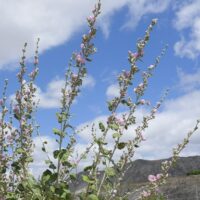
Native to western Southern California, this fast growing, evergreen shrub grows to 6 + feet tall and spreads to form colonies. A multi-branched mallow with hairy, gray-green, leaves often shaped like those of maples. The pale pink, cup-shaped flowers held in clusters along the stem, bloom from spring into summer. A native bee magnet. Useful as an evergreen screen for full sun. Occasional irrigation to drought tolerant once established. A larval food source for the west coast lady and the northern white-skipper butterflies. Reported to be deer resistant.
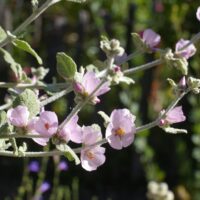
Malacothamnus fremontii
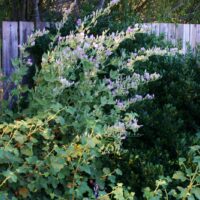
A fast growing, thicket forming, native shrub with silvery white, felted foliage 4 - 6 ft. tall and spreading. A profusion of pale-pink, cup-shaped flowers decorate the branch tips in summer. A tough and adaptable shrub for sunny dry areas, appreciating occasional summer water once established. Useful on banks or other challenging sites. Host plant for the Painted Lady and West Coast Lady butterfly. An excellent nectar source for orioles. Deer often seem to leave it alone.
Malacothamnus jonesii
A rare endemic from southern Monterey and San Luis Obispo counties, growing in foothill woodland and chaparral plant communities. Fast growing shrub, often coming in after fires or disturbance. Growing 4 - 6 ft. tall and wide with beautiful gray foliage, covered in white, velvety hairs. Lovely, soft pink, cup-shaped flowers appear in profusion on the slender branch tips, late spring into summer. Nectar is highly attractive to a myriad of insects, hummingbirds (who seek both nectar and insects), bees and butterflies. Larval food source for the West Coast Lady and Northern White Skipper butterflies. Plant in full sun to ight shade, where it will be drought tolerant once established.
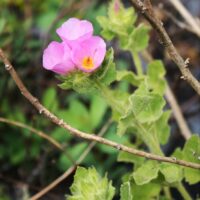
Malacothamnus palmeri var. lucianus
From the hot valleys of the Santa Lucia mountains in central California comes this rare form of the native bush-mallow. Deep pink, cup-shaped flowers appear in late spring and early summer above the fuzzy, light green leaves. Reaches a height of about 6 ft and slowly spreads to form colonies. Give full sun to light shade and provide little to no water once established. A good choice for hot, dry banks with Toyon, Ceanothus and Manzanita. An excellent nectar source for orioles. Deer seem to leave it alone.
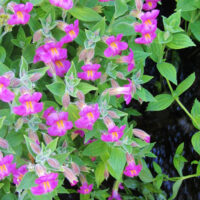
Mimulus (Erythranthe) lewisii – dark flowered form
From cold streams in the Cascade Mountains comes this particularly dark flowered form of Lewis' monkeyflower. Trumpet-shaped blossoms with flared mouths are colored a deep, rich rose-pink, unlike the paler Sierra form. Reaching up to more than a foot tall and spreading to form small clumps, this moisture-loving monkeyflower enjoys part-shade and decent drainage. Hummingbirds love the flowers. Plant with sedges, blue lobelia and false bugbane for a colorful woodland display filled with texture. Great in a container.
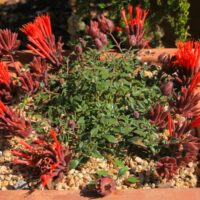
Monardella macrantha ‘Marian Sampson’
A choice native perennial forming low mats of fragrant dark green shiny leaves. Mid to late spring brings spectacular heads of scarlet tubular flowers which are hummingbird magnets. Well suited for rock garden or container use where good drainage can be provided along with occasional summer water. Appreciates light shade in hot regions. The cultivar ‘Marian Sampson’ is a vigorous and disease resistant selection, but still likely to be short lived, lasting 2 to 4 years. Fantastic accent plant which is deer resistant and attractive to butterflies and hummingbirds.