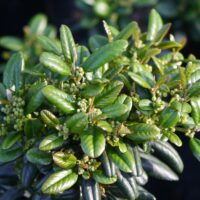
Frangula (Rhamnus) californica ‘Leatherleaf’
Another fine Roger Raiche selection, this coffeeberry cultivar is well worth growing. The evergreen leaves are particularly dark and broad with a mounding habit growing 5 - 6 ft. tall and wide. The tiny flowers attract a wide array of pollinators. Larval food source for pale swallowtail butterfly. The handsome fruits go green to red to black and are enjoyed by small mammals and birds. Plant in sun to light shade. Drought tolerant once established though occasional summer watering is helpful. An adaptable and useful shrub for both formal and naturalistic plantings.
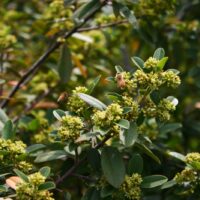
Frangula (Rhamnus) californica ‘Mound San Bruno’
Selected by Roger Raiche on San Bruno Mountain in San Mateo County, this is one of the most reliable coffeeberries. Grows 6 ft tall and wide, with narrow, evergreen leaves and a compact habit. For full sun on the coast to part shade inland. Will tolerate irrigation, but needs only occasional summer water once established. Flowers are loved by pollinators, especially bees. A larval food source for the pale swallowtail butterfly. Provides black juicy fruit in the fall for thrushes, jays, mockingbirds, and robins. May grow to as much as 8 ft. tall with moderate water and good drainage in cooler areas.
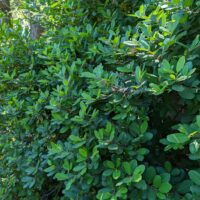
Frangula (Rhamnus) californica ‘Olema’
We discovered this large, dense form of our native coffeeberry near the town of Olema in coastal Marin County. While it reached up to around 15 ft. tall and wide in nature, it has been a little slow to do so in the ground here at the nursery. After about 4 years, it’s reached a height of about 9 ft. This selection of coffeeberry is ideal for a tall hedge or screen where an evergreen shrub is needed to create privacy. Grows well in full sun somewhat near the coast but will need a little shade in hot, inland sites. Occasional to infrequent irrigation once established. Coffeeberries are some of the best habitat plants. The small, yellowish flowers are adored by bees in spring and summer, while the plump, purple fruits that follow are relished by birds.
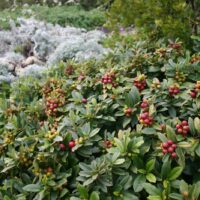
Frangula (Rhamnus) californica ‘Seaview’
This highly sought after selection of our native coffeeberry stays low and compact only reaching 2 – 3 ft tall and up to 6 ft wide. The tidy, deep green leaves form dense rosettes with small cream-colored flowers appearing from spring through summer. Deep purple “berries” form dense clusters in the summer and fall. Enjoys full sun to moderate shade and moderate to occasional water once established. An excellent habitat plant for bees and birds.
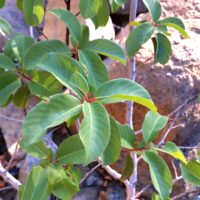
Frangula (Rhamnus) californica ssp. occidentalis
Description coming soon!
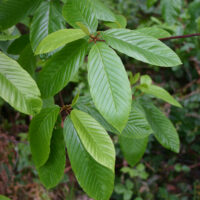
Frangula (Rhamnus) purshiana
Native to moist places from Mendocino County northwards and throughout the Sierra Nevadas, this medium sized deciduous tree is distinctive for its shiny, green leaves with strong venation. Ranges in height from 15 to 30 ft. tall. Bees are attracted to the clusters of small, cream-colored flowers and birds enjoy the dark purple berries which follow. Plant in riparian zones or in areas where it can receive regular moisture. Give full sun to part shade. Requires protection from the afternoon sun in the hottest areas.
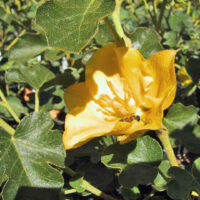
Fremontodendron ‘California Glory’
Beautiful, evergreen hybrid flannel bush to 20 ft. tall. Rich yellow, cup-shaped flowers cover the shrub May - June. Plant in full sun with plenty of room and no summer water once established. Fast growing and drought tolerant. The large flowers are attractive to bees and other pollinators. An excellent nectar plant for orioles. Needs decent drainage.
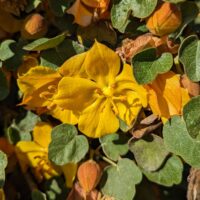
Fremontodendron ‘Ken Taylor’
Showy native shrub for sunny, dry areas. This form of flannel bush only grows 4 - 6 ft. tall and 10 ft. (or more) wide but can be pruned to be kept narrower. Beautiful cup-shaped golden yellow flowers with orange backs bloom in late spring and into summer. Highly attractive to bees and other pollinators. An excellent nectar plant for orioles. Once established, this selection of flannel bush is completely drought tolerant and will accept infrequent summer water only where drainage is excellent.
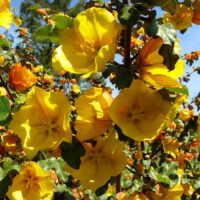
Fremontodendron ‘Pacific Sunset’
This showy hybrid flannel bush grows in a broad “V” shape to 20 ft. tall. Covered with large orange-yellow cup-shaped flowers for a long period in spring. The large flowers attract bees and other pollinators. An excellent nectar plant for orioles. Requires full sun and plenty of room. Best if not watered once established. Needs decent drainage

Fremontodendron ‘San Gabriel’
Large, showy, hybrid flannel bush quickly growing to 20 ft. tall. Covered with buttercup yellow blossoms in the spring. Because of the nature of their branching, ‘San Gabriel’ and ‘Pacific Sunset’ both espalier well. An excellent nectar plant for orioles. Requires full sun. No summer water once established. Needs decent drainage.
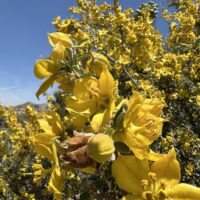
Fremontodendron californicum
In late spring, this evergreen shrub makes for a stunning display along dry foothill slopes. As masses of bright yellow blooms cover its stems, its leathery, fuzzy leaves all but disappear among the showy, cupped flowers. Of the three Fremontodendron species, all native to California, this flannel bush has the widest distribution, mostly in the western Sierra foothills and Southern California. Its range is limited to sites with well-draining, sandy or rocky soil, and it can be sensitive to garden irrigation and heavy soils. Best planted in full sun with similarly low-water species where it receives minimal direct water once established. When happy, it is fast-growing to 15 or more feet, making it a good all-season hedge. Flowers are wildly popular with bees and other pollinators.
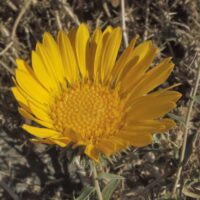
Grindelia camporum
A tough and attractive native perennial found in valleys and lowlands of California. An upright grower, 18-24 inches tall, with resinous foliage and stiff leaves and flower stems. Thick green flower buds hold bright yellow daisies summer through fall which are attractive to bees and butterflies. Best in full sun where it is drought tolerant once established. Tolerates heavy soils and is said to be deer resistant.
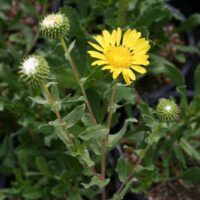
Grindelia hirsutula
Easy to grow, vigorous native perennial that is adaptable to a variety of soils and watering regimes. Grows 1 - 2 ft. tall with good-sized bright yellow daisies over a long period from spring into summer. An excellent nectar plant to add to a habitat garden. With a little grooming and dead heading this sometimes rough looking perennial can look quite handsome in a garden setting. Requires full sun and little to no summer water. Said to be deer resistant.
Grindelia stricta var. platyphylla ‘Mendocino’
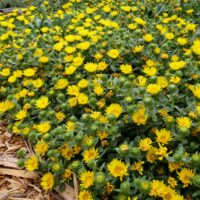
This selection features particularly large bright yellow 2 1/2 inch daisies over a long period in the summer. Each fat green flower bud holds a dollop of gummy white resin which protects the blooms from predators, hence the name “gum plant”. 'Mendocino' is a particularly prostrate form under 8 inches tall and spreading to at least 6' wide. Native to dunes, marshes and bluffs in coastal scrub throughout coastal California. Excellent pollinator plant. Useful in a meadow planting or with other low groundcovers and shrubs. Looks nice draping over a wall too. An adaptable plant for sun to light shade, moderate to occasional water. A natural along the coast where it tolerates wind and salt spray. Deer resistant.
Hastingsia alba
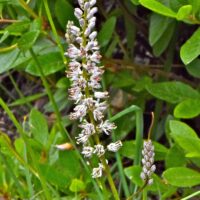
This hard-to-find native bulb features elegant, branched stalks, 3 ft or more high, supporting racemes of sparkling white flowers. The dense blossoms display narrow petals and protruding stamens, giving them a delicate and soft appearance. Grey-green, strap-like leaves grow radially from base of the stalk, creating a tidy rosette 12" - 18" wide. Grows happily in most soils in full sun with regular water, where the bulbs may multiply. In part shade, this lily relative will be a little more drought tolerant. Plants emerge in late winter and go dormant by the end of summer. Hails from the mountains of Northern California, where it makes its home in meadows and open woodlands.
Hazardia squarrosa v. squarrosa
For a splash of color in late summer and fall, this goldenbush is a great choice, providing clusters of cheery, golden flowers at the height of the dry season, which supply food for butterflies. Birds enjoy the seeds which follow. Rounded leaves with sawtooth margins line the stems and emit a wonderfully sweet scent. This seed strain comes from a hot area in Big Sur and is remarkably compact and rounded, reaching about 3 ft. tall and wide. We’ve found it to be very adaptable, tolerant of clay soils and zero to occasional irrigation. Likes full sun but will accept a little shade. Plant with buckwheats, Salvias, and California fuchsias. Not usually available in Northern California nurseries.
Helenium autumnale
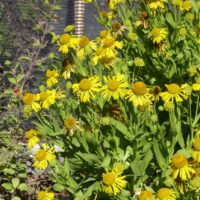
This desirable autumn bloomer is known for its masses of bright yellow daisies up to three inches wide, perched atop stems two to three feet high. Lance-shaped leaves of light green create dense mats six inches high. Native to Northern California and much of North America where it grows in moist meadows. Will slowly increase to form small colonies. Plant in full to part sun and provide regular water. Attracts bees and butterflies. Deer resistant. Despite the common name, this plant is insect pollinated and isn't known to cause hay fever. It was originally used to make snuff, hence the name sneezeweed.
Helenium bigelovii
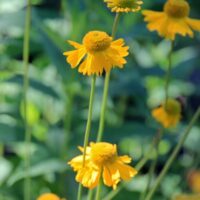
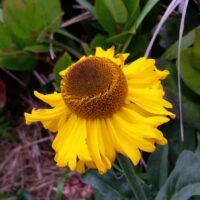
Native to moist meadows of California and S. Oregon, this summer flowering perennial makes a lovely addition to the garden. The cheerful golden-yellow petals turn down slightly from the rounded dome-like center. The golden daisy-like blossoms are held above the rosette of smooth green leaves on 2 - 3 ft. tall stems and attract a wide variety of insects including bees and butterflies. Despite the common name this plant does not cause allergies. It was originally used for snuff, hence the name sneezeweed. Plant in full sun to light shade with regular water. The seed for this crop is from the Pitkin Marsh in Sonoma County.
Helenium puberulum
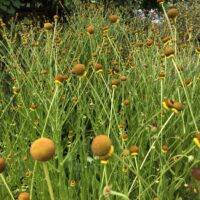
Summer brings clouds of yellow pom-poms which age to brown on this native member of the sunflower family. The round flower clusters sit atop rings of small, down-turned petals, held up on flat stems lined with lanceolate leaves. The flower stalks reach 3 to 5 ft. in height and can be cut down once blooming has finished. Plant in full sun to light shade. Rosilla grows naturally by creeks and seeps and enjoys regular moisture, but will tolerate some drier periods. Attracts a wide variety of insects including bees and butterflies. Goldfinches love the seed. Reseeds readily.
Helianthella californica
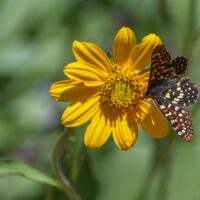
Native perennial sunflower growing in chaparral and woodland communities throughout much of California. Forms clumps of dark green, lance shaped leaves under a foot tall. Blooms April through June with small, golden-yellow sunflower heads which rise above foliage 18 inches to 2 ft. tall. Plant in full sun to light shade where it will be quite drought tolerant once established. The flowers attract a wide array of pollinators and beneficial insects.
Helianthemum (Crocanthemum) scoparium
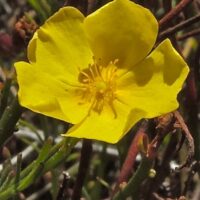
An interesting and little known member of the rockrose family, found in disturbed areas of chaparral, especially abundant after fires. Smooth, rush-like, green stems, lacking obvious leaves with age, grow 6 - 20 inches tall and wide. Summer brings an abundance of little, cheerful, bright-yellow blossoms. Perfect rock garden item or planted with other dryland species such as manzanita, California lilac or native sages. Plant in full sun with good drainage, where it will be very drought tolerant once established. Tolerant of serpentine soils too.
Helianthus annuus
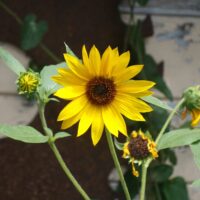
Native to much of North America, this is a wild California selection from the Central Valley just east of Lake Berryessa. A fast growing annual with coarse heart-shaped leaves and topped with an abundance of 3 inch flowers, with bright yellow petals and brown centers on branched stalks. An excellent habitat plant, providing nectar and pollen for a wide array of bees and butterflies as well as seed relished by birds. A highly variable species with a long history of uses and domestication. Plant in full sun where it is adaptable to soil types and watering regimes. Can manage in dryish conditions but best with moderate water, especially early in its growth.
Helianthus californicus
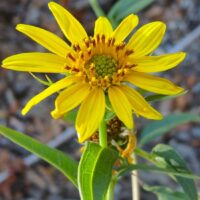
This giant, perennial sunflower is native to riparian habitats in openings with decent light. Dormant in the winter, spring brings rapid growth, with narrow, bright green leaves on tall stalks rising 7 feet or more above a root system which spreads widely. Summer brings many small, golden-yellow sunflowers on the branch tips which are quite dramatic in full bloom. Flowers attract bees and butterflies and the seeds are relished by birds. Perfect for stabilizing soil where there is some summer water and plenty of space. Once established it can take it dryish, but will flower better with water. An excellent cut flower.
Heracleum maximum
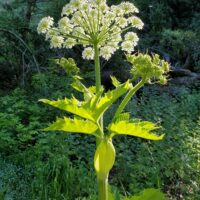
Big, bold, native perennial 3 - 8 ft. tall, is striking in mass or as a specimen. Forms a rosette of large lobed leaves followed by stout flower stems carrying large umbels of white flowers. Thrives in rich soils with some moisture. Full sun along coast, part shade inland. As a member of the carrot family (Apiaceae) the flowers are very effective at attracting beneficial insects. Larval food source for anise swallowtail butterfly. Formerly known as Heracleum lanatum.
Hesperoyucca whipplei
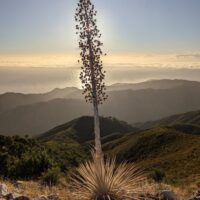
Bold and dramatic architectural accent plant native to southern California coast and mountains south to Baja. Forms a dense rosette of rigid silver-blue blades, 2 foot tall by 3 - 4 foot wide. Each blade has a VERY SHARP tip and careful thought should be given to its placement to avoid injury. Plants can take 3 to 15 years to bloom with impressive stalks rising 6 foot or more above the rosette with drooping, creamy white, bell shaped, fragrant flowers. The flowering rosette dies after blooming often being replaced by vegetative offsets. Best with good drainage in full sun to light shade. No water once established. Deer resistant
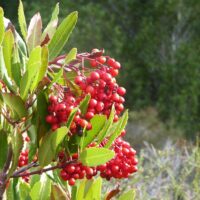
Heteromeles arbutifolia
Toyon is a handsome native evergreen shrub 6 - 10 ft. tall and wide. Sun to part shade, drought tolerant. Clusters of lacy white flowers bloom in summer and areattractive to pollinators. Spectacular bundles of red berries are relished by birds and are a great winter decoration. Valuable as a specimen, screen, hedge or bank plant. Birds attracted to the fruit include the following species: Cedar waxwing, California towhee, spotted towhee, Western bluebird, robins, mockingbirds, bandtailed pigeon, waxwing and quail.
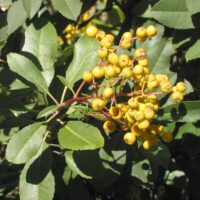
Heteromeles arbutifolia ‘Davis Gold’
An interesting cultivar of the native toyon which bears bright golden yellow berries rather than the more common red-colored fruits. A handsome evergreen shrub 8 - 12 ft. tall and wide (or more). Sun to part shade, drought tolerant. Clusters of lacy white flowers bloom in summer and are attractive to pollinators. The showy clusters of orange-yellow berries are relished by birds and are great winter decoration. Valuable as a specimen, screen, hedge or bank plant. This selection is considered more disease resistant than most toyon.
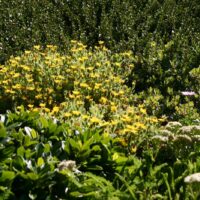
Heterotheca sessiliflora ssp. bolanderi ‘San Bruno Mountain’
Versatile and tough native perennial well suited for the rock garden front of the border or container plantings. Evergreen foliage forms low mats topped with bright yellow daisies in summer - fall. For sunny sites and dryish conditions. Flowers are appealing to bees and butterflies.
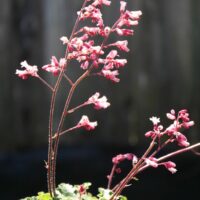
Heuchera ‘Canyon Duet’
A Santa Barbara Botanic Garden selection, part of their Quartet Series of hybrids. This charming, diminutive coral bells forms low, sturdy clumps of small rounded leaves slowly spreading to about 10-12 inches wide. Bi-colored flowers of dark pink and white rise 12 to 18 inches above the dense foliage in spring and early summer. Heuchera's require good light to bloom well but resent full sun, especially inland. Moderate to occasional water. Excellent small scale perennial for mixed border, edging or rock garden. Good container subject too.