
Acer circinatum
Deciduous shrub or tree 5 to 20 ft. tall, native to moist woods and streambanks in the coastal mountains of northern California to British Columbia. Attractive in all seasons: bare reddish twigs in winter, delicate lobed leaves in spring and summer, and good color in autumn. Wonderful in the woodland setting, under tall conifers where its fall color will stand out. A natural with ferns and other woodland plants that receive dappled to part shade and regular to moderate summer water. Can be espaliered too.


Acer macrophyllum
This stately and picturesque tree is native to stream banks and moist canyons from Southern Alaska to the foothills of California. A large, round-topped tree with large dark green lobed leaves and smooth silver-gray bark. Fast growing 30 ft or more tall. One of the few native trees to offer good fall color. Sun to partial shade, occasional to regular water. When planting in a sunny location, protect the trunk from sun-scald with a dilute application of white latex paint.
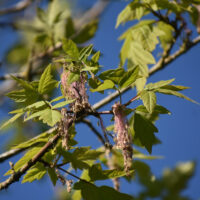
Acer negundo var. californicum
The box elder at maturity features a broad canopy supported by thick branches and a wide, gray trunk. In spring, the silky pink inflorescences hang from the tips of the branches as the leaves begin to emerge. Quickly grows to a height and width of up to 50 ft. Often used as a restoration plant in riparian zones. Full sun to part shade. Enjoys regular moisture. Deer seem to leave it alone once established.

Adiantum aleuticum
Five finger fern provides a delicate, airy, fresh effect in the shade garden. Easy to grow with regular water and humusy soil. Does well in containers too. Fronds form finger-like patterns on handsome black stems up to 1 1/2 feet tall. Somewhat winter deciduous. Combine with wild ginger, redwood sorrel, leopard lilies and sword fern for a handsome woodland garden. Somewhat deer resistant.

Adiantum capillus-veneris
A lacy and delicate looking fern with arching dark stems that carry bright green fan-shaped leaflets. A wonderful addition to a woodland garden or any shady space where it is easy to grow as long as it receives regular water. Lovely in containers or raised beds, on a shady bank or border, along the north side of a building. Can grow as much as 1 1/2 ft. tall and wide. Southern maidenhair can be grown through much of California except for high mountain areas. Goes winter dormant with cold. Somewhat deer resistant.

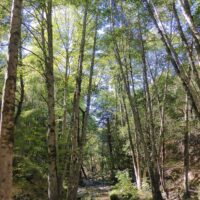
Alnus rhombifolia
From creeks and rivers throughout California, the white alder rapidly grows to become a large tree, reaching to 50 ft. or more at maturity. Serrated green leaves produce an excellent canopy above the straight, silvery-gray trunk. In winter, when the leaves have fallen, the ghostly branches make a striking silhouette with dangling catkins from the branch tips. An excellent plant for creek restoration where its aggressive roots help to stabilize banks. Keep away from irrigation pipes and foundations. Needs regular moisture and sun to light shade.
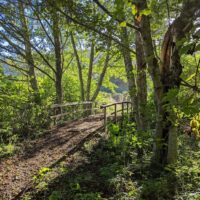
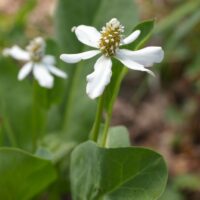
Anemopsis californica
An unusual plant - native to wet areas, but adaptable to regular or moderate garden water. The low rosettes of leaves spread into attractive colonies. The white flowers, or actually, flower bracts, are very showy in late spring. Sun to light shade with moisture. Herbalists use roots and leaves for a topical antibiotic and other uses.
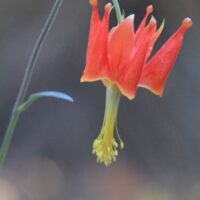
Aquilegia eximia
Large, orangey-red flowers with yellow stamens adorn this beautiful and uncommon native columbine. The pendant, brightly colored blossoms are larger than those of the western columbine but just as attractive to hummingbirds. Forms a 1 ft. high mound of foliage with flowering stalks reaching up to 5 ft. tall. Native to the Coast Ranges from Mendocino to Ventura Counties often on serpentine soils. Provide full sun to part shade and only water enough to prevent the soil from drying out completely. In areas far away from the coast provide a little shade from the hot afternoon sun. This species is a little more drought tolerant than the more common Western columbine.
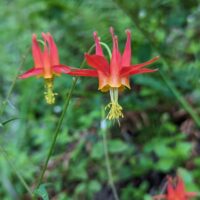
Aquilegia formosa
A popular native perennial with fern-like foliage and wonderful, nodding, spurred blossoms of red and yellow. Best with a little shade and moderate to regular moisture, but will tolerate full sun in somewhat cooler climates. The flower stalks reach 1 1/2’ to 3’ tall, with the grey-green foliage forming a mound of about 1 ft tall and wide. Flowers attract hummingbirds, while the seeds are relished by small birds such as sparrows and Juncos. If seed pods are left on the plants, you may get volunteer seedlings in the fall.
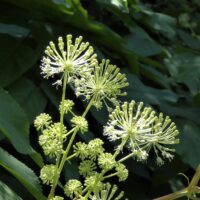
Aralia californica
A striking and dramatic native perennial for shady areas with regular water. The elk clover boasts tropical looking foliage 4 - 8 ft. tall with stalks of white, ball-like flower clusters followed by purple berries. In the autumn the foliage turns yellow and dies to the ground, returning with exuberance in the spring. Birds relish the fruits. Deer resistant.
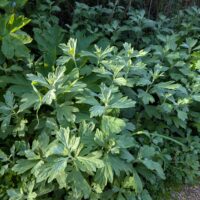
Artemisia douglasiana
Mugwort is native to many plant communities where there is at least some year round moisture: streams and riverbanks, road cuts, ditches, and moist meadows. A stout, rhizomatous perennial with aromatic foliage that is green on top and silvery beneath. The flowers are small and not particularly showy. The foliage is beautiful and fragrant with a long history of medicinal uses. Plant in sun to light shade where it will grow 3 ft. tall and spreading to form a colony. Well watered plants can grow even taller. Provides excellent cover and seeds for birds. Deer resistant.
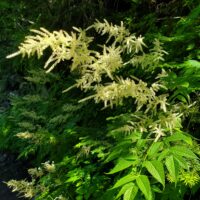
Aruncus dioicus
Native to stream sides and moist woods from Mendocino County, California north to Alaska. A bold and showy perennial looking like a giant astilbe. Forms dense clumps of finely divided foliage with arching, feathery plumes of white flowers 3-5 ft. tall in summer. Requires regular moisture and part shade where it makes a striking specimen or accent plant in the woodland garden. Dies back to its roots in winter. The frothy flower plumes attract an array of tiny little pollinators and the seed heads on female plants are an important food source for birds. Said to be deer resistant.
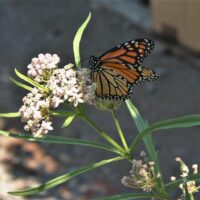
Asclepias fascicularis
Our most common native milkweed is found in meadows and on the banks above ponds. Its flowers are held in umbels of a pale mauve color. They form at the top of 1 - 3 ft. tall slender stems that die back in winter to a perennial rootstock. Its wandering roots form small colonies. Drought tolerant, it prefers seasonally moist soils and likes moderate water in the garden. The narrow leaves are the preferred larval food for the Monarch Butterfly. Full sun to part shade. Unlikely to be bothered by deer.
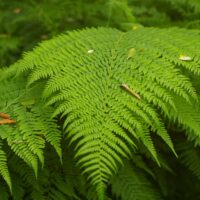
Athyrium filix-femina
Native to much of North America, lady fern grows in moist shady places. The newly emerging fiddleheads in the spring are particularly attractive. The graceful, delicate looking fronds grow 3 foot or more tall by 3 ft. or more wide. Lovely in a forest setting, as a background plant, or around a pond. Goes dormant in the winter. Plant in full to part shade with regular water.
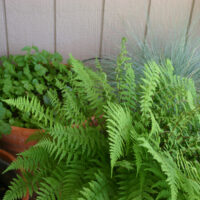
Athyrium filix-femina ‘Minutissimum’
A miniature form of the lovely lady fern, growing up to one foot tall and two feet wide. Forms compact mounds of finely divided light green fronds. Perfect for the small spaces, rock gardens or containers. A vigorous and hardy fern needing only shade and moisture to thrive. Dies back to the ground in the winter. The new unfurling fiddleheads adds charm in the spring. Deer resistant.
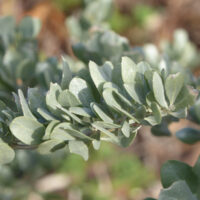
Atriplex lentiformis
This native bird favorite is a tough and useful shrub with beautiful silvery gray foliage. Growing 5 ft. or more tall and spreading widely, quail bush is valued for its ability to deal with difficult sites where it tolerates wind, salt spray, saline and alkaline soils. A terrific habitat plant, providing food and cover for a wide array of birds and mammals. Native from the coast to the desert. Excellent for erosion control and is fire resistant. Benefits from annual shearing and occasional aggressive pruning to rejuvenate. Plant in full sun with occasional to little summer water.
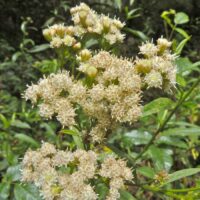
Baccharis glutinosa (douglasii)
This native perennial is a powerhouse for pollinators, luring small butterflies, predatory wasps and other beneficial insects to its dense, white, flat-topped, nectar rich flower heads. Found in wetland and riparian habitats such as salt marshes and stream edges along the coast and interior valleys of California. An erect perennial, growing 3 ft. or more tall, with long, lance-shaped, resinous, leaves and spreading by rhizomes. Blooming in late summer to early fall, the flowers lack petals and are dioecious, with male and female disc flowers occurring on separate plants. Plant in full sun to light shade with moderate to regular water. Deer resistant.
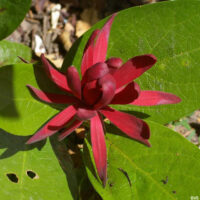
Calycanthus occidentalis
Native along streams, rivers and moist places in California. This attractive deciduous shrub is well worth growing. Bright green aromatic foliage with interesting maroon-red flowers in spring-summer that resemble small waterlilies and have a wine-like fragrance. Can be grown as a multi-stemmed small tree, trimmed hedge or left alone to become a large background shrub. 5 - 12 ft. tall and wide. Part-shade is ideal. Tolerates full sun with lots of moisture in somewhat cooler areas. Accepts full shade but will grow more slowly with a more open habit. Regular to moderate water. Somewhat deer resistant.
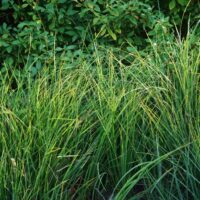
Carex barbarae
Widely distributed native sedge that is an important traditional basket fiber plant. Bright green sharp blades in clumps 1 - 3 ft. tall and spreading. Oval-shaped tufts of small reddish-brown flowers on spikes at the tip of the flowering stems. An attractive sedge, though it can be invasive. For sunny or partly shaded areas with regular to moderate moisture. Drought tolerant in clay soils or with some shade. Handsome container plant too. Often used in bio swales and riparian restoration. Deer resistant.
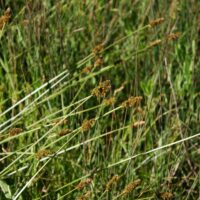
Carex densa
While uncommon in nurseries, this semi-evergreen sedge forms green tussocks which are very useful in seasonally moist meadows and open woodlands. Elongated, chunky seed heads rise above the dense leaf blades on slender stalks up to 2 ½ ft. tall. The foliage reaches 1 to 2 ft. high and slowly spreads to form small clumps. Useful for smaller gardens where you want a sedge that doesn’t spread super vigorously. Tolerates summer drought in somewhat heavier soils. A little extra irrigation will keep this sedge more evergreen. Native to much of California and north to Washington. Deer resistant.
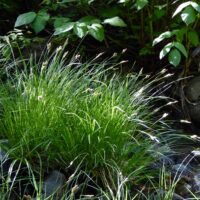
Carex nudata
Native to below the high water mark along perennial water courses. Forms a bright green, dense, arching mound with interesting black flowers in spring. Best in moist soils, full sun to light shade. 1 - 2 1/2 ft. tall and wide. Lovely yellow fall color in colder locations. Winter deciduous. Beautiful in containers too. Deer resistant.
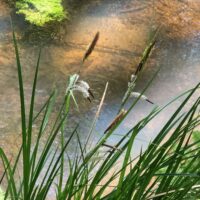
Carex obnupta
From moist coastal sites to shady redwood forests comes this tall sedge, one of the tallest of our native sedges. Spreads vigorously to form dense drifts up to 4 feet in height. One of the more shade tolerant sedges, the slough sedge can grow under the darkness of a redwood canopy but will also accept full sun as long as it has access to moisture. A great plant for naturalizing in moist areas. Used by native peoples for basket making.
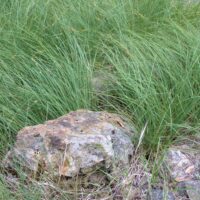
Carex serratodens
From serpentine meadows comes this lush, blue-green sedge. Our form grows 1 - 2 ft. tall and spreads at a moderate pace, creating broad drifts over time. Needs moderate to regular moisture and full sun to part shade. Often goes semi-dormant in winter at which time the plants can be cut back to just a few inches. A useful sedge for gardens on serpentine or for bank stabilization where it can provide cover for tree frogs and other critters. Does not require serpentine soils to thrive. Deer resistant.
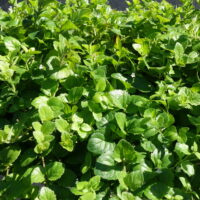
Clinopodium (Satureja) douglasii
Wonderfully fragrant native perennial with trailing stems about 6 inches tall and spreading. Roundish, scallop-edged, deliciously minty leaves have a long history of herbal uses. Tiny white flowers are borne in axils of leaves in the spring. A sweet small scale groundcover for the woodland garden with light shade and moderate to a little summer water.
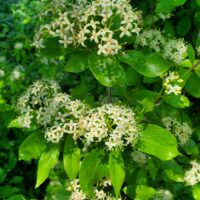
Cornus glabrata
The bluish-white fruits of this species are reputed to be especially good for attracting birds. Small creamy white flowers appear in spring on subtly beautiful arching branches. A type of stream dogwood, it forms thickets with time, 6 - 10 ft. tall. Deciduous. Prefers moisture and some shade. Western tanager and warblers eat the flowers. Grosbeak, Northern oriole, flickers, spotted towhee, Western bluebird, robins, mockingbirds, bandtailed pigeon, waxwing and quail eat the fruits. A great plant for stream restoration.
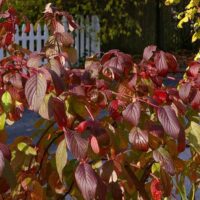
Cornus sericea
Redtwig dogwood is a spreading shrub growing 6 ft. or more tall and at least as wide, forming broad thickets along creeks and rivers. The beautiful red stems stand out in the winter landscape once they loose their leaves in the fall. Flat topped flower clusters are creamy white and are followed by clusters of white fruits. Often takes on nice fall color before loosing its leaves. Plant in full sun to light shade with regular to moderate watering. Does great on heavy clay soils and is a very good soil stabilizer. An excellent habitat plant where it provides food and cover. The fruits are very popular with birds. At the nursery, bluebirds and mockingbirds compete aggressively for the fleshy white fruits.
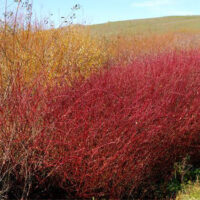
Cornus sericea ssp. occidentalis ‘Tomales Bay’
This selection of the native creek dogwood is from Tomales Bay, Marin County, where it forms broad clumps 6 ft. or more tall and wide. The beautiful red stems stand out in the winter landscape. Flat topped flower clusters are creamy white followed by small white fruits. Good fall color. Plant in full sun to light shade and give regular irrigation. Western tanager and warblers eat the flowers. Grosbeak, Northern oriole, flickers, spotted towhee, Western bluebird, robins, mockingbirds, bandtailed pigeon, waxwing and quail eat the fruits.