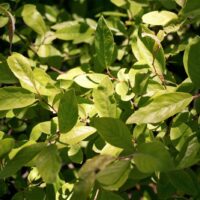
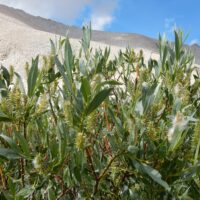
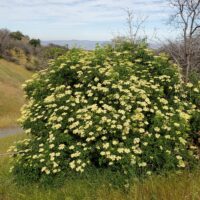
Sambucus mexicana (nigra ssp. caerulea)
Our native blue elderberry, often seen on banks above rivers and streams, or even on somewhat drier slopes. A fast growing deciduous shrub or small tree 8 to 30 ft. tall with pinnately divided leaves. Creamy yellow flowers appear in late spring in flat-topped clusters, followed by blue berries. High on the birds’ favorite list! Ripe berries feed many species of birds. Moderate to infrequent summer water.
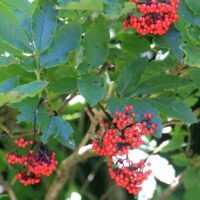
Sambucus racemosa
Red elderberry has light-green foliage topped by pretty, white flowers in pyramidal clusters which are followed by bright red berries. This 7-to-18-ft shrub or small tree is native to moist areas along the coast and in the Sierra-Nevada mountains. The fruits are relished by birds but are reputed to be poisonous to humans. Prefers cool sun or light shade, and moisture. Ripe berries are high on many birds’ favorite list!
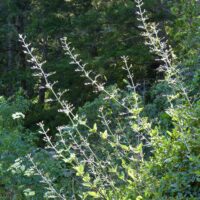
Scrophularia californica
Native to open places of the coastal scrub and woodlands where it can form large colonies in moist areas. Grows 3 to 6 ft. tall and wide in cool full sun to light shade. Pretty purplish-red new growth matures to deep green. The flower spikes carry many small open-mouthed maroon-red flowers followed by attractive seed stalks which are nice in dried flower arrangements. This prolific nectar producer attracts all sorts of pollinators including bees and hummingbirds. Larval food source for the Chalcedon Checkerspot and Common Buckeye butterfly.
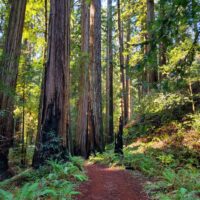
Sequoia sempervirens
A beautiful and fast growing conifer, famous, as it is the world’s tallest tree. Outside its native range or in a garden setting, it provides a symmetrical pyramid of soft fragrant foliage 70 to 150 ft. The columnar trunks are covered with thick fibrous red-brown bark. Small one inch cones form in clusters at the branch tips. Grows easily in areas with coastal influence and fog but will grow in drier interior sites with regular summer water. Performs well in the regular watering regimes of many urban gardens and lawns. Can be planted as a specimen, in groves, or even pruned as a hedge. As long as its watering requirements are met it has very few pest or disease problems.
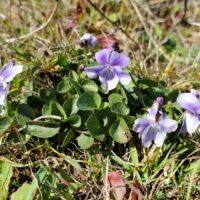
Viola adunca
Native to both coastal and mountain plant communities, this violet can be seen locally blooming in coastal meadows and bluffs. Forms low-growing, slowly creeping, neat clumps of heart-shaped leaves. Sweetly fragrant, nodding, blue to purple flowers with white interiors and purple nectar guides bloom in the spring. This pretty little wildflower is visited by bees and other pollinators and is a host plant for a number of butterflies, some of which are rare and endangered. Grows in sun along the coast and light shade inland with moderate summer water. Can reseed if happy.
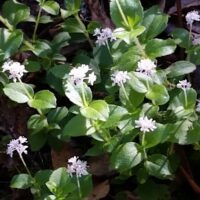
Whipplea modesta
The common name “modesty” fits this unassuming evergreen creeper. Though not super showy, one has to admire its ability to thrive on difficult sites. A good stabilizer native to forests of the Coast Ranges where it tolerates dry shady situations. Will appreciate a little summer water, but it is drought tolerant once established. Numerous tiny white flowers in late spring. Deer seem to leave it alone.
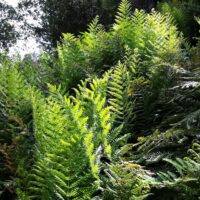
Woodwardia fimbriata
The evergreen giant chain fern is the largest American fern, with striking fronds 4 - 6 ft. tall. Prefers part shade but will accept darker conditions. Will grow in open, somewhat sunny areas within the fog belt, as long as it has access to moisture. Great in moist woodland gardens near a stream or against a shady wall. Keep in mind, this fern likes some moisture but does not want to be kept wet. Allowing it to dry out just a little between waterings can be beneficial. To keep it looking fresh and vigorous, cut back to the ground in late winter just before the new fiddleheads begin to emerge. Deer resistant.