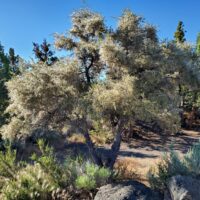
Cercocarpus ledifolius
Large shrub or small, multitrunked, evergreen tree, 6 - 30 ft. tall, native to arid mountains of the western US. Often takes on a gnarled, picturesque form depending on the conditions it is growing in. Adapted to dry, rocky slopes where it weathers drought, extreme heat and cold, wind and snow. Slow growing, densely branching, with dark green, leathery leaves with curled under edges and silvery undersides. Trunks develop beautiful, red-brown bark with silvery new growth. The flowers are similar to our local mt. mahogany species, small, greenish- yellow, smelling of honey, and attractive to pollinators. The fruits are long, silvery, plumes that glow when back lit. Plant in full sun to light shade with good drainage where it will blend well with other dryland shrubs and perennials and requires little input. Fixes nitrogen. Interesting container or bonsai subject.
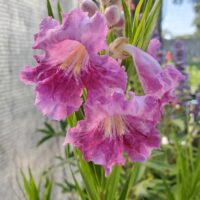
Chilopsis linearis
A graceful, summer-blooming, deciduous shrub, native to desert washes where it grows in gravelly soils and intense heat. Forms a large, multi-branched shrub or small tree reaching up to 15'-20' tall and wide with narrow, willow-like leaves. Terminal clusters of showy, trumpet-shaped flowers in summer come in shades of white, to pink and purple that attract hummingbirds and butterflies. Long, bean-like pods follow and hold on into winter. Enjoys hot climates with plenty of sun, decent drainage and occasional to moderate water. Avoid cool coastal conditions and heavy wet soils. Grows fast when happy with no pest or disease problems, demanding little. A great option for along sidewalks.
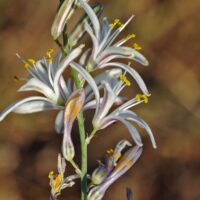
Chlorogalum angustifolium
You may be familiar with the common soap plant and its tall stalks of delicate white flowers. But this unusual, diminutive species of soap root is much smaller, only reaching 1 – 2 ft. high. Rarely offered in nurseries, this species has short, narrow leaves which are not wavy like the common soap plant. Grows in dry grassland and open woodlands in the northern Sierra foothills and coast range. Enjoys full sun to light shade and no additional irrigation once established. Tolerates clay. The seed for these plants came from Windsor and was generously given to us by Vicki Wilson.
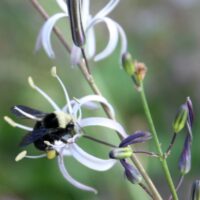
Chlorogalum pomeridianum v. pomeridianum
Known for their large, fibrous bulbs historically used by indigenous peoples and early settlers for soap, food and to stupefy fish. Long, wavy-margined leaves form a rosette in winter followed in late spring by tall, airy flower stems bearing small white flowers that open in the late afternoon and evening. Great in naturalistic settings in full sun to light shade. Needs to go summer dry once established. Larval food source for the Western Brown Elfin butterfly.
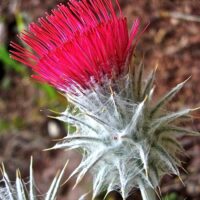
Cirsium occidentale
A beautiful NATIVE and NON-WEEDY thistle. Forms a rosette of gray woolly and spiny leaves the first year. A BIENNIAL, flowering occurs the second year with tall, narrow spikes of showy maroon-red to dark pink flowers with cobweb hairs on the bracts. A striking plant, usually reaching 3 - 6 ft tall when blooming, for sunny areas with good drainage and low to no irrigation. An excellent addition to the habitat garden where it attracts bees, butterflies and hummingbirds. Butterflies such as the painted lady and the mylitta crescent depend on cobweb thistle as a larval food source. Deer resistant.

Clarkia amoena ssp. whitneyi
Nearly extinct in the wild, this beautiful ANNUAL was found in coastal communities in Mendocino and Humboldt Counties. Growing 3 ft. tall and wide, the branched leafy stems are topped with a long succession of 3 inch cup- shaped flowers. The large flowers are light lavender-pink with whitish areas at the base of the petals. Clarkias make excellent garden plants needing very little and giving much in return. Plant in full sun to light shade, as a filler among trees or shrubs, in mixed flower border or meadow planting. A little water while flowering will extend their show. Good container subject too. Excellent cut flowers. Seems to be deer resistant. Attractive to bees and butterflies.
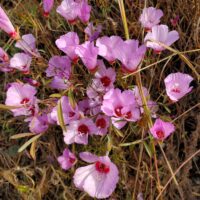
Clarkia rubicunda
Showy and floriferous, with gorgeous, cup shaped blossoms of silky, pink-purple petals featuring a dark red center with a long bloom from late spring into summer. This endemic, ANNUAL wildflower grows in openings of woodlands and chaparral near the coast, mostly in the central part of state. Grows 2-ft. tall or more in full sun with low water needs. Tolerant of heavy soils, the exuberant blossoms attract bees, butterflies and moths, including Sphinx moth species. Performs well in containers and is an excellent cut flower too. Deer resistant.
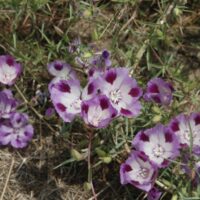
Clarkia williamsonii
The incredibly showy flowers of this native ANNUAL will take your breath away in late spring and early summer. The large, lavender-pink, papery flowers feature deep, burgundy-red brush strokes and cheery white centers. Plants form a loose mound about 1 ½ ft. around. Butterflies and other pollinators love Clarkias. Native to the Sierra foothills, where it grows in full sun to light shade. Plants enjoy moisture while they are developing in the winter and spring, but are accustom to hot and dry summers. Needs decent drainage. Reseeds readily, as long as there is exposed soil nearby. Deer resistant!
Claytonia sibirica
This native perennial with white to pink candy-striped flowers seeks shady, moist conditions. Our form is from Sonoma Coast and has particularly pink flowers. Related to miners lettuce, candy stripe produces dark green, succulent, edible leaves in low rosettes. Blooms over a long period beginning in spring and will frequently reseed. A sweet, spreading, low ground cover for a shady area with regular moisture. A charming and colorful addition to the forest garden, combining beautifully with ferns, wild ginger and false Solomon’s seal.
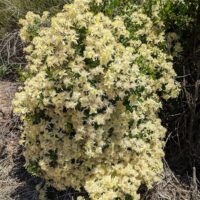
Clematis lasiantha
This deciduous native vine climbs over shrubs and trees in full sun to part shade. Produces a wealth of one inch, creamy-white flowers in spring and summer followed by large fluffy attractive seed heads. Use clematis to adorn a pergola or archway, or to train up trees or other structures. Plant in full sun to light shade. Little water once established. Generally deer resistant.
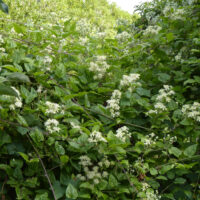
Clematis ligusticifolia
Native to riparian areas where the vining stems will climb and weave their way up and over shrubs and trees. Large masses of fragrant, small creamy-white flowers bloom in summer. Beautiful, silvery, feather-like fruits follow and are as attractive as the blossoms. The intricately divided leaves on long stems can climb 20 - 30 ft. Full sun to light shade with regular to moderate summer water. Deciduous. Generally deer resistant.
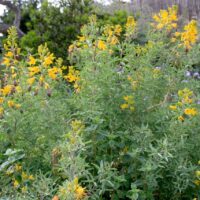
Cleomella (Isomeris) arborea
This distinctive small shrub from Southern California features clusters of golden-yellow flowers with long stamens, giving them a delicate, airy quality. The flowers are followed by papery, lantern-like seed pods which can become almost translucent with age. While this species blooms strongest in the spring, flowers can be seen year-round. Bladderpod has a loose, rounded habit, reaching 4 to 6 ft. tall and wide. If your plant becomes too lanky, simply cut it to the ground to rejuvenate it. Plant in full sun with good drainage and provide infrequent to zero irrigation once established. A great nectar source for hummingbirds, bees and butterflies. Deer resistant.
Previously known as: Peritoma arborea
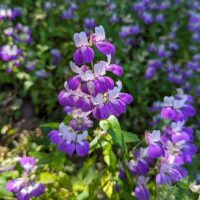
Collinsia heterophylla
A striking form of a native annual wildflower found in open woodlands in much of California. The open lipped flowers are stacked in tiers, and said to look pagoda-like. This charming woodlander is best in bright shade, in edges and openings, or under oaks, where it blooms from mid spring to early summer. Grows around 2 ft. by 2 ft. When happy it will reseed and those seedlings will require no irrigation. A bee and butterfly favorite.
Comarostaphylis diversifolia
Looking something like a toyon but closely related to manzanita, this handsome evergreen is a useful landscape subject. Native to chaparral communities near the coast in Southern California where it usually grows on north facing slopes. Growing slowly 6-20 ft. tall with shredded red bark and shiny dark green foliage. Creamy-white urn-shaped flowers in racemes bloom March-May are attractive to hummingbirds and pollinators. The dark-red rough textured fruits in summer are enjoyed by many kinds of birds. Grow as an upright shrub or with selective pruning can be trained into a small tree. Useful as a specimen, background screen or informal hedge in full sun to light shade with good drainage. Will except summer water only with good drainage and is drought tolerant once established.
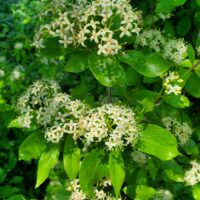
Cornus glabrata
The bluish-white fruits of this species are reputed to be especially good for attracting birds. Small creamy white flowers appear in spring on subtly beautiful arching branches. A type of stream dogwood, it forms thickets with time, 6 - 10 ft. tall. Deciduous. Prefers moisture and some shade. Western tanager and warblers eat the flowers. Grosbeak, Northern oriole, flickers, spotted towhee, Western bluebird, robins, mockingbirds, bandtailed pigeon, waxwing and quail eat the fruits. A great plant for stream restoration.
Cornus sericea
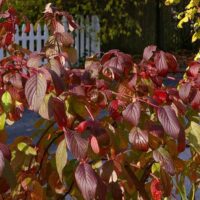
Redtwig dogwood is a spreading shrub growing 6 ft. or more tall and at least as wide, forming broad thickets along creeks and rivers. The beautiful red stems stand out in the winter landscape once they loose their leaves in the fall. Flat topped flower clusters are creamy white and are followed by clusters of white fruits. Often takes on nice fall color before loosing its leaves. Plant in full sun to light shade with regular to moderate watering. Does great on heavy clay soils and is a very good soil stabilizer. An excellent habitat plant where it provides food and cover. The fruits are very popular with birds. At the nursery, bluebirds and mockingbirds compete aggressively for the fleshy white fruits.
Cornus sericea ‘Hedgerow’s Gold’
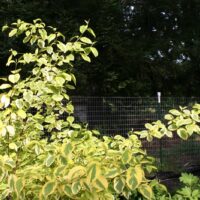
A striking selection of redtwig dogwood, discovered near the Deschutes River in Eastern Oregon and introduced by Hedgerows Nursery. The large leaves of soft green have a broad, irregular, bright golden edge. In autumn the leaves turn an attractive ruby color. Forms a thicket that easily reaches 6 ft. tall by 6 ft. wide. The red stems stand out in the winter landscape after the leaves have fallen. Flat topped cluster of white flowers appear in spring and are followed by small white fruits enjoyed by birds. Best with regular water, good light and protection from the hot afternoon sun.
Cornus sessilis
Native to moist ravines and stream banks of the coast ranges and the Sierra Nevada Mts, this deciduous shrub or small tree grows 5-10 ft. or more tall and wide. Beautiful shiny, jade green leaves with prominent lateral veining decorate the graceful green barked stems. Small, yellow flowers appear early as it leafs out in the spring and are followed by oval fruits. Fruit color changes as it matures from greenish-white to yellow, red and finally shiny black which attract a wide range of fruit eating birds. Foliage can take on pretty tones of yellow and red in the autumn. Thrives in moist shady locations, but will grow well with just part shade and moderate to occasional summer water once established.
Crataegus gaylussacia
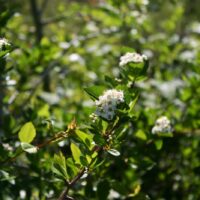
Klamath hawthorn occurs in seasonally wet meadows or borders of forests in northern California. A large deciduous shrub or small tree 6 - 20 ft. tall with reddish-brown bark and formidable thorns. Small, white flowers in flat topped clusters in late spring are followed by red fruits that ripen to black. The fruits are highly attractive to birds. A slight fall/winter chill can turn the leaves a brilliant orangey-red. Plant in full sun to partial shade with regular to moderate water. This shrub tends to sucker and could be encouraged to form a thicket. It is also amenable to pruning, and can be trained into a slender tree. This is our most common, local native hawthorn., and until recently was once thought to be C. douglasii.
Cucurbita foetidissima
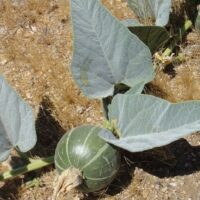
Found in valley grasslands and coastal scrub environments of Central and Southern California, the buffalo gourd is a deciduous perennial ground cover or vine that is sure to grab attention. In late winter and early spring, this vigorously spreading gourd emerges from a tuberous root, potentially spreading to 20’ feet or more, producing big, triangular, gray-green fuzzy leaves, followed by large, showy, orange-yellow, bell-shaped flowers in summer which attract bees. The round fruits, about 4 inches across, are green-striped when young, maturing to yellow. As the fruit matures, it is too bitter for humans to eat. The mature fruit is used by native peoples for decorative purposes or for making musical rattles. Plant in full sun. Drought-tolerant once established.
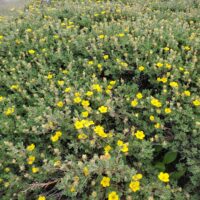
Dasiphora (Potentilla) fruticosa
A popular landscape subject, valued for its long bloom period, hardiness and carefree nature. A member of the rose family, this deciduous shrub can be found across the northern hemisphere, often growing at higher elevations. Here in California, it ocurrs in the Sierras, the Klamath Mountains and the Warners. Grows 2 -3 ft tall and wide with handsome, pinnately compound leaves. Cheerful, rich-yellow, saucer-shaped flowers bloom over a long period, summer into fall. Plant in full sun to light shade with moderate watering. Drought tolerant once established. Attracts bees and butterflies. Great in a pot. Deer resistant.
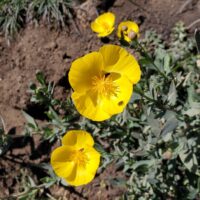
Dendromecon rigida
This is our local bush poppy, growing 4 - 8 ft. tall with bluish-gray foliage and a showy display of brilliant yellow poppy blossoms from spring into early summer. Scattered flowers may be seen throughout the year in mild climates. The leaves are narrower than those of the island bush poppy and the plant has a more open form. Requires full sun, good drainage, and little to no irrigation once established.
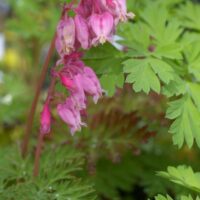
Dicentra formosa
Ferny foliage makes a lacy groundcover in shady areas. Clusters of pendulous, pink, heart-shaped flowers in spring and into summer. Will spread rapidly when happy, enjoying moist but not soggy woodland conditions. Tolerates dry shade where it goes dormant with drought. Early nectar source for hummingbirds and bumble bees. Deer resistant.
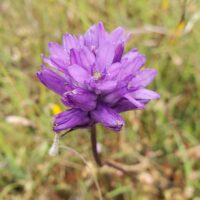
Dichelostemma congestum
A perennial wildflower with rounded, purple flower clusters held atop slender, naked stems. In late spring and early summer, the cheerful floral umbels rise 2 to 3 feet above low, grass-like leaves. Native to hillside grasslands and mountain meadows throughout western North America, this wild hyacinth species is taller than its Brodiaea relatives, with larger inflorescences than the similar blue dick. Usually spreads slowly by corms and seed to form colonies. An excellent nectar plant for the dry borders of pollinator gardens, alongside other native bulbs, and in meadow plantings. Plant in full sun to light shade with decent drainage. Water minimally and leave dry during summer dormancy.
Diplacus (Mimulus) ‘Changeling’
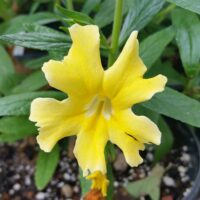
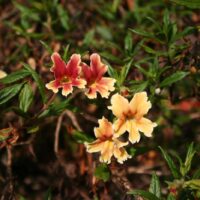
This charming hybrid monkeyflower offers a beautiful blend of soft orange, red, and cream hues on ruffly-edged, trumpet-shaped blossoms. As the mottled colors mellow with age, each bloom looks a little different from the next, adding to the appealing "changeling" effect. Foliage is evergreen and grows to 3 ft. tall and wide. Plant in full sun on the coast to light shade inland and give it well drained soil. Drought tolerant once established, but some occasional summer water is helpful. Bees, butterflies and hummingbirds work the flowers and the painted lady and checkerspot butterflies use it as a larval food source. Deer resistant.
Diplacus (Mimulus) ‘Creamsicle’
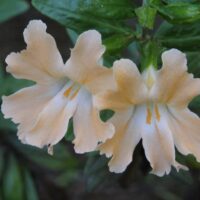
The trumpet-shaped blossoms of the 'Creamsicle' monkeyflower are a beautiful, light shade of pastel orange. With their white throats and dark orange nectar guides, the flowers have a two-toned affect. This is one of Phil Van Soelen's first hybrids using Diplacus bifidus from Bowman Lake in the Sierra Nevada (thanks to Ted Kipping). It has proved long lived in both Fulton and Sebastopol and has the useful characteristic of sprouting new growth from the base so that old growth can be pruned away. Evergreen foliage grows 2-3 feet tall and wide. Best with light shade, good drainage, and minimal summer water. Deer resistant.
Diplacus (Mimulus) ‘Eleanor’
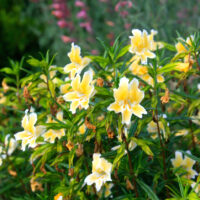
The ‘Eleanor’ monkeyflower selection, introduced by Yerba Buena Nursery, offers an abundance of soft citrusy-yellow blossoms edged in white. Monkeyflowers are evergreen, floriferous subshrubs that bloom spring through the summer. This hybrid form grows to around 3-foot tall and wide. Best with good drainage, light shade, and occasional deep watering once established. Avoid drip irrigation. Pinching older stems helps produce a fresh, dense habit for these profusely blooming plants. Monkeyflowers are deer resistant, and are a larval food source for the painted lady and checkerspot butterflies.
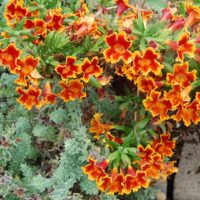
Diplacus (Mimulus) ‘Fiesta Marigold’
Selected for its large, frilly, brick-red blossoms with orange edging, this striking monkeyflower hybrid comes from horticulturalist Richard Persoff. It is also a relatively compact form at 18 inches to 2 feet tall and wide. Valued for their long bloom season, monkeyflowers perform best with good drainage and sun to light shade. Drought tolerant, but some occasional summer water is helpful. Monkeyflowers benefit from pinching to produce a nice shape and strong structure to hold the abundant blossoms. Highly attractive to bees and hummingbirds. Deer resistant.
Diplacus (Mimulus) ‘Georgie Red’
This hybrid monkey flower has large, brick-red flowers that have an apricot edge to the frilly petals. The result of a breeding program by Ball Horticultural Co. using both wild and commercial material, it has a compact habit, growing 1-2 ft. tall and wide . Monkeyflowers prefer good drainage in sun to light shade with occasional deep watering. Humming bird favorites and deer resistant.