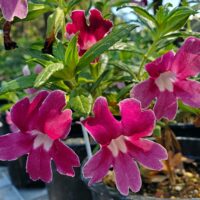
Diplacus (Mimulus) ‘Grape’
Large, open-mouthed flowers in a fruity purple with white throats and edging make the 'Grape' monkeyflower vibrant and showy. The lush, deep-green foliage stays a compact 2-foot or more tall and wide. This unique selection comes from Bay Area horticulturalist and teacher, Kathy Echols. Plant in full sun on the coast to part shade inland and give it good drainage. Best with occasional summer watering and pinching to keep good form. A favorite of hummingbirds and other pollinators. Checkerspot and buckeye butterfly larval food source. Deer resistant.
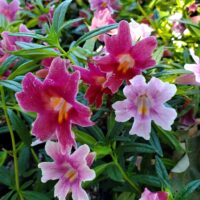
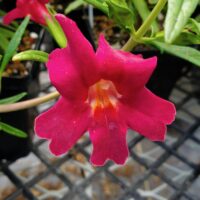
Diplacus (Mimulus) ‘Jelly Bean Dark Pink’
This fine selection by monkeyflower breeder Richard Persoff has large, showy flowers in a dark rosy-pink with orange throats and white edging. As the flowers age, their color becomes paler, creating a dramatic contrast between new and old flowers. Selected for its attractive foliage, floriferousness, and compact habit, it grows to 2 ft. tall and wide. Monkeyflowers are dought tolerant once established, but need good drainage and occasional deep watering to keep the flowers coming. Plant in full sun along the coast and light shade inland. A favorite of hummingbirds and butterflies. Deer resistant.
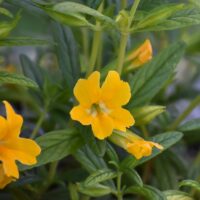
Diplacus (Mimulus) ‘Jelly Bean Gold’
This cheerful monkeyflower boasts impressive displays of sunny yellow flowers throughout most of the year. One of Richard Persoff’s hybrid selections known for their vibrant color and profuse, long-lasting blooms. The lush, evergreen foliage is a compact 2-feet tall and wide, and with periodic pinching back of stems, stays dense and bushy. Monkeyflowers are drought tolerant, but provide them with afternoon shade and occasional summer water to extend the blooming season. Grows even in poor soils so long as it has good drainage. A favorite nectar plant for hummingbirds, bees, and butterflies. The painted lady and checkerspot butterflies use it as a larval food source.
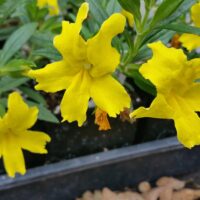
Diplacus (Mimulus) ‘Jelly Bean Lemon’
A selection from the Jelly Bean series of hybrid monkeyflowers with glowing, lemon-yellow, frilly flowers that decorate the branch tips over a long period. Dark green compact foliage grows 18 inches to 2 ft. tall and wide. Valued for their long bloom period, monkeyflowers perform best with good drainage and sun to light shade. Drought tolerant, but some occasional summer water is helpful. Benefits from pinching to produce a nice shape and strong structure to hold the abundant blossoms. Nice in containers too. Highly attractive to bees and hummingbirds. Deer resistant. Formerly: Mimulus 'Jelly Bean Lemon.'
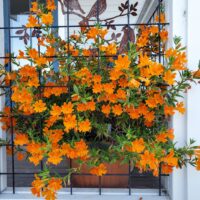
Diplacus (Mimulus) ‘Jelly Bean Orange’
This bright and multi-toned orange selection from the Jelly Bean Series of hybrid monkeyflowers was chosen for its compact habit and heavy display of frilly blossoms. Monkeyflowers are a useful group of free-flowering, drought-tolerant, native sub-shrubs that bloom spring through summer. Provide good drainage, light shade and careful watering. Monkeyflowers do best with an occasional deep watering in the summer and pinching to form good support for the profuse blossoms. Bees, butterflies and hummingbirds work the flowers and the painted lady and checkerspot butterflies use it as a larval food source. Deer resistant.
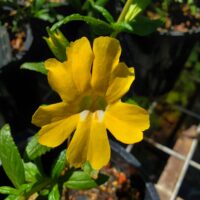
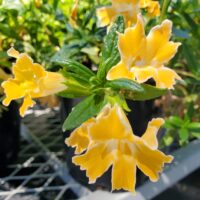
Diplacus (Mimulus) ‘Pamela’
This monkeyflower hybrid offers striking, golden-yellow flowers with white edging. Monkeyflowers are shrubby perennials, beloved for their showy displays of frilly, trumpet-shaped flowers from mid spring through summer. This selection comes from Susan Ashley, a Bay Area grower and instructor of plant propagation. Relatively compact, it will grow 1 to 2 foot tall by 2 foot wide, with narrow, shiny, dark-green foliage. Plant in full sun on the coast to light shade inland, with good drainage. Drought tolerant once established, but occasional deep watering extends the bloom period. Pinching stems helps produce a sturdy structure to hold its abundant blossoms. Highly attractive to bees and hummingbirds, and a larval food source for painted lady and checkerspot butterflies. Deer resistant.
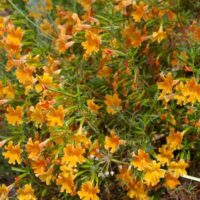
Diplacus (Mimulus) ‘Peach Hybrid’
This dependable monkeyflower hybrid is one of the oldest in our collection. The large, frilly blossoms are a rich peachy-orange and bloom profusely from spring through autumn. Grows 2-3 ft. tall, but benefits from pinching back to keep compact. A drought tolerant shrub that can grow in full sun on the coast to part shade inland. Monkeyflowers require good drainage and respond to occasional watering, but resent drip irrigation systems that deliver water on a regular basis. A larval food source for painted lady and checkerspot butterflies. Deer resistant.
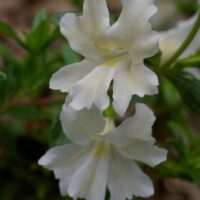
Diplacus (Mimulus) ‘Phil’s White’
The blooms of this monkeyflower hybrid open as a pale ivory-yellow and mature to a cool white. 'Phil's White' is a cross between the lovely White Verity Diplacus (Mimulus) hybrid and Diplacus bifidus from Bowman Lake in the Sierra Nevada (thanks to Ted Kipping). It has proved long-lived in both Fulton and Sebastopol. Foliage is evergreen but benefits from occasional pinching of older stems. This selection has the useful characteristic of sprouting new growth from the base so that old growth can be pruned away. Best with light shade and good drainage. Water occasionally for best blooms. The flowers provide nectar for hummingbirds and butterflies. Deer resistant.
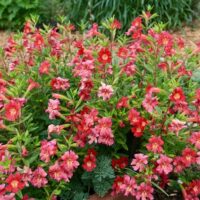
Diplacus (Mimulus) ‘Trish’
Large rosy-pink flowers are the hallmark of this hybrid monkeyflower developed by Richard Persoff. Monkeyflowers are evergreen, drought tolerant sub-shrubs with attractive tubular flowers. This is a restrained form at 1 - 2 ft. tall and wide. Best with good drainage, light shade and careful watering. Give it occasional deep soaks in the summer and pinch the stems to create a good support for the abundant flowers. Bees, butterflies and hummingbirds work the flowers and painted lady and checkerspot butterflies use it as a larval food source. Deer resistant.
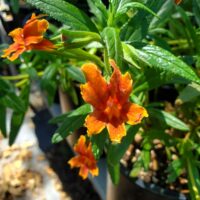
Diplacus (Mimulus) ‘U.C. Hybrid’
A rich-toned hybrid monkeyflower displaying mamalade-orange flowers with contrasting burnished-red throats. Monkeyflowers are 2-3-foot evergreen subshrubs that bloom from spring through summer, and this cultivar is an especially verdant and vigorous form. Does best with good drainage, and prefers afternoon shade inland. Thrives when kept on the dry side with occasional deep summer waterings. Stems can be pinched to form a stronger, denser framework to support its floriferous branches. Hummingbirds, butterflies and bees enjoy the flowers. A larval food source for checkerspot and painted lady butterflies. Deer resistant.
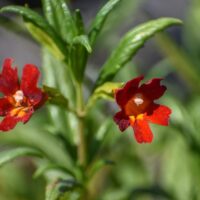
Diplacus (Mimulus) ‘Vibrant Red’
This monkeyflower hybrid sports large, tubular flowers in a vibrant dark red with yellow nectar guides, a color combination highly attractive to hummingbirds and pollinators. The glossy green foliage grows 2 ft. or more tall and wide and is the perfect foil for the showy, late spring and summer blossoms. Pinch back older stems to keep it looking fresh and dense. Monkeyflowers can be planted in full sun to light shade, but prefer afternoon shade inland. Needs good drainage and occasional summer water. A larval food source for buckeye and checkerspot butterflies. Deer resistant.
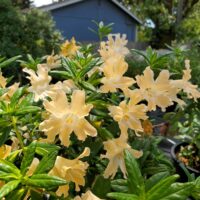
Diplacus (Mimulus) ‘Willits Apricot’
A chance seedling, this apricot-yellow monkeyflower appeared in a Willits garden near plantings of other hybrids. The large, trumpet-like flowers are elegant and buttery-soft in tone. A vigorous and willing grower, the evergreen foliage reaches up to 3 ft. tall and wide. Does well in full sun on the coast to light shade inland, and prefers good drainage. Best with occasional deep watering in the summer and pinching to form good support for the abundant flowers. Bees, butterflies and hummingbirds work the flowers and the painted lady and checkerspot butterflies use it as a larval food source. Deer resistant.
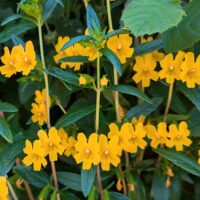
Diplacus (Mimulus) aurantiacus
Sticky monkeyflower is the native monkeyflower species that brightens the hills and coast around Sonoma County. From spring through summer, its profuse yellow-orange tubular flowers decorate evergreen foliage reaching 2-4 feet tall and wide. An unbeatable habitat plant that is highly attractive to hummingbirds. Give it good drainage and keep on the dry side. Thrives in full sun near coast with light shade inland, and benefits from light annual trimming. A larval food source for the common checkerspot and buckeye butterflies. Deer resistant.
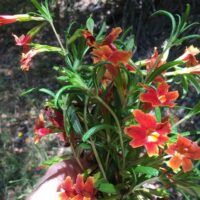
Diplacus (Mimulus) aurantiacus ‘Freezeout Creek’
This stand-out form of our local native monkeyflower was found growing on a slope near a lush redwood forest in western Sonoma County. Instead of the more typical yellow-orange, the trumpet-shaped flowers of 'Freezeout Creek' are larger and boast velvety red petals edged with gold. Monkeyflowers are evergreen sub-shrubs, that grow 2 -4 ft. tall, and bloom profusely in the late spring and into summer. Plant in full sun on the coast to light shade inland and give it decent drainage. Drought tolerant once established but responds to occasional summer water, especially when blooming. Benefits from annual pruning and pinching. The flowers are pollinated by bees and hummingbirds and are a host plant for checkerspot and buckeye butterflies. Deer resistant.
Diplacus (Mimulus) aurantiacus ‘Mattole Point’
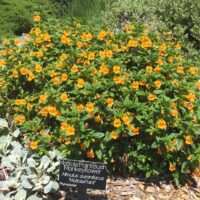
Found along the Lost Coast near the mouth of the Mattole River by Mark Moore of the Humboldt Botanic Garden, this fine selection of our native sticky monkeyflower has particularly beautiful evergreen foliage and a compact habit with glossy, dark-green, deeply veined leaves. The abundant orange, tubular flowers are tucked into the dense foliage which grows 2 ft. or so tall and wide. Plant in full sun on the coast to light shade inland and provide good drainage and occasional summer water. Hummingbirds and bees use the flowers and it is a larval food source for checkerspot and buckeye butterflies. Deer resistant.

Diplacus (Mimulus) aurantiacus ‘Rodeo Gold’
This form of sticky monkeyflower offers warm yellow tubular flowers with a golden throat, rather than the more usual orange flowers. This Cal Flora Nursery selection was found in southern coastal Marin County. Evergreen foliage grows roughly 3 ft. tall and wide. Benefits from pinching back of older stems to keep it denser. Plant in full sun on the coast to part shade insland, and provide with occasional summer water. Monkeyflowers are attractive to hummingbirds, butterflies and other pollinators. The checkerspot and buckeye butterflies use it as a larval food source. Deer resistant.
Diplacus (Mimulus) aurantiacus ‘Russian Gulch’
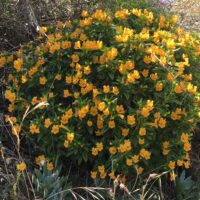
From the bluffs of the Sonoma Coast comes this beautifully compact form of sticky monkeyflower. The shiny, evergreen leaves are spaced to form a tight mound, 2 ft or so tall and wide. From late spring into autumn, cheerful, orange, tubular flowers cover the dense foliage. Makes a colorful, drought-tolerant addition to the garden where it can grow in full sun on the coast to part shade inland. Benefits from pinching to form a strong framework to support the flower display. Requires good drainage and responds to occasional watering, but resents drip irrigation systems that deliver water on a regular basis. Hummingbirds and bees relish the flowers and it is the larval food source for checkerspot and buckeye butterflies. Deer resistant.
Diplacus (Mimulus) aurantiacus ‘Ted’s Yellow’
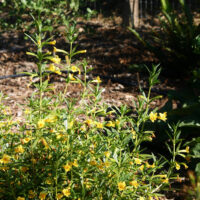
Grows 2 - 3 ft. tall with yellow tubular flowers. Full sun near coast, light shade inland. Good drainage, keep on the dry side and fertilize minimally. Benefits from annual trimming. Larval food source for the common checkerspot and buckeye butterflies. The flowers provide nectar for hummingbirds. Deer resistant.
Diplacus (Mimulus) bifidus ‘Esselen’
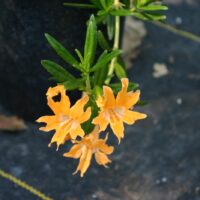
We have been impressed with this fine selection from Big Sur, which offers compact habit, shiny green foliage and broad bright-orange flowers over a long period. Plant in sun to light shade with little to occasional summer water. Bees, butterflies and hummingbirds all work the flowers and it is a larval food source for the Checkerspot butterfly. Deer resistant.
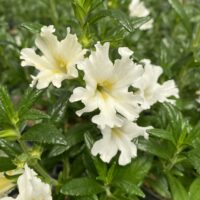
Diplacus (Mimulus) bifidus ‘White’
This elegant monkeyflower has extra frilly, creamy-white, azalea-like flowers, with soft yellow throats. The abundant blossoms stand out against the slender, deep green foliage and bloom over a long period, late spring and into fall. Reaches about 2 ft. tall and 3 ft. wide. Plant in sun to light shade with good drainage and occasional summer water. Hummingbirds, bees and butterflies are all drawn to the flowers and it is a larval food source for checkerspot and painted lady butterflies. Great in a container. Deer resistant.
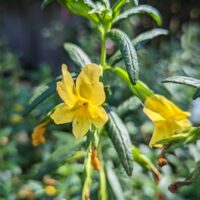
Diplacus (Mimulus) calycinus
From central and southern California, this species is similar to our local sticky monkeyflower but has large, creamy-yellow, trumpet-shaped flowers. Grows 2 - 3 ft tall, and at least as wide, and flowers from late spring through summer. For sun to light shade with good-draining soils and occasional summer water. Flowers attract hummingbirds, bees and butterflies and it is a larval food source for checkerspot and painted lady butterflies. Deer resistant. Previously: Mimulus longiflorus ssp. calycinus.
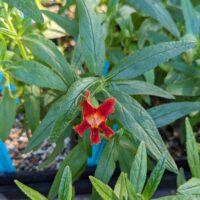
Diplacus (Mimulus) longiflorus
Hummingbirds love the abundant deep red flowers of this stand-out monkeyflower. Hailing from Southern California and growing 2 -3 ft. tall, and at least as wide, this drought-tolerant, floriferous shrublet blooms late spring into fall. Plant in sun to light shade with good drainage and occasional summer water. Besides hummingbirds, other pollinators will be attracted to the flowers, and the foliage is used by checkerspot and painted lady butterfly larvae. Deer resistant.
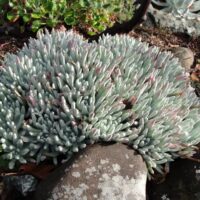
Dudleya ‘Frank Reinelt’
The beautiful and rarely offered Dudleya will form dense mounds 6" - 8" tall with silvery, finger-like leaves, sometimes developing a purple-red blush. Slender stalks appear in late spring and display star-like flowers of soft yellow up to a foot above the foliage. They make handsome specimens in a rock garden or perform as a striking groundcover up to 2' wide mixed with other coastal bluff plants like red buckwheat, seaside daisy, and sea thrift. Great in a container or planted under manzanitas amongst rocks. Needs good drainage and little water once established. Full sun near the coast, but light shade inland.
Dudleya ‘Seedlings from ‘Frank Reinelt’
These seedlings from the beautiful Dudleya ‘Frank Reinelt’ will form dense mounds 6 - 8 inches tall with silvery finger-like leaves. They make handsome specimens in a rock garden or perform as a striking groundcover in mass plantings mixed with other coastal bluff plants like red buckwheat, seaside daisy, and sea thrift. Avoid over-watering and control snails. Full sun to light shade with good drainage.
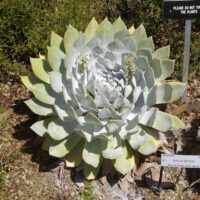
Dudleya brittonii
A Baja California native. Useful and very dramatic in containers or well-drained rock gardens. Likes a protected and sunny microclimate where cold air and winter wet can drain away. Enjoys a little afternoon shade in hotter climates. Develops up to 1 1/2 ft. wide rosettes with fleshy chalk-covered leaves. Yellow flowers sit atop tall stalks in late spring and early summer.
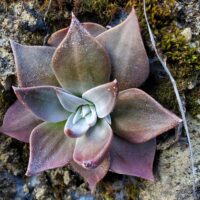
Dudleya cymosa
This charming succulent is in native to California where it grows in between rocks on inland cliffs in sun or bright shade. Best in the garden in a rock wall or terra-cotta pot with some afternoon shade. Height in flower is under one foot. The yellow to orange flowers are attractive to hummingbirds. Occasional to infrequent water in the ground. In pots, let dry out between waterings.
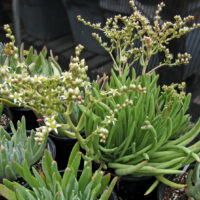
Dudleya edulis
Native to rocky slopes and ledges below 3900’ in Southern Coastal California, the Peninsular Ranges, and Northern Baja California. This Dudleya forms clustering rosettes of dainty, light green, pencil-like leaves. In summer, tall stalks of fragrant, pale yellow flowers rise high above the foliage. Growing about a foot tall (with flowers) by one foot wide. Plant in well drained soil and cool full sun to part shade inland. A delicate accent in a rock garden or amongst coastal plants, also fine in containers. Known as “mission lettuce” for its fleshy raw leaves, once considered a delicacy.
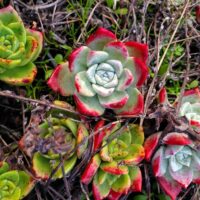
Dudleya farinosa
Native to sea bluffs in central and northern California. Rosettes of fleshy leaves are chalky grey or bright green and often red tipped. Candelabra-like clusters of light yellow flowers on thick stalks appear in summer. Provide part shade away from the coast. Excellent for rock garden, walls or containers, where good drainage and a little summer water can be provided.