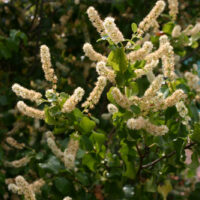
Prunus ilicifolia ssp. ilicifolia
Hollyleaf cherry is a large, evergreen shrub that can grow more than 15 feet tall and wide, but is easily pruned to be more compact. This adaptable foothill native can be clipped into a formal hedge, pruned to be treelike, or left to its own natural gumdrop-shaped habit. Often it is used for background or screen plantings. Glossy, holly-like leaves are accompanied by showy displays of creamy-white flowers in narrow spikes from late spring to early summer. Plant in full sun to very light shade. Looks best with occasional deep waterings, but can tolerate very dry conditions once established. Although it requires good drainage, it is tolerant of heat, drought, wind and oak root fungus. An excellent habitat plant, offering food and cover for wildlife. Birds enjoy the small reddish-purple cherries. Generally deer resistant.
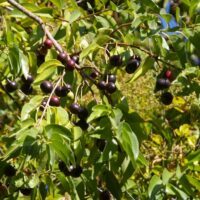
Prunus ilicifolia ssp. lyonii
This subspecies of our native cherry comes from Southern California and can be grown as a large shrub or trained into a small tree. The Catalina cherry is evergreen, with soft, glossy leaves and without the toothed leaf margin of our more local hollyleaf cherry. Gorgeous, creamy-white flower clusters make a showy display in spring. The purple-red fruits are edible, but are mostly preferred by wildlife. At 20-40 feet in height and slightly narrower in width, it is also larger than the hollyleaf cherry, but can be pruned to 8-10 feet. Its dense foliage makes an excellent hedge. Does best in well-drained soil with occasional deep watering once established. The flowers are adored by pollinators. Black-headed Grosbeaks, Cedar Waxings, Western Tanagers, and many other bird species love the cherries, which offer an excellent fall-migration food source.
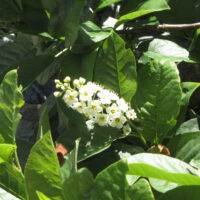
Prunus virginiana v. demissa
Large, deciduous shrub or small tree with red-purple bark and dark green foliage. Growing 8 foot or more tall and spreading slowly to form a thicket. Striking racemes of fragrant white flowers in the spring followed by dark red fruits which can be sweet but astringent. Foliage can take on nice fall color before dropping its leaves. Fabulous habitat plant drawing bees, butterflies and other pollinators to its flowers. Birds, especially bluebirds, adore the fruits and are known to swoop in and finish them off quickly. Where summers are hot, light or part shade is best, with regular to occasional water once established. They often grow where there is seasonal moisture in the spring, but somewhat dry as the season progresses.
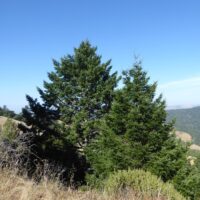
Pseudotsuga menziesii
We are not currently growing this plant due to flammability and reduced demand.
Ptelea crenulata
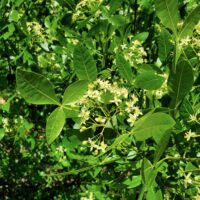
This interesting California endemic deserves wider use in California gardens. Hoptree is a deciduous, large shrub/small tree, growing 6 - 15 ft. tall, in the citrus family. Native to hot, interior coast ranges and the Sierra Nevada foothills, often growing in canyons where residual moisture can be found. Glossy, green, fragrant, trifoliate leaves with panicles of small creamy-white flowers decorate the branch tips in spring. Handsome, circular, flattened, fruits which look like hop seeds, start out green and age to tan and may hold on after the leaves have fallen in the autumn. Plant in full sun to light shade with occasional, deep summer watering. The fragrant flowers are attractive to a variety of pollinators including butterflies. A larval host for the two-tailed swallowtail butterfly.
Quercus agrifolia
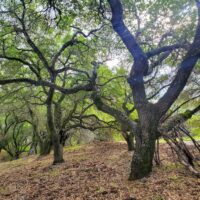
A beautiful and stately evergreen oak, native to many plant communities from Mendocino County south to Baja. One of the fastest growing California oaks and a versatile landscape subject as long as space allows. Young trees have a dense rounded canopy covered with thick, dark green, oval and convex leaves with spiny margins. Smooth gray bark becomes furrowed with age. Flowers are produced on short yellow hanging catkins followed by long tapered acorns. In time, develops a magnificent architecture with broad spreading branches. Planting native oaks provides beauty, shade, food and cover to a dazzling array of wildlife. Plant in sun to light shade. No additional summer water required once established.

Quercus chrysolepis
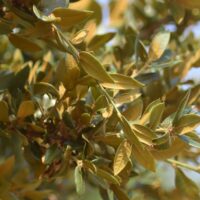
A handsome evergreen oak with a rounded, spreading crown, 20 - 60 ft tall and wide. The leaves of its broad, low canopy are dark-green and shiny with fuzzy gold or silver hairs on the underside. Native from Oregon to Baja, it is the most widely distributed oak in California. Often grows near creeks, but requires only occasional water. Plant in full sun to light shade where it will be drought tolerant once established. A good choice for bank stabilization. Like other oaks, it is habitat powerhouse, offering food and cover for a huge variety of wildlife.
Quercus douglasii
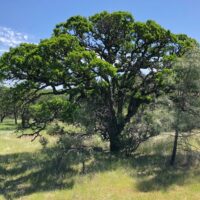
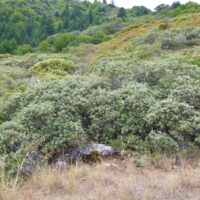
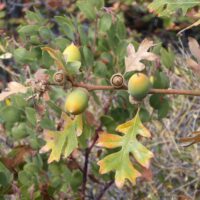
This is the oak of California’s interior, where hot and dry summer conditions prevail. A medium-sized oak, growing 20 to 50 feet tall, The canopy is compact and round with bluish-green lobed leaves. The acorns are oval shaped with shallow caps. Grows slowly but is long lived. A well sited oak is a gift to future generations of humans as well as a myriad of wildlife. Plant in full sun where it will be extremely drought tolerant once established.
Quercus kelloggii
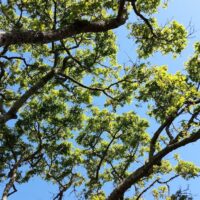
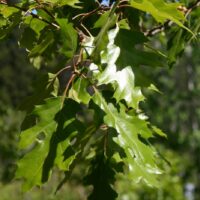
Beautiful in all seasons, the native black oak makes a fine specimen. Found mostly in foothills and low mountains away from the immediate coast, often in association with conifers, from California to Oregon. Growing 35 - 80 ft tall, this graceful, deciduous tree starts the spring with gorgeous, rosy-pink new growth. The soft pink leaves soon mature to a lustrous, shiny, dark green and are deeply lobed with pointed tips. Gold-green catkins dangle from the branch tips in the spring, leading to plump acorns, set deep in their scaly cups. In the autumn, the bold, leathery leaves take on golden hues before they fall. Oak trees are the ultimate habitat plant, offering food and cover for a myriad of species, including invertebrates, mammals and birds. Plant in full sun to light shade where it will be drought tolerant once established.
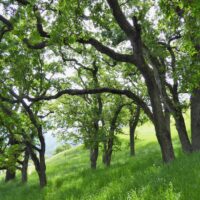
Quercus lobata
This majestic oak once covered the Santa Rosa Valley and many other fertile valleys throughout the state. Becomes large and picturesque with long drooping branches and beautiful thick, checked bark. Best in deep soils with room to develop. Wonderful planted for wildlife. Deciduous, long lived. Oaks are some of the greatest trees for birds. Oak titmice, acorn woodpeckers, and many other species utilize them for nest sites, cover, insects and acorns.
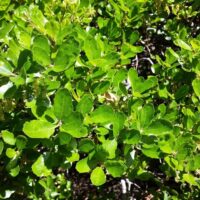
Quercus tomentella
The rarest of all California oaks, an ancient relict of the mainland, now confined to the Channel Islands, off the coast of southern California. Island oak is a small evergreen tree with a rounded canopy, 25 to 40 foot tall. Beautiful dark-green, shiny, leathery leaves with prominent parallel veins are edged with widely spaced teeth. Whitish woolly hairs cover the growing tips, undersides of leaves, and the caps of the 1 inch long acorns. A natural for gardens with coastal influence where it will be drought tolerant once established. Tolerant of many soil conditions, but attains full stature in deeper soils in sheltered locations. Oaks provide beauty, shade and food and cover for a wide array of wildlife.
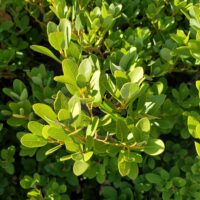
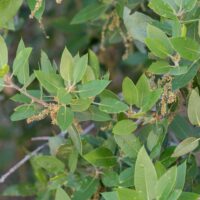
Quercus wislizeni
Typically more compact in stature than the coast live oak, this evergreen oak has similar dark-green, leathery leaves, though often narrower and flatter. A native of dry foothills, the interior live oak has a range that extends throughout much California, and is the dominant live oak in the western Sierra-Nevadas. While it can flourish in the shade, it may remain shrublike. In full sun, its densely-foliated canopy has a pleasingly broad, rounded habit. This adaptable oak takes inland heat, and once established is drought tolerant and generally deer resistant. It tolerates clay, but does best in well-draining soils. Like other oaks, it’s a great habitat plant that supports a wide range of wildlife.
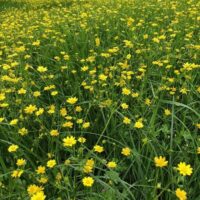
Ranunculus californicus
Cheerful harbinger of spring, this western native grows in vernally moist sites in a number of plant communities throughout California. Easy to grow perennial, sports bright green succulent foliage topped with slender stems 1 to 2 ft. tall and wide. A profusion of shiny, bright yellow blossoms bloom freely until soil dries out. Goes dormant with drought, returning in spring, often reseeding. Full sun to light shade. Excellent early pollen and nectar source, attractive to bees and other beneficials.
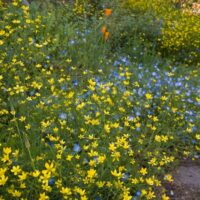
Ranunculus occidentalis
Native to open woodlands and meadows, this buttercup often occurs under deciduous oaks and buckeyes or on edges of forests. Perennial, with basal foliage, the flower stems rise 12 to 20 inches with bright yellow shiny petals. Has been surprisingly adaptable. Does fine with moderate summer irrigation, where it stays evergreen and long blooming. Once established can be allowed to go summer dry, where it will go dormant after setting seed, and returning with the winter rains.
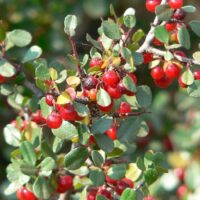
Rhamnus crocea
An under-used evergreen shrub native to chaparral, woodland, and coastal-sage scrub communities in California. Spiny redberry can grow up to 6 feet tall and wider, but is typically in the 2 - 4 ft. height range, spreading to 6 ft. or more across. Small, leathery, dark-green ovate leaves give this tough shrub a delicate look once established. The flowers on both male and female plants are inconspicuous, blooming from late winter into early spring. Female plants produce sporadic, jelly-like red berries. Great for dappled light under oaks, or a dry, shady woodland slope with California fescue. Can tolerate more sun near the coast, but prefers afternoon shade inland. Drought-tolerant once established. Larval host for a multitude of butterflies and moths, including the pale tiger swallowtail butterfly, Ceanothus silk moth, and Hermes copper butterfly. Deer resistant.
Rhamnus ilicifolia
A handsome evergreen shrub with small, dark green, leathery, serrated leaves. Found in the foothills and mountains of southern and central California, the Sierras and west of the Sacramento Valley up to 3,500 feet. Slow-growing, reaching 6-10 feet tall and wide, with a somewhat open, upright habit. Male and female plants are separate, producing inconspicuous yellow-cream flowers from spring into early summer. Female plants produce sporadic, gelatinous red fruits. Hollyleaf redberry can be planted in full sun to shade, but prefers a bit of relief from the afternoon sun in inland sites. It requires decent drainage and is drought-tolerant once established. Larval host for the pale swallowtail butterfly. Reportedly deer resistant.
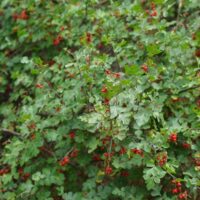
Rhus aromatica
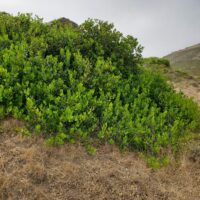
An arching, mounding native shrub related to sugar bush and lemonade berry. Early spring brings a profusion of soft yellow flowers followed by orange-red fruits relished by wildlife. The leaves turn shades of yellow, orange and red in the fall. Plant in sun to light shade where it is drought, cold and heat tolerant. Useful addition to the naturalistic garden, as a shrubby groundcover, along seasonally moist streams, and for erosion control. Used by the native people for basketry.
Rhus integrifolia
This sturdy native shrub or small tree is highly valued for its evergreen foliage and as a source of food for birds, bees and butterflies. Round, serrated, leaves, flatter than those of the sugar bush, cover this plant from head to toe. In late winter to early spring, white to pink flower clusters emerge, followed by sticky, reddish fruits. Ranging in height and width from 6 to 20 ft., lemonade berry is very tolerant of pruning, either into a small tree or a low hedge. Cold hardy to about 20 degrees. Plant in full sun to part shade. Will be very drought tolerant once established. Fire resistant. Deer resistant.
Rhus ovata
Handsome evergreen shrub native to dry slopes away from the coast in Southern California, Baja, and Arizona. A durable shrub thriving in hot, rocky conditions in full sun to part shade where it will be completely drought tolerant once established. Grows 6 - 10 ft. tall and wide. A profusion of dense flower clusters are rosy tinted in bud opening to white with a pinkish blush. Small reddish fruits follow that are coated with a sugary secretion that tastes lemony. Excellent subject for hot, dry inland conditions. Good for birds, bees and butterflies. Fire resistant. Deer resistant.
Ribes aureum
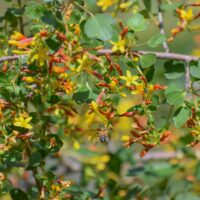
A vigorous deciduous shrub with masses of cheerful yellow blooms that appear in early spring. The light green foliage returns in late winter followed by delicate clusters of bright yellow tubular flowers that mature to a reddish-orange. Makes a wonderful addition to any habitat garden. Hummingbirds and bees adore the flowers, and the golden berries attract birds. Tolerates a variety of conditions from creeksides to dry woodland foothills to higher elevations - and even snow. Grows 6 to 8 ft. tall and wide. Where it finds water, it can spread by suckers, but is highly amenable to pruning. Adaptable to sun or shade, but does best with afternoon shade and moderate to occasional summer water.
Ribes divaricatum var. pubiflorum
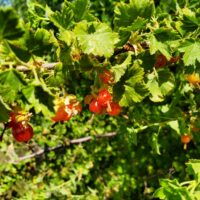
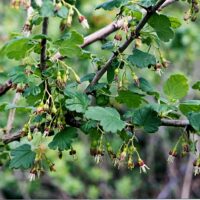
Native to coastal scrub, moist woods and shady canyons of the Pacific coast from British Columbia south through much of coastal California. This gooseberry is perhaps the most tasty of all of our native Ribes. The berries have the added benefit of being free of thorns. Forms an arching shrub 3-6 ft. tall and a bit wider with thorns at the leaf nodes. The tiny flowers are composed of reddish sepals and white petals that dangle beneath the branches and are attractive to hummingbirds. The small, blue-black berries are relished by birds. Plant in light shade with some summer moisture. Will tolerate full sun near the coast. Useful as a barrier, hedgerow or habitat plant where it provides excellent food and thorny cover for birds.
Ribes indecorum
Native to Southern California chaparral and coastal scrub plant communities from Santa Barbara County to Northern Baja. This vase shaped deciduous shrub features thick, aromatic, scalloped leaves and grows 6 feet or so tall and wide. Small clusters of white flowers cover the stems in November and attract hummingbirds, bees and butterflies. The fruits that follow are very appealing to birds. Plant in sun to light shade. Little to no summer water is required once established. While this currant is often summer deciduous, a little extra water will help it to retain most of its leaves all year long.
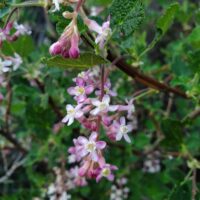
Ribes malvaceum
Chaparral currant is a tough and durable native shrub 5 to 8 ft. tall. This deciduous shrub will grow in full sun to light shade and is quite drought tolerant. Flowers early, often midwinter with dangling clusters of pink blossoms. Good early nectar source for hummingbirds. Berries attract many birds including grosbeak and mockingbirds.