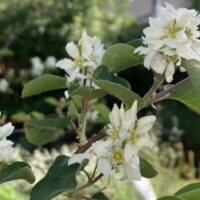
Amelanchier alnifolia
A common native shrub or small multi-trunked tree often found growing along seasonal streams. Serviceberries provide a touch of autumn color where the leaves turn a lovely butterscotch yellow. The white spring flowers are followed by dark blue-purple fruits coveted by band-tailed pigeons in the wild. Sun to partial shade. Moderate to infrequent water. Many butterflies use this species as a larval host, such as the California hairstreak and the Ceanothus silkmoth. Grows well in a large container.

Berberis (Mahonia) aquifolium
This attractive, western native evergreen has a long history in cultivation for good reason. Erect stems rise 4 to 7 feet or more tall and wide, spreading slowly by underground rhizomes to form dense clumps. Bronzy-red new growth gives way to dark-green, glossy leaves with spiny margins that are prickly to the touch. Cold winters can darken the foliage with purple-red tones. Late spring brings clusters of bright yellow, sweetly scented flowers. Edible blue-black fruits follow and are pretty and tasty. A useful and adaptable shrub in a hedge or a shrubby border. Takes full sun to part shade. Performs best with some afternoon shade in hot areas and moderate to infrequent water. A great habitat plant which provides cover, nectar rich flowers and fruits relished by all. Deer resistant.
Claytonia sibirica
This native perennial with white to pink candy-striped flowers seeks shady, moist conditions. Our form is from Sonoma Coast and has particularly pink flowers. Related to miners lettuce, candy stripe produces dark green, succulent, edible leaves in low rosettes. Blooms over a long period beginning in spring and will frequently reseed. A sweet, spreading, low ground cover for a shady area with regular moisture. A charming and colorful addition to the forest garden, combining beautifully with ferns, wild ginger and false Solomon’s seal.
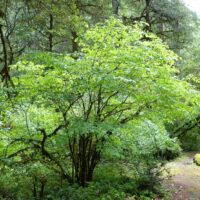
Corylus cornuta ssp. californica
Western hazelnut is a handsome, open, multi-stemmed shrub native to forests from Santa Cruz northwards in the Coast Range, and from Sequoia northwards in the Sierra foothills. Winter deciduous with decorative dangling catkins in winter. The soft, somewhat hairy leaves turn yellow in the fall. Small amounts of tasty nuts are produced in late summer and are relished by wildlife and people. Part shade with some moisture, but will tolerate fairly dry conditions once established. Usually grows 6 - 10 ft. tall. Somewhat deer resistant.
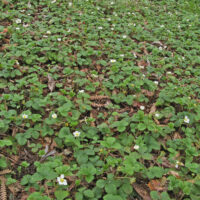
Fragaria vesca
This native woodland strawberry is a great colonizer and can cover a lot of ground in a hurry. Pretty little white flowers are followed by small, tasty, red berries. Tolerates drought but best with a little summer water. Well suited for under oaks and conifers. Said to be deer resistant.
Fragaria vesca ‘Montana de Oro’
A vigorous, heavy blooming selection of woodland strawberry from a coastal canyon at Montana de Oro in San Luis Obisbo County. This easy to grow, carpet forming, ground cover is a great colonizer and stabilizer for lightly shaded areas. Deals well with root competition and thin soils. Pretty little white flowers are followed by small, tasty, red fruits. Often deer resistant.
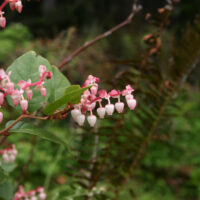
Gaultheria shallon
A handsome evergreen shrub, happiest in fog shrouded coastal zones. Large, leathery, dark green leaves are a gorgeous foil to the loose clusters of white to pinkish urn-shaped flowers. Fat, blue-black berries follow and are relished by wildlife and eaten by people too. Salal can grow tall in moist coastal areas of the Pacific Northwest but usually forms a ground cover 2 - 4 ft. tall and spreading in California. Best with some shade and acidic, humus-rich, moist soils. The foliage is prized for flower arranging. Deer resistant.
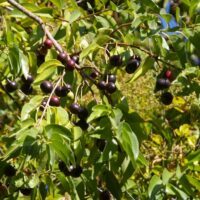
Prunus ilicifolia ssp. lyonii
This subspecies of our native cherry comes from Southern California and can be grown as a large shrub or trained into a small tree. The Catalina cherry is evergreen, with soft, glossy leaves and without the toothed leaf margin of our more local hollyleaf cherry. Gorgeous, creamy-white flower clusters make a showy display in spring. The purple-red fruits are edible, but are mostly preferred by wildlife. At 20-40 feet in height and slightly narrower in width, it is also larger than the hollyleaf cherry, but can be pruned to 8-10 feet. Its dense foliage makes an excellent hedge. Does best in well-drained soil with occasional deep watering once established. The flowers are adored by pollinators. Black-headed Grosbeaks, Cedar Waxings, Western Tanagers, and many other bird species love the cherries, which offer an excellent fall-migration food source.
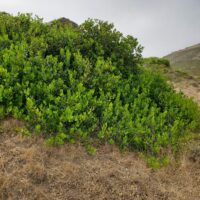
Rhus integrifolia
This sturdy native shrub or small tree is highly valued for its evergreen foliage and as a source of food for birds, bees and butterflies. Round, serrated, leaves, flatter than those of the sugar bush, cover this plant from head to toe. In late winter to early spring, white to pink flower clusters emerge, followed by sticky, reddish fruits. Ranging in height and width from 6 to 20 ft., lemonade berry is very tolerant of pruning, either into a small tree or a low hedge. Cold hardy to about 20 degrees. Plant in full sun to part shade. Will be very drought tolerant once established. Fire resistant. Deer resistant.
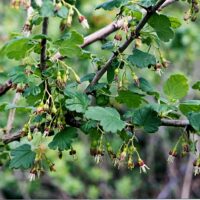
Ribes divaricatum var. pubiflorum
Native to coastal scrub, moist woods and shady canyons of the Pacific coast from British Columbia south through much of coastal California. This gooseberry is perhaps the most tasty of all of our native Ribes. The berries have the added benefit of being free of thorns. Forms an arching shrub 3-6 ft. tall and a bit wider with thorns at the leaf nodes. The tiny flowers are composed of reddish sepals and white petals that dangle beneath the branches and are attractive to hummingbirds. The small, blue-black berries are relished by birds. Plant in light shade with some summer moisture. Will tolerate full sun near the coast. Useful as a barrier, hedgerow or habitat plant where it provides excellent food and thorny cover for birds.
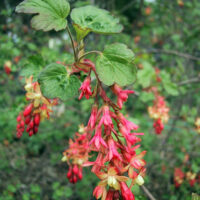
Ribes x gordonianum
A special hybrid flowering currant created in England by Donald Beaton in 1837 between our western U.S. Ribes sanguineum and the central U.S. Ribes odoratum. The fragrant flowers hang in dense dangling clusters in late spring and produce a dazzling color display with warm coppery red on the outside and yellow on the inside. The green maple-like leaves are deciduous. Robust and spreading, this currant grows to about 6 ft. tall and 8 ft. wide. Provide full sun to light shade and give moderate water.
Rubus leucodermis
West coast native found in open or wooded places from British Columbia south to California.Forms an arching deciduous shrub 3-4 foot tall and wide.The stems and back of the leaves are covered in beautiful white blooms. White flowers are followed by tasty red to purple fruits.Tolerates many soil types, preferring some moisture and a little shade from the hottest sun. Excellent habitat plant where the the prickly shoots and thorny canes provide safe cover for birds, flowers attract a wide array of pollinators and tasty berries are a favorite of animals of all sorts.
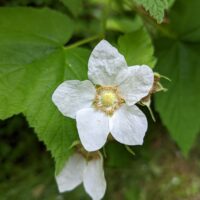
Rubus parviflorus
Thimbleberry is a deciduous native shrub with handsome large pale green velvety leaves. Small clusters of pretty white single flowers in spring and early summer followed by thimble-shaped mild-flavored edible berries in mid summer. Grows 3 - 6 ft. tall and spreading. Needs part shade and moisture.
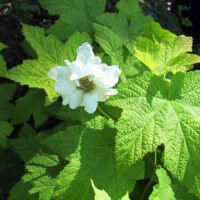
Rubus parviflorus ‘Dr. Stasek’
Bob Hornback found this interesting form of thimbleberry. Instead of the usual single white flowers, this cultivar offers double flowers. The extra petals are a nice touch against the background of large velvety leaves. Thimble-shaped edible berries follow which are mild flavored but sweet and much enjoyed by birds. Grows 3 - 6 ft. tall and spreading. Needs part shade and moisture.
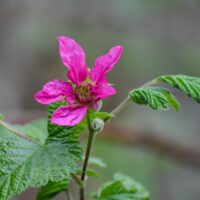
Rubus spectabilis
Native to moist places in and about the woods of coastal Northern California. Forms an upright shrub that arches at the tips, growing easily 6 ft. by 6 ft. Dark green foliage with weak prickles can form a dense hedge. The dark pink flowers resemble small single rose blossoms and are followed by showy orange-red berries that look like salmon eggs. Wildlife relishes the fruit, people too, though they aren’t as tasty as blackberries. Grows best with summer water and some shade.
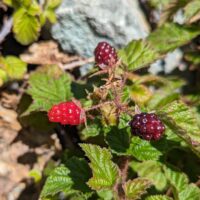
Rubus ursinus
Not to be confused with the weedy non-native Himalaya berry that has taken over acres in northern California. The native blackberry when happy can form a good sized patch, growing to about 3 ft. tall and spreading more than 6 ft. wide depending on available moisture. This thorny, spreading evergreen has excellent habitat value. The berries are widely used as a food source for wildlife. Offers excellent escape and nesting cover and is good for erosion control. People relish the berries and its fruits are highly prized for pies and jam. Best with some shade and moisture, but is drought tolerant once established.
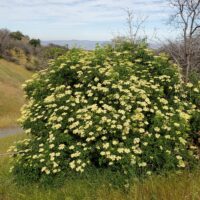
Sambucus mexicana (nigra ssp. caerulea)
Our native blue elderberry, often seen on banks above rivers and streams, or even on somewhat drier slopes. A fast growing deciduous shrub or small tree 8 to 30 ft. tall with pinnately divided leaves. Creamy yellow flowers appear in late spring in flat-topped clusters, followed by blue berries. High on the birds’ favorite list! Ripe berries feed many species of birds. Moderate to infrequent summer water.
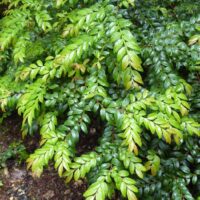
Vaccinium ovatum
A handsome evergreen shrub native to moist forests of the Pacific Coast. Leathery dark green leaves with new growth flushed bronzy-red. Small pinkish flowers in the spring are followed by delectable black berries prized in pies and jams. A slow growing shrub for shady situations or cool sun along the coast with moderate to regular water. Grows 4 - 5 ft. tall and wide or as much as 8 ft. in especially prime locations given time. Flowers provide nectar for hummingbirds and bees, fruit for many species including humans. Fire resistant. Deer resistant.
Vaccinium ovatum ‘Scarlet Ovation’
A round of applause for this cultivar of the evergreen huckleberry, featuring an especially compact habit and stand out bronzy-red new growth. Forms a small, dense shrub, 3 -4 ft. tall and wide. The new growth in the spring is dependably fiery-red, contrasting beautifully with the neat, dark-green older foliage. Small, urn-shaped, pinkish-white flowers are rich in nectar and attract an array of pollinators, including hummingbirds. The small, dark-blue berries are tasty and enjoyed by wildlife and humans. Huckleberries can grow in full sun along the coast, but require some shade in hot areas. Moderate to regular summer water. Fire and deer resistant.
Vaccinium ovatum (Inverness)
This Marin County selection of the evergreen huckleberry was chosen by landscape architect Ron Lutsko for its dense and compact habit. The leaves appear to us to be smaller than usual for this species and spaced more closely together. It has the classic, tasty huckleberries and blooms and fruits readily. Plant in part shade and provide regular to moderate irrigation. Will grow in full sun near the coast. While tolerant of somewhat shadier locations, evergreen huckleberries fruit best with adequate light. Fire resistant. Deer resistant.

Vitis californica
California wild grape is a vigorous deciduous vine, native to watercourses in California and Oregon. Lush foliage on woody vines create leafy draperies in riparian areas. Useful in the garden for trellises, arbors, fences or to spill down a bank. Round green leaves take on nice yellow tones in the autumn. Flowers are very attractive to bees.Fruits are small and seedy but tasty. Excellent habitat value providing food and cover for wildlife.
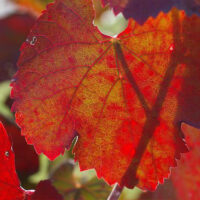
Vitis californica ‘Russian River’
Our own selection of what is likely a hybrid between the native Vitis californica and the European wine grape Vitis vinifera, originating along the Russian River near Rio Nido in Sonoma County. Similar to 'Roger’s Red’ in vigor and heavy fruit production, this cultivar has deeper purple-red fall colored leaves that tend to hold on to the vine longer than the selection 'Roger’s Red'. An adaptable vine, thriving in full sun to light shade with regular to moderate water. Will grow well with far less summer water, though plants in dryish conditions tend to be less rampant. Good habitat plant.
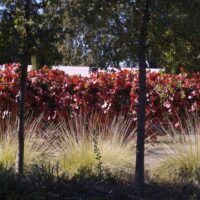
Vitis californica x ‘Roger’s Red’
Selected by Roger Raiche, this cultivar is now thought to be a natural hybrid between the native Vitis californica and the European wine grape, Vitis vinifera. A beautiful and vigorous vine used to cover fences, trellises, arbors, or used as a ground cover. This selection has gorgeous warm red fall color and ample fruit clusters that are small (with seeds), but sweet and tasty. An adaptable vine, thriving in full sun to light shade with regular to moderate water. Will grow well with far less summer water, though plants in dryish conditions tend to be less rampant. Good habitat plant.
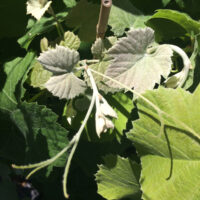
Vitis girdiana
This close relative of Vitis californica is native to southern California where it grows stream side or in moist canyons. Fast growing and heat tolerant, this vigorous vine can climb up to 50 ft. The growing tips, tendrils and new leaves are covered in downy hairs, providing gorgeous silvery colored new growth. Beautiful when allowed to spill and climb over walls or when trained to a fence or arbor. A good choice for hotter inland gardens. The purple-black fruits are highly attractive to birds and other mammals, including humans!