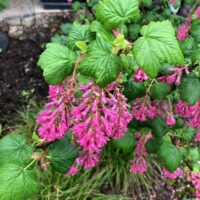
Ribes sanguineum v. glutinosum ‘Heart’s Delight’
A coastal Marin County selection of one of the West's choicest native shrubs. Deciduous, grows 6 ft. tall or more. In early spring it produces long drooping racemes of deep rosy-pink blossoms. Best with light shade inland, humusy soil and some summer water. Hummingbirds love the flowers and the berries attract many birds including robins, grosbeak and mockingbirds.
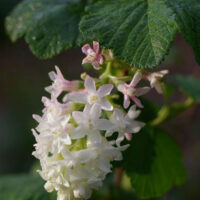
Ribes sanguineum v. glutinosum ‘Inverness White’
Selected by Roger Raiche on Inverness Ridge in Marin County. Distinguished from other white flowering cultivars in that the pure white blossoms develop a rosy cast as they fade. Deciduous shrub about 6 ft. tall by 6 ft. wide. Best with a little shade, woodsy soil and a little summer water. Berries attract many birds including grosbeak and mockingbirds.
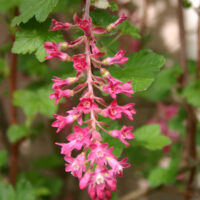
Ribes sanguineum v. glutinosum ‘Monte Bello’
This Cal Flora introduction was discovered in the hills west of Cupertino in the Santa Cruz Mountains. Long clusters of deep pink flowers make this selection of the pink-flowering currant stand out from other forms. In late winter and spring the flowers emerge on bare stems followed by rounded, maple-like leaves. This deciduous shrub has a vase-like shape, reaching a height of up to 10 ft. over time and a width of at least 6 ft. Provide full sun near the coast and light shade inland. Needs moderate to occasional irrigation once established. A great plant for hummingbirds and a wide array of pollinators. Birds enjoy the fruits.
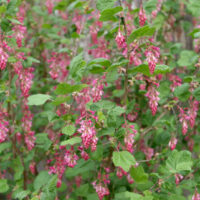
Ribes sanguineum v. glutinosum ‘Tranquillon Ridge’
A Native Sons Nursery selection from Tranquillon Ridge in Santa Barbara County, found growing under a canopy of Bishop pines. Super vigorous and very large, up to 10 ft. tall with extremely long racemes of dark pink flowers in the early spring. The racemes have an appealing shape, tapering to a point at the end of their long pendant flower clusters. Best with some shade even in coastal gardens where it’s drought tolerant. Occasional deep waterings are best in hot inland areas. Berries attract many birds including grosbeak and mockingbirds.
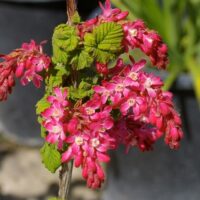
Ribes sanguineum v. sanguineum ‘Barrie Coate’
This selection of red flowering currant is a knock out in bloom. An early bloomer often starting in February with short racemes of nodding clusters of very deep rosy-pink, nearly red blossoms. Clusters of blue-black fruits follow and are enjoyed by birds. This deciduous shrub will grow 6 foot tall by 4 foot wide. Plant in sun to light shade with afternoon shade in hot regions and moderate to occasional summer water. An excellent early source of nectar for hummingbirds.
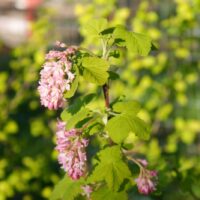
Ribes sanguineum v. sanguineum ‘Brocklebankii’
A distinctive shrub with gorgeous golden foliage on 5 ft. tall stems. Pendulous racemes of pink flowers in early spring just as the leaves are emerging are a favorite of hummingbirds. The leaves will scorch in the hot sun so part shade is best, especially during the hottest time of day. This cultivar prefers even moisture.
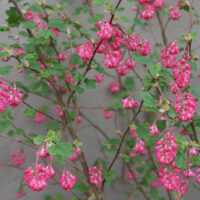
Ribes sanguineum v. sanguineum ‘Elk River Red’
This selection of the red flowering currant is from the Pacific Northwest. A deciduous shrub growing 6 ft. or more tall. Early spring brings eye catching bright rosy-red blossoms in drooping clusters. A wonderful early nectar source for hummingbirds. Plant in cool sun or light shade inland with occasional to moderate summer water. Berries attract many birds including grosbeak and mockingbirds.
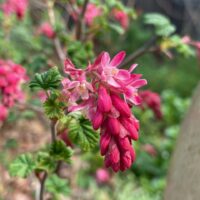
Ribes sanguineum v. sanguineum ‘King Edward VII’
Deep pink flower tassels adorn this native deciduous currant in early spring, providing a vivid splash of color to an awakening landscape. The pendulous flower clusters are followed by scalloped, deep green leaves, creating a useful texture to pair with Iris, Ceanothus and ferns. ‘King Edward VII’ has a very upright vase shape, reaching between 5 to 7 ft. tall and 4 to 5 ft. wide. Provide full sun in coastal climates and bright shade elsewhere, especially in the afternoon. Needs moderate to occasional irrigation. The flowers provide an excellent nectar source for bees, butterflies and hummingbirds while the deep purple fruits are enjoyed by birds. A sturdy selection.
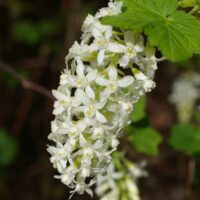
Ribes sanguineum v. sanguineum ‘White Icicle’
This selection of flowering currant is from the University of British Columbia Botanic Garden. Flowers in early spring are pure white on long racemes. Foliage is bright green. Compact habit, 6 - 8 ft. tall. Light shade in hot regions with occasional summer water. Berries attract many birds including grosbeak and mockingbirds.
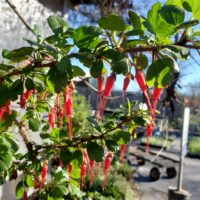
Ribes speciosum
One of California’s showiest gooseberry, blooming in late winter - early spring with charming bright red, pendant, fuchsia-like flowers. The thorny branches are arching and grow 4 - 6 ft. tall and wide. Best with light shade and needs no irrigation once established. Occasional summer water keeps most of the leaves green through the summer, but will go summer dormant with dry conditions. An excellent choice for under native oaks. The flowers attract hummingbirds and the spiny fruits attract many birds including grosbeak and mockingbirds. Deer resistant.
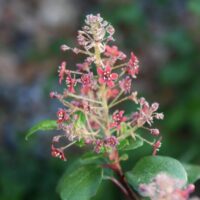
Ribes viburnifolium
Native to Santa Catalina Island, this Ribes is unique for the genus, being evergreen and low growing. Leathery, dark green, glossy leaves with a spicy fragrance on red stems forms a spreading shrubby groundcover to 2- 3 ft. tall. Small clusters of interesting, star-shaped, salmon-pink flowers decorate the arching branches in late winter to early spring, followed by little, red fruits. Requires part shade and is drought tolerant once established. Adaptable to a variety of soil types including heavy clay. Tip pruning is recommended to encourage a dense growth habit. Deer resistant.
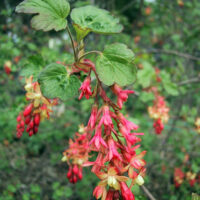
Ribes x gordonianum
A special hybrid flowering currant created in England by Donald Beaton in 1837 between our western U.S. Ribes sanguineum and the central U.S. Ribes odoratum. The fragrant flowers hang in dense dangling clusters in late spring and produce a dazzling color display with warm coppery red on the outside and yellow on the inside. The green maple-like leaves are deciduous. Robust and spreading, this currant grows to about 6 ft. tall and 8 ft. wide. Provide full sun to light shade and give moderate water.
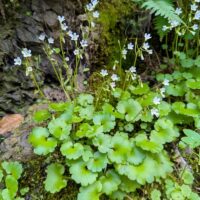
Romanzoffia californica
The California mistmaiden is diminutive, reaching a bit over a foot tall when its dainty white flowers are in bloom. The bell-shaped blossoms appear in winter, perched in clusters on tall, thin stems above lush foliage. Summer dormant until the first autumn rains, this plant is often the first garden greenery to return after a hot, dry summer. At home in the Coast Range from the Santa Cruz Mountains north to Oregon, it requires light shade and decent moisture during the growing season. Allow to go dry when the rains stop. Great for rock gardens and small nooks with excellent drainage.
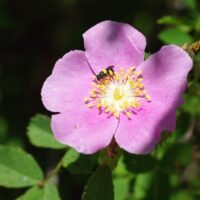
Rosa californica
A thicket forming, deciduous shrub native to riparian zones throughout the state. Fragrant, pink blossoms with yellow centers are followed by attractive red fruits or rosehips. The stems are lined with little thorns and gray-green, pinnately divided leaves. A good screen or living fence, where it will grows at least 5 ft. tall and usually spread wider. Very important for erosion control along streams. This is one of our most popular hedgerow plants due to the cover it provides for foraging wildlife and the value it offers to pollinators and birds. Prefers full sun to light shade and seasonally moist soils, but can go a little drier in the summer. A larval host to several butterflies.
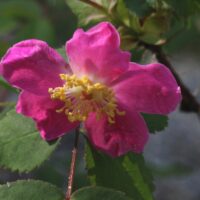
Rosa gymnocarpa
Delicate, native rose of woodlands, growing 3 - 4 ft. tall. Sprinkled with sweetly fragrant single pink flowers followed by small red rose hips. Best in woodsy shade where it tolerates drought. Bees, butterflies and other pollinators are attracted to rose blossoms and the fruits are enjoyed by birds.
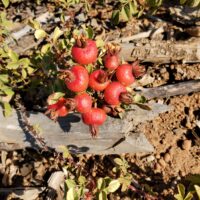

Rubus leucodermis
West coast native found in open or wooded places from British Columbia south to California.Forms an arching deciduous shrub 3-4 foot tall and wide.The stems and back of the leaves are covered in beautiful white blooms. White flowers are followed by tasty red to purple fruits.Tolerates many soil types, preferring some moisture and a little shade from the hottest sun. Excellent habitat plant where the the prickly shoots and thorny canes provide safe cover for birds, flowers attract a wide array of pollinators and tasty berries are a favorite of animals of all sorts.
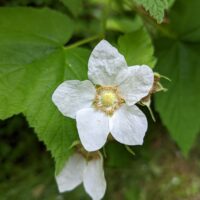
Rubus parviflorus
Thimbleberry is a deciduous native shrub with handsome large pale green velvety leaves. Small clusters of pretty white single flowers in spring and early summer followed by thimble-shaped mild-flavored edible berries in mid summer. Grows 3 - 6 ft. tall and spreading. Needs part shade and moisture.
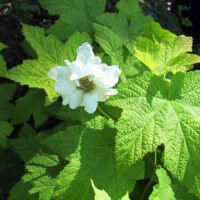
Rubus parviflorus ‘Dr. Stasek’
Bob Hornback found this interesting form of thimbleberry. Instead of the usual single white flowers, this cultivar offers double flowers. The extra petals are a nice touch against the background of large velvety leaves. Thimble-shaped edible berries follow which are mild flavored but sweet and much enjoyed by birds. Grows 3 - 6 ft. tall and spreading. Needs part shade and moisture.
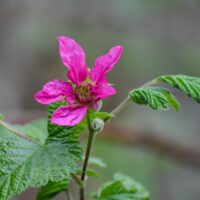
Rubus spectabilis
Native to moist places in and about the woods of coastal Northern California. Forms an upright shrub that arches at the tips, growing easily 6 ft. by 6 ft. Dark green foliage with weak prickles can form a dense hedge. The dark pink flowers resemble small single rose blossoms and are followed by showy orange-red berries that look like salmon eggs. Wildlife relishes the fruit, people too, though they aren’t as tasty as blackberries. Grows best with summer water and some shade.
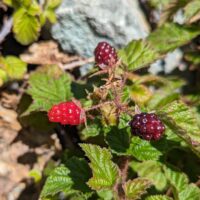
Rubus ursinus
Not to be confused with the weedy non-native Himalaya berry that has taken over acres in northern California. The native blackberry when happy can form a good sized patch, growing to about 3 ft. tall and spreading more than 6 ft. wide depending on available moisture. This thorny, spreading evergreen has excellent habitat value. The berries are widely used as a food source for wildlife. Offers excellent escape and nesting cover and is good for erosion control. People relish the berries and its fruits are highly prized for pies and jam. Best with some shade and moisture, but is drought tolerant once established.
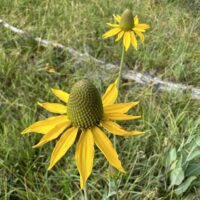
Rudbeckia glaucescens
This uncommon coneflower hails from the Klamath Mountains of northern California and southern Oregon. While similar in flower to the California coneflower, featuring yellowish-brown cones encircled with a skirt of long, yellow petals, this species has waxy leaves tinted a striking blue-gray. The flowers perch atop leafless stalks reaching 3 to 4 ft tall, rising above the large, lance-shaped leaves. A favorite of bees and butterflies. Even though this species normally occurs in serpentine soils, it grows easily in almost any soil type, as long as it is kept moist. Enjoys regular to moderate irrigation and full sun to part shade.
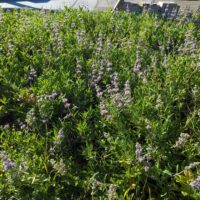
Salvia ‘Bee’s Bliss’
A beautiful native hybrid sage grows around 18 inches tall by 6 ft. wide or more. The handsome gray foliage is topped with a profusion of lavender flowers on long spikes in the spring. Sun, decent drainage, occasional to little water. Deer tolerant. A bee and hummingbird favorite.
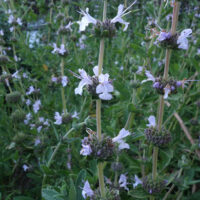
Salvia ‘Calamity Jane’
A cross between Salvia leucophylla and a prostrate form of Salvia mellifera. Forms a fragrant mounding shrub up to 4 ft. tall and spreading, with flower spikes of light lavender blossoms. An excellent choice for a dry sunny bank with little to no summer water once established. Flowers are highly attractive to bees and hummingbirds. Deer resistant.
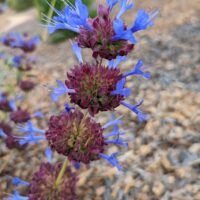
Salvia ‘Celestial Blue’
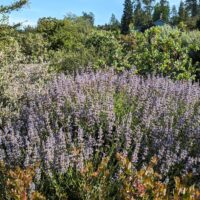
A pollinator powerhouse, this sage attracts hummingbirds, bees and butterflies with its vibrant blossoms. Selected and introduced by Las Pilitas Nursery, thought to be a hybrid between Salvia clevelandii and S. pachyphylla, or perhaps a three way hybrid involving Salvia 'Pozo Blue'. Gray-green, sweetly fragrant foliage, grows 3 to 5 ft. tall and wide. The striking blue flowers are on widely spaced whorls of eye-catching violet-blue. The decorative, architectural seed heads that follow provide food for songbirds. Plant in full sun with good drainage and occasional water. Drought and deer tolerant tolerant.
Salvia ‘Mrs. Beard’
This cultivar has been around since 1965, a chance seedling discovered in a Berkeley garden. A hybrid between Salvia sonomensis and Salvia mellifera, 'Mrs. Beard’ has proven durable and disease resistant. Forms a dense mat of gray fragrant foliage up to 2 ft. tall and 4-6 ft. wide. Spring brings an abundance of tiny pale lavender-blue flowers in ball-like clusters that are highly attractive to bees and hummingbirds. Plant in full sun along coast and light shade in hot inland sites, where it will be quite drought tolerant once established. Deer resistant.
Salvia ‘Shirley’s Creeper’
A vigorous garden hybrid involving the native Salvia mellifera selected by Charlie Christiansen. The cultivar name is misleading. This shrub does not creep exactly but mounds up 4-6 ft. tall and wide. It can be kept lower and more dense by an annual cutting back after flowering. Dark green aromatic foliage is a nice foil for the whorls of white flowers in the spring which are a favorite of bees and hummingbirds. Plant in full sun to light shade. Very drought tolerant once established. Dependably deer resistant.
Salvia apiana ‘Compacta’
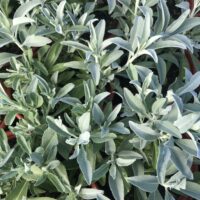
Having all the attributes of white sage, but growing about half the size, topping out at around 3 ft. tall. Gorgeous silver-gray foliage and stately flower stems of white, pollinator attracting blossoms. Heat and drought tolerant, this striking sage makes a wonderful specimen and contrasts beautifully with greener foliage. Plant in full sun with good drainage where it thrives with summer heat and drought. The powerfully fragrant foliage is dependably deer resistant.