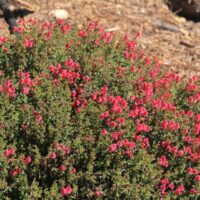
Scutellaria suffrutescens
Sturdy, compact, long blooming perennial growing less than 6 inches tall by 15 inches wide. Deep green foliage and dense growth habit make a tidy foil for the profusion of small rosy- pink snapdragon-like flowers over a long period spring-summer. Highly attractive to pollinators and hummingbirds. Plant in full sun to light shade with occasional water. Drought and heat tolerant. Deer tolerant too.
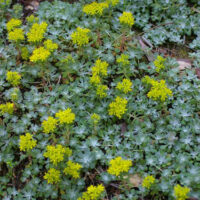
Sedum spathulifolium
A mat forming native succulent often seen on rocky cliffs and shady banks in California’s Coast Ranges and Sierra Nevada north to British Columbia. Small, spoon-shaped leaves form flat rosettes where bright yellow star-like flowers appear in late spring and early summer. A natural for the rock garden or container plantings where they are best with part shade. Very drought tolerant.
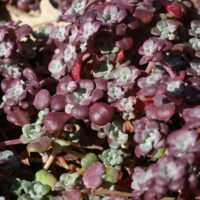
Sedum spathulifolium ‘Purpureum’
This distinctive form of the Pacific stonecrop features purple leaves which turn particularly dark in the winter. Bright yellow flowers are produced in late spring and early summer on short stems up to 4 inches high. This mat forming succulent grows in rocky crevices and shady banks in California’s Coast Ranges and Sierra Nevada north to British Columbia. The small, spoon-shaped leaves form flat rosettes. Needs excellent drainage and some shade, especially in the afternoon. A natural for the rock garden or container plantings where its diminutive nature can be appreciated. Very drought tolerant.
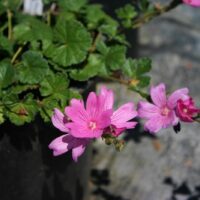

Sidalcea hendersonii
A striking, rare checkerbloom from western Oregon northwards, featuring stalks up to 3 ft high densely clothed in substantial, rich pink flowers. The rounded, scalloped leaves create low mounds on the ground. Will slowly spread to from small drifts, blending beautifully with other showy perennials in the moist garden bed. Enjoys full sun to light shade. If the spent blooms are removed, it can bloom from spring through to autumn! Attractive to bees and butterflies. Works well in a container.
Sidalcea malviflora
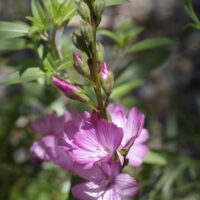
Beautiful spring blooming native perennial found in moist meadows along the coast and inland from Southern Oregon to the Mexican border. Reliable and easy to grow, and an excellent addition to a grasslands or meadow planting. Grow in full sun to partial shade where it thrives with moisture and tolerates moderate to little water once established. With drought will go summer dormant. Light to dark pink, small to large flowered; they are all beautiful. A nectar and larval food source for the West Coast Lady, Painted Lady, Common Checkered Skipper, and the Gray Hairstreak butterflies.
Sidalcea malviflora ‘Palustre’
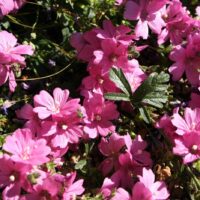
This selection of our native checkerbloom has particularly large, saturated pink flowers held on stems which spread across the ground. Leathery, dark-green, scalloped leaves form a carpet on this small-scale groundcover. Plant in full sun to light shade and provide moderate irrigation. Butterflies nectar on the flowers and also use checkerbloom as a larval host plant. West Coast lady, painted lady, checkered skipper and gray hairstreak butterflies all depend on this species to support their caterpillars.
Sidalcea malviflora ssp. patula
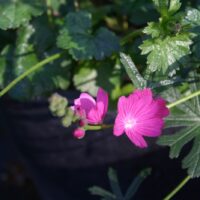
Bright, rose-pink flowers line foot long stems on this rare checkermallow from northwest California. Spreading mats of fuzzy, round leaves provide an appealing backdrop for the colorful flowers. Enjoys full sun to part shade. Protect from the hot afternoon sun in inland climates. Provide moderate to occasional irrigation. An excellent plant for bees and butterflies.
Sidalcea malviflora ssp. virgata
This beautiful, perennial mallow can be found in grasslands, meadows, and roadsides of Oregon. Forms a low rosette 1 to 2 ft. wide with trailing branches and rounded, lobed leaves. The showy, hollyhock-like flowers are arranged on upright spikes, ranging from light to deep pink and bloom for a long period beginning in late spring. Plant in full sun to light shade with moderate to occasional water once established. Lovely in meadow plantings with other perennials, bulbs and grasses. An important nectar source for bees, butterflies and other beneficial insects and a host plant for several butterfly species.
Sidalcea reptans
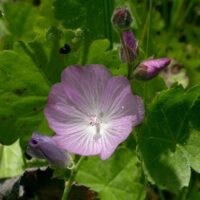
From moist meadows in the Sierra Nevada comes this charming checkerbloom groundcover. In early summer, soft-pink, cup-shaped flowers perch along stems up to 2 feet high. Thick, bright-green leaves with scalloped edges carpet the ground. Plant in full sun to light shade and don’t let them dry out completely. The Sierra checkerbloom is an easy-to-grow mountain species which combines nicely with umbrella plant, rushes and Dunn’s lobelia. Great in a container, too!
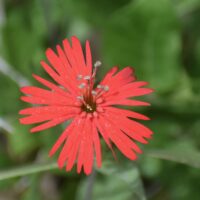
Silene laciniata ssp. californica
Native to open woods from Southern California north to Oregon, this native perennial is a knock out in bloom. Late spring and early summer bring brilliant, deeply lobed scarlet petals over the low growing mound of foliage 1-2 feet tall and about as wide. Best suited for well drained soils in lightly shaded settings where water can be withheld once plants begin to go dormant. A top notch rock garden subject and hummingbird favorite.
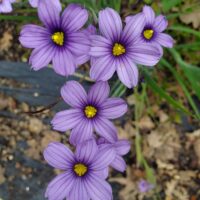
Sisyrinchium bellum
A beloved native perennial wildflower with grass-like foliage and six-petaled spring blossoms that range from blue to purple with occasional pure white forms. Grows 6 - 12 inches tall in small clumps where it is useful in meadow or grassland plantings as well as mixed borders. Sun to partial shade, with moderate to infrequent summer water. Goes summer dormant in dry gardens. Does well in heavy soils and often seeds about when happy.
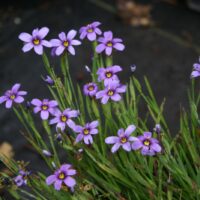
Sisyrinchium bellum ‘Dwarf’
While we’re a little unsure about this selection’s origins, we do know it’s an AMAZING bloomer and an easy garden plant! In spring and into summer, deep blue-purple flowers with yellow centers cover this very dwarf blue-eyed grass which stays under 6 inches tall. Very narrow, iris-like leaves slowly increase to form a small clump. Plant in full sun to light shade and provide moderate to infrequent irrigation. If allowed to go dry in summer, it will go dormant, only to re-emerge with the winter rains. Deer resistant.
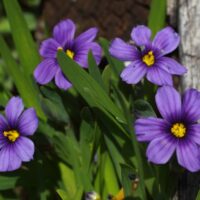
Sisyrinchium bellum ‘Rocky Point’
A vigorous selection of dwarf blue-eyed grass discovered on Rocky Point south of Carmel in Monterey County and introduced by Native Sons Nursery. Robust, rich green clumps of wide, iris-like leaf blades 4 - 6 inches tall feature vibrant blue-purple flowers with yellow centers. A great rock garden item. Plant in full sun to part shade. This spring bloomer will go semi-dormant in summer if allowed to go somewhat dry. With moderate irrigation it will be evergreen and have an extended bloom preiod. Deer resistant.
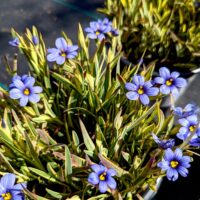
Sisyrinchium bellum ‘Stripey’
An eye-catching cultivar of blue-eyed grass, forming compact clumps of narrow variegated foliage. The gray-green blades have pale yellow margins growing around 6 inches tall and a foot or so wide. The chubby clumps of narrow, variegated leaves are topped with cool blue flowers in the spring. Perfect rock garden item or container accent for sun to light shade with moderate water. Deer resistant.
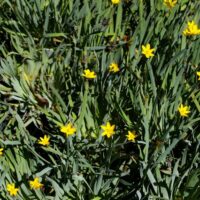
Sisyrinchium californicum
Native mostly to coastal areas where this easy perennial thrives in moist locations. From spring through to the end of summer, the bright yellow flowers rise above narrow, pale-green, iris-like leaves. Grows 6 inches to a 1.5 ft tall and at least a foot wide. Plant in sunny areas with regular water. Reseeds readily. Occurs from San Luis Obispo County north to British Columbia.
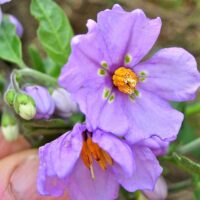
Solanum umbelliferum
A perennial subshrub from chaparral and oak woodland plant communities, often growing on the edge where they may receive some relief from the full sun. Grows quickly, to as much 3 ft. high with pale green oval leaves on green stems, often sprawling wider. Blooms over a long period with a multitude of blue-purple saucer shaped flowers followed by small tomato-like fruits. Plant in full sun to partial shade with little to no summer water. May go summer deciduous with drought, becoming twiggy and leafless until the rains return. All parts of the plant are poisonous which should make them dependably deer resistant.
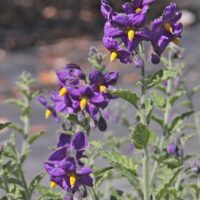
Solanum xanti ‘Mountain Pride’
Outstanding selection by Carol Bornstein from the hills surrounding Santa Barbara,following the wildfires of 2008. Chosen for its particularly dark purple flowers, this subshrub grows 3 ft. tall and at least as wide. Clusters of rich purple one inch blossoms with bright yellow stamens bloom over a long period but heaviest in spring. In nature it is often found growing along the borders of coastal scrub,chaparral and woodlands. Plant in full sun along the coast with a little shade inland, where it will be drought tolerant once established. Prune to promote bushy habit. A good container subject. Should be deer resistant as all parts of the plant are poisonous.
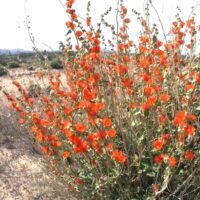
Sphaeralcea ambigua
Native to desert plant communities, apricot mallow is a showy evergreen shrublet growing 2-4 foot tall and wide. Soft-green, woolly, scalloped leaves provide the foil for long wands with an abundance of small hollyhock-like flowers in delicious shades of orange. Plant in full sun with good drainage and occasional summer water. Adaptable, tolerating cold, dry conditions but not heavy wet soils. When happy can bloom for months- trim back flowering stems after bloom for repeat performance. A beautiful addition to the dry sunny garden, ideal for inland gardens. Relatively short lived but grows rapidly and occasionally reseeds. Honeybees, native bees and hummingbirds are attracted to its flowers.
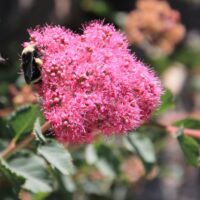
Spiraea densiflora ‘Trinity Rose’
This cultivar hails from the Trinity Alps in northwestern California. A neat looking deciduous shrub growing 2-3 foot tall and a bit wider with a compact habit and pretty bluish-green leaves. Early summer brings flat topped clusters of rosy-pink flowers on the branch tips. Foliage often takes on nice yellow tones in the autumn before losing its leaves. Plant in sun to light shade with regular water. Flowers attract butterflies.
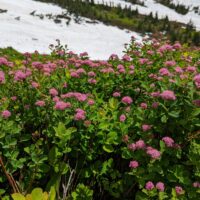
Stachys bullata
A native perennial from the mint family, found primarily near the coast from San Francisco southward, where it inhabits oak, pine and fir woodlands. Medium-green leaves are softly fuzzy with scalloped edges, growing around 2 ft. or more tall and spreading by underground rhizomes to form a colony. Blooming spring through summer, with lavender-pink tubular flowers in whorls, which attract bees, butterflies and hummingbirds. Tends to grow in somewhat drier areas, but responds well to moisture and also tolerates inundation. A natural with rushes, ferns and snowberries. Useful for partly shaded bioswales and oak/mixed conifer woodlands. The underground rhizomes make it a good choice for erosion control. Deer resistant.
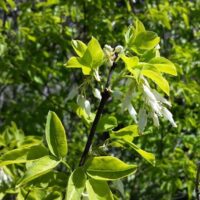
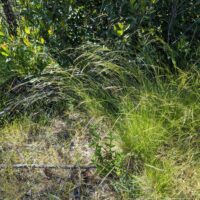
Stipa (Nassella) lepida
The native foothill needlegrass is a fine-bladed, medium-sized, perennial bunchgrass perfectly adapted to our Mediterranean climate. Growing vegetatively during the cool season and flowering in mid to late spring, going dormant with the dry of summer. Tufts of fine-textured blades 8 - 12 inches tall, give rise to slender, graceful flowering stems, 2 ft or more tall with panicles of silky awns which shimmer when back lit. Well suited for the dry garden, open woods, meadows and rocky slopes. Easy to grow, disease and pest resistant, tolerating more shade than other Stipa species. A strong re-seeder and deer resistant. Host plant for a number of butterflies. Deer resistant.
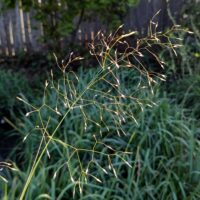
Stipa hymenoides
This rugged, incredibly drought tolerant bunchgrass hails from hot, sunny locations in desert areas and juniper woodlands of California. The inflorescences which emerge above the green foliage in spring and summer, are incredible airy and delicate. By the end of summer, plants take on an ivory color, appearing like billowing little clouds which create a wonderfully soft texture for the late season garden. Plants reach to about 2’ around. In winter, plants will go dormant. Little to no water once established. Needs decent drainage. Deer resistant.
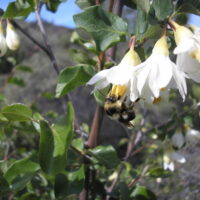
Styrax redivivus
A beautiful but little known California native. Slow to mature but worth the wait. Develops into a graceful multistemed deciduous shrub. Dark green rounded leaves clothe the smooth gray branches. Late spring brings dangling clusters of pure white, waxy, bell-shaped blossoms. Grows 6 to 10 ft. tall for sun to light shade. Drought tolerant. We have observed hummingbirds and pipevine swallowtail butterflies nectaring on styrax blossoms.
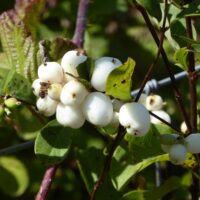
Symphoricarpos albus var. laevigatus
Snowberry is a deciduous, native shrub for dry or moist shade. Reaches about 4 - 6 ft. tall and spreading. Clusters of tiny, pinkish, urn-shaped flowers are followed by showy white berries on arching branches. Responds well to shearing. A good choice for under native oaks. Fruit may be toxic to humans. Hummingbirds like the flowers. Berries are palatable to hermit thrush, Swainson’s thrush, robins and other birds. Also creates good cover for birds.
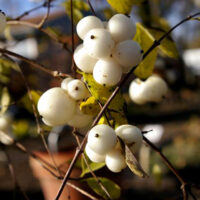
Symphoricarpos albus var. laevigatus ‘Bartlett Springs’
Snowberry is a deciduous, native shrub for dry or moist shade. Our own selection from Lake County, has particularly large oval leaves on graceful arching branches with exceptionally big fruits. Reaches about 4 ft. tall and spreading. Clusters of tiny, pinkish, urn-shaped flowers are followed by showy white berries on the branch tips. Responds well to shearing. A good choice for under native oaks. Fruit may be toxic to humans. Hummingbirds and bees like the flowers. Berries are palatable to hermit thrush, Swainson’s thrush, robins and other birds. Also creates good cover for birds.
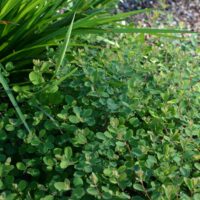
Symphoricarpos albus var. laevigatus ‘San Bruno Mountain’
This attractive low-growing form of our native snowberry is a Cal Flora Nursery selection from San Bruno Mountain. Its dimensions are about 8 inches tall and spreading. Indeed the spreading nature of this plant is robust and it should be included in areas where that is an asset rather than a liability. The wiry arching branches hold light green rounded leaves and the effect of the new growth is delicate and appealing. Tiny pink urn-shaped flowers decorate the branch tips, followed by small white fruits. Perfect for a lightly shaded bank or the light shade of a tree where it will be very drought tolerant. With total drought it may go summer deciduous but occasional summer water will keep it looking fresh. The flowers attract bees and hummingbirds.
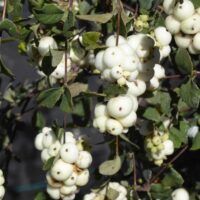
Symphoricarpos albus var. laevigatus ‘Tilden Park’
Here is a particularly fine selection of the native snowberry, notable for its dependable crop of showy white berries on arching branches. A deciduous shrub, snowberry grows to about 4 ft. tall and spreads to form drifts. A good choice for a shady bank, woodland edge, or under oaks. Appreciates and responds to moisture, but once established will tolerate dry conditions. Fruit may be toxic to humans. Hummingbirds like the flowers. Berries are palatable to hermit thrush, Swainson’s thrush, robins and other birds. Also creates good cover for birds.