
Arctostaphylos x media – Tilden form
This big-leaved selection was discovered at Point Arena on the southern Mendocino coast by Steve Edwards of Tilden Botanic Garden. Distinctive for its large, hairy, apple-green leaves and low, dense form only reaching up to about 2 ft in height and at least 6 ft. in width. Clusters of white flowers appear in spring followed by round, bright green fruits. Plant in full sun to light shade and provide moderate to occasional irrigation once established. Should be quite drought tolerant once established.
Arctostaphylos x media ‘Humboldt Mystery’
Arching branches and a mounding habit up to 6 ft. tall and 8 ft. wide distinguish this manzanita from its relatives. In winter, pinkish-white flowers provide nectar for hummingbirds and bees, followed by large, red berries in the autumn. Burnished red trunks display a colorful backdrop to the leathery, large, dark green leaves. Plant in full sun to light shade and provide moderate to infrequent irrigation. James Roof of Tilden Botanic Garden discovered this unusual selection somewhere on the Humboldt Coast, but, true to his enigmatic character, refused to say where he found it. It is believed to be a natural cross between bearberry and the hairy manzanita.
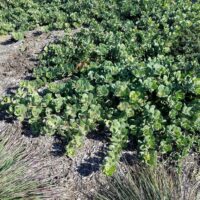
Arctostaphylos x media ‘Peter Ehrlich’
This unusual manzanita from the southern Mendocino coast features what may be the largest leaves of any of the groundcover manzanitas. The round, grey-green foliage mounds densely over time to reach a height of about 3 ft. and a width of up to 8 ft. Clusters of white flowers gather at branch tips in winter, followed by little apple-like fruits in the spring. While fairly adaptable in the garden, decent drainage is best and full sun to light shade. Accepting of moderate irrigation but will become quite drought tolerant once established.
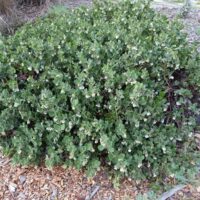
Arctostaphylos x media ‘Reina de Arena’
An outstanding selection from a special population of natural manzanita hybrids, holding court on the rugged, fog shrouded, coastal bluffs of Point Arena in Mendocino County. The "Queen" forms a lovely, compact mound of large, rounded, fuzzy leaves, reaching up to about 2 ft. high and at least 6 ft. wide. Elegant, pure white, urn-shaped flowers decorate the branch tips in winter and are an early nectar source for hummingbirds and bumblebees. Plant in full sun to light shade and give moderate to infrequent summer water once established. Plants grown in hot areas will benefit from some afternoon shade and extra irrigation.

Aristolochia californica
Dutchman’s pipe vine is an interesting vine native to river, stream side and woodland habitats. Soft heart-shaped leaves and unusual purplish pipe-shaped flowers bloom in early spring. This deciduous twining plant will need some support if you wish it to grow upwards. Adaptable, but best with a little shade and moderate water. Slow to establish, we offer this adage to encourage patience: “The first year it sleeps, the second year it creeps and the third year it leaps”. Once established it will put on ample growth, easily covering a trellis or chain link fence. THE larval food source for the pipevine swallowtail butterfly. Deer resistant.
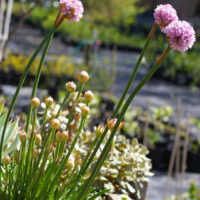
Armeria maritima ssp. californica
Grown from northern California seed source, this coastal native is a sturdy perennial with grass-like blades in compact clumps. Pink pompom flowers on long stems bloom spring into summer. A natural along the coast where it grows in full sun, needing a little shade in hotter regions. Moderate to little water with decent drainage. Excellent for rock gardens. Deer resistant.
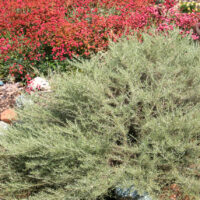
Artemisia californica ‘Montara’
Selected by Roger Raiche at Montara Ridge in San Mateo County. Forms a mound of finely cut fragrant foliage to around 2 ft. tall by 3 ft. (or more) wide. Requires full sun with decent drainage and is drought tolerant once established. Occasional summer water helps retain fresh look. Thrives in coastal environments. Deer resistant.
Artemisia douglasiana
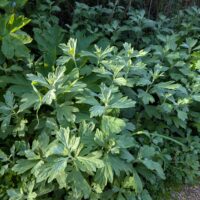
Mugwort is native to many plant communities where there is at least some year round moisture: streams and riverbanks, road cuts, ditches, and moist meadows. A stout, rhizomatous perennial with aromatic foliage that is green on top and silvery beneath. The flowers are small and not particularly showy. The foliage is beautiful and fragrant with a long history of medicinal uses. Plant in sun to light shade where it will grow 3 ft. tall and spreading to form a colony. Well watered plants can grow even taller. Provides excellent cover and seeds for birds. Deer resistant.
Artemisia suksdorfii
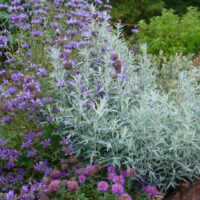
Rhizomatous perennial with sturdy upright stems of whitish-gray felted foliage. Native to coastal California where it grows in seasonal drainages near the ocean. Growing 1 1/2 ft. to 3 ft. tall and spreading to form colonies of beautiful wooly foliage with a pleasant sage scent. The tiny flowers are not particularly showy but are attractive to pollinators. Useful in informal gardens for sunny areas with some summer moisture. Probably best in areas with some coastal influence. Cut to the ground annually to freshen and make room for new spring growth. Deer resistant.
Aruncus dioicus
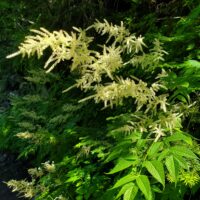
Native to stream sides and moist woods from Mendocino County, California north to Alaska. A bold and showy perennial looking like a giant astilbe. Forms dense clumps of finely divided foliage with arching, feathery plumes of white flowers 3-5 ft. tall in summer. Requires regular moisture and part shade where it makes a striking specimen or accent plant in the woodland garden. Dies back to its roots in winter. The frothy flower plumes attract an array of tiny little pollinators and the seed heads on female plants are an important food source for birds. Said to be deer resistant.
Asarum caudatum
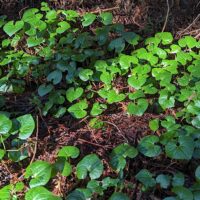
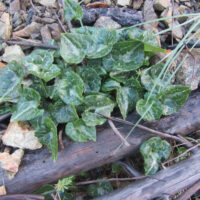
Native to the deep shade of forest floors, this evergreen perennial forms a handsome low groundcover. The large, deep green, heart-shaped leaves appear to hover over the ground, creating a lush, almost tropical effect. The unusual flowers which nestle under the leaves are normally maroon, but occasionally white, with long spidery tails. Thrives in the deep shade under redwoods, competing well with the aggressive roots and dense duff. The ginger scented leaves are deer resistant.

Asarum caudatum ‘Alba’
An interesting form of the native, shade loving wild ginger. Calling the flowers white is a stretch, they are more of a wasabi-green rather than the usual maroon color of the species. The intriguing long tailed flowers are hidden beneath the glossy heart shaped leaves and would need to be planted on a wall, slope or container to make them easier to view. Wild ginger prefers shade and moisture where it will form a low spreading groundcover.
Asclepias fascicularis
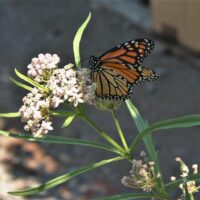
Our most common native milkweed is found in meadows and on the banks above ponds. Its flowers are held in umbels of a pale mauve color. They form at the top of 1 - 3 ft. tall slender stems that die back in winter to a perennial rootstock. Its wandering roots form small colonies. Drought tolerant, it prefers seasonally moist soils and likes moderate water in the garden. The narrow leaves are the preferred larval food for the Monarch Butterfly. Full sun to part shade. Unlikely to be bothered by deer.
Asplenium trichomanes
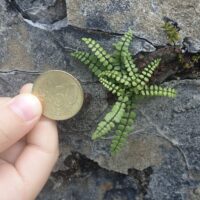
This small fern is found in rocky habitats almost worldwide, though uncommon in California, where it is found only in Del Norte County. Tiny, dark green, oval leaves line the black stems of this diminutive evergreen fern. The narrow fronds form short tufts under 8 inches tall that spread slowly. Easy to grow, this little cutie is perfect for tucking into a shady rock garden, wall or container planting. Best in gritty, well drained soils with regular to moderate summer irrigation. Deer resistant.
Aster (Eurybia) radulinus ‘Gilliam Creek’
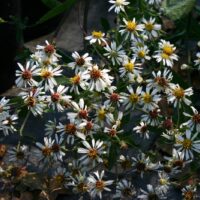
This charming woodland aster makes its home in bright, dryish woods from the Channel Islands all the way up to the Oregon border and into the northern Sierras. Normally a shy, dainty little forest dweller, this selection from Sonoma County is far more robust, featuring large clusters of white-petaled daisies with white centers which turn yellow with age, and finally a deep maroon. Flower stalks reach up to 2 ft. high, much taller than is typical for the species. Serrated, deep green leaves form a high mat on this slowly spreading ground cover. An excellent plant for dry, woodland gardens, but will also tolerate moderate irrigation. One of the few excellent pollinator plants for the lightly shaded garden.
Aster x frikartii ‘Monch’
A particularly fine hybrid from the 1920’s, valued for its long display of clear lavender-blue daisies on stout, upright foliage, to around 2 ft. tall and wide. Easy to grow in full sun with good drainage and regular to moderate water. A wide variety of bee species visit this perennial, foraging for nectar and pollen. Attractive to butterflies too. Its long bloom period, May through October, make it a wonderful color accent and a powerhouse in the pollinator garden.
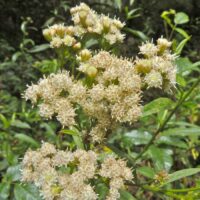
Baccharis glutinosa (douglasii)
This native perennial is a powerhouse for pollinators, luring small butterflies, predatory wasps and other beneficial insects to its dense, white, flat-topped, nectar rich flower heads. Found in wetland and riparian habitats such as salt marshes and stream edges along the coast and interior valleys of California. An erect perennial, growing 3 ft. or more tall, with long, lance-shaped, resinous, leaves and spreading by rhizomes. Blooming in late summer to early fall, the flowers lack petals and are dioecious, with male and female disc flowers occurring on separate plants. Plant in full sun to light shade with moderate to regular water. Deer resistant.
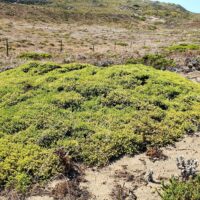
Baccharis pilularis – Bodega Dunes form
Coyote bush is a tough, native, evergreen shrub, forming mounds of dense foliage that hold soil and provide food and cover for birds and mammals. Flowers are small and cream-colored and appear in the autumn. This crop is grown from seed collected in the Bodega Bay Dunes from parents that were under two feet tall and around 6 ft or so wide. Time will reveal the exact form and sex of each plant in this crop. Both male and female plants have significant habitat value, with their combined contributions of abundant pollen, nectar and copious seed late in the season. It will be a surprise as well as a useful addition to the habitat garden. Plant in full sun, though a little shade is helpful in hotter sites. Shear occasionally to renovate and keep dense. Drought tolerant on the coast, but best with occasional water inland. Deer resistant.
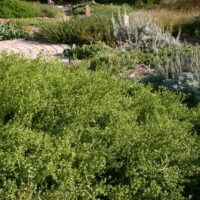
Baccharis pilularis ‘Pigeon Point’
Adaptable and dependable low growing form of the native coyote bush. Forms a mound of bright green leaves with an undulating habit 2 - 3 ft. tall and 6-8 ft. wide. Able to tolerate many soil types and watering regimes this shrub is best in full sun to light shade. Extremely drought tolerant along the coast but best with moderate to occasional summer water inland. When watered and annually trimmed to keep low and free of debris it is recommended for fire resistance landscapes. A good addition to the habitat garden, coyote bush offers excellent cover to a wide variety of wildlife. ‘Pigeon Point’ is a male selection and does not make seed. Deer resistant.
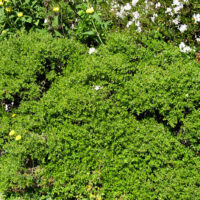
Baccharis pilularis ‘Twin Peaks’
One of the fastest, toughest, densest evergreen native large scale groundcovers. Discovered on Twin Peaks in San Francisco. Grows at least to 6 ft. wide and 2 - 3 ft. tall. Extremely drought tolerant along the coast but best with moderate to occasional summer water inland. Shear hard annually in spring to keep rejuvenated. Sun on coast, afternoon shade inland. This is a male selection so it won't produce seeds. Deer don’t seem to eat it.
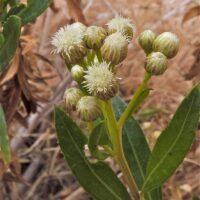
Baccharis salicifolia
This native shrub looks something like a willow in foliage and is found in similar habitats in California and the southwest US. Not a willow at all, but a member of the aster family, this evergreen shrub blooms nearly year round, making it a powerhouse for pollinators. The profusion of small, creamy white, fuzzy flowers, tinged with pink or red are highly attractive to butterflies, bees and other beneficial insects. Extremely tough and easy to grow in full sun with summer water, where it will grow 6 - 10 feet tall and wide with rich, green foliage. Able to survive drier conditions than a willow could handle, but it will look rough if it gets too dry. Responds well to pruning and can be cut down to six inches to refresh. Excellent screen, windbreak and for soil stabilization. Stellar for attracting pollinators.
Berberis (Mahonia) aquifolium
This attractive, western native evergreen has a long history in cultivation for good reason. Erect stems rise 4 to 7 feet or more tall and wide, spreading slowly by underground rhizomes to form dense clumps. Bronzy-red new growth gives way to dark-green, glossy leaves with spiny margins that are prickly to the touch. Cold winters can darken the foliage with purple-red tones. Late spring brings clusters of bright yellow, sweetly scented flowers. Edible blue-black fruits follow and are pretty and tasty. A useful and adaptable shrub in a hedge or a shrubby border. Takes full sun to part shade. Performs best with some afternoon shade in hot areas and moderate to infrequent water. A great habitat plant which provides cover, nectar rich flowers and fruits relished by all. Deer resistant.
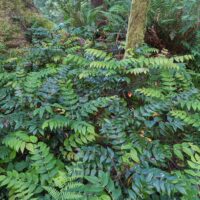
Berberis (Mahonia) nervosa
A handsome species with especially long, leathery, evergreen leaves. Grows to around 2 or more feet tall and spreads by underground stems. Yellow flowers in spring are born in upright clusters, followed by blue berries. Great woodland groundcover for full or partial shade with occasional to regular summer water. Deer resistant. Fruits eaten by robins, finches and towhees. The flowers have nectar for hummingbirds and bees.
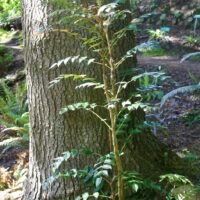
Berberis (Mahonia) nervosa var. mendocinoensis
The rare Mendocino longleaf mahonia comes from moist coniferous forests around Fort Bragg. Differs from the more diminutive longleaf mahonia in its unusual size: growing slowly to 5 ft tall or more and spreading to form narrow colonies. The pointed, leathery, deep green leaves, bronzy orange when young, provide a striking contrast to the bright yellow flower clusters produced in the spring. Attractive deep purple berries are a food source for birds. Needs shade and moderate moisture. Deer resistant.
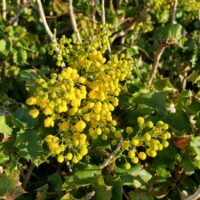
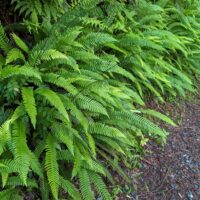
Blechnum (Struthiopteris) spicant
A beautiful and charming fern native to moist coastal forests of northern California. Deep green glossy, narrow fronds are of two strikingly different forms. The outer skirt of fronds is evergreen. The central "fertile" fronds are stiffly erect and airy. It makes for a striking effect. Grows 18" to 2 ft. tall and wide. Best with partial shade to shade and regular moisture.
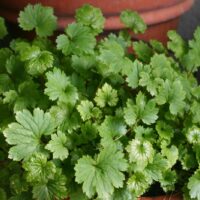
Boykinia occidentalis
Clusters of dainty white flowers and glossy dark green leaves make the brook saxifrage a wonderful addition to the moist shade garden. Flowers open in the spring on arching stems up to a foot tall. May continue to bloom into autumn. The round, serrated leaves form low mounds up to 2 feet wide. Tolerates heavy soil and may seed around. Will grow in part to heavy shade. Needs regular moisture.
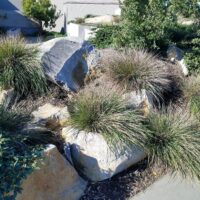
Calamagrostis foliosa
A beautiful native grass offering a very useful size and form for the landscape. Growing one foot tall by two feet wide with beautiful arching mounds of blue-grey blades often highlighted with purple tones. Spring brings flower spikes on arching stems with tight silvery- purple heads that turn tawny with age. A natural for coastal climates with good drainage and moderate to occasional watering, where it will tolerate wind and salt spray. In warmer interior sites it requires some shade and additional water. Excellent as a specimen or in mass, in a rock garden, perennial border, meadow, woodland margin or slope. Deer resistant.
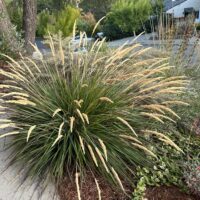
Calamagrostis foliosa x nutkaensis ‘Little Nootka’
This robust, but elegant bunchgrass was discovered by Cal Flora as a chance cross between the Pacific and Mendocino reed grasses. A beautiful garden plant which inherited useful traits from both parents. It’s shorter and denser than the Pacific reed grass, with foliage reaching up to about 1 ½ ft. high, but still retaining its lush, broad, green leaves. One can see the influence of the Mendocino reed grass in the broader form, spreading up to 3 ft. wide. The tight grass flowers are generally held upright on prolific stalks which rise to about a foot above the foliage. Plant in full sun near the coast, but with some afternoon shade in hotter areas. Somewhat drought tolerant once established. Accepts moderate to occasional irrigation. Deer resistant.