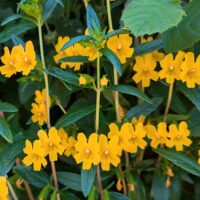
Diplacus (Mimulus) aurantiacus
Sticky monkeyflower is the native monkeyflower species that brightens the hills and coast around Sonoma County. From spring through summer, its profuse yellow-orange tubular flowers decorate evergreen foliage reaching 2-4 feet tall and wide. An unbeatable habitat plant that is highly attractive to hummingbirds. Give it good drainage and keep on the dry side. Thrives in full sun near coast with light shade inland, and benefits from light annual trimming. A larval food source for the common checkerspot and buckeye butterflies. Deer resistant.
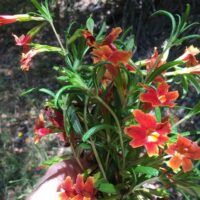
Diplacus (Mimulus) aurantiacus ‘Freezeout Creek’
This stand-out form of our local native monkeyflower was found growing on a slope near a lush redwood forest in western Sonoma County. Instead of the more typical yellow-orange, the trumpet-shaped flowers of 'Freezeout Creek' are larger and boast velvety red petals edged with gold. Monkeyflowers are evergreen sub-shrubs, that grow 2 -4 ft. tall, and bloom profusely in the late spring and into summer. Plant in full sun on the coast to light shade inland and give it decent drainage. Drought tolerant once established but responds to occasional summer water, especially when blooming. Benefits from annual pruning and pinching. The flowers are pollinated by bees and hummingbirds and are a host plant for checkerspot and buckeye butterflies. Deer resistant.
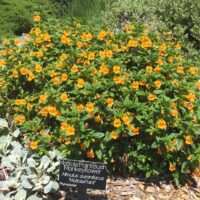
Diplacus (Mimulus) aurantiacus ‘Mattole Point’
Found along the Lost Coast near the mouth of the Mattole River by Mark Moore of the Humboldt Botanic Garden, this fine selection of our native sticky monkeyflower has particularly beautiful evergreen foliage and a compact habit with glossy, dark-green, deeply veined leaves. The abundant orange, tubular flowers are tucked into the dense foliage which grows 2 ft. or so tall and wide. Plant in full sun on the coast to light shade inland and provide good drainage and occasional summer water. Hummingbirds and bees use the flowers and it is a larval food source for checkerspot and buckeye butterflies. Deer resistant.

Diplacus (Mimulus) aurantiacus ‘Rodeo Gold’
This form of sticky monkeyflower offers warm yellow tubular flowers with a golden throat, rather than the more usual orange flowers. This Cal Flora Nursery selection was found in southern coastal Marin County. Evergreen foliage grows roughly 3 ft. tall and wide. Benefits from pinching back of older stems to keep it denser. Plant in full sun on the coast to part shade insland, and provide with occasional summer water. Monkeyflowers are attractive to hummingbirds, butterflies and other pollinators. The checkerspot and buckeye butterflies use it as a larval food source. Deer resistant.
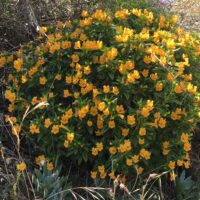
Diplacus (Mimulus) aurantiacus ‘Russian Gulch’
From the bluffs of the Sonoma Coast comes this beautifully compact form of sticky monkeyflower. The shiny, evergreen leaves are spaced to form a tight mound, 2 ft or so tall and wide. From late spring into autumn, cheerful, orange, tubular flowers cover the dense foliage. Makes a colorful, drought-tolerant addition to the garden where it can grow in full sun on the coast to part shade inland. Benefits from pinching to form a strong framework to support the flower display. Requires good drainage and responds to occasional watering, but resents drip irrigation systems that deliver water on a regular basis. Hummingbirds and bees relish the flowers and it is the larval food source for checkerspot and buckeye butterflies. Deer resistant.
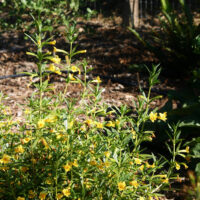
Diplacus (Mimulus) aurantiacus ‘Ted’s Yellow’
Grows 2 - 3 ft. tall with yellow tubular flowers. Full sun near coast, light shade inland. Good drainage, keep on the dry side and fertilize minimally. Benefits from annual trimming. Larval food source for the common checkerspot and buckeye butterflies. The flowers provide nectar for hummingbirds. Deer resistant.
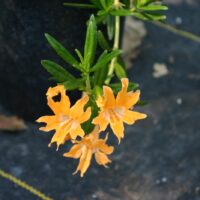
Diplacus (Mimulus) bifidus ‘Esselen’
We have been impressed with this fine selection from Big Sur, which offers compact habit, shiny green foliage and broad bright-orange flowers over a long period. Plant in sun to light shade with little to occasional summer water. Bees, butterflies and hummingbirds all work the flowers and it is a larval food source for the Checkerspot butterfly. Deer resistant.
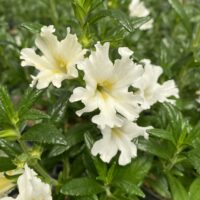
Diplacus (Mimulus) bifidus ‘White’
This elegant monkeyflower has extra frilly, creamy-white, azalea-like flowers, with soft yellow throats. The abundant blossoms stand out against the slender, deep green foliage and bloom over a long period, late spring and into fall. Reaches about 2 ft. tall and 3 ft. wide. Plant in sun to light shade with good drainage and occasional summer water. Hummingbirds, bees and butterflies are all drawn to the flowers and it is a larval food source for checkerspot and painted lady butterflies. Great in a container. Deer resistant.
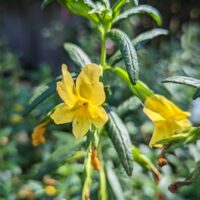
Diplacus (Mimulus) calycinus
From central and southern California, this species is similar to our local sticky monkeyflower but has large, creamy-yellow, trumpet-shaped flowers. Grows 2 - 3 ft tall, and at least as wide, and flowers from late spring through summer. For sun to light shade with good-draining soils and occasional summer water. Flowers attract hummingbirds, bees and butterflies and it is a larval food source for checkerspot and painted lady butterflies. Deer resistant. Previously: Mimulus longiflorus ssp. calycinus.
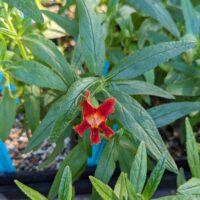
Diplacus (Mimulus) longiflorus
Hummingbirds love the abundant deep red flowers of this stand-out monkeyflower. Hailing from Southern California and growing 2 -3 ft. tall, and at least as wide, this drought-tolerant, floriferous shrublet blooms late spring into fall. Plant in sun to light shade with good drainage and occasional summer water. Besides hummingbirds, other pollinators will be attracted to the flowers, and the foliage is used by checkerspot and painted lady butterfly larvae. Deer resistant.
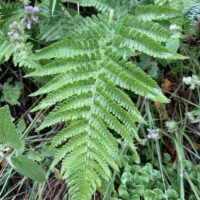
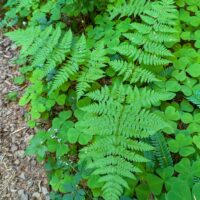
Dryopteris expansa
A very elegant native fern, with soft, bright green, finely divided fronds and a gently arching form. Rarely offered in California nurseries. Mature plants reach up to 3’ tall and wide, make them suitable for most garden spaces. Grows in moist, shady woodlands, mostly along our coast, from the Central Coast north to Alaska. Winter deciduous. Very similar to the lady fern, but with triangular-shaped fronds, not diamond-shaped. Said to be deer resistant.
Dryopteris filix-mas
The male fern is a beautiful, large, deciduous fern, native to much of Europe, Asia as well as North America, where it is uncommon in California. Large and slightly arching, the medium green fronds can reach 3 ft. tall and form a sizable clump. This fern increases slowly from stout rhizomes making it a fine choice for containers. An excellent addition to the woodland garden where it is easy to grow in part to full shade. Prefers humusy soil, rich in organic matter, though it is adaptable and accommodating. Best with regular to moderate watering. Rabbit and deer resistant.
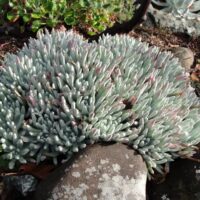
Dudleya ‘Frank Reinelt’
The beautiful and rarely offered Dudleya will form dense mounds 6" - 8" tall with silvery, finger-like leaves, sometimes developing a purple-red blush. Slender stalks appear in late spring and display star-like flowers of soft yellow up to a foot above the foliage. They make handsome specimens in a rock garden or perform as a striking groundcover up to 2' wide mixed with other coastal bluff plants like red buckwheat, seaside daisy, and sea thrift. Great in a container or planted under manzanitas amongst rocks. Needs good drainage and little water once established. Full sun near the coast, but light shade inland.
Dudleya ‘Seedlings from ‘Frank Reinelt’
These seedlings from the beautiful Dudleya ‘Frank Reinelt’ will form dense mounds 6 - 8 inches tall with silvery finger-like leaves. They make handsome specimens in a rock garden or perform as a striking groundcover in mass plantings mixed with other coastal bluff plants like red buckwheat, seaside daisy, and sea thrift. Avoid over-watering and control snails. Full sun to light shade with good drainage.
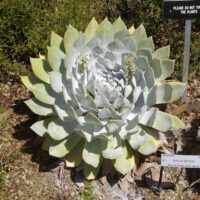
Dudleya brittonii
A Baja California native. Useful and very dramatic in containers or well-drained rock gardens. Likes a protected and sunny microclimate where cold air and winter wet can drain away. Enjoys a little afternoon shade in hotter climates. Develops up to 1 1/2 ft. wide rosettes with fleshy chalk-covered leaves. Yellow flowers sit atop tall stalks in late spring and early summer.
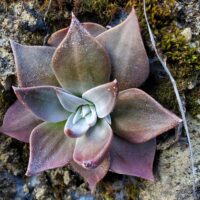
Dudleya cymosa
This charming succulent is in native to California where it grows in between rocks on inland cliffs in sun or bright shade. Best in the garden in a rock wall or terra-cotta pot with some afternoon shade. Height in flower is under one foot. The yellow to orange flowers are attractive to hummingbirds. Occasional to infrequent water in the ground. In pots, let dry out between waterings.
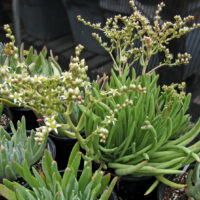
Dudleya edulis
Native to rocky slopes and ledges below 3900’ in Southern Coastal California, the Peninsular Ranges, and Northern Baja California. This Dudleya forms clustering rosettes of dainty, light green, pencil-like leaves. In summer, tall stalks of fragrant, pale yellow flowers rise high above the foliage. Growing about a foot tall (with flowers) by one foot wide. Plant in well drained soil and cool full sun to part shade inland. A delicate accent in a rock garden or amongst coastal plants, also fine in containers. Known as “mission lettuce” for its fleshy raw leaves, once considered a delicacy.
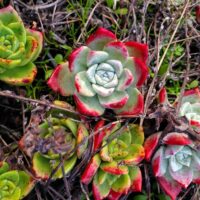
Dudleya farinosa
Native to sea bluffs in central and northern California. Rosettes of fleshy leaves are chalky grey or bright green and often red tipped. Candelabra-like clusters of light yellow flowers on thick stalks appear in summer. Provide part shade away from the coast. Excellent for rock garden, walls or containers, where good drainage and a little summer water can be provided.
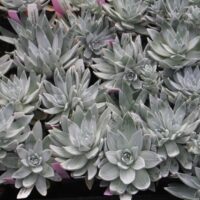
Dudleya farinosa – Noyo River form
Perched on the cliffs of the Noyo River are beautiful rosettes of bluish-white succulents known as bluff lettuce. This special form from the Mendocino coast was selected by Matt Teel for its small and compact stature, striking color and flat leaves. The foliage reaches a height of about 4 inches and slowly spreads to make small colonies. Yellow flowers sit atop slender pink stalks rising 8 inches off the ground. Provide protection from the afternoon sun in inland sites and plant in well-draining soil. Excellent in containers where it only needs occasional water.
Dudleya pulverulenta
Large, broad, chalky-white leaves forming rosettes up to two ft. wide make this Dudleya one of our most sought-after native succulents. A multitude of tubular red flowers appear in late spring and early summer on stalks reaching from 1.5 to 3 ft. tall. Fleshy, heart-shaped bracts line the stems. Plant in bright shade or provide morning sun and afternoon shade. Needs excellent drainage and infrequent irrigation. Plant at an angle to prevent water from gathering around the base in winter. A gravel mulch around the plant can help stabilize soil temperature and prevent excessive dehydration. Good container plant.
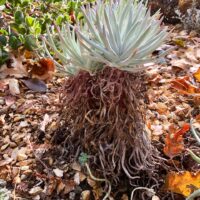
Dudleya virens ssp. hassei
Endemic to Catalina Island, this rare succulent forms chalky-grey rosettes made up of plump fingerlike leaves, 6 inches tall and spreading to form a mat 1 – 2 feet wide. Small white flowers with yellow centers on stems 6 -12 inches tall, bloom in the late spring and are attractive to hummingbirds and other pollinators. Plant in full sun to light shade with occasional deep summer watering. Tolerates heavier soils than most Dudleyas. A dependable small-scale groundcover or container plant.
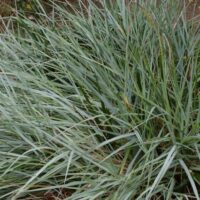
Elymus (Leymus) condensatus ‘Canyon Prince’
A beautiful selection from the Channel Islands off Southern California. Distinctive for the lovely, broad, silver-blue blades 2 1/2 to 3 ft. tall with wand-like grass flowers reaching up to 2 feet above the foliage. Accepts sun to very light shade and moderate to little water. Tolerates heavy soil. Spreads by rhizomes to form striking silver drifts, but is vigorous and aggressive. Best to use where a large patch is desired or where it is contained, such as a parkway strip. Cut back in winter to rejuvenate and remove old leaves. Drought and deer resistant.
Elymus (Leymus) triticoides x ‘Lagunita’
Discovered by grass expert and John Greenlee, who describes it as his personal favorite ground cover grass for meadow installations. Often this species has blue-grey blades and grows tall and floppy, but 'Lagunitas' grows just 10 - 16 inches tall, with rich green blades. This form rarely flowers and is quite adaptable to soil types and watering regimes. The ability to tolerate both wet and dry conditions makes it valuable for areas that seasonally flood like rain gardens. A vigorous spreader, especially when well watered, but is better behaved in dryer sites. Once established, can be maintained with one or two waterings a month, keeping it green and fire safe. Tolerates trimming to about 4 inches, possibly more. Grows in full sun to light shade. Host plant to the Woodland Skipper butterfly.
Epilobium ‘Bert’s Bluff’
A Las Pilitas Nursery selection, named for the founder, Bert Wilson. This California fuchsia sports grey foliage, growing 2 -3 foot tall and spreading. Blooming in late summer, the bright orange-red, tubular flowers are beloved by hummingbirds, but visited by bees as well. This cultivar is reputed as being particularly tolerant of a wide range of soil conditions and growing environments. Plant in full sun with occasional deep summer watering.
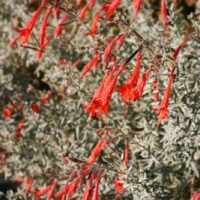
Epilobium ‘Chaparral Silver’
This California fuchsia that we obtained from another grower appears to be identical to our ‘Roger’s U. C. Hybrid’ - same lovely gray foliage 12 -18 inches tall, spreading, with narrow red tubular flowers that the hummingbirds love. Provide full sun to bright shade. Flowers best with occasional deep watering. Pruning plants down to a few inches in late autumn helps to rejuvenate them for the following year.
Epilobium canum ‘Carman’s Grey’
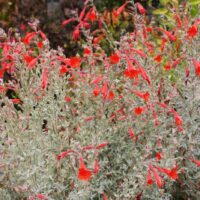
We love California fuchsias and have grown this cultivar for over twenty years. Valued for their beauty and important late season nectar source for hummingbirds, California fuchsias offer many forms and foliage colors. 'Carman's Grey' has gorgeous grey foliage which contrasts beautifully with the masses of orangey-red, tubular flowers, late summer and fall. The grey, narrow leaves form soft mounds 2 foot tall, spreading by underground rhizomes, 4 foot or so wide. Plant in full sun to very light shade where it is tolerant of many soil types, even heavy clay, drought tolerant, but best with occasional summer watering. Hummingbird magnet and bees use it too.
Epilobium canum ‘Coral Canyon’
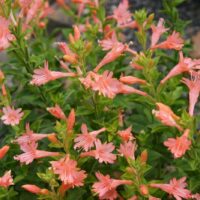
This elegant and unusual form of the California fuchsia offers a prolific display of peachy-pink flowers, a departure from the more common orangey-red blossoms. The late-summer, autumn blooms are held on distinctly upright stems reaching 1 ½ ft. high above broader, bright green foliage. Unlike most native fuchsias, this selection is somewhat shy to spread, generally forming a rounded mound about 2 ft. wide. Enjoys full sun, but will benefit from a little afternoon shade in hot areas. Likes moderate to occasional irrigation. Hummingbirds and bees partake from the flowers. We must thank Cistus Nursery for discovering the parent plant on a high ridge above the North Fork of the American River.
Epilobium canum ‘Sierra Salmon’
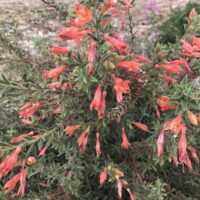
California fuchsias have many charms, blooming in late summer into fall with hummingbird attracting, tubular flowers, mostly in shades of red and orange. 'Sierra Salmon' offers unusual salmon-colored blossoms on soft blue-green foliage. This cultivar doesn't tend to wander like some can and forms dense clumps of erect stems 12 - 24 inches tall and wide. Looks wonderful amongst rocks or boulders, in perennial borders or to add pizazz with grass and shrub plantings. Plant in full sun with occasional summer water. Prune down to a few inches after blooms are done.

Epipactis gigantea
Here’s a native orchid that’s easy in cultivation. In time it will form a colony producing many flower stems. Each stem holds several interesting orchid blossoms of subtle orange, coral and green tones 12 - 18 inches tall. Dies back to the ground in winter. Best with decent drainage and regular to moderate moisture (NOT soggy soils) and dappled shade part of the day. Wonderful addition to the woodland garden, around pond or near streams. Good in containers too.