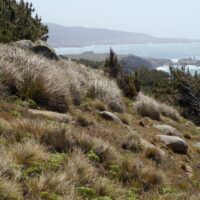
Calamagrostis nutkaensis
A large handsome bunch grass from the coastal regions of Monterey County to Alaska that forms huge tussocks in open moist meadows and on coastal bluffs. It can also be found as an understory at the edges of coniferous forests. Wide green blades grow 2 - 3 ft. tall with flowering culms to 4 ft. Good background or accent plant for the woodland or meadow. Will take full sun in somewhat cooler areas. Best with some summer water and partial shade inland. Deer resistant.
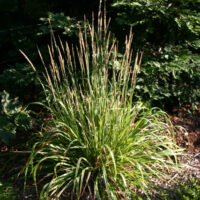
Calamagrostis nutkaensis ‘The King’
Large, handsome, evergreen native bunch grass selected by Roger Raiche in the King Range on the North Coast. Big bold deep green foliage and robust form 3 - 4 ft. tall and wide. Flower stalks rise a foot or two above the foliage. Good background or accent for woodland or partly shaded meadow. Will take full sun in somewhat cooler areas. Best with some summer water. Deer resistant.
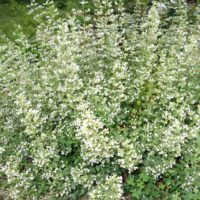
Calamintha nepetoides
A pretty, little, non-spreading mint relative, forming a rounded shrublet of shiny, bright green foliage to around 1’ tall and about 2 ft wide. Covered with hundreds of tiny, pale blue, nearly white blossoms over a long period in summer. Good for full sun to light shade with moderate watering. Tolerant of clay soil. One of our bee magnets. Deer resistant.
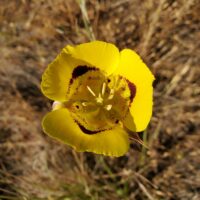
Calochortus luteus
This showy mariposa lily offers vibrant, golden-yellow flowers, often with reddish brown markings at the base of each of the three petals. The upward facing, bowl-shaped flowers seem to hover over grasslands on stems reaching one to two feet tall. In early winter, grass like leaves emerge from the soil, followed by the butterfly-favored blossoms in late spring and early summer. Once the flowers are done, this native bulb will go dormant. Plant in full sun to light shade with well-draining soil. Allow to go completely dry in the summer. Said to be one of the easiest of the mariposa lilies to grow in gardens.
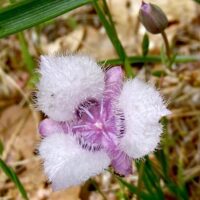
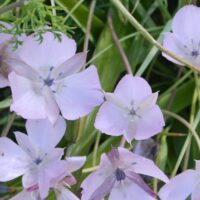
Calochortus uniflorus ‘Cupido’
While many Calochortus are known to be challenging in the garden, this selection is quite easy and blooms in abundance! Blue-grey, iris-like leaves emerge in the winter, followed by soft lavender-pink, tulip-like flowers in late spring. After flowering they will go dormant. Plant in full sun to light shade. Very drought tolerant but will tolerate occasional irrigation. This rare species has a surprisingly wide-ranging distribution, from the coast to the mountains of Northern California. Attracts native pollinators.
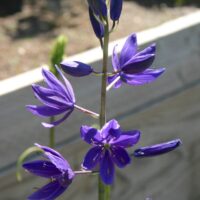
Camassia leichtlinii ssp. suksdorfii
Similar to the common camas, but with larger, star-shaped flowers ranging in color from soft to dark violet-blue on stems up to 3 ft tall. Native to grasslands and moist meadows that dry out in the summer. Also found in open, well lit woodlands. Easy to grow in full sun to light shade in a variety of soil types, including heavy clay. Allow to go dry after seed is set, where it will go completely dormant. This eye catching beauty is appealing to bees, butterflies and hummingbirds. An excellent container plant and cut flower. Deer resistant.
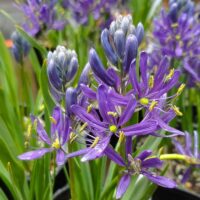
Camassia quamash
Camas lily is a beautiful native bulb, producing stunning displays of sky blue to violet-purple, star-shaped flowers. Found throughout much of the western United States, growing in moist meadows and grasslands that dry out in the summer. Important species to native peoples, who encouraged the bulb through fire management. Historical accounts describe fields of blue from the massive floral displays. Easy to grow in full sun to very light shade and tolerant of a wide variety of soils, including heavy clay. Long, slender leaves give way to erect racemes of blossoms, to 2 ft. tall in late spring. Allow to go dry once seed set commences. Dormant in the winter. An excellent container plant and cut flower. A favorite of bees, butterflies and hummingbirds. Deer resistant.
Campanula rotundifolia
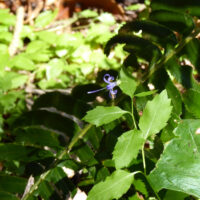
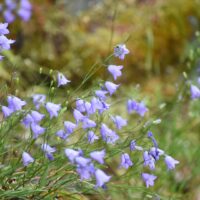
This charming little perennial is found growing around the world in the Northern Hemisphere, including Northern California. Forms a basal mound of small, heart-shaped, green leaves with slender flowering stems rising to about a foot tall. Sweet, little, pendant, lavender-blue, bell-shaped flowers, bloom sporadically in the summer and into the fall. Grow in lightly shaded woodland settings with gravelly soils and regular moisture. Perfect rock garden, crevice or container plant. Bee pollinated.
Carex barbarae
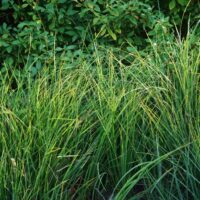
Widely distributed native sedge that is an important traditional basket fiber plant. Bright green sharp blades in clumps 1 - 3 ft. tall and spreading. Oval-shaped tufts of small reddish-brown flowers on spikes at the tip of the flowering stems. An attractive sedge, though it can be invasive. For sunny or partly shaded areas with regular to moderate moisture. Drought tolerant in clay soils or with some shade. Handsome container plant too. Often used in bio swales and riparian restoration. Deer resistant.
Carex nudata
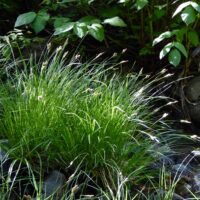
Native to below the high water mark along perennial water courses. Forms a bright green, dense, arching mound with interesting black flowers in spring. Best in moist soils, full sun to light shade. 1 - 2 1/2 ft. tall and wide. Lovely yellow fall color in colder locations. Winter deciduous. Beautiful in containers too. Deer resistant.
Carex praegracilis
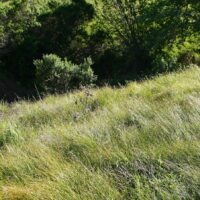
Similar to Carex pansa but growing taller. The fine textured grass-like blades can reach a foot or more tall and spreads freely by rhizomes to form a thick weed smothering groundcover. Useful for meadows, green roofs, bio-swales, erosion control and as a lawn substitute. Can be left natural where it has a lush tousled appearance or trimmed occasionally for a low turf-like appearance. Tolerates drought, inundation, poor soils, salt spray, heat, cold, shade and foot traffic. Plant in sun to light shade where it requires some summer moisture but far less than a conventional lawn. Will go summer dormant if allowed to get too dry. Deer resistant.

Carex praegracilis ‘Chisai’
An excellent cultivar of the native field sedge, selected for it's compact form and slower spreading habit. Increases by short rhizomes to form a sturdy, dark-green carpet, 6 -8 inches tall and 1 - 2 ft wide. Grows more clumping and significantly tighter than the rapidly spreading forms more typical of the species. Still, it will form a solid, small scale ground cover or turf substitute, between stepping stones or mixed with bulbs and perennials for a meadow affect. Plant in full sun to light shade with occasional to moderate water. Tolerates light foot traffic. Deer resistant.
Carex spissa
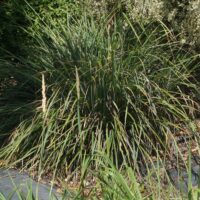
Native to watercourses in coastal sage scrub, chaparral and oak woodlands from San Luis Obispo County to San Diego County. Has proven adaptable and easy to grow here. Wide silvery blades 3 - 4 ft. tall with brown nodding flowers. Sun to light shade. Regular to moderate water. Deer resistant.
Carpenteria californica
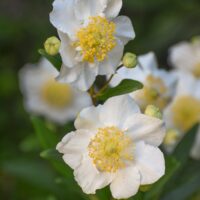
Long in cultivation, this native, evergreen shrub is rare in the wild, with a limited distribution in their native habitat. Forms a multi-branched shrub, 5 - 7 foot tall or more and nearly as wide, with dark green, leathery, lanceolate shaped leaves, which provides a dark foil to the brilliant white flowers. Late spring brings terminal clusters of white, 2 -3 inch, sweetly scented, anemone-like blossoms with yellow centers. An adaptable shrub which makes a striking specimen or foundation plant in a woodland area with morning sun and afternoon shade. Responds well to pruning and can be trained as an espalier. Drought tolerant, but appreciates occasional summer water. Flowers enjoyed by bees and butterflies.
Carpenteria californica ‘Elizabeth’
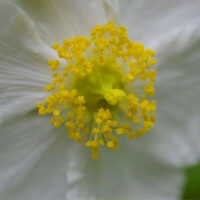
A beautiful native evergreen shrub 5 - 7 ft. tall and 4 ft. or more wide. Blooms May-July with sweetly scented, pure white, yellow-stamened, camellia-like single flowers. This cultivar is especially free flowering with smaller than usual (2 inch) flowers in masses of up to 20 in each of the terminal clusters. Said to be more disease resistant. Has a narrow upright appearance which is unusual for a native shrub. Best with light shade or morning sun. Drought tolerant, but appearance is improved with some summer water. Does want decent drainage.
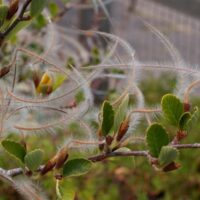
Cercocarpus betuloides
Mountain mahogany is an adaptable, semi-evergreen native shrub (8 to 12 ft. high and wide) or small tree with charming birch-like leaves set against silver-grey bark. Small, honey-scented flowers appear in spring followed by seeds with intriguing silky, curled, feather-like tails. The open habit contrasts nicely with evergreen shrubs or rock walls where its pleasing silhouette can be seen. Flowers are attractive to bees. Mountain mahogany is one of those rare native shrubs which can easily be pruned for narrow garden beds. Grows on dry slopes in chaparral or at the edges of woodlands. Provide full sun to light shade. It is surprisingly adaptable to diferent water regimes, from moderate irrigation to no water once established. Somewhat deer resistant.
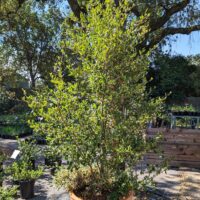
Cercocarpus betuloides var. blancheae
This rare and beautiful variety of our native mountain mahogany offers larger, birch-like leaves with fuzzy and whitish undersides. The highly useful from generally reaches 8 – 15 ft. tall, but only spreads to about 6 ft. wide, making it ideal for narrow locations where a screening, evergreen, fast-growing bush is needed. Small, disk-like, creamy flowers appear in the spring, followed in summer by seed pods with hairy, grey tails which curl upwards, giving the plant a silver halo. Over time, the trunks are covered in a smooth, grey bark. The Island mountain mahogany typically grows much more rapidly than our local variety and is tolerant of moist or dry soils once established and part shade to full sun. Heat isn’t an issue. A great candidate for a container, where it is very amenable to pruning.
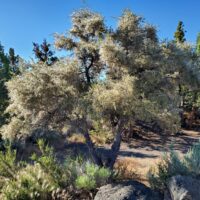
Cercocarpus ledifolius
Large shrub or small, multitrunked, evergreen tree, 6 - 30 ft. tall, native to arid mountains of the western US. Often takes on a gnarled, picturesque form depending on the conditions it is growing in. Adapted to dry, rocky slopes where it weathers drought, extreme heat and cold, wind and snow. Slow growing, densely branching, with dark green, leathery leaves with curled under edges and silvery undersides. Trunks develop beautiful, red-brown bark with silvery new growth. The flowers are similar to our local mt. mahogany species, small, greenish- yellow, smelling of honey, and attractive to pollinators. The fruits are long, silvery, plumes that glow when back lit. Plant in full sun to light shade with good drainage where it will blend well with other dryland shrubs and perennials and requires little input. Fixes nitrogen. Interesting container or bonsai subject.
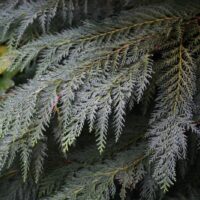
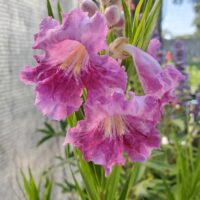
Chilopsis linearis
A graceful, summer-blooming, deciduous shrub, native to desert washes where it grows in gravelly soils and intense heat. Forms a large, multi-branched shrub or small tree reaching up to 15'-20' tall and wide with narrow, willow-like leaves. Terminal clusters of showy, trumpet-shaped flowers in summer come in shades of white, to pink and purple that attract hummingbirds and butterflies. Long, bean-like pods follow and hold on into winter. Enjoys hot climates with plenty of sun, decent drainage and occasional to moderate water. Avoid cool coastal conditions and heavy wet soils. Grows fast when happy with no pest or disease problems, demanding little. A great option for along sidewalks.
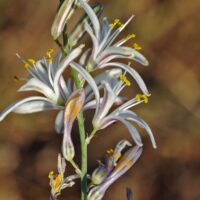
Chlorogalum angustifolium
You may be familiar with the common soap plant and its tall stalks of delicate white flowers. But this unusual, diminutive species of soap root is much smaller, only reaching 1 – 2 ft. high. Rarely offered in nurseries, this species has short, narrow leaves which are not wavy like the common soap plant. Grows in dry grassland and open woodlands in the northern Sierra foothills and coast range. Enjoys full sun to light shade and no additional irrigation once established. Tolerates clay. The seed for these plants came from Windsor and was generously given to us by Vicki Wilson.
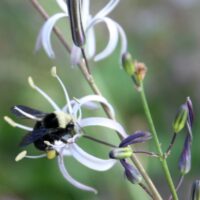
Chlorogalum pomeridianum v. pomeridianum
Known for their large, fibrous bulbs historically used by indigenous peoples and early settlers for soap, food and to stupefy fish. Long, wavy-margined leaves form a rosette in winter followed in late spring by tall, airy flower stems bearing small white flowers that open in the late afternoon and evening. Great in naturalistic settings in full sun to light shade. Needs to go summer dry once established. Larval food source for the Western Brown Elfin butterfly.
Clarkia amoena ssp. whitneyi
Nearly extinct in the wild, this beautiful ANNUAL was found in coastal communities in Mendocino and Humboldt Counties. Growing 3 ft. tall and wide, the branched leafy stems are topped with a long succession of 3 inch cup- shaped flowers. The large flowers are light lavender-pink with whitish areas at the base of the petals. Clarkias make excellent garden plants needing very little and giving much in return. Plant in full sun to light shade, as a filler among trees or shrubs, in mixed flower border or meadow planting. A little water while flowering will extend their show. Good container subject too. Excellent cut flowers. Seems to be deer resistant. Attractive to bees and butterflies.
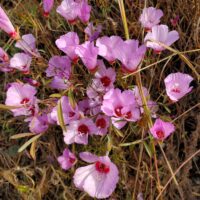
Clarkia rubicunda
Showy and floriferous, with gorgeous, cup shaped blossoms of silky, pink-purple petals featuring a dark red center with a long bloom from late spring into summer. This endemic, ANNUAL wildflower grows in openings of woodlands and chaparral near the coast, mostly in the central part of state. Grows 2-ft. tall or more in full sun with low water needs. Tolerant of heavy soils, the exuberant blossoms attract bees, butterflies and moths, including Sphinx moth species. Performs well in containers and is an excellent cut flower too. Deer resistant.
Clarkia williamsonii
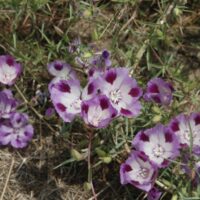
The incredibly showy flowers of this native ANNUAL will take your breath away in late spring and early summer. The large, lavender-pink, papery flowers feature deep, burgundy-red brush strokes and cheery white centers. Plants form a loose mound about 1 ½ ft. around. Butterflies and other pollinators love Clarkias. Native to the Sierra foothills, where it grows in full sun to light shade. Plants enjoy moisture while they are developing in the winter and spring, but are accustom to hot and dry summers. Needs decent drainage. Reseeds readily, as long as there is exposed soil nearby. Deer resistant!
Claytonia sibirica
This native perennial with white to pink candy-striped flowers seeks shady, moist conditions. Our form is from Sonoma Coast and has particularly pink flowers. Related to miners lettuce, candy stripe produces dark green, succulent, edible leaves in low rosettes. Blooms over a long period beginning in spring and will frequently reseed. A sweet, spreading, low ground cover for a shady area with regular moisture. A charming and colorful addition to the forest garden, combining beautifully with ferns, wild ginger and false Solomon’s seal.
Clematis ligusticifolia
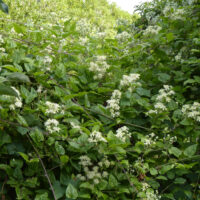
Native to riparian areas where the vining stems will climb and weave their way up and over shrubs and trees. Large masses of fragrant, small creamy-white flowers bloom in summer. Beautiful, silvery, feather-like fruits follow and are as attractive as the blossoms. The intricately divided leaves on long stems can climb 20 - 30 ft. Full sun to light shade with regular to moderate summer water. Deciduous. Generally deer resistant.
Collinsia heterophylla
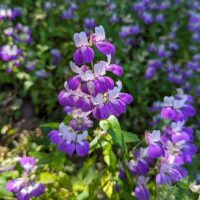
A striking form of a native annual wildflower found in open woodlands in much of California. The open lipped flowers are stacked in tiers, and said to look pagoda-like. This charming woodlander is best in bright shade, in edges and openings, or under oaks, where it blooms from mid spring to early summer. Grows around 2 ft. by 2 ft. When happy it will reseed and those seedlings will require no irrigation. A bee and butterfly favorite.