
Epilobium canum ‘John Bixby’
A Rancho Santa Ana Botanic Garden introduction, 'John Bixby' is a chance seedling of Epilobium 'Everett's Choice'. Forming a broad patch with a dense rounded form of grey-green foliage 12 -18 inches tall or more. Showy, vivid red-orange tubular flowers put on a spectacular display from summer into fall and are highly attractive to hummingbirds. Vigorous perennial, spreading by underground rhizomes to form large colonies. Plant in full sun to light shade with occasional deep watering for best appearance. Cutting plants down after flowering rejuvinates them for the following year.
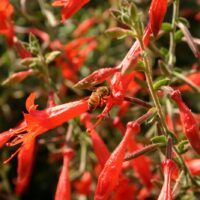
Epilobium canum ‘Liz’s Choice’
This selection of California fuchsia features particularly large, trumpet-shaped, scarlet flowers atop stems reaching 3 ft. tall. The flowers, blooming from summer into fall, are a favorite of hummingbirds and bees. The lance-shaped leaves are a pewter green, providing a striking contrast to the brilliant flowers. It spreads over time to create small colonies. Trim plants down to about 4 inches in winter for vigorous, tidy growth the next year. Provide moderate to infrequent irrigation and full sun. This beautiful cultivar was selected by Milo Baker Chapter CNPS Fellow Liz Parsons.
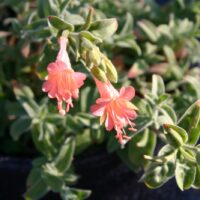
Epilobium canum ‘Marin Pink’
California fuchsias are appreciated for their abundant tubular flowers that bloom in late summer and fall, predominantly in different shades of orange-red. This unusual selection has beautiful PINK tubular flowers produced on sage green mounds of foliage to about 2 ft. tall and spreading by underground rhizomes. Vigorous and easy to grow in full sun to very light shade. Touted as drought tolerant, they will survive dry conditions but will thrive with occasional summer water. Beautiful against a rock wall, in dry stream beds, or naturalistic plantings where they have some room to spread. Hummingbird favorite. Pruning plants down to a few inches in late autumn helps to rejuvenate them for the following year.
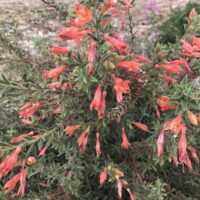
Epilobium canum ‘Sierra Salmon’
California fuchsias have many charms, blooming in late summer into fall with hummingbird attracting, tubular flowers, mostly in shades of red and orange. 'Sierra Salmon' offers unusual salmon-colored blossoms on soft blue-green foliage. This cultivar doesn't tend to wander like some can and forms dense clumps of erect stems 12 - 24 inches tall and wide. Looks wonderful amongst rocks or boulders, in perennial borders or to add pizazz with grass and shrub plantings. Plant in full sun with occasional summer water. Prune down to a few inches after blooms are done.
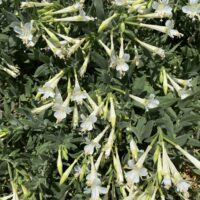
Epilobium canum ‘Summer Snow’
While CA fuchsias are generally known for their abundant showy red flowers, this unusual variety offers surprising clean-white blossoms on low growing green foliage up to 10 inches tall. Spreading by underground rhizomes, this mat forming perennial grows in full sun to light shade with occasional to little summer water once established. Perfect in naturalistic plantings, on slopes amongst boulders, dry creek beds or rock walls. California fuchsias bloom heavily late summer into fall and their tubular flowers are hummingbird favorites. The habit of this plant can be improved with shearing in the winter.
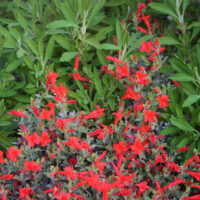
Epilobium septentrionale ‘Select Mattole’
This California fuchsia forms tidy, low, 6 inch high mats of beautiful silver foliage with a matte finish. Late summer through fall brings orangey-red tubular flowers which attract hummingbirds. A somewhat redder flowering selection. Spreading by underground rhizomes, this Epilobium increases a little less vigorously than the others. Full sun to light shade. More shade tolerant than most California fuschias. Needs more water than most Epilobiums. Pruning plants down to a few inches in late autumn helps to rejuvenate them for the following year.
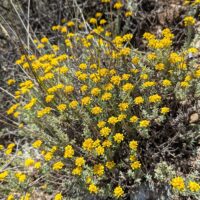
Eriophyllum confertiflorum
Native to dry sites in many plant communities of California. Forms a mound of pale green, finely cut foliage with woolly undersides 12-24 inches tall. Late spring and summer brings domes of bright golden yellow daisies in dense heads. Tough little shrublet for the dry garden in full sun where its interesting fine-textured foliage provides a useful contrast to grasses and bold-leaved shrubs and perennials. The flowers provide nectar to bees and butterflies. Needs good drainage.
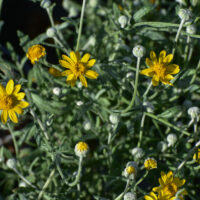
Eriophyllum lanatum – inland form
A cheerful native perennial with yellow, daisy-like flowers from spring to fall. While the species varies in size and habit, our seed-grown strains are upright, reaching around 1.5-3 feet tall and wide when in full bloom. The woolly foliage tends to be silvery, but comes in shades of green, and is most lush and dense around the base. Woolly sunflower is found in a range of plant communities from Central California through the Pacific Northwest, thriving in sun to part-shade. Our seed-grown plants come from hot, inland sites where they grow on dry, rocky slopes and bluffs. Tolerates various soil types with good drainage and minimal irrigation once established. The sunny, 2-in. blossoms are butterfly favorites and attractive to bees and other pollinators. A good choice for rock and habitat gardens. Deer and gopher resistant.
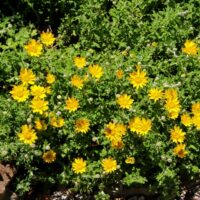
Eriophyllum lanatum ‘Horseshoe Cove’
This western native grows on rocky slopes and bluffs over a wide range of plant communities in California, Oregon and Washington. This low dense coastal selection forms a mat of woolly, bright green foliage just a few inches tall and 1-2 ft. across, topped with cheerful golden yellow daisies rising to 6 inches tall, late spring and summer. The flowers are attractive to bees, butterflies and other beneficial insects. Plant in full sun to light shade inland with good drainage and moderate summer water.
Eriophyllum lanatum ‘Siskiyou’
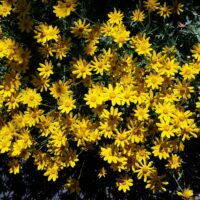
An extremely variable species ranging from the immediate coast to the high mountains of California and into Oregon. The cultivar 'Siskiyou' is a Siskiyou Rare Plant Nursery selection. Lush gray-green woolly foliage forms low mats up to 10 inches and 3-4 feet wide. Blooms over a long period, spring into fall with cheery 2 inch golden-yellow daisies. This tough perennial will thrive in full sun to light shade, decent drainage and moderate to infrequent summer water once established. The open-faced daisies are an excellent sources of pollen and nectar and make good platforms for insects to perch, attracting butterflies, bees and other insects.
Eriophyllum staechadifolium
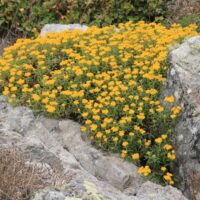
This native perennial is perfect for coastal environments where it tolerates full sun, wind, salt spray and drought. Forms leafy mounds 2 - 3 ft. tall and at least as wide. The foliage is grey-green above and silvery beneath with flower heads densley packed with tiny golden-yellow daisies from May through August. Drought tolerant but appreciates occasional summer waterings, especially when grown away from the coast. Excellent for pollinators. Tip pruning helps keep the mounds tidy. Annual pruning back will refresh.
Eschscholzia californica – cream colored flowers
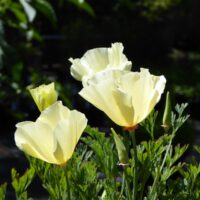
Smaller in stature than the typical robust orange forms of California poppy, this perennial fits into plantings nicely without overwhelming. Low foliage is ferny and finely dissected and topped with cup-shaped blossoms that are a lovely shade of cream to pale yellow. Best in full sun with dryish conditions. Given the opportunity may seed about. Flowers provide pollen that is favored by native bees, bumbles and honey bees.
Eschscholzia californica var. maritima
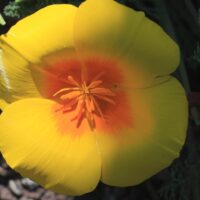
This is the perennial, coastal form of California poppy. Low growing and spreading with beautiful, finely cut, blue-gray foliage. Abundant flowers are golden yellow with orange centers, blooming over a long period, especially in mild climates. Plants retreat to leafy rosettes in winter. Best in full sun where they are drought tolerant, but a little summer water can extend their bloom period. Seeds about if happy.
Festuca ‘Beyond Blue’
A natural mutation of Festuca glauca ‘Elijah Blue’, introduced by a Dutch nursery and said to offer the bluest of the blue colored blades. This cool season grass forms a neat mound of vibrant blue foliage, 9 - 12 inch tall and 12 - 18 inches wide, with silvery grass flowers that fade to tan. Requires decent drainage with full sun along the coast and light shade inland and moderate to occasional summer water. Beautiful in mass or as an accent, grows well in containers too. Deer resistant.
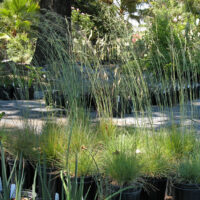
Festuca idahoensis
A modest sized native bunchgrass with beautiful green to blue-green, fine-textured foliage. The blades grow eight inches to 1 ft. tall with flower stems 18 inches to 2 ft. tall. Grow in full sun to light shade. Appreciates some protection from hot afternoon sun, especially inland. Drought tolerant, though a little water in hot regions is helpful. Deer resistant.
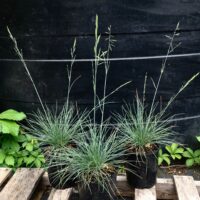
Festuca idahoensis ‘Little Bald Hills’
This tidy little beauty was discovered on the south fork of the Smith River in Del Norte County. Soft, blue-grey leaves form a dense little mound about 10 inches high by a foot wide. Airy grass flowers rise another foot with chalky-blue stems. Enjoys full sun near the coast but will appreciate some afternoon shade in hot, inland areas. Needs moderate to infrequent irrigation once established. Plant with iris, yarrows and buckwheats to create a little meadow in your own garden. Deer resistant.
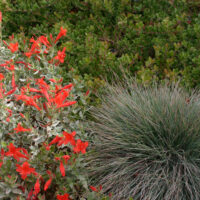
Festuca idahoensis ‘Muse Meadow’
Idaho fescue is a widely distributed native bunch grass growing in seasonally dry habitats below 5,000 ft. The cultivar ‘Muse Meadow’ was selected in the Marble Mountains by Nevin Smith of Suncrest Nursery. Forms hummocks of fine-textured blue blades around 6 inches tall, making it one of the smallest native Idaho fescue cultivars. The flower stems are 12 - 18 inches tall and become straw colored with age. Best in well drained soils in full sun or partial shade. Protect from the hot afternoon sun in hot areas. Provide moderate to occasional irrigation. Deer tolerant.
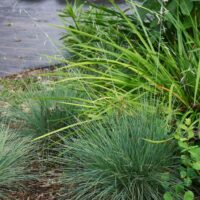
Festuca idahoensis ‘Stony Creek’
From Del Norte County comes this blue-gray native. Tolerant of full sun even inland, getting chalkier with summer scorching, but would prefer some afternoon shade. It grows to about 12 inches by 18 inches, with inflorescences rising to 2 ft in height. Enjoys moderate to occasional water. Good drainage, as its name implies. Deer resistant.
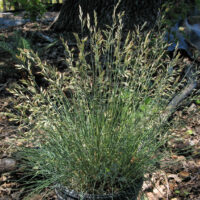
Festuca idahoensis ‘Tomales Bay’
This attractive blue-green selection of our native bunchgrass was discovered in the Nicasio area of Marin County. The soft foliage reaches a height of up to a foot and a width of about 1 1/2 ft.. The inflorescences are smaller than is typical for this species and can grow up to 18 inches tall. Best with full sun near the coast and light afternoon shade inland. Prefers moderate to occasional water. Deer resistant.
Festuca idahoensis ‘Warren Peak’
A Nevin Smith selection of Idaho fescue from the Warner Mts. in northeastern California. Forms dense 8 inch hummocks of very narrow bright green blades that become grey-blue with age. Perhaps the bluest of the native Idaho fescues. The 1 - 2 ft. tall flowering stems are silvery in color. Best in well draining soils in full sun to part shade (especially in hot regions) with moderate to occasional water. Deer resistant.
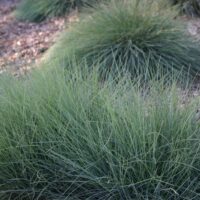
Festuca rubra – Molate strain
Discovered on Point Molate near Richmond, this selection spreads to form soft, flowing drifts of gray-green foliage 12 to 18 inches tall with graceful, open flowers rising to 3 feet. One of the biggest forms of our native red fescue, it’s eye-catching when planted in large masses or when combined with mounding shrubs or some of the more robust native bulbs. Very choice for a meadow or parking strip. Prefers some afternoon shade in the hotter climates and occasional water away from the coast. More drought tolerant than many other red fescues. Deer resistant.
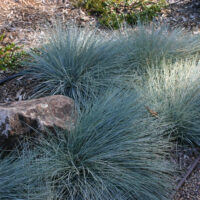
Festuca rubra ‘Patrick’s Point’
Discovered on a rock at Patrick's Point on our north coast, this perennial grass slowly spreads by creeping rhizomes to form tufted drifts of silvery blue. Effective as a component of a meadow or as a small scale groundcover. Typically at its best in situations where it is either unmown or infrequently mown. The 6 - 12 inch tall, vivid blue-gray blades have a soft flowing appearance which combines strikingly with dark foliaged plants such as Iris and beach strawberries. The grass flowers rise 6 to 12 inches above the foliage in loose panicles. Plant in full sun to light shade. Protect form the hot afternoon sun in inland areas. Enjoys occasional to moderate irrigation away from the coast. Deer resistant.
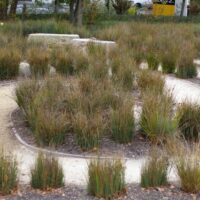
Juncus patens
This handsome evergreen rush provides a striking vertical accent 1-1/2 to 2-1/2 ft. tall with grey-green to grey-blue foliage. Brownish-yellow, tassel-like flowers appear in the spring and early summer. Very adaptable, tolerating a wide range of conditions. Enjoys sun with moisture, but will tolerate dry conditions once established. Accepts moderate shade. Robust root systems are excellent for soil stabilization. Deer resistant.
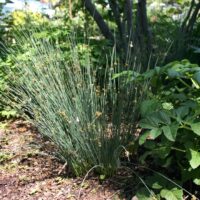
Juncus patens ‘Elk Blue’
Introduced by San Marcos Growers, this form of Juncus patens was selected from the hills southeast of the town of Elk in Mendocino County. Features exceptionally blue foliage and and a vigorous spreading habit. This selection is shorter than the typical grey rush only reaching about 18 inches tall. An adaptable species, will thrive in moist soils, even shallow water but once established tolerates dry conditions too. Grows in sun to moderate shade. An excellent accent plant with its stiff, vertical foliage. Deer resistant.
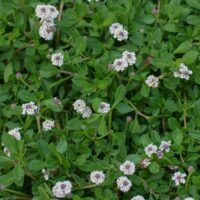
Phyla nodiflora
Vigorous, spreading ground cover native to California, North America and other parts of the world. It's a tough one, able to survive a wide range of conditions and soil types. Tolerates both drought and flooding, but best with occasional deep watering in full sun to very light shade. Flowers heavily over a long period with charming little heads of mauve-pink, lavender and white blossoms, delighting an assortment of bees and butterflies. This dense, carpeting plant makes a serviceable ground cover or lawn-like replacement, tolerating moderate foot traffic and occasional mowing. May look rough in the winter, but quickly recovers in spring. Free flowering and pollinator friendly.
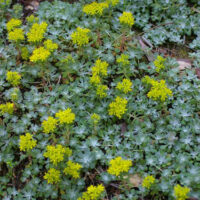
Sedum spathulifolium
A mat forming native succulent often seen on rocky cliffs and shady banks in California’s Coast Ranges and Sierra Nevada north to British Columbia. Small, spoon-shaped leaves form flat rosettes where bright yellow star-like flowers appear in late spring and early summer. A natural for the rock garden or container plantings where they are best with part shade. Very drought tolerant.
Sedum spathulifolium ‘Cape Blanco’
A mat forming, western native succulent, often seen on rocky cliffs and shady banks in California’s Coast Ranges and Sierra Nevada north to British Columbia. Small, spoon-shaped leaves form flat rosettes where bright yellow star-like flowers appear in late spring and early summer. The cultivar 'Cape Blanco' was selected along the Oregon coast, for its chalky-white foliage. A natural for the rock garden or container plantings where they are best with part shade. Very drought tolerant.
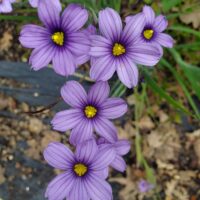
Sisyrinchium bellum
A beloved native perennial wildflower with grass-like foliage and six-petaled spring blossoms that range from blue to purple with occasional pure white forms. Grows 6 - 12 inches tall in small clumps where it is useful in meadow or grassland plantings as well as mixed borders. Sun to partial shade, with moderate to infrequent summer water. Goes summer dormant in dry gardens. Does well in heavy soils and often seeds about when happy.
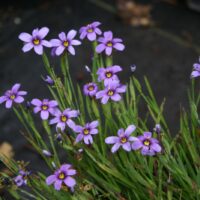
Sisyrinchium bellum ‘Dwarf’
While we’re a little unsure about this selection’s origins, we do know it’s an AMAZING bloomer and an easy garden plant! In spring and into summer, deep blue-purple flowers with yellow centers cover this very dwarf blue-eyed grass which stays under 6 inches tall. Very narrow, iris-like leaves slowly increase to form a small clump. Plant in full sun to light shade and provide moderate to infrequent irrigation. If allowed to go dry in summer, it will go dormant, only to re-emerge with the winter rains. Deer resistant.
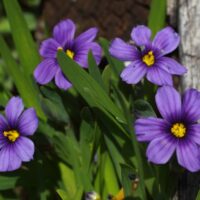
Sisyrinchium bellum ‘Rocky Point’
A vigorous selection of dwarf blue-eyed grass discovered on Rocky Point south of Carmel in Monterey County and introduced by Native Sons Nursery. Robust, rich green clumps of wide, iris-like leaf blades 4 - 6 inches tall feature vibrant blue-purple flowers with yellow centers. A great rock garden item. Plant in full sun to part shade. This spring bloomer will go semi-dormant in summer if allowed to go somewhat dry. With moderate irrigation it will be evergreen and have an extended bloom preiod. Deer resistant.