
Achillea millefolium – Bodega Bay form
Larger leaves up to 10 inches long distinguish this form from most other local yarrow selections. While most yarrow from our coastline have very green leaves, this strain is on the grey side. From spring through autumn, large white flower clusters sit upon stalks about to at least 2 feet in height. Water occasionally in areas away from the coast and provide full sun. The foliage is deer resistant.

Achillea millefolium – inland form – Lake County seed source
A vigorous and easy to grow perennial, yarrow grows native throughout California in many plant communities. This crop is grown from seed collected from a hot inland site in Lake County. In this form, flower stems rise 18 inches above the gray ferny foliage bearing white flowers in flat topped clusters. Plant in a sunny location with moderate to a little water. Spreads by rhizomes and can form sizable clumps if happy. A good addition to the habitat garden where the flowers provide nectar for bees and butterflies and the foliage provides winter forage for birds. The foliage is deer resistant.

Achillea millefolium – inland form – Napa County seed source
A vigorous and easy to grow perennial, yarrow grows native throughout California in many plant communities. This crop is grown from seed collected from a hot inland site in Napa County. In this form, flower stems rise 18 inches above the gray ferny foliage bearing white flowers in flat topped clusters. Plant in a sunny location with moderate to a little water. Spreads by rhizomes and can form sizable clumps if happy. A good addition to the habitat garden where the flowers provide nectar for bees and butterflies and the foliage provides winter forage for birds. The foliage is deer resistant.

Achillea millefolium – inland form – Sonoma County seed source
A vigorous and easy to grow perennial, yarrow grows native throughout California in many plant communities. This crop is grown from seed collected from a hot inland site in Sonoma County. In this form, flower stems rise 18 inches above the gray ferny foliage bearing white flowers in flat topped clusters. Plant in a sunny location with moderate to a little water. Spreads by rhizomes and can form sizable clumps if happy. A good addition to the habitat garden where the flowers provide nectar for bees and butterflies and the foliage provides winter forage for birds. The foliage is deer resistant.
Achillea millefolium – Montara Mountain form
We discovered the parent of this giant seed strain on the lower slopes of Montara Mountain in San Mateo Co.. With broad, white flower clusters reaching up to 4 ft. high, this is the largest yarrow we've encountered. While seedlings can vary, we have high hopes for this new introduction. Give full sun and moderate to infrequent irrigation. Potentially an excellent spreading perennial for a tall meadow. Attracts all sorts of pollinators. The green, fuzzy leaves are usually considered to be deer resistant.

Achillea millefolium ‘Island Pink’
A color variant of the normally white California native yarrow from Santa Cruz Island. Dark green ferny foliage topped with clusters of bright pink flowers on 18 inch stems over a long period. Sun to partial shade, occasional to moderate water. Good habitat value, providing nectar for bees and butterflies. The foliage is deer resistant.

Achillea millefolium ‘Red Velvet’
This yarrow is getting rave reviews for its deep-red flowers produced atop grey-green ferny foliage. Spreading 2 foot or so wide with flowers rising 2 – 2 ½ feet tall. Best in full sun with moderate to occasional watering. Popular with bees and butterflies. Often deer resistant.

Achillea millefolium ‘Sonoma Coast’
This is a local selection from the Sonoma County coast near Salmon Creek. Bright green foliage is topped with white flowers in dense heads on compact stems to around 1 ft. tall. Can bloom over a long period, spring through fall, depending on conditions. Best in sunny areas with some summer water, though it is drought tolerant. Flowers attract butterflies and other insects. The foliage is deer resistant.

Achillea millefolium ‘Terracotta’
This hybrid yarrow forms a mat of grey-green ferny foliage 2 - 3 ft. wide with interesting earth-tone colored flowers. The long-lasting flower clusters simultaneously sport peachy-yellow tones through burnt orange, on sturdy non-floppy stems to around 2 ft. tall. Plant in full sun with moderate to occasional summer water once established. Bees and butterflies love yarrows, but they are not deer favorites. Excellent cut flowers too.
Antennaria rosea
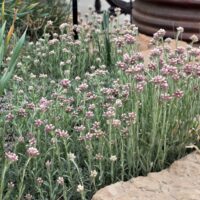
A charming, native, mountain dweller which grows among rocks and onto boulders at meadow edges. Forms low mats only a couple of inches high of woolly, gray leaves that creep and cascade. Short flower stems with small, creamy-white and rosy-pink papery bracts, bloom summer into fall. Plant in full sun to very light shade with good drainage and a little summer water. Good addition for the pollinator garden and is the larval food source for a number of butterflies including the American lady. This is one of the few natives which is so low growing you can plant it between stepping stones.
Arctostaphylos uva-ursi ‘Green Supreme’
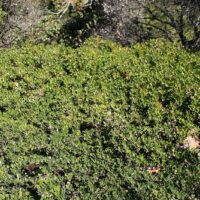
A superior garden hybrid of the trailing bearberry. A volunteer seedling discovered by staff at Tilden Regional Parks Botanic Garden. Ultimately spreads 6 - 12 ft. across and less than a foot tall. Enjoys moderate to occasional irrigation. The glossy bright green leaves create a beautiful groundcover. Tolerates a wide range of soil types with reasonable drainage. Very disease resistant and fast growing. Shy to bloom or set berries. Sun to part-shade.
Arctostaphylos uva-ursi ‘Point Reyes’
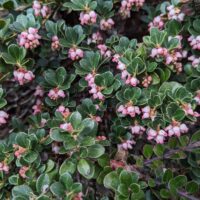
An unusual selection of our native bearberry discovered near the Point Reyes lighthouse in Marin County. Dark green, leathery leaves form distinctive whorls along the stems with pale pink, urn-shaped flowers emerging in early winter. The showy red berries contrast nicely with the dark green leaves. Reaching a height of about 18” and a width of at least 6 ft., this groundcover works well in a rock garden or mixed with other low shrubs and grasses from our coastal areas. Give moderate water in interior locations and protect from the hot afternoon sun.
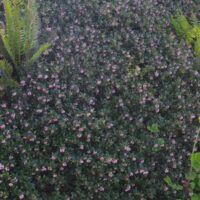
Arctostaphylos uva-ursi ‘Radiant’
A very low mat of glossy, dark green foliage 6 - 8 inches high and creeping at least 6 ft. across. Light pink flowers in early winter are followed by showy red berries. In hot inland areas give moderate water and light afternoon shade. A sturdy evergreen groundcover.
Arctostaphylos uva-ursi ‘Samoa Dunes’
This Humboldt County selection of the ubiquitous bearberry distinguishes itself with large, rounded, glossy leaves of deep green. Reaching a height of about 6 inches and a width of at least 6 feet, this durable groundcover spreads quickly to form a weed-smothering carpet. Little urn-shaped flowers colored soft pink appear in spring and are followed by shiny red berries. Provide full sun to part shade and moderate to occasional irrigation once established. Protect from the hot afternoon sun in warmer areas. The shiny, dark green foliage combines well with grey-leaved plants such as Artemisia ‘David’s Choice’ and the fescue ‘Patrick’s Point’.
Arctostaphylos uva-ursi ‘San Bruno Mountain’
A beautiful selection of bearberry from San Bruno Mountain south of San Francisco. This groundcover manzanita forms a luxuriant mat of large, glossy, spatulate leaves spreading to around 6 feet wide. The soft pink urn-shaped flowers lead to big red showy berries. A natural for coastal plantings where it can grow in full sun with little to no summer water needed. Inland, bearberry does best with shade from the hot afternoon sun and moderate summer watering.
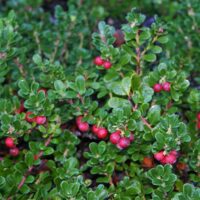
Arctostaphylos uva-ursi ‘Wood’s Compact’
A low growing, spreading manzanita with lustrous green, rounded foliage, little pink urn-shaped flowers and pretty red berries, quite large for the species. This selection from coastal Oregon spreads at a moderate pace to 6-8 feet wide and only getting 6-8 inches tall. Full sun to light shade in hot areas with moderate summer water.
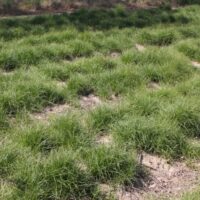
Carex pansa
A durable spreading sedge which can be used as a lawn substitute or unmowed meadow. Growing 8 -12 inches tall and spreading by rhizomes to form dense colonies of curling dark green foliage. The foliage is evergreen in mild climates and grows well in full sun to partial shade with regular to occasional water. Too much drought causes summer dormancy. Flowers appear in early spring but are not real showy. Deer resistant.
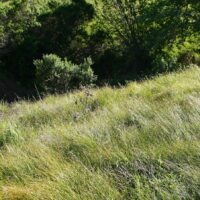
Carex praegracilis
Similar to Carex pansa but growing taller. The fine textured grass-like blades can reach a foot or more tall and spreads freely by rhizomes to form a thick weed smothering groundcover. Useful for meadows, green roofs, bio-swales, erosion control and as a lawn substitute. Can be left natural where it has a lush tousled appearance or trimmed occasionally for a low turf-like appearance. Tolerates drought, inundation, poor soils, salt spray, heat, cold, shade and foot traffic. Plant in sun to light shade where it requires some summer moisture but far less than a conventional lawn. Will go summer dormant if allowed to get too dry. Deer resistant.
Carex praegracilis ‘Chisai’
An excellent cultivar of the native field sedge, selected for it's compact form and slower spreading habit. Increases by short rhizomes to form a sturdy, dark-green carpet, 6 -8 inches tall and 1 - 2 ft wide. Grows more clumping and significantly tighter than the rapidly spreading forms more typical of the species. Still, it will form a solid, small scale ground cover or turf substitute, between stepping stones or mixed with bulbs and perennials for a meadow affect. Plant in full sun to light shade with occasional to moderate water. Tolerates light foot traffic. Deer resistant.
Epilobium ‘Bert’s Bluff’
A Las Pilitas Nursery selection, named for the founder, Bert Wilson. This California fuchsia sports grey foliage, growing 2 -3 foot tall and spreading. Blooming in late summer, the bright orange-red, tubular flowers are beloved by hummingbirds, but visited by bees as well. This cultivar is reputed as being particularly tolerant of a wide range of soil conditions and growing environments. Plant in full sun with occasional deep summer watering.
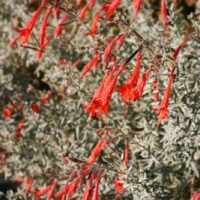
Epilobium ‘Chaparral Silver’
This California fuchsia that we obtained from another grower appears to be identical to our ‘Roger’s U. C. Hybrid’ - same lovely gray foliage 12 -18 inches tall, spreading, with narrow red tubular flowers that the hummingbirds love. Provide full sun to bright shade. Flowers best with occasional deep watering. Pruning plants down to a few inches in late autumn helps to rejuvenate them for the following year.
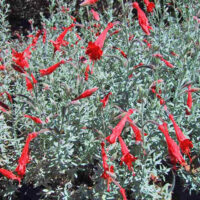
Epilobium ‘Roger’s U.C. Hybrid’
A California fuchsia that is upright in habit with narrow silver-gray foliage and slender trumpet-shaped blossoms of orange-red. Reaches a height of about 1 1/2 ft. and spreads easily. Very similar to the selections ‘Carman’s Gray’ and ‘Chaparral Silver’. Flowers best with occasional deep watering. Hummingbird favorite. Pruning plants down to a few inches in late autumn helps to rejuvenate them for the following year.
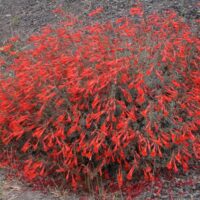
Epilobium ‘Schieffelin’s Choice’
This California fuchsia grows close to the ground - 10 - 12 inches tall with arching flower stalks. Gray foliage makes a wonderful foil for the bright orangey-red tubular flowers which appear summer through fall. Believed to be a cross between E. septentrionale and E. canum. Provide full sun to very light shade. One of the more drought tolerant selections but flowers best with occasional deep watering. Hummingbird favorite. Pruning plants down to a few inches in late autumn helps to rejuvenate them for the following year. Perhaps more deer resistant than other California fuchsias.
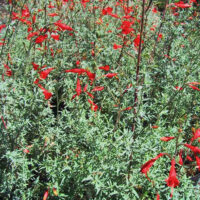
Epilobium canum ‘Bowman’s Hybrid’
This California fuchsia has distinctive narrow, olive-green foliage and an upright habit about 2-3 ft. tall and spreading widely. The orange-red tubular flowers are petite but profuse. Plant in sunny areas. Flowers best with occasional deep watering. Pruning plants down to a few inches in late autumn helps to rejuvinate them for the following year. Hummingbird favorite.
Epilobium canum ‘Calistoga’
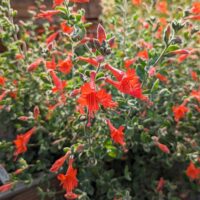
Phil Van Soelen’s selection of California fuchsia from the Palisades east of Calistoga. Forms a spreading mat of unusually wide, fuzzy, gray leaves. The flowers are the typical hummingbird attracting orange-red trumpet shape and appear on stalks reaching up to 18 inches high. For sunny areas. Flowers best with occasional deep watering. Pruning plants down to a few inches in late autumn helps to rejuvenate them for the following year.
Epilobium canum ‘Carman’s Grey’
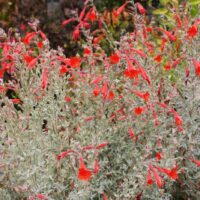
We love California fuchsias and have grown this cultivar for over twenty years. Valued for their beauty and important late season nectar source for hummingbirds, California fuchsias offer many forms and foliage colors. 'Carman's Grey' has gorgeous grey foliage which contrasts beautifully with the masses of orangey-red, tubular flowers, late summer and fall. The grey, narrow leaves form soft mounds 2 foot tall, spreading by underground rhizomes, 4 foot or so wide. Plant in full sun to very light shade where it is tolerant of many soil types, even heavy clay, drought tolerant, but best with occasional summer watering. Hummingbird magnet and bees use it too.
Epilobium canum ‘Catalina’
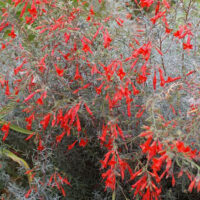
An outstanding selection of California fuchsia growing 3 ft. tall or more. This may be the tallest cultivar available, sometimes reaching as much as 5 ft. tall. The foliage is silvery-gray with an abundance of large, brilliant orangey-red tubular flowers late summer through fall. This species from southern California is particularly drought tolerant. Hummingbird favorite. Flowers best with occasional deep watering. Pruning plants down to a few inches in late autumn helps to rejuvenate them for the following year.
Epilobium canum ‘Cloverdale’
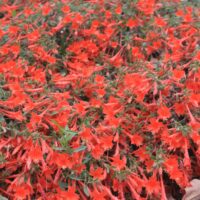
This form of California fuchsia was selected by U.C. Santa Cruz Arboretum from along the Russian River north of Cloverdale. Low, slightly mounding fuzzy olive-green foliage with an abundance of orangey-red tubular flowers the hummingbirds love. Usually stays bellow one ft. in height. 'Cloverdale' is one of the most orange selections of California fuchsia. Plant in full sun. Flowers best with occasional deep watering. Pruning plants down to a few inches in late autumn helps to rejuvenate them for the following year.
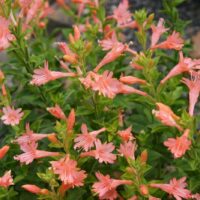
Epilobium canum ‘Coral Canyon’
This elegant and unusual form of the California fuchsia offers a prolific display of peachy-pink flowers, a departure from the more common orangey-red blossoms. The late-summer, autumn blooms are held on distinctly upright stems reaching 1 ½ ft. high above broader, bright green foliage. Unlike most native fuchsias, this selection is somewhat shy to spread, generally forming a rounded mound about 2 ft. wide. Enjoys full sun, but will benefit from a little afternoon shade in hot areas. Likes moderate to occasional irrigation. Hummingbirds and bees partake from the flowers. We must thank Cistus Nursery for discovering the parent plant on a high ridge above the North Fork of the American River.
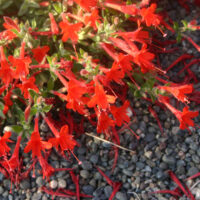
Epilobium canum ‘Everett’s Choice’
A low, spreading form of Californica fuchsia staying below one ft. in height. Distinctive for its fuzzy, gray-green foliage with many scarlet tubular flowers from summer through to fall. Good for sunny areas, though tolerates light shade. Flowers best with occasional deep watering. Attracts hummingbirds. Pruning plants down to a few inches in late autumn helps to rejuvenate them for the following year.