
Aristolochia californica
Dutchman’s pipe vine is an interesting vine native to river, stream side and woodland habitats. Soft heart-shaped leaves and unusual purplish pipe-shaped flowers bloom in early spring. This deciduous twining plant will need some support if you wish it to grow upwards. Adaptable, but best with a little shade and moderate water. Slow to establish, we offer this adage to encourage patience: “The first year it sleeps, the second year it creeps and the third year it leaps”. Once established it will put on ample growth, easily covering a trellis or chain link fence. THE larval food source for the pipevine swallowtail butterfly. Deer resistant.
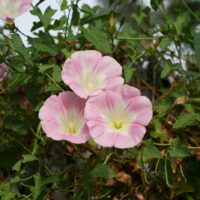
Calystegia purpurata ssp. purpurata
Lush, slender-stemmed vine with gray-green heart-shaped leaves scrambles up, over, or through any support provided. From late spring through early summer the plant is decorated with trumpet-shaped blossoms ranging in color from white to pink to purple. This deciduous vine can grow up to 10 ft. tall and wide. Sun to light shade, most soils, moderate to occasional watering for best appearance. Native throughout the Coast Range of California.
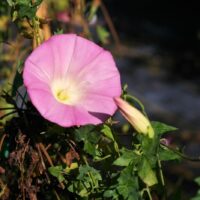
Calystegia purpurata ssp. purpurata ‘Palomarin’
Large flowers which open pinkish-white and darken to a rich lavender distinguish this selection which we discovered near Bolinas in Marin County. This vigorous, deciduous vine spreads quickly to climb over fences and shrubs with clasping stems and grey-green, arrow-shaped leaves. Reaches a height of up to 10 ft. or so and can spread at least as wide. In late spring and early summer, the morning glory flowers put on quite the display, opening at dawn and then closing at dusk. Does great in full sun but also enjoys a little shade, especially in hot, inland areas. Likes moderate irrigation but will become somewhat drought tolerant once established. Hummingbirds and native pollinators are drawn to the flowers.
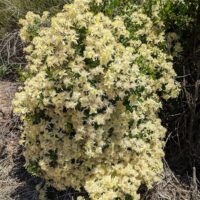
Clematis lasiantha
This deciduous native vine climbs over shrubs and trees in full sun to part shade. Produces a wealth of one inch, creamy-white flowers in spring and summer followed by large fluffy attractive seed heads. Use clematis to adorn a pergola or archway, or to train up trees or other structures. Plant in full sun to light shade. Little water once established. Generally deer resistant.
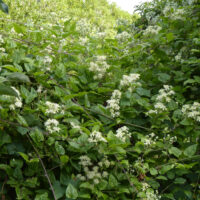
Clematis ligusticifolia
Native to riparian areas where the vining stems will climb and weave their way up and over shrubs and trees. Large masses of fragrant, small creamy-white flowers bloom in summer. Beautiful, silvery, feather-like fruits follow and are as attractive as the blossoms. The intricately divided leaves on long stems can climb 20 - 30 ft. Full sun to light shade with regular to moderate summer water. Deciduous. Generally deer resistant.
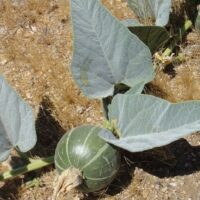
Cucurbita foetidissima
Found in valley grasslands and coastal scrub environments of Central and Southern California, the buffalo gourd is a deciduous perennial ground cover or vine that is sure to grab attention. In late winter and early spring, this vigorously spreading gourd emerges from a tuberous root, potentially spreading to 20’ feet or more, producing big, triangular, gray-green fuzzy leaves, followed by large, showy, orange-yellow, bell-shaped flowers in summer which attract bees. The round fruits, about 4 inches across, are green-striped when young, maturing to yellow. As the fruit matures, it is too bitter for humans to eat. The mature fruit is used by native peoples for decorative purposes or for making musical rattles. Plant in full sun. Drought-tolerant once established.
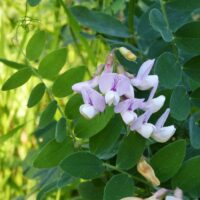
Lathyrus vestitus
From woodland to chaparral throughout much of the California coast ranges comes this charming sweet pea relative. Clusters of dainty flowers ranging in color from white to pink and lavender grace this evergreen vine in the spring, followed by clusters of small peapods. Plant along a fence or amongst shrubs where it will climb up to 8 ft. tall and wide. Provide light shade inland but will tolerate full sun near the coast. Drought tolerant once established but will also accept occasional irrigation. This vine is a host plant to the silvery blue butterfly and the arrowhead blue butterfly.
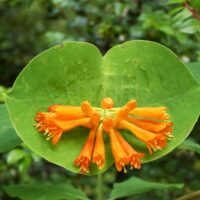
Lonicera ciliosa
Native to north slopes, creeks and river banks from very northern California to British Columbia and Montana. Lovely blue-green, oval-shaped leaves on rapidly growing woody stems will clamber up any support it can find. Terminal flower clusters with narrow, trumpet-shaped, orange flowers are adored by hummingbirds. Red translucent fruits follow that are relished by birds. Plant in cool sun to moderate shade with regular water. Possibly deer resistant.
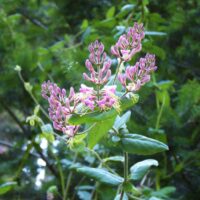
Lonicera hispidula
This native honeysuckle is often seen climbing over shrubs on the edge of woodlands where its roots are shaded and its foliage is sun drenched. The trumpet-shaped flowers range in color from rosy-pink to pink and white and feature prominent yellow stamens emerging from their mouths. They form clusters which decorate the tips of the vining branches and are attractive to bees and hummingbirds. The high point is the drooping clusters of luminous red berries in late summer which are beautiful to behold and provide a feast for birds, especially orioles. A drought tolerant vine but would appreciate occasional deep summer watering. Considered by some to be deer resistant.
Marah oregana
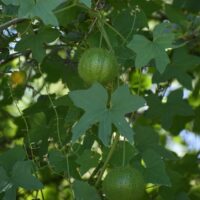
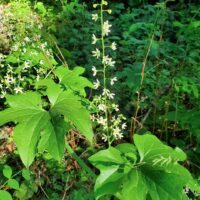
A native perennial vine found in coastal counties from Santa Clara, California to British Columbia. Growing from a massive, enlarged tuber in forest edges and riparian habitats. The lush-green, palmate leaves with spiraling tendrils clamber along the ground and climb and sprawl over shrubs and trees. White, star-like flowers bloom in the spring and are favored by native bees as well as honeybees. The flowers lead to showy, inflated, bright-green, fruits with soft spines. The generic name Marah comes from the Hebrew word for bitter, in reference to all parts of the plants being extremely bitter to taste. Completely herbaceous, dying back to the woody root in late summer or fall, returning in the spring. Best with part shade. Quite drought tolerant but will accept moderate irrigation. Probably deer resistant.

Vitis californica
California wild grape is a vigorous deciduous vine, native to watercourses in California and Oregon. Lush foliage on woody vines create leafy draperies in riparian areas. Useful in the garden for trellises, arbors, fences or to spill down a bank. Round green leaves take on nice yellow tones in the autumn. Flowers are very attractive to bees.Fruits are small and seedy but tasty. Excellent habitat value providing food and cover for wildlife.
Vitis californica ‘Russian River’
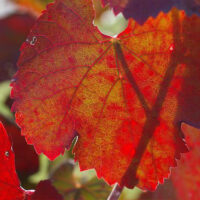
Our own selection of what is likely a hybrid between the native Vitis californica and the European wine grape Vitis vinifera, originating along the Russian River near Rio Nido in Sonoma County. Similar to 'Roger’s Red’ in vigor and heavy fruit production, this cultivar has deeper purple-red fall colored leaves that tend to hold on to the vine longer than the selection 'Roger’s Red'. An adaptable vine, thriving in full sun to light shade with regular to moderate water. Will grow well with far less summer water, though plants in dryish conditions tend to be less rampant. Good habitat plant.
Vitis californica x ‘Roger’s Red’
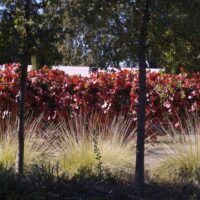
Selected by Roger Raiche, this cultivar is now thought to be a natural hybrid between the native Vitis californica and the European wine grape, Vitis vinifera. A beautiful and vigorous vine used to cover fences, trellises, arbors, or used as a ground cover. This selection has gorgeous warm red fall color and ample fruit clusters that are small (with seeds), but sweet and tasty. An adaptable vine, thriving in full sun to light shade with regular to moderate water. Will grow well with far less summer water, though plants in dryish conditions tend to be less rampant. Good habitat plant.
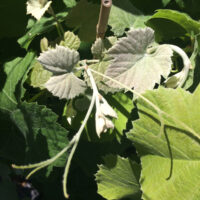
Vitis girdiana
This close relative of Vitis californica is native to southern California where it grows stream side or in moist canyons. Fast growing and heat tolerant, this vigorous vine can climb up to 50 ft. The growing tips, tendrils and new leaves are covered in downy hairs, providing gorgeous silvery colored new growth. Beautiful when allowed to spill and climb over walls or when trained to a fence or arbor. A good choice for hotter inland gardens. The purple-black fruits are highly attractive to birds and other mammals, including humans!