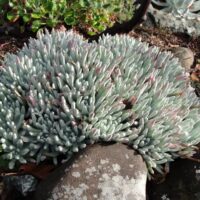
Dudleya ‘Frank Reinelt’
The beautiful and rarely offered Dudleya will form dense mounds 6" - 8" tall with silvery, finger-like leaves, sometimes developing a purple-red blush. Slender stalks appear in late spring and display star-like flowers of soft yellow up to a foot above the foliage. They make handsome specimens in a rock garden or perform as a striking groundcover up to 2' wide mixed with other coastal bluff plants like red buckwheat, seaside daisy, and sea thrift. Great in a container or planted under manzanitas amongst rocks. Needs good drainage and little water once established. Full sun near the coast, but light shade inland.

Dudleya ‘Seedlings from ‘Frank Reinelt’
These seedlings from the beautiful Dudleya ‘Frank Reinelt’ will form dense mounds 6 - 8 inches tall with silvery finger-like leaves. They make handsome specimens in a rock garden or perform as a striking groundcover in mass plantings mixed with other coastal bluff plants like red buckwheat, seaside daisy, and sea thrift. Avoid over-watering and control snails. Full sun to light shade with good drainage.
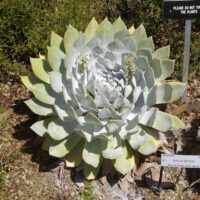
Dudleya brittonii
A Baja California native. Useful and very dramatic in containers or well-drained rock gardens. Likes a protected and sunny microclimate where cold air and winter wet can drain away. Enjoys a little afternoon shade in hotter climates. Develops up to 1 1/2 ft. wide rosettes with fleshy chalk-covered leaves. Yellow flowers sit atop tall stalks in late spring and early summer.
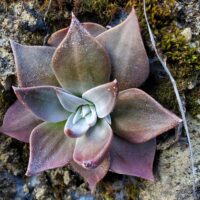
Dudleya cymosa
This charming succulent is in native to California where it grows in between rocks on inland cliffs in sun or bright shade. Best in the garden in a rock wall or terra-cotta pot with some afternoon shade. Height in flower is under one foot. The yellow to orange flowers are attractive to hummingbirds. Occasional to infrequent water in the ground. In pots, let dry out between waterings.
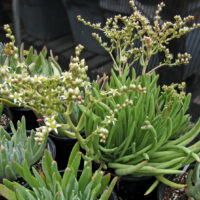
Dudleya edulis
Native to rocky slopes and ledges below 3900’ in Southern Coastal California, the Peninsular Ranges, and Northern Baja California. This Dudleya forms clustering rosettes of dainty, light green, pencil-like leaves. In summer, tall stalks of fragrant, pale yellow flowers rise high above the foliage. Growing about a foot tall (with flowers) by one foot wide. Plant in well drained soil and cool full sun to part shade inland. A delicate accent in a rock garden or amongst coastal plants, also fine in containers. Known as “mission lettuce” for its fleshy raw leaves, once considered a delicacy.
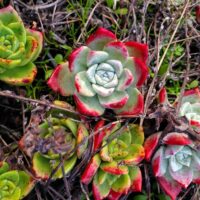
Dudleya farinosa
Native to sea bluffs in central and northern California. Rosettes of fleshy leaves are chalky grey or bright green and often red tipped. Candelabra-like clusters of light yellow flowers on thick stalks appear in summer. Provide part shade away from the coast. Excellent for rock garden, walls or containers, where good drainage and a little summer water can be provided.
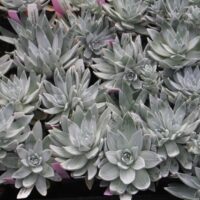
Dudleya farinosa – Noyo River form
Perched on the cliffs of the Noyo River are beautiful rosettes of bluish-white succulents known as bluff lettuce. This special form from the Mendocino coast was selected by Matt Teel for its small and compact stature, striking color and flat leaves. The foliage reaches a height of about 4 inches and slowly spreads to make small colonies. Yellow flowers sit atop slender pink stalks rising 8 inches off the ground. Provide protection from the afternoon sun in inland sites and plant in well-draining soil. Excellent in containers where it only needs occasional water.
Dudleya pulverulenta
Large, broad, chalky-white leaves forming rosettes up to two ft. wide make this Dudleya one of our most sought-after native succulents. A multitude of tubular red flowers appear in late spring and early summer on stalks reaching from 1.5 to 3 ft. tall. Fleshy, heart-shaped bracts line the stems. Plant in bright shade or provide morning sun and afternoon shade. Needs excellent drainage and infrequent irrigation. Plant at an angle to prevent water from gathering around the base in winter. A gravel mulch around the plant can help stabilize soil temperature and prevent excessive dehydration. Good container plant.
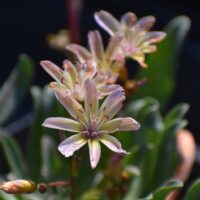
Lewisia longipetala ‘Little Peach’
Large flowers with long petals colored peachy apricot make this selection of our native cliff maids a knockout in the garden. Round clusters of narrow, succulent leaves form patches up to about 8 inches wide. The irresistible flowers emerge en masse from between the leaves on slender stalks up to about 10 inches high. A very long bloomer, beginning in spring and often re-blooming in summer. Works really well in a container with lean, fast draining soil, placed in bright partial shade. Water sparingly. For best results, mulch with granite chips and fertilize occasionally. Lewisias are native to the mountains of California and beyond, where they grow in rock cliffs. An excellent choice for the rock garden.
Lewisia longipetala ‘Little Raspberry’
The parent of this strain of Lewisias is found in rocky outcroppings of the Sierra Nevada Mts. Forms low, fleshy rosettes of tough evergreen leaves. Raspberry-red flowers bloom on short stems above the leathery foliage in the spring into summer and often again in the autumn. Requires good sharp drainage and rock mulch, but appreciates partial shade in hot summer areas. Perfect for rock walls, rock garden, containers and troughs. Water as you would any succulent, sparingly, and keep crown high and dry. This is not the plant for your perennial border, but it is easy to make happy in containers.