
Agrostis pallens
A fine textured, drought tolerant, spreading, perennial grass that forms an undulating, naturalistic, meadow look, or can be mowed and used as a lawn substitute. Native to meadows, open woodlands and forests in many plant communities in California north to British Columbia. Grows 1 -2 ft. tall with airy flower stems in late spring to early summer. May be shy to flower in shady areas. Plant in sun to light shade, with decent drainage, where it will accept both water and drought. Will go dormant in summer without irrigation. If using as a lawn substitute, it will need summer irrigation, though requiring far less than a traditional lawn. Excellent understory among trees or shrubs, for rain gardens, bio-swales, meadows or mowed as a lawn substitute. Host plant for a number of butterflies. Deer resistant.

Bouteloua curtipendula
A perennial bunch grass with 2-3 foot stalks of tiny, purple-tinged flowers that emerge in the heat of summer. The common name of the species derives from the arrangement of floral spikelets along one side of the inflorescence. Its blue-green foliage forms low, clumping mounds, turning purple-ish in fall and eventually going winter dormant. As the flowers mature into seeds and dry to golden, they hang decoratively off arching stems, bearing a resemblance to oat grass. Native to a large swath of central North America, its range reaches into hotter, drier areas of Southern California and the Southwest. Adapts to various irrigation schedules and soil types, but requires minimal water once established. Plant in full sun or part shade. Useful for meadows or rock gardens. Seeds attract birds.

Bouteloua gracilis
Here’s a wonderful grass - an important species of the original North American shortgrass prairie. In California it occurs in desert regions. Fine textured light green-gray foliage topped with interesting flowers 8 - 36” tall. The flowers are attached to the stem at right angles and resemble tiny combs. The whole plant turns purple with frost then fades to blonde. Use in mass or as a specimen in rock garden or containers. Often suggested for a mowed or unmowed lawn where it tolerates extreme cold, heat, drought and foot traffic. Deer resistant.
Bouteloua gracilis ‘Blonde Ambition’
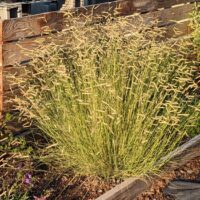
An exceptionally robust selection of grama grass, with 2-1/2 to 3 ft. tall flowering stems above the narrow grey-green tufts of foliage, forming clumps up to 3 ft. wide. The curious flowers look like tiny brushes on tall stems, start out chartreuse aging to blonde. They are persistent and will hold on through winter providing many months of ornamental interest. Retains some green foliage in winter in mild areas, goes winter dormant in hot inland situations. Native to the North American shortgrass prairie, this is a rugged species enduring heat, drought, cold, a wide range of soil types and even foot traffic. An excellent water conserving grass for full sun. Deer resistant.
Bouteloua gracilis ‘Pestanas de Angeles’
Long lived, warm season, perennial grass, native to North America. The selection ‘Pestanas de Angeles’ is from San Bernardino County in Southern California. Fine textured, grey-green blades about 6 inches tall. Intriguing flower heads look like little flags or eye lashes on wiry stems under a foot tall. Tolerant of heat, drought and poor soils, this grass is at home in the arid west. Plant in full sun where it will be drought tolerant once established. Blades go dormant in the winter. Excellent in rock gardens, with succulents or as a meadow subject. Good cut flower. Deer resistant.
Calamagrostis foliosa
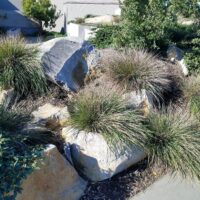
A beautiful native grass offering a very useful size and form for the landscape. Growing one foot tall by two feet wide with beautiful arching mounds of blue-grey blades often highlighted with purple tones. Spring brings flower spikes on arching stems with tight silvery- purple heads that turn tawny with age. A natural for coastal climates with good drainage and moderate to occasional watering, where it will tolerate wind and salt spray. In warmer interior sites it requires some shade and additional water. Excellent as a specimen or in mass, in a rock garden, perennial border, meadow, woodland margin or slope. Deer resistant.
Calamagrostis foliosa x nutkaensis ‘Little Nootka’
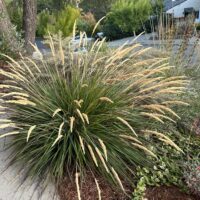
This robust, but elegant bunchgrass was discovered by Cal Flora as a chance cross between the Pacific and Mendocino reed grasses. A beautiful garden plant which inherited useful traits from both parents. It’s shorter and denser than the Pacific reed grass, with foliage reaching up to about 1 ½ ft. high, but still retaining its lush, broad, green leaves. One can see the influence of the Mendocino reed grass in the broader form, spreading up to 3 ft. wide. The tight grass flowers are generally held upright on prolific stalks which rise to about a foot above the foliage. Plant in full sun near the coast, but with some afternoon shade in hotter areas. Somewhat drought tolerant once established. Accepts moderate to occasional irrigation. Deer resistant.
Calamagrostis koelerioides
An uncommon but widely distributed mid-sized native grass appearing in meadows and on rocky ridges throughout California. The soft green leaves reach a height of up to 2 ft. tall and will slowly spread to create a small clump. Narrow, feathery grass flowers reach 2 - 3 ft. high in summer and age to a pale tan color. Since this grass is new to us and we don't know of any other nurseries who have grown it, we are uncertain of its requirements. Based on this species' habitat in nature, we would recommend providing it full sun to light shade and moderate to infrequent irrigation with excellent drainage. Deer resistant.
Calamagrostis nutkaensis
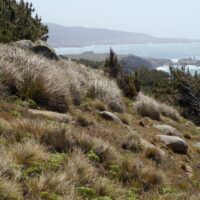
A large handsome bunch grass from the coastal regions of Monterey County to Alaska that forms huge tussocks in open moist meadows and on coastal bluffs. It can also be found as an understory at the edges of coniferous forests. Wide green blades grow 2 - 3 ft. tall with flowering culms to 4 ft. Good background or accent plant for the woodland or meadow. Will take full sun in somewhat cooler areas. Best with some summer water and partial shade inland. Deer resistant.
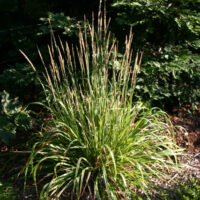
Calamagrostis nutkaensis ‘The King’
Large, handsome, evergreen native bunch grass selected by Roger Raiche in the King Range on the North Coast. Big bold deep green foliage and robust form 3 - 4 ft. tall and wide. Flower stalks rise a foot or two above the foliage. Good background or accent for woodland or partly shaded meadow. Will take full sun in somewhat cooler areas. Best with some summer water. Deer resistant.
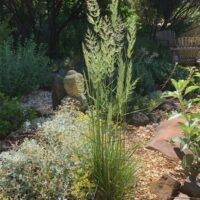
Calamagrostis ophitidis
This handsome native bunchgrass deserves special attention for its tidy, upright form and sturdy character. A rare and threatened species from serpentine areas along our central coast, serpentine reed grass performs well in full sun but may need afternoon shade in hot, inland locations. The leaves reach a height of between one and two feet with flower spikes rising up to three feet tall. Does best with decent drainage and moderate summer water. Deer resistant.
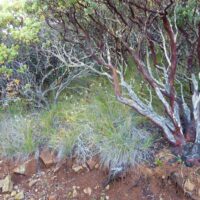
Calamagrostis rubescens
Native to wooded areas throughout the West, this slowly spreading grass forms dense drifts excellent for naturalizing in bright shade. The foliage reaches a height of about 12 inches with narrow inflorescences rising another 12 inches or so. While drought tolerant, it enjoys an occasional watering. Works well under oaks. Deer resistant.
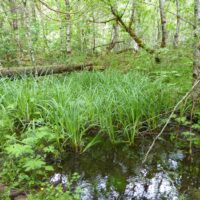
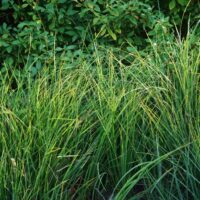
Carex barbarae
Widely distributed native sedge that is an important traditional basket fiber plant. Bright green sharp blades in clumps 1 - 3 ft. tall and spreading. Oval-shaped tufts of small reddish-brown flowers on spikes at the tip of the flowering stems. An attractive sedge, though it can be invasive. For sunny or partly shaded areas with regular to moderate moisture. Drought tolerant in clay soils or with some shade. Handsome container plant too. Often used in bio swales and riparian restoration. Deer resistant.
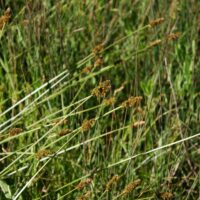
Carex densa
While uncommon in nurseries, this semi-evergreen sedge forms green tussocks which are very useful in seasonally moist meadows and open woodlands. Elongated, chunky seed heads rise above the dense leaf blades on slender stalks up to 2 ½ ft. tall. The foliage reaches 1 to 2 ft. high and slowly spreads to form small clumps. Useful for smaller gardens where you want a sedge that doesn’t spread super vigorously. Tolerates summer drought in somewhat heavier soils. A little extra irrigation will keep this sedge more evergreen. Native to much of California and north to Washington. Deer resistant.
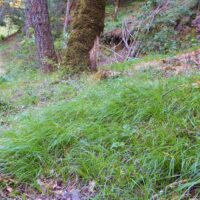
Carex globosa
Here is a sturdy and useful woodland sedge native to well-drained soils in wooded areas. Grows 6 - 12 inches tall and spreads slowly to form bright green tussocks. Useful as a filler among shrubs or trees in filtered shade where it tolerates drought; but some summer water will keep it looking fresh for longer. Great under oaks. Deer resistant.
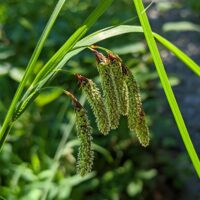
Carex mertensii
This is one of our most ornamental native sedges, forming clumps up to 2 ft. wide with gracefully arching leaves radiating out from the center. Tall flower stalks reaching up to 3 ft. high sit well above the foliage with dangling, soft, fuzzy inflorescences perched elegantly from the tips. The Mertens’ sedge hales from moist meadows and bright woodlands in the Klamath Mountains of Northern California, but does well in lowland climates as long as it is kept moist. Plant in light shade. Combines beautifully with columbines, angelicas, cardinal and seep monkeyflowers, and fringecups. Will go dormant in winter, only to remerge with lush green growth in the spring. Deer resistant.
Carex nudata
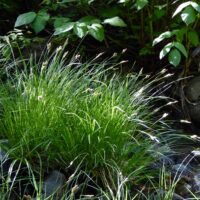
Native to below the high water mark along perennial water courses. Forms a bright green, dense, arching mound with interesting black flowers in spring. Best in moist soils, full sun to light shade. 1 - 2 1/2 ft. tall and wide. Lovely yellow fall color in colder locations. Winter deciduous. Beautiful in containers too. Deer resistant.
Carex obnupta
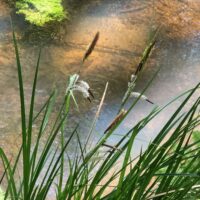
From moist coastal sites to shady redwood forests comes this tall sedge, one of the tallest of our native sedges. Spreads vigorously to form dense drifts up to 4 feet in height. One of the more shade tolerant sedges, the slough sedge can grow under the darkness of a redwood canopy but will also accept full sun as long as it has access to moisture. A great plant for naturalizing in moist areas. Used by native peoples for basket making.
Carex pansa
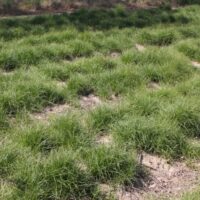
A durable spreading sedge which can be used as a lawn substitute or unmowed meadow. Growing 8 -12 inches tall and spreading by rhizomes to form dense colonies of curling dark green foliage. The foliage is evergreen in mild climates and grows well in full sun to partial shade with regular to occasional water. Too much drought causes summer dormancy. Flowers appear in early spring but are not real showy. Deer resistant.
Carex praegracilis
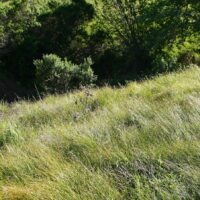
Similar to Carex pansa but growing taller. The fine textured grass-like blades can reach a foot or more tall and spreads freely by rhizomes to form a thick weed smothering groundcover. Useful for meadows, green roofs, bio-swales, erosion control and as a lawn substitute. Can be left natural where it has a lush tousled appearance or trimmed occasionally for a low turf-like appearance. Tolerates drought, inundation, poor soils, salt spray, heat, cold, shade and foot traffic. Plant in sun to light shade where it requires some summer moisture but far less than a conventional lawn. Will go summer dormant if allowed to get too dry. Deer resistant.
Carex praegracilis ‘Chisai’
An excellent cultivar of the native field sedge, selected for it's compact form and slower spreading habit. Increases by short rhizomes to form a sturdy, dark-green carpet, 6 -8 inches tall and 1 - 2 ft wide. Grows more clumping and significantly tighter than the rapidly spreading forms more typical of the species. Still, it will form a solid, small scale ground cover or turf substitute, between stepping stones or mixed with bulbs and perennials for a meadow affect. Plant in full sun to light shade with occasional to moderate water. Tolerates light foot traffic. Deer resistant.
Carex serratodens
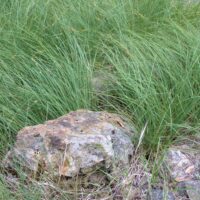
From serpentine meadows comes this lush, blue-green sedge. Our form grows 1 - 2 ft. tall and spreads at a moderate pace, creating broad drifts over time. Needs moderate to regular moisture and full sun to part shade. Often goes semi-dormant in winter at which time the plants can be cut back to just a few inches. A useful sedge for gardens on serpentine or for bank stabilization where it can provide cover for tree frogs and other critters. Does not require serpentine soils to thrive. Deer resistant.
Carex spissa
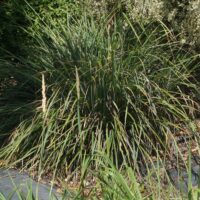
Native to watercourses in coastal sage scrub, chaparral and oak woodlands from San Luis Obispo County to San Diego County. Has proven adaptable and easy to grow here. Wide silvery blades 3 - 4 ft. tall with brown nodding flowers. Sun to light shade. Regular to moderate water. Deer resistant.
Carex tumulicola
This is the TRUE Carex tumulicola, the foothill sedge, not to be confused with the so called Berkeley sedge which is correctly identified as Carex divulsa and is non-native AND invasive. Foothill sedge has a wide distribution in California and north to Washington. A tough and adaptable tufted evergreen growing 12 inches (or more) tall and spreading slowly by underground rootstocks. Useful as an informal groundcover under shrubs or trees, for a meadow planting or for soil stabilization where the spreading roots help control erosion. Best with some shade unless right along the coast. Responds to water but is able to tolerate periods of dryness.
Danthonia californica
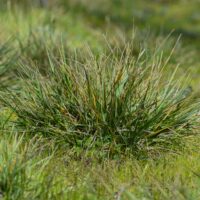
California oatgrass is a native bunchgrass found throughout mountains and coast ranges in both open and partly shaded areas. Forms dense leafy tufts with flower stalks of nodding spikelets to 1 1/2 ft. tall. Not to be confused with the invasive alien wild oats, this native makes a good basic grass for a meadow planting. Withstands trampling and traffic. Good for soil stabilization. Sun to very light shade. Little to no summer water once established. Deer resistant.
Deschampsia cespitosa ssp. cespitosa
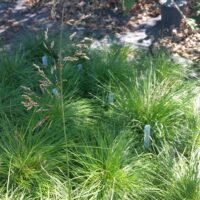
Tufted hairgrass has a large natural distribution, in both the northern and southern hemispheres, in high elevation mountains as well as lower elevations along the coast. The seed for this crop is from coastal Sonoma County, a good choice for low elevation gardens. Forms a deep-green bunch of finely textured blades up to one foot tall with airy flower panicles extending two foot or more above the foilage. Useful framework among wildflowers or with perennials and shrubs. Sun to light shade and a little summer water. Deer resistant.
Deschampsia cespitosa ssp. holciformis
This native bunchgrass makes its home on windswept coastal bluffs from Central CA north to British Columbia. The tidy, evergreen clumps of foliage reach 6 – 12 inches tall and get at least as wide. Stiff, green leaf blades can give plants a spiky appearance, but also make this variety look more symmetrical than many native grasses. The narrow Inflorescences can reach up to 2 ft tall. Does best with full sun near the coast, but enjoys some afternoon shade in hotter areas, where moderate irrigation is recommended. Grows well with iris, seaside daisies and other coastal species. Deer resistant.
Deschampsia elongata
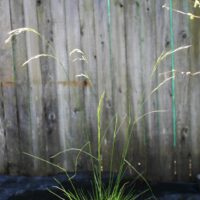
Graceful fine-textured perennial bunch grass, native to partly shaded, seasonally moist areas in California. Features bright green blades and gently arching flower stalks 12-18 inches tall. Yellowish-green in spring, turns soft gold in summer. Deer resistant.
Elymus (Leymus) condensatus ‘Canyon Prince’
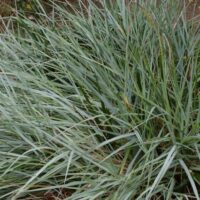
A beautiful selection from the Channel Islands off Southern California. Distinctive for the lovely, broad, silver-blue blades 2 1/2 to 3 ft. tall with wand-like grass flowers reaching up to 2 feet above the foliage. Accepts sun to very light shade and moderate to little water. Tolerates heavy soil. Spreads by rhizomes to form striking silver drifts, but is vigorous and aggressive. Best to use where a large patch is desired or where it is contained, such as a parkway strip. Cut back in winter to rejuvenate and remove old leaves. Drought and deer resistant.