

Abies grandis
Grand indeed. Glossy, dark green needles and a symmetrical form make this native fir one of our choicest conifers. Native from coastal Sonoma County, just south of the Russian River, north to British Columbia and east to the Rockies. Grows up to a foot a year and is not suitable for the small garden. Plant in full sun along the coast but protect from hot afternoon sun in the interior. Occasional deep waterings are required when young. Combines well with redwoods and bigleaf maples. Often used as a Christmas tree.


Abutilon palmeri
Lovely, tangerine-orange flowers and fuzzy, grey-green, heart-shaped leaves make this evergreen native a real treat for the gardener. The cup-shaped blossoms appear throughout spring, attracting butterflies, followed by striking seed pods which can accent flower arrangements. A smallish shrub, reaching 4 – 5 ft tall and wide, suitable for full sun or part shade. Plant in soil with decent drainage and water infrequently once established. While native to Southern California, it does well in our area in places which don’t drop below 25F in winter.

Acer circinatum
Deciduous shrub or tree 5 to 20 ft. tall, native to moist woods and streambanks in the coastal mountains of northern California to British Columbia. Attractive in all seasons: bare reddish twigs in winter, delicate lobed leaves in spring and summer, and good color in autumn. Wonderful in the woodland setting, under tall conifers where its fall color will stand out. A natural with ferns and other woodland plants that receive dappled to part shade and regular to moderate summer water. Can be espaliered too.


Acer macrophyllum
This stately and picturesque tree is native to stream banks and moist canyons from Southern Alaska to the foothills of California. A large, round-topped tree with large dark green lobed leaves and smooth silver-gray bark. Fast growing 30 ft or more tall. One of the few native trees to offer good fall color. Sun to partial shade, occasional to regular water. When planting in a sunny location, protect the trunk from sun-scald with a dilute application of white latex paint.
Acer negundo var. californicum
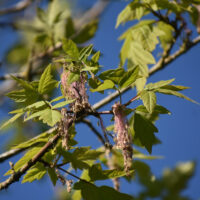
The box elder at maturity features a broad canopy supported by thick branches and a wide, gray trunk. In spring, the silky pink inflorescences hang from the tips of the branches as the leaves begin to emerge. Quickly grows to a height and width of up to 50 ft. Often used as a restoration plant in riparian zones. Full sun to part shade. Enjoys regular moisture. Deer seem to leave it alone once established.

Achillea millefolium – Bodega Bay form
Larger leaves up to 10 inches long distinguish this form from most other local yarrow selections. While most yarrow from our coastline have very green leaves, this strain is on the grey side. From spring through autumn, large white flower clusters sit upon stalks about to at least 2 feet in height. Water occasionally in areas away from the coast and provide full sun. The foliage is deer resistant.

Achillea millefolium – inland form – Lake County seed source
A vigorous and easy to grow perennial, yarrow grows native throughout California in many plant communities. This crop is grown from seed collected from a hot inland site in Lake County. In this form, flower stems rise 18 inches above the gray ferny foliage bearing white flowers in flat topped clusters. Plant in a sunny location with moderate to a little water. Spreads by rhizomes and can form sizable clumps if happy. A good addition to the habitat garden where the flowers provide nectar for bees and butterflies and the foliage provides winter forage for birds. The foliage is deer resistant.

Achillea millefolium – inland form – Napa County seed source
A vigorous and easy to grow perennial, yarrow grows native throughout California in many plant communities. This crop is grown from seed collected from a hot inland site in Napa County. In this form, flower stems rise 18 inches above the gray ferny foliage bearing white flowers in flat topped clusters. Plant in a sunny location with moderate to a little water. Spreads by rhizomes and can form sizable clumps if happy. A good addition to the habitat garden where the flowers provide nectar for bees and butterflies and the foliage provides winter forage for birds. The foliage is deer resistant.

Achillea millefolium – inland form – Sonoma County seed source
A vigorous and easy to grow perennial, yarrow grows native throughout California in many plant communities. This crop is grown from seed collected from a hot inland site in Sonoma County. In this form, flower stems rise 18 inches above the gray ferny foliage bearing white flowers in flat topped clusters. Plant in a sunny location with moderate to a little water. Spreads by rhizomes and can form sizable clumps if happy. A good addition to the habitat garden where the flowers provide nectar for bees and butterflies and the foliage provides winter forage for birds. The foliage is deer resistant.
Achillea millefolium – Montara Mountain form
We discovered the parent of this giant seed strain on the lower slopes of Montara Mountain in San Mateo Co.. With broad, white flower clusters reaching up to 4 ft. high, this is the largest yarrow we've encountered. While seedlings can vary, we have high hopes for this new introduction. Give full sun and moderate to infrequent irrigation. Potentially an excellent spreading perennial for a tall meadow. Attracts all sorts of pollinators. The green, fuzzy leaves are usually considered to be deer resistant.

Achillea millefolium ‘Island Pink’
A color variant of the normally white California native yarrow from Santa Cruz Island. Dark green ferny foliage topped with clusters of bright pink flowers on 18 inch stems over a long period. Sun to partial shade, occasional to moderate water. Good habitat value, providing nectar for bees and butterflies. The foliage is deer resistant.

Achillea millefolium ‘Sonoma Coast’
This is a local selection from the Sonoma County coast near Salmon Creek. Bright green foliage is topped with white flowers in dense heads on compact stems to around 1 ft. tall. Can bloom over a long period, spring through fall, depending on conditions. Best in sunny areas with some summer water, though it is drought tolerant. Flowers attract butterflies and other insects. The foliage is deer resistant.

Acmispon (Lotus) glaber (scoparius)
Bees go nuts over the bright-yellow flowers of this California native. From spring and into summer you can find this plant covered in blooms at the edges of chaparral throughout much of California. The intricate, pea-shaped flowers, often colored burnished red as they are pollinated, emerge along wand-like stems. Deerweed usually reaches a height and width of about 2 – 3 ft. Plant in full sun to light shade. Needs good drainage and no summer water once established. A remarkable number of butterflies use this species as a larval host plant, including the bramble hairstreak, orange sulphur, funeral duskywing, silvery blue, acmon blue and the avalon hairstreak.

Actaea rubra
Native to moist wooded plant communities throughout the Coast Ranges and the Sierra Nevada. The attractive astilbe-like foliage emerges in the early spring. The tiny white flowers have no petals and are made up of clusters of creamy white stamens. The spikes of vivid, shiny red berries are very showy though poisonous - hence the common name baneberry. A wonderful addition to shady situations with some summer water. Goes dormant in the winter. Deer resistant.
Actaea rubra – white fruited form
This is the special white fruited form of the more commonly seen red fruited baneberry. We are not sure how true these will come from seed and suspect there will be some red berries showing up in this crop. So far we have had only white fruits coming from this seed source, but we will have to see how the entire crop develops. Baneberry is a wonderful woodland plant and easy to grow in shady locales with some summer moisture. The foliage is astilbe-like and late spring brings tall flower stems topped with white flowers that have no real petals and are made up of clusters of creamy white stamens. The showy and VERY POISONOUS fruits follow, hopefully in this case white, but may be shiny red. Dies back to the ground in the winter. Deer resistant.

Adelinia (Cynoglossum) grandis
From woodlands throughout Northern and Central California comes this alluring bluebells relative. Dainty flower clusters ranging in color from periwinkle blue to lavender appear on slender stalks in the spring. The leaves are what gives this plant its name: grey-green and tongue-shaped, emerging in the winter from basal roots. Plant in bright shade and don’t water once established. Needs decent drainage. Once this plant goes to seed it will go dormant, re-emerging in late winter. A great accent plant for under the dry shade of deciduous oaks.

Adenostoma fasciculatum
Chamise is found on the poorest soils in hot, dry, exposed areas of chaparral plant communities. Bright green needle-like leaves cover this evergreen shrub. Late spring brings showy plumes of creamy white flowers in small dense sprays, persisting as they age to reddish brown. This tough shrub can grow 4-10 ft tall and wide depending on conditions. An excellent erosion control plant for tough sites where it holds soil, provides cover for wildlife and acts as a nurse plant, paving the way for the other species to get started. Plant in full sun with no water required once established.

Adiantum aleuticum
Five finger fern provides a delicate, airy, fresh effect in the shade garden. Easy to grow with regular water and humusy soil. Does well in containers too. Fronds form finger-like patterns on handsome black stems up to 1 1/2 feet tall. Somewhat winter deciduous. Combine with wild ginger, redwood sorrel, leopard lilies and sword fern for a handsome woodland garden. Somewhat deer resistant.

Adiantum capillus-veneris
A lacy and delicate looking fern with arching dark stems that carry bright green fan-shaped leaflets. A wonderful addition to a woodland garden or any shady space where it is easy to grow as long as it receives regular water. Lovely in containers or raised beds, on a shady bank or border, along the north side of a building. Can grow as much as 1 1/2 ft. tall and wide. Southern maidenhair can be grown through much of California except for high mountain areas. Goes winter dormant with cold. Somewhat deer resistant.

Adiantum x tracyi
A naturally occurring cross between Western five finger and California maidenhair fern. Offers a delicate lacy effect with gorgeous bright green fronds on black arching stems. One of the parents is winter dormant, the other, summer dormant, with the resulting hybrid being evergreen. Easy to grow with shade, woodsy soil and summer irrigation. Excellent container plant too. Deer resistant.

Aesculus californica
Beautiful in all its seasons, this native tree is perfectly adapted to our summer dry climate. Broad headed, deciduous tree rapidly growing to 15 feet or more with smooth grey bark and a rounded shapely habit. Bright green palmate leaves unfurl in the spring. Striking, fragrant white to pink flowers in long spikes are followed by pear shaped fruits that split open to reveal large chestnut-brown shiny seeds dangling from branch tips. Buckeyes lose their leaves in summer to avoid the long dry season. Adaptable and tolerant of a wide range of conditions. Sun to light shade, little to no water once established. Flowers provide nectar for hummingbirds, butterflies and native bees.


Agoseris grandiflora
With a wide distribution throughout the state, the California dandelion is much more refined and well-behaved than its European, weedy look-alike. Found in oak woodland, chaparral, and many other plant communities in part-shade or bright dappled light. Slender, dissected, low, fuzzy gray-green leaves give rise to stem-like peduncles up to 2+ feet tall that are topped with rounded, flat, gold-yellow flower clusters from March-May, followed by large, perfectly rounded white globes of seeds that are wind-dispersed. Plant in part-sun or in areas with bright dappled light that drain well and are summer dry. Does not reseed aggressively like the European dandelion. Drought-tolerant.

Agrostis pallens
A fine textured, drought tolerant, spreading, perennial grass that forms an undulating, naturalistic, meadow look, or can be mowed and used as a lawn substitute. Native to meadows, open woodlands and forests in many plant communities in California north to British Columbia. Grows 1 -2 ft. tall with airy flower stems in late spring to early summer. May be shy to flower in shady areas. Plant in sun to light shade, with decent drainage, where it will accept both water and drought. Will go dormant in summer without irrigation. If using as a lawn substitute, it will need summer irrigation, though requiring far less than a traditional lawn. Excellent understory among trees or shrubs, for rain gardens, bio-swales, meadows or mowed as a lawn substitute. Host plant for a number of butterflies. Deer resistant.
Agrostis scabra
Native to middle and high elevation forests and meadows throughout California, this small bunchgrass forms dense tufts of blue-green foliage about six inches high with airy inflorescences rising another eighteen inches. Works well in a meadow planting or in a container. Combine with other small perennials such as Grindelia and yarrow or plant in large masses to show off the delicate grass flowers. Needs regular moisture and full sun to light shade. Deer resistant.

Allium amplectens ‘Graceful Beauty’
This western native onion grows in sunny openings in forests and woodlands, often on serpentine. Narrow, fragrant leaves make way for globe shaped flower heads on sturdy stems 12 - 16 inches tall. The flower heads which emerge in late spring and early summer are made up of many starry, white florets with elegant lavender anthers and pale pink veins. Papery bracts persist after blossoms fade, adding interest. If happy can reseed readily. Attractive to bees and butterflies. Very drought tolerant. Reported to be gopher resistant, but may need further analysis. Deer resistant.